

Order Total (1 Item Items):
Shipping Destination:

American Broadside (12 results)
Skip to main search results
Search filters
Product Type
- All Product Types
- Books (5)
- Magazines & Periodicals (No further results match this refinement)
- Comics (No further results match this refinement)
- Sheet Music (No further results match this refinement)
- Art, Prints & Posters (No further results match this refinement)
- Photographs (No further results match this refinement)
- Maps (4)
- Manuscripts & Paper Collectibles (3)
Condition Learn more
- New (No further results match this refinement)
- As New, Fine or Near Fine (2)
- Very Good or Good (1)
- Fair or Poor (No further results match this refinement)
- As Described (9)
Binding
- All Bindings
- Hardcover (No further results match this refinement)
- Softcover (1)
Collectible Attributes
- First Edition (No further results match this refinement)
- Signed (3)
- Dust Jacket (No further results match this refinement)
- Seller-Supplied Images (11)
- Not Print on Demand (12)
Language (2)
Price
- Any Price
- Under US$ 25 (No further results match this refinement)
- US$ 25 to US$ 50 (No further results match this refinement)
- Over US$ 50
Free Shipping
Seller Location
Seller Rating
-

Grand Opera House Playbill - Janauschek as Marie Antoinette
Language: English
Published by Grand Opera House, 1883
Seller: Books & Bidders, Cleveland, OH, U.S.A.
Association Member: IOBA
Seller rating 5 out of 5 stars

Manuscript / Paper Collectible
No Binding. Condition: Good. Original single-sheet playbill advertising a performance at the Grand Opera House on Saturday evening, January 20 [1883], starring the renowned tragedienne Fanny Janauschek in the grand historical drama Marie Antoinette. Janauschek's name dominates the bill in bold display type, reflecting her status as one of the most celebrated actresses on the American stage during the late 19th century. The playbill includes a full cast list and management credits, and advertises additional upcoming attractions at the venue: Gilbert & Sullivan's Iolanthe (January 22) and Meteors (January 23). Printed on light cream paper in striking wood-type and letterpress, typical of American opera house ephemera of the period. Good condition, even age toning; pronounced vertical and horizontal fold lines; scattered creasing and light edge wear. No losses; text remains fully legible throughout. An authentic, well-preserved example of period theatrical advertising. Fanny Janauschek was among the most important tragic actresses touring the United States in the 1870's-1880's, particularly admired for her portrayals of historical queens and classical roles. Playbills prominently featuring her name are scarce and sought after by collectors of theatre history, women performers, and 19th-century Americana.
-
![Seller image for Illustrated Broadside or Poster Announcing WRESTLING: HOOD RIVER [Oregon]; Seelie Samara [George Hardison] (Boston) versus Jack Forsgren (Canada); Albert Carral vs. Bob Kruse for sale by Arches Bookhouse](https://pictures.abebooks.com/inventory/md/md32035632350.jpg)
Illustrated Broadside or Poster Announcing WRESTLING: HOOD RIVER [Oregon]; Seelie Samara [George Hardison] (Boston) versus Jack Forsgren (Canada); Albert Carral vs. Bob Kruse
Published by [Hood River News], 1939
Seller: Arches Bookhouse, Portland, OR, U.S.A.
Seller rating 5 out of 5 stars
Signed
Paperback. Condition: FINE. Printed Red on 11 x 17' white cardstock. We date this poster around 1939 based on martching Hood River News wrestling broadsides with dated newspaper clippings. 'Former location Penny-Wise Store on Heights, Hood River.' Some very trivial rubbing to the tips, otherwise uncommonly clean and sharp. Top billing heavyweight match features an absolutely yoked and glistening Seelie Samara, stage-name for George Hardison, an African-American athlete and one of the most prominent characters in the early years of the 'Golden Age' revival of dramatic/entertainment wrestling in America. Hardison was born in Georgia and after a stint as a carnival strongman was scouted by 'Tiger Man' John Pesek who became his boxing trainer. Sometime in the late 30's, Hardison began competing in staged Wrestling matches in the Northeast. In 1938 he signed with promoter Jack Pfefer, with whom he began traveling extensively; while he was regularly billed in the Midwest and California, this broadside is the only record we found of Pacific Northwest appearance. From the early-40's onward, Hardison's appearances were confined to segregated 'Race Matches'; he would hold claim to the 'Negro World Heavyweight Championship' belt through the early 50's. Cory Santos writes, 'A fan favorite, Samara had power and technical prowess in equal measures. His muscularity was unique for the era; his bulging physique was a striking contrast to the bulkier frames of many heavyweights of the period. The Samara character also included costume elements ? the most noteworthy of which was a Muslim head wrap Hardison used when being advertised from Algeria (his most common birthplace) or Afghanistan. Still, given the huge number of strange hometowns, it is difficult to keep track of exactly what character elements are geographically based and which are just random items based on the fanciful imaginations of ?Africa? from countless midwestern promoters. But a sense of fair play, honor, and respect defined the Seelie (and variants Ras and Haille) Samara characters to audiences. Combined with his impressive physique, these virtues earned him lasting nicknames, including ?Negro Hercules,? ?Black Adonis,? the ?(insert location here) Wildman,? and famously, the ?Black Panther.? ('Seelie Samara: A Forgotten African-American Great.').
-

A Funeral Elegy, Occasioned by the Tragedy, At Salem near Boston, on Thursday Afternoon, the Seventeenth of June, 1773, : at which Time the Ten following Persons, Seven Women, and Three Men, were drowned, having been out on a Party of Pleasure .
Seller: William Matthews/The Haunted Bookshop, Sidney, BC, Canada
Seller rating 5 out of 5 stars
Signed
anticat16 (illustrator). Salem, Mass.: Ladies' Centennial Committee, 1875. A broadside, one sheet measuring 12.5 X 18.5 inches. Folded once, in half, some splitting along the fold, and some chipping to the margins. Very brittle and fragile. Affixed to the remains of a backing paper at the top edge, secured there by a pasted strip of paper. A verse in fifteen numbered stanzas, with cuts of ten initialed coffins at head; first line: "Awake, my muse, and tune the song." A lengthy note following the elegy is signed: "A Friend to the Deceased." The colophon at the bottom reads: "Copied from a broadside in possession of Geo. R. Curwen, Esq., and printed to be sold at an Exhibition of Antique Relics, &c., held by the Ladies' Centennial Committee, of Salem, Mass., Dec. 15, 1875." This is a facsimile reprint of: [Boston] : Printed and sold by E. Russell, next the cornfield, Union Street, near the market. (Pr. 3 cop.), [1773] (Bristol B3565).
-
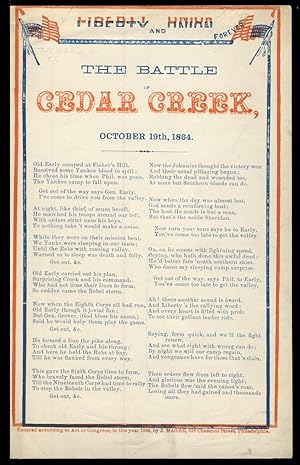
The Battle of Cedar Creek, October 19th, 1864. Liberty and Union Forever
Published by J. Magee, Philadelphia, 1864
Seller: Parigi Books, Vintage and Rare, Schenectady, NY, U.S.A.
Seller rating 5 out of 5 stars
Manuscript / Paper Collectible
Broadside. Single sheet, folded. Printed in blue and red on the first page only. Thirteen verses with chorus, red and blue ornamental border with American flags and the words Liberty and Union Forever. Blindstamp of the Southworth Co. paper company of Massachusetts on the top left edge. Measures approximately 20 x 25 cm (8 x 10"). The red part of the ornamental border is printed out of register. Faint pencil markings on the top edge and on the lower edge of the last page, mild soiling. Very good+.
-

Company "I" / First North Dakota / Volunteers
Published by W.W. Jameson; no place; pp.; ; F-; nd/1900, 1900
Seller: Watermark West Rare Books, Wichita, KS, U.S.A.
Seller rating 4 out of 5 stars

No Binding. Condition: Near Fine. Single sheet of cardstock, 13.25 x 10", printed on one side. _____ There is a glue stain on the rear, as from a scrapbook mounting. _____ The top half is a 6 x 8" halftone photo of 66 officers and enlisted men, posed on a grandstand. _____ Each man has been numbered in the negative. _____ These serve to identify each man in the accompanying legend roster printed at the bottom. _____ That roster includes: two officers, 14 NCOs and 49 enlisted men. _____ For those of you doing the math, #37 does not exist in the photo or legend. _____ The photographer's credit appears to be B. F. Rahmeyer. _____ Company "I" was built in Wahpeton, Richland County, North Dakota and served in the Philippines in the Spanish American War. _____ The bottom half contains: an ad for the sponsoring Jamieson's hardware store, a monthly calendar for 1900 and the roster table. _____ Not in WorldCat (05/22). ____.
-

Revolution in France! [drop title]
Published by Office of the Daily Commercial Gazette, [Boston], 1830
Seller: James Cummins Bookseller, ABAA, New York, NY, U.S.A.
Seller rating 5 out of 5 stars
Printed broadside, one page in 4 columns. 1 vols. Folio (22 x 11 inches; 56.5 x 28.6 cm). This Boston broadside, published by the [Boston] Daily Commercial Gazette, contains extracts from the London papers detailing the July 1830 Revolution in France that overthrew Charles X. It is presumably one of the earliest American reports of the overthrow of the Bourbons. The French Revolution of 1830, also known as the July Revolution, was a revolt by the middle class against Bourbon King Charles X which forced him out of office and replaced him with the Orleanist King Louis-Philippe. It is best known to many Americans through the climax of Victor Hugo's landmark novel, Les Miserables, and its adaptation as a long-running Broadway play. We didn't notice any quotes from Jean Valjean or Marius in this historic broadside but the content is, nonetheless, absolutely fascinating. To quote, in part: "It was evident from the complexion of the foreign advices that a crisis was near at hand in France. Still we had no idea that the gathering tempest was so soon to break upon us. But the explosion has fallen upon the startled ear quick as the thunder-crash follows the blaze of the lightning. Another agony has begun. The streets of the French capital have again been deluged with blood. Charles X has ceased to reign. The haughty Bourbons are again our fugitives. LAFAYETTE - almost OUR OWN Lafayette - is again at the head of the National Army. And France reposes once more in the arms of her legitimate sovereigns the PEOPLE." Some minor waterstaining, but overall a very good copy of an impressive document, docketed on the verso by an early owner, giving details of the history of the imprint and its receipt in Boston Printed broadside, one page in 4 columns. 1 vols. Folio (22 x 11 inches; 56.5 x 28.6 cm).
-
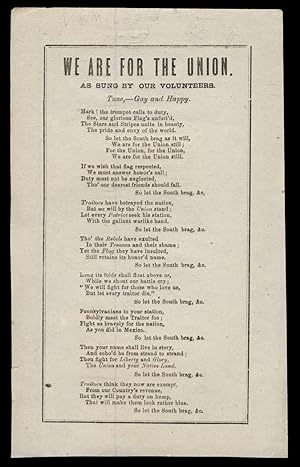
We Are for the Union. As Sung by Our Volunteers
Seller: Parigi Books, Vintage and Rare, Schenectady, NY, U.S.A.
Seller rating 5 out of 5 stars
Manuscript / Paper Collectible
Broadside. Circa 1860s. No publisher. Eight verses with chorus with a simple ornamental border. Measures approximately 12 x 19 cm (4.5 x 7.5"). Faint pencil markings on the top edge, tiny spot to the left of the last verse. Near fine.
-

General Statutes Chap 161 Sect 73: Whoever Wilfully Maliciously, and.
Publication Date: 1900
Seller: The Lawbook Exchange, Ltd., ABAA ILAB, Clark, NJ, U.S.A.
Association Member: ABAA ESA ILAB
Seller rating 5 out of 5 stars
American Ice Trade, (illustrator). American Ice Trade, A Souvenir of the American Ice Trade [Broadside]. [Massachusetts]. General Statutes Chap. 161, Sect. 73. Whoever Wilfully Maliciously, And Without Right or License, Cuts, Injures, Mars, Or Otherwise Damages or Destroys, Any Ice, Upon Any Waters Within this State from which Ice is or may be Taken, As an Article of Merchandise, Whereby the Taking Thereof is Hindered; Or the Waters Thereof Diminished for That Purpose, Shall be Punished, By Fine Not Exceeding One Hundred Dollars. [Massachusetts: S.n., after 1850]. 9-3/4" x 12-1/4" broadside, text in single column below headline. Moderate toning, faint fold lines, a few clean tears to edges, chip to top-edge, small tear to "G" in "General" without loss to text. $300. * As the American ice trade began to expand westward from its New England roots, several states, including Massachusetts, passed laws governing ice harvesting and making it illegal to damage another party's uncut ice. This broadside indicates that the fee could be up to $100. The statute it references was first passed in 1850 and remained on the books through the early 1900s.
-

Civil War Centennial 1861 - 1865.
Publication Date: 1960
Seller: Geographicus Rare Antique Maps, Brooklyn, NY, U.S.A.
Association Member: ABAA ESA ILAB
Seller rating 4 out of 5 stars
Map
Very good. Closed margin tears professionally repaired on verso. Size 28 x 40.5 Inches. This is a 1960 Ralph G. Newman and E.B. Long broadside pictorial map of the eastern United States and American Civil War battle locations. Commemorating the centennial of the American Civil War, a map of the eastern United States occupies half the sheet and is shaded to illustrate the Union, the Confederacy, and the two 'border states' (Missouri and Kentucky). Pictorial vignettes illustrate the Draft Riots in New York City, the bombardment of Fort Sumter, the Battle of Gettysburg, and the surrender at Appomattox, among other events. Sixty-four events, listed in chronological order, appear on a banner to the left. Each event is numerically labeled and corresponds with a number on the map or on the inset map of Virginia situated in the lower right. Illustrations of Union and Confederate soldiers flank this banner. Portraits of Union and Confederate leaders, including Abraham Lincoln, Ulysses S. Grant, William T. Sherman, Jefferson Davis, and Robert E. Lee appear along the top border. Names of important battles in chronological order adorn the border and are separated by illustrations of cannons and pistols. Publication History and Census This map was compiled under the direction of Ralph G. Newman and E. B. Long and published by Creative Merchandisers in 1960. This map is well represented in institutional collections but is scarce on the private market. References: OCLC 16774545; 1031617613.
-

The Pictorial War Record.
Publication Date: 1898
Seller: Geographicus Rare Antique Maps, Brooklyn, NY, U.S.A.
Association Member: ABAA ESA ILAB
Seller rating 4 out of 5 stars
Map
Fair. Closed tear extending 1 inch into printed area professionally repaired on verso. Scuffing and wear, including to a few lines of the commemorative text at center. Size 26 x 19.75 Inches. This is a rare 1898 James M. Vickroy chromolithograph broadside commemorating the Spanish-American War (1898) and the American Civil War (1861 - 1865) - the two most significant American wars of the second part of hte 19th century. The view is part of a genre of decorative broadsides sold commercially to those wishing to commemorate the military service of a family member. This example was never used. A Closer Look Of the 15 scenes commemorating the two wars, 10 illustrate events during the American Civil War. Beginning just below the presidential portraits on the left, the Civil War vignettes include the attack on Fort Sumter, the Battle of Shiloh, the Battle of Gettysburg, the death of General McPherson, the surrender of General Robert E. Lee, and the parade of the Grand Army of the Republic in Washington, D.C. The five vignettes of the Spanish-American War illustrated the U.S.S. Maine (which exploded in Havana Harbor on February 15, 1898, and ignited the war between Spain and the United States), the Battle of Manila, the Battle of Santiago, the destruction of the Spanish fleet at Santiago, and the surrender of General Toral. A section at center provides space for an individual to write their war record or that of a family member. This is surmounted by a portrait of Rear Admiral Richard P. Hobson (1870 - 1937), who was taken prisoner during the naval battle at Santiago, Cuba, and was later awarded the Congressional Medal of Honor. Portraits of President George Washington and President Abraham Lincoln appear above and to the left and right of Hobson. Portraits of the other U.S. Presidents up to President McKinley appear along the top. Below, a row of portraits of U.S. Civil War and Spanish American War generals and admirals is included. Chromolithography Chromolithography, sometimes called oleography, is a color lithographic technique developed in the mid-19th century. The process uses multiple lithographic stones, one for each color, to yield a rich composite effect. Generally, a chromolithograph begins with a black basecoat upon which subsequent colors are layered. Some chromolithographs used 30 or more separate lithographic stones to achieve the desired effect. Chromolithograph color can be blended for even more dramatic results. The process became extremely popular in the late 19th and early 20th centuries when it emerged as the dominant method of color printing. The vivid color chromolithography made it exceptionally effective for advertising and propaganda. Publication History and Census This broadside was created and published by James M. Vickroy in 1898. We note a single cataloged example, which is part of the collection at the Library of Congress. We know of only one other instance of this piece entering the private market. References: Library of Congress Control Number 2018695148.
-

Special Feature No. 32 - Timely Chinese Cuts No. 4.
Publication Date: 1900
Seller: Geographicus Rare Antique Maps, Brooklyn, NY, U.S.A.
Association Member: ABAA ESA ILAB
Seller rating 4 out of 5 stars
Map
Good. Infill to left and right edges. Heavy toning. Light wear along original fold lines. Text on verso. Size 22 x 14 Inches. This is a fascinating 1900 American Press Association broadside of the Boxer Rebellion its syndicated content. It is a unique example of how syndication agencies promoted themselves to newspapers around the country. Syndication agencies provided newspapers with up-to-date reporting that could be printed in regional publications, giving small town papers national and global coverage. A Closer Look The broadside features six illustrations that subscribing newspapers could use, each providing insight into the Boxer Rebellion. The top left is a map covering from Bohai Bay (Gulf of Pechili) to Beijing (Pekin) by way of Tianjin (Tientsin). Other towns and villages are marked, along with the railway connecting Beijing with Tianjin and Tangku. Three of the other illustrations are portraits of important individuals, such as the American general leading the relief expedition, the British customs agent in Beijing, and the six ambassadors who were in Beijing during the event. The final two illustrations include a street view of Beijing and a depiction of captured Boxers awaiting execution. Newspaper Syndication News syndication is a system whereby a central press organization creates and sells content to other newspapers. One of the earliest cases of syndication in the United States happened in 1841, when a newspaperman in New York City printed special editions of President John Tyler's annual speech to Congress and then sold them to various newspapers. The first syndicate was operating by the end of 1861. The American Press Association (who published this piece) was one of the first news agencies in the United States concerned only with providing syndicated material. They promoted their work with pieces like the present broadside. Newspaper syndication grew nationally, leading to publishing conglomerates and a homogenization of American news. By the turn of the 20th century, news agencies were providing their clients with complete printing plates of their material (so each newspaper did not have to set their own type), which allowed images to be syndicated as well. The Boxer Rebellion or Yihetuan Movement The Boxer Rebellion or Yihetuan Movement (1899 - 1901, ?????) was an anti-foreign anti-imperialist uprising marked by proto-nationalism in northeastern China. The rebellion was largely a response to Christian missionary activity in China and was initially supported by the Qing Empress Dowager Cixi and her ministers who distrusted the radical and unpredictable peasant movement but sympathized with their goal of driving foreign influence out of China. In June of 1900, some 20,000 Boxers, convinced that their spiritual and martial prowess gave them immunity to foreign weapons, attacked the Chinese Christians and foreign nationals living in Beijing's Legation Quarter. Although terrible violence ensued, the Legation Quarter was able to mount a ragtag defense which is outlined on this map. Relief came about a month later in the form of the Eight-Nation Alliance China Relief Force, which, with an army of some 20,000, defeated the Boxers and occupied Beijing, as well as several other northern Chinese cities. The atrocities and looting that ensued, particularly at the hands of Russian and Japanese forces, are well documented and horrifying. Publication History and Census This broadside was created and published by the American Press Association in 1900. This is the only known surviving example.
-

La Preghiera di Roosevelt.
Publication Date: 1944
Seller: Geographicus Rare Antique Maps, Brooklyn, NY, U.S.A.
Association Member: ABAA ESA ILAB
Seller rating 4 out of 5 stars
Map Signed
Very good. Poster mounted. Blank on verso. Size 29.5 x 38.875 Inches. Printed in 1944 during World War II and shortly after the Allies seized Rome and the D-Day landings in Normandy, this anti-American anti-Roosevelt broadside was published by Italian fascists to expose what they considered to be American hypocrisy. It references American President Franklin D. Roosevelt's 'D-Day Prayer,' broadcast on June 6, 1944. The broadside centers on an imposing caricature of Roosevelt kneeling with hands folded and eyes closed, as if in prayer. To both his right and left, text bubbles appear, almost ephemerally as if in a dream, stating Roosevelt's wishes for the coming battles and, ultimately, final unconditional victory. Each phrase is accompanied by a vignette that does not illustrate Roosevelt's words, but what the Italian fascist creator of this broadside wants its viewers to understand from the words. Perhaps, the creator even references the reality of what the war had become, instead of Roosevelt's sanitized and propagandized pleas to Almighty God. Roosevelt's Use of the Radio Roosevelt famously employed the radio as a means of connecting with average Americans throughout his presidency. Begun in 1933, Roosevelt made thirty such broadcasts, known as 'Fireside Chats', which varied in length from fifteen minutes to over half an hour. Each broadcast discussed a different subject with the American people, most of which were recorded and are now part of the National Recording Registry of the Library of Congress. Roosevelt's last Fireside Chat took place on June 12, 1944, to mark the opening of the Fifth War Loan Drive. The broadcast on June 5, 1944, which proclaimed the Fall of Rome, was also a Fireside Chat. Roosevelt's D-Day Prayer On the evening of June 6, Roosevelt felt he needed to address the nation about the Normandy invasion. This invasion, codenamed Operation Overlord, came at a pivotal point in World War II and opened a second front in the European war, with Soviet Russia's Red Army fighting Hitler's Germany in the east. Roosevelt had not acknowledged the Normandy invasion the previous night in his discussion of events in Italy and addressed that silence at the beginning of his D-Day broadcast, stating last night, when I spoke with you about the fall of Rome, I knew at that moment that troops of the United States and our allies were crossing the Channel in another and greater operation. It has come to pass with success thus far. Then he asks the American people to join him in prayer. Roosevelt begins by calling the invasion a 'mighty endeavor' and states that it is 'a struggle to preserve our Republic, our religion, and our civilization, and to set free a suffering humanity.' As he continues, he evokes the imagery of the righteousness of the Allied cause against the enemy, whom he calls 'strong'. He states several times that the Allies will triumph, but that the victory will be hard won. Then he identifies the values for which the Allies believe to be fighting, and contrasts them with the ethos of the enemy, For these men are lately drawn from the ways of peace. They fight not for the lust of conquest. They fight to end conquest. They fight to liberate. They fight to let justice arise, and tolerance and good will among all Thy people. At the end of his prayer, Roosevelt beseeches God to aid in achieving final victory, With Thy blessing, we shall prevail over the unholy forces of our enemy. Help us to conquer the apostles of greed and racial arrogancies. Lead us to the saving of our country, and with our sister Nations into a world unity that will spell a sure peace a peace invulnerable to the schemings of unworthy men. And a peace that will let all of men live in freedom, reaping the just rewards of their honest toil. Although this message was intended for the American people, it was immediately picked up and broadcast globally. Roosevelt's Prayer and This Broadside Around the central image of a nearly-beatific Roosevelt, fiv. Signed by Author(s).


