Order Total (1 Item Items):
Shipping Destination:

Anna Heermans (2 results)
Skip to main search results
Search filters
Product Type
- All Product Types
- Books (2)
- Magazines & Periodicals (No further results match this refinement)
- Comics (No further results match this refinement)
- Sheet Music (No further results match this refinement)
- Art, Prints & Posters (No further results match this refinement)
- Photographs (No further results match this refinement)
- Maps (No further results match this refinement)
- Manuscripts & Paper Collectibles (No further results match this refinement)
Condition Learn more
- New (No further results match this refinement)
- As New, Fine or Near Fine (No further results match this refinement)
- Very Good or Good (1)
- Fair or Poor (1)
- As Described (No further results match this refinement)
Binding
- All Bindings
- Hardcover (2)
- Softcover (No further results match this refinement)
Collectible Attributes
- First Edition (No further results match this refinement)
- Signed (No further results match this refinement)
- Dust Jacket (No further results match this refinement)
- Seller-Supplied Images (2)
- Not Print on Demand (2)
Language (1)
Price
- Any Price
- Under US$ 25 (No further results match this refinement)
- US$ 25 to US$ 50 (No further results match this refinement)
- Over US$ 50
Free Shipping
- Free Shipping to U.S.A. (No further results match this refinement)
Seller Location
Seller Rating
-
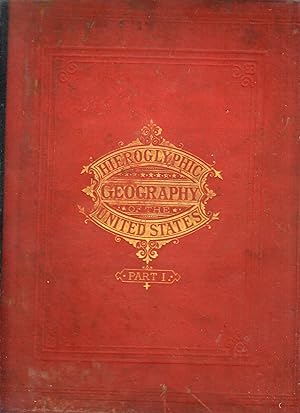
A Hieroglyphic Geography of the United States; Part I containing the States of Maine, New Hampshire, Vermont, Massachusetts, Rhode Island, Connecticut, and New York
Published by E.P. Dutton, New York, 1875
Seller: Old Book Shop of Bordentown (ABAA, ILAB), Bordentown, NJ, U.S.A.
Seller rating 4 out of 5 stars

Hardcover. Condition: fair. Very scarce. Part I (all issued so far as can be determined) covering the New Englans states and New York. OCLC locates only 12 copies in book form. Quarto sized (10" x 12") in blindstamped red cloth hardcovers stamped in gilt, over black tape cloth spine. Unpaginated (46 pp.). A uniquely designed geography/freading aid for young people that instead of maps features a full page of small hieroglyphic engravings for each descriptive word or group of words that illustrated notable facts, places, names, etc. for each of the states covered. For example, for Maine one small item is "The minerals are" with a small engraving of a (hand)iron, "granite" (small picture of a rock); "More (engraving of a ship) are built here than in any other State". Each hieroglyphic page is followed by a single page of text of desciptive text which which is an non-illustated transcription of the the illustrated page. Covers well soiled though the gilt titling is still bright. Some tape stains to the dark brown endpapers, front hinge split but all pages firmly attached; dampstaing to the lower aprox. quarter of all pages. Christmas 1882 gift inscription on the first front blank to a boy from his grandfather. Complete, SOLD AS IS.
-
A Hieroglyphic Geography of the United States. Part I Containing the State of Maine, New Hampshire, Vermont, Massachusetts, Rhode Island, Connecticut, and New York
Published by NY: E. P. Dutton & Company, 1875
Seller: Philip Salmon & Co. Rare Books, Boston, MA, U.S.A.
Association Member: MBS
Seller rating 5 out of 5 stars

Hardcover. Condition: Very good. Quarto. (24)ff. A rare 19th-century entrant in the peculiar genre of the rebus, Heermans and Cogswell's geography recalls the hieroglyphic bibles that proliferated in the United States since the late 18th century, when Isaiah Thomas published his A Curious Hieroglyphick Bible. Each state receives a full-page description made up of a bemusing arrangement of engravings, text, numerals, ampersands, and the occasional solitary "s" and/or "d." The design experiments, somewhat incautiously, with both semiotics and phonetics. Sometimes the image refers to what it represents, so that a stand of trees in Maine really is "forest," pluralized by the proximate "s." Elsewhere, however, the image is only useful as a homophone, as when a bow supplies the "bow" in Bowdoin. The surfeit of engravings, each one apparently unique, sometimes leads to a true riddle, either because the picture has more than one possible referent or because the referent is a specific name, often of the idiosyncratic New England variety. Both are present in Rhode Island, where a swan emerging from reeds provides the "neck" in "Aquidneck." To great relief, an answer key appears just after the rebus description. Both Heermans and Cogswell were alumnae of the Cooper Hewitt Engraving School. The title of the volume suggests plans for further entries in the series, but none were apparently published, probably no thanks to a contemporary (December 10, 1874) review in The Nation which worried over the prevalence "insoluble riddles" and the moments when what is presented "is not hieroglyphic at all." Regardless, the book stands as a intersection between competing methods of language acquisition and instruction, and the role of art in pedagogy. Bound in full orange cloth over boards, embossed in blind and titled in gilt. Mild rubs overall and stray soiling to covers, miniscule loss to head of spine, else very good.