Order Total (1 Item Items):
Shipping Destination:

Artefact (13 results)
Author:
artefact
Refine with Advanced Search
Skip to main search results
Search filters
Product Type
- All Product Types
- Books (13)
- Magazines & Periodicals (No further results match this refinement)
- Comics (No further results match this refinement)
- Sheet Music (No further results match this refinement)
- Art, Prints & Posters (No further results match this refinement)
- Photographs (No further results match this refinement)
- Maps (No further results match this refinement)
- Manuscripts & Paper Collectibles (No further results match this refinement)
Condition Learn more
- New (2)
- As New, Fine or Near Fine (3)
- Very Good or Good (4)
- Fair or Poor (No further results match this refinement)
- As Described (4)
Binding
Collectible Attributes
- First Edition (2)
- Signed (1)
- Dust Jacket (No further results match this refinement)
- Seller-Supplied Images (6)
- Not Print on Demand (13)
Language (4)
Free Shipping
- Free Shipping to U.S.A. (No further results match this refinement)
Seller Location
Seller Rating
-

Hardcover. Condition: Bon. Ancien livre de bibliothèque avec équipements. Ammareal reverse jusqu'à 15% du prix net de cet article à des organisations caritatives. ENGLISH DESCRIPTION Book Condition: Used, Good. Former library book. Ammareal gives back up to 15% of this item's net price to charity organizations.
-

Condition: very good. Gut/Very good: Buch bzw. Schutzumschlag mit wenigen Gebrauchsspuren an Einband, Schutzumschlag oder Seiten. / Describes a book or dust jacket that does show some signs of wear on either the binding, dust jacket or pages.
-
A Business of Ferrets: The First 100 Days of Nine Ferret Kits
Language: English
Published by Privately printed - author, Hayle, cornwall, 2018
ISBN 10: 0993256848 ISBN 13: 9780993256844
Seller: The Cornish Bookworm, CAMBORNE, CORNW, United Kingdom
Seller rating 5 out of 5 stars

Signed
US$ 22.16
US$ 27.71 shipping
Ships from United Kingdom to U.S.A.Quantity: 2 available
Add to basketSoft cover. Condition: New. 277 pages of charming photographs (300) and descriptive notes describing the ups and downs of a family of ferrets (business) from birth, and also including a section on their adult life, previous ferrets and other pets owned by the author from Hayle, Cornwall. SIGNED by author Size - 210mm. x 148mm. Pp.277. Signed by Author(s).
-

Aboriginal Remains Near Naples, Illinois. Written by John G. Henderson. An article published by the Smithsonian Institution in 1882; 36 Pages.
Published by Smithsonian Institution, Washington, 1882
US$ 22.45
US$ 16.01 shipping
Ships from United Kingdom to U.S.A.Quantity: 4 available
Add to basketBooklet - Unbound Pages. Condition: Very Good. A substantial report on archaeological investigations near Naples, Illinois, detailing burial features, pottery, stone tools, and other artefacts. The article discusses cultural affiliations and the broader significance of the site within the Mississippi Valley. 36 Pages. An authentic standalone article, extracted from a larger volume. Not a reprint or reproduction, but an original work in its own right. Preserved in a modern card cover, prepared for practicality - an unassuming but serviceable presentation that favours function over finery. Size: 16 x 24 cms. Category: Smithsonian Institution; Cosmo Books : 29 years on ABE, 47 years taking care of customers. A bookseller you can rely on.
-

150 jaar Rijksmuseum van Oudheiden, 1818 - 1968. Een keuze uit de verzamelingen. (By) W.C. BRAAT & A. KLASENS.
Published by Leiden, 1968., 1968
Seller: Antiquariaat Fragmenta Selecta, AMSTERDAM, Netherlands
Seller rating 5 out of 5 stars
82 p.; 150 plates. Cloth. 0 gr.
-
150 jaar Rijksmuseum van Oudheiden, 1818 - 1968. Een keuze uit de verzamelingen. (By) W.C. BRAAT & A. KLASENS.
Published by Leiden, 1968., 1968
Seller: Antiquariaat Fragmenta Selecta, AMSTERDAM, Netherlands
Seller rating 5 out of 5 stars
82 p.; 150 pls. Cl. 0 gr.
-
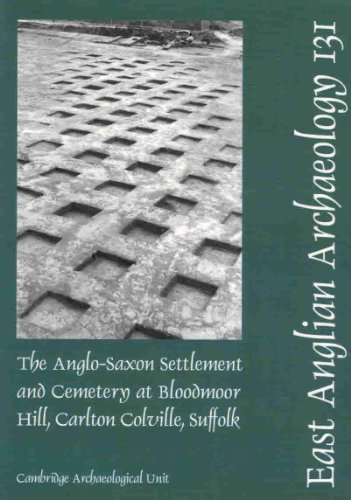
THE ANGLO-SAXON SETTLEMENT AND CEMETERY AT BLOODMOOR HILL, CARLTON COLVILLE, SUFFOLK. East Anglian Archaeology, Report No.131, 2009.
Language: English
Published by Cambridge, Cambridge Archaeolgical Unit, 2009., 2009
ISBN 10: 0954482468 ISBN 13: 9780954482466
Seller: Minster Gate Bookshop (est. 1970), YORK, United Kingdom
Association Member: PBFA
Seller rating 5 out of 5 stars
US$ 76.21
US$ 24.89 shipping
Ships from United Kingdom to U.S.A.Quantity: 1 available
Add to basketCondition: Good. 4to.,pp. xiii,462, pictorial wrappers, b/w figures and tables, b/w fold-out figures, colour plates; creasing to upper corner of wrapper and leaves to p.48, lightly rubbed to extremities, otherwise very good.
-

The Excavation of an Enclosed Middle Bronze Age Cemetery at Gransha, Co. Londonderry, Northern Ireland (British Archaeological Reports British Series, 521)
Language: English
Published by Oxford : British Archaeological Reports, BAR Publishing, 2010
ISBN 10: 140730724X ISBN 13: 9781407307244
Seller: Joseph Burridge Books, Dagenham, United Kingdom
Seller rating 5 out of 5 stars
US$ 97.00
US$ 30.94 shipping
Ships from United Kingdom to U.S.A.Quantity: 1 available
Add to basketSoft cover. Condition: New. viii, 151 pages : illustrations, maps, plans ; 30 cm. This volume details the excavation of a remarkably well preserved, enclosed Middle Bronze Age cemetery in the townland of Gransha, Co Londonderry, Northern Ireland (Site 19). The cemetery comprised a series of atypical cists, cut into the bedrock and lined with slabs. In a small number of cases, the original covering slabs survived in situ. While relatively few cists contained human bone, many produced large quantities of charred grain, especially barley. While a number of explanations for this form of deposition are explored, it appears consistent with the tradition of cenotaphic burial and commemoration current in later Irish prehistory. The cists were enclosed within a segmented circle, which may have included a number of alignments between a central stakehole and various other features in its construction. A short distance to the north a second segmented circle, though not associated with burial or grain deposition, was investigated. The whole was enclosed by a narrow, rock-cut, ditch with a possible southern entrance. A series of high-precision AMS radiocarbon determinations, many on barley from the cists, conclusively dated the activity to the Middle Bronze Age period and ranged from 3350±21 BP to 3062±22 BP. Later activity on the site included theconstruction of a remarkably rare iron-working structure, dated to the Iron Age (dated to 2187±46 BP), and the twentieth century AD disposal of a sheep carcass. While many aspects of the enclosed cemetery may be paralleled at other sites within Ireland, the Gransha site is, by far, the best preserved and most completely excavated. The presence of such large quantities of charred grain, at a site of this date and type, is also unique within the published record.
-
Hard Back. Condition: Good Clean Cond. Dust Jacket Condition: No Dust Jacket. 7. [illustated with Numerous Color Plates of Original Works] (illustrator). Collectible hardback book, very nice condition. Clean bright, hardly opened, with minor edge wear for its age, without dust jacket. Excellent source for art collectors, and fans of his work. Book has pictorial/decorative cover. Corners slightly bumped, cloth portion has minor soil. Spanish artist Ceesepe's illustrative works are exhibited in this book, much like a coffee table book with a collection/compilation of his genre works. Highly sexual, chaotic and violent. Excellent reference guide for collectors, students of and/or enthusiasts. Overall a nice copy of the scarce import title. Firmly readable. ** Good vintage condition. Typical of used books has some wear to edges, scuffs, light soil, bumps, the sort of thing you'd expect from a book that was read a few times then stored. Oversized, coffee table style book. Subject, Features: Oversized Pictorial Folio of Ceesepe's Works, Paintings, Illustrations, Sex, Violence, Chaos Depicted in This Spanish Artist's Work, Spain, in Both English & French languages, illustrated with Numerous Color Plates of Original Works. Profusely illustrated, thoroughly engaging! Defects: None found. Book is older, but in good shape. ~~ Carlos Ceesepe was a Spanish visual artist, painter, film director and comic artist. He was one of the most important artists of the Madrilean counterculture movement La Movida Madrileña ("The Madrid Movement"). Early in his career Ceesepe made several controversial and outrageous underground comix. A 1984 satirical comic strip by his hand caused protest among the right-wing political party Allianza Popular. His best known comic series were the surreal humorous 'Slober' (1975-1979). Ceesepe's work often changed in styles and techniques, but was always instantly recognizable as his own. Photographer Ouka Leele once described him as the "Spanish Toulouse-Lautrec". ~~ Early life and influences: Carlos Sánchez Pérez was born in 1958 in Madrid. He came from a family of carpenters who originally lived in Torrevieja, but settled in Madrid after World War II. His father was a veteran from the Spanish Civil War. Ceesepe's older brother also enjoyed drawing. As a youngster Ceesepe underwent strong influence from the pop art movement, particularly Peter Phillips and Peter Blake, the man who designed the album cover of 'Sgt. Peppers' (1967) by the Beatles. Other graphic influences were Henri de Toulouse-Lautrec, Pablo Picasso, Salvador Dalí, Joan Miró, Amadeo Modigliani, Max Ernst, David Hockney, Lucian Freud and Marc Chagall. The young boy started drawing at the age of 16 and enrolled at the Madrid School of Fine Arts, but dropped out after only a month. (Archives web). We appreciate your consideration of one of our books, art prints or novelty items. We strive to offer fast, courteous and professional service to all our patrons. Reading is one of life's great pleasures. Please inquire for further details, our items arrive shrink wrapped and well packed. ~ Thank you for viewing + stopping by. Book.
-
CAMILLE CLAUDEL (1864 - 1943). Das Lebenswerk der ersten großen europäischen Bildhauerin. Skulpturen und Zeichnungen.
Language: German
Published by Apolda, Mück, Artus GmbH, 2006., 2006
Seller: Antiquariat Zwiebelfisch, Weimar, THU, Germany
Seller rating 2 out of 5 stars

214 Seiten mit teils farbigen Abb., OPappband, 4° (neuwertig) 1310 gr. Buch.
-

Vingt d'yeux, c'est le synode
Published by Enghien (3, rue du Marché, 95880) : Artefact, 1977
First Edition
Couverture souple. Condition: Bon. Edition originale. ln-12° broché, 20 pages circa.
-

Softcover. Condition: Sehr gut. Alle Bücher & Medienartikel von Book Broker sind stets in gutem & sehr gutem gebrauchsfähigen Zustand. Die Ausgabe des gelieferten Exemplars kann um bis zu 10 Jahre vom angegebenen Veröffentlichungsjahr abweichen und es kann sich um eine abweichende Auflage handeln. Unser Produktfoto entspricht dem hier angebotenen Artikel, dieser weist folgende Merkmale auf: Leicht nachgedunkelte/saubere Seiten in fester Bindung. Leichte Gebrauchsspuren. Verlag: Artefact. Sprache: Deutsch Gewicht in Gramm: 1100.
-
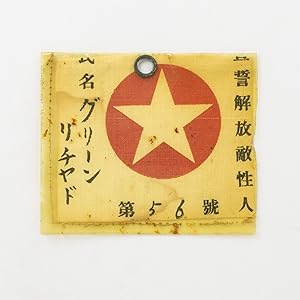
The identity tag or pass of one Richard Green, a prisoner-of-war of the Japanese during the Second World War
Seller: Michael Treloar Booksellers ANZAAB/ILAB, Adelaide, SA, Australia
Association Member: ANZAAB ILAB
Seller rating 5 out of 5 stars
First Edition
Hardcover. Condition: Very Good. First Edition. A piece of white cloth (approximately 80 × 86 mm, slightly unevenly cut on all sides, with the top 6 mm turned over), printed with an unidentified emblem in the centre. This is a five-pointed white star set within, and almost to the circumference of, a 50 mm red circle; in essence, it resembles the Japanese national flag surmounted by a white star. Japanese text is printed in black down both sides and across the bottom margin. The cloth is in excellent condition, apart from some light stains. It has been inserted in a sheet of rigid cellulose nitrate sheet film; this has been folded in half along the top edge, with a metal eyelet pierced through it near the centre of the fold, and machine-stitching along the left and bottom edges (only a small portion of the fine thread remains). 'Eastman-Nitrate-Kodak 3' is imprinted on one edge, which also has the V-shaped notches identifying nitrate film. (Due to the inherent instability of cellulose nitrate, production of portrait and commercial sheet films was discontinued in 1939; aerial films followed in 1942. Its use here would appear to be as recycled obsolete material.) The sheet film is a little marked and uniformly discoloured yellow, with a short split near the eyelet, but essentially it is also in excellent condition. The right-hand column of printed text can be translated as 'Enemy released under oath'; the name 'Richard Green' on the left-hand side, and the number '56' at the bottom, have been added by hand in black ink. A thorough search through information on prisoner-of-war relics located approximately fifty examples of means of identification of prisoners-of-war. The great majority are metal tags engraved with a unique identification number (often the soldier's service number), the prisoner's country of origin, and whether he is an officer or enlisted man. However, examples in institutional collections show that a bewildering range of other formats and materials (including wood, paper, bamboo, plastic and - rarely - cloth) was used; very few examples mention the prisoner by name. Our research has discovered at least three Richard Greens who were interned by the Japanese - an Australian (NX73681 Private Richard Harold Green, 2/19th Battalion, who was in Changi Prison), and two Americans (one a Captain and one a civilian, both interned in the Philippines) - and there may well have been more. We cannot assign this tag with any degree of certainty to any particular individual, or even to any particular country of imprisonment, but ongoing research makes it unlikely that it was issued to the Australian private. Recent correspondence from Dr Kaori Maekawa, one of the POW Research Network Japan members living in the Netherlands, refers to a similar item in the collection of the Netherlands Institute of War Documentation (NIOD). The small cloth tag has the same star motif and printed text ('Enemy released under oath'), with the handwritten name and number 'Zaalberg 733'. This is attached to an armband on which is written 'Interpreter, P.H. Zaalberg, M.K.K.' (the latter being possibly the institution where Zaalberg worked as an interpreter). Dr Maekawa knows of a number of cases where civilians or POWs were taken as interpreters or engineers, and were granted the status 'Released on oath' by local Japanese Military Administration authorities. Apart from the fact that this item was purchased privately in Australia some decades ago, the provenance of this prisoner-of-war identity tag remains a mystery; however, its very existence is in itself remarkable.


![Seller image for Ceesepe : Paris - Madrid [oversized Pictorial Folio of Ceesepe's Works, Paintings, Illustrations, Sex, Violence, Chaos Depicted in This Spanish Artist's Work, Spain, in Both English & French languages] Collection Phosphene Volume 3 for sale by GREAT PACIFIC BOOKS](https://pictures.abebooks.com/inventory/md/md605045187.jpg)