
Atkinson Rev Thomas (2 results)

Published by D. Brunner, Baltimore 1851
- Softcover
- First Edition
Seller: The Kelmscott Bookshop, ABAA, Savage, MD, U.S.A.The Kelmscott Bookshop, ABAA
Contact seller5-star sellerCondition: Used - Very good
US$ 45.00
US$ 8.00 shippingShips within U.S.A.Quantity: 1 available
Paperback. Condition: Very Good. Paperback. First Edition. Lacks wrappers. Black title to first page. Light wear with chip to top margin of last page. Clean. 14 pages. REL/060722.
 More images
Language: English
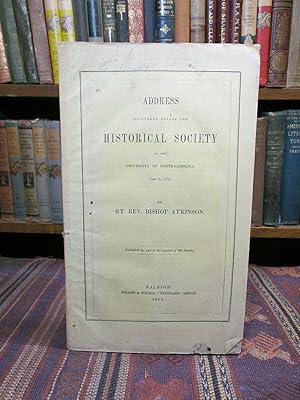
Published by Holden & Wilson, "Standard" Office, Raleigh 1855
- Softcover
- First Edition
Seller: Pages Past--Used & Rare Books, Greensboro, NC, U.S.A.Pages Past--Used & Rare Books
Contact seller5-star sellerCondition: Used - Very good
US$ 100.00
US$ 4.00 shippingShips within U.S.A.Quantity: 1 available
Soft cover. Condition: Very Good. First Edition First Printing. 8vo. 32 pages. Bound in yellow printed wrappers. The binding is rubbed and has some soiling from handling is quite sound. There is a dark brown stain at the bottom edge of the title page (from ink?) which affects the next few leaves and is also visible on the front…wrapper. There are a couple of chips on the spine. An old partly erased signature is difficult to read ("J. A. J.?")The text is toned. The subject of the address focuses on history, and there is much about Cromwell throughout. Housed in a removable plastic sleeve with a board backing. Quite scarce. [Thornton 436]. Thomas Atkinson (1807-1881) was the third Episcopal Bishop of North Carolina. He was born in Dinwiddie County, Virginia, and he was one of four brothers who all went into either the Episcopal or Presbyterian ministry. He graduated from Hamden-Sydney College in 1825 and he was ordained by Bishop William Meade. He served in several places in Virginia and Baltimore, and in 1853 he was elected Bishop of North Carolina and held that post for 28 years. This period was full of challenges for North Carolina, the church and Atkinson as the country struggled with the Civil War and its aftermath. The issue of slavery was divisive in North Carolina before the War an Atkinson represented the complexity of the times. He was opposed to slavery, but he was also against abolition. He had freed his own slaves years earlier, and he wanted to be a calming and moderating influence, hoping to bridge both sides of the issue. He rejected the notion of the inherent inferiority of blacks as a justification of slavery. He opposed Secession, but when Lincoln sent troops to South Carolina he put the church at the service of the Confederates. After the War he continued to work to heal both sides, and he was one of only two southern bishops to attend the Philadelphia Convention. In 1866 he put the control of the black Episcopal Churches wholly in the hands of the black clergymen. After the War he also spearheaded a move to open an Episcopal school for blacks near Raleigh.

