
Austrian Philosopher (9 results)
 More images
Language: French
Published by Korea International Economic Institute, Seoul 1978
- Softcover
- Signed
- Manuscript
Seller: PhP Autographs, Hastière, BelgiumPhP Autographs
Contact seller5-star sellerCondition: Used - Near fine
US$ 1,125.91
US$ 46.03 shippingShips from Belgium to U.S.A.Quantity: 1 available
Couverture souple. Condition: Bon. VERY RARE - Authentic bilingual edition signed in February 1984 : Economic Progress in an Open Society (Seminar) Seoul, Korea International Economic Institute, 1978. + Envelope. Size : 24x16.5 cm. Condition : see scans please. Provenance : Gérard Leman collection. Certificate of Authenticity an…d lifetime guarantee. Signé par l'auteur.
 More images
Published by [Vienna, 1949]. 1949
- Softcover
- Manuscript
Seller: Antiquariat INLIBRIS Gilhofer Nfg. GmbH, Vienna, A, AustriaAntiquariat INLIBRIS Gilhofer Nfg. GmbH
Contact seller5-star sellerCondition: Used
US$ 14,222.13
US$ 34.52 shippingShips from Austria to U.S.A.Quantity: 1 available
Offprint from: "Chronik des Wiener Goethe-Vereins", vols. LII and LIII. Pages 113-146. Original wrappers (spine defective, cover with multiple creases). Wittgenstein's proof copy of Hänsel's essay on Goethe's "Farbenlehre" with his often scathing autograph annotations (in German): "If you only would shut up and keep out of it!"…(p. 122), "You are not Goethe" (p. 124), "Christian peoples are not Christianity" (p. 145). - Wittgenstein and Hänsel had met in the POW camp at Monte Cassino. Wittgenstein visited Vienna during Easter 1949, and Hänsel gave him the offprint to read. "The friendship between Wittgenstein and Hänsel had then lasted three decades, and during this time Wittgenstein uttered many a brusque word about Hänsel's ideas. To be sure, the aggressive, vicious tone is irritating" (cf. Christian Paul Berger, in: "L. Hänsel - L. Wittgenstein. Eine Freundschaft", Innsbruck [1994], p. 339). - "Hänsel was an uncommonly well-read man; above all, he appreciated Pascal, St. Augustine, Kierkegaard, and Goethe, about whom he wrote numerous essays. He studied modern issues of Christianity and the church, the philosophy of values, epistemology, and basic questions of education. Hänsel was considered a conservative: like Wittgenstein, he favoured 'tradition' in matters of literature, art, music, and 'the modern life' in general. For Wittgenstein, Hänsel embodied both the classical Austrian tradition and the faculty to perform an observant examination of current trends in culture and criticism. Harshly though Wittgenstein chastises Hänsel, his letters repeatedly end with his criticising the failures attributed to his friend even more sharply in himself" (cf. Ilse Somavilla, Der rechte Ton, in: ibid., p. 325). - Numerous pencil marginalia, underlinings, deletions and corrections by Wittgenstein.

- Signed
- Manuscript
Seller: Herbst-Auktionen, Detmold, , GermanyHerbst-Auktionen
Contact seller4-star sellerCondition: Used
US$ 88.89
US$ 9.78 shippingShips from Germany to U.S.A.Quantity: 1 available
Albumblatt (1 S. kl. 8 to quer, Vordruck aus Studienbuch), von Alois Riehl zweimal mit Initiale R und Datum 1912 in Tinte signiert - mit Repro-Porträtfoto unter dunkelgrünes Passepartout (4 to) gerahmt.
 More images
Published by Princeton, 8.21.1963 1963
- Manuscript
Seller: Kotte Autographs GmbH, Roßhaupten, , GermanyKotte Autographs GmbH
Contact seller5-star sellerCondition: Used
US$ 14,222.13
US$ 23.01 shippingShips from Germany to U.S.A.Quantity: 1 available
4to. 1 p. Rare and desirable letter to Dr. Martin Davis:On Institute for Advanced Study letterhead. Gödel asks for clarification regarding the subject matter of the Davis-edited book, the Undecidable.Provenance: American mathematician Dr. Martin Davis received his doctorate at Princeton University where his adviser was Alonzo Ch…urch. Davis is best known for his work on Hilbert's tenth problem as well as for pioneering work on the so-called "satisfiability problem." Davis edited the 1965 publication The Undecidable: Basic Papers on Undecidable Propositions, Unsolvable Problems and Computable Functions, which included 5 pieces by Gödel as well as material by Alan Turing, Alonzo Church, Emil Post, Stephen K. Kleene and J.B. Rosser. Kurt Gödel, who was a friend and colleague of Albert Einstein, has been considered one of the most important logicians since Aristotle who, according to Dr. Davis, "utterly transformed the field of mathematical logic and our understanding of the foundations of mathematics, starting with his famous 'incomplete theorem.'"Davis recounts the context of the above material:"As a young man committed to making mathematical logic my life's work, Gödel was a towering and inspirational figure. I was also thrilled to be part of the circle at the Institute for Advanced Studies at Princeton, and to see Einstein and Gödel walking together.Many years later, I was editing an anthology of fundamental research papers, The Undecidable (1965), all concerned with the new perspectives that Gödel's revolutionary 1931 paper on formally undecidable propositions had illuminated. Several of the articles included were by Gödel himself.The book was entirely in English although three of Gödel's contributions had been originally published in German, and I translated two of these. I was pleased when during our correspondence he approved my translations. He also wrote me adding a significant amount of new material to another article (one that had originated in a series of lectures given in English at the Institute of Advanced Study in Princeton in 1934), bringing it up to date, emphasizing the importance of Alan Turing's work in extending the incompleteness theorem. Gödel sent some of this material to me in a handwritten letter, explaining that, because he was ill, he'd been unable to have it typewritten. After Gödel's death in 1978, I was studying a manuscript found with his effects for a project to publish his collected works. I was amazed to discover in it work by Gödel that was very close in method and form to a theorem in my doctoral dissertation of 1950 that had enabled a strengthened form of the incompleteness theorem."In his book The Universal Computer, Dr. Davis summarized what Gödel had done with his paper on undecidability, the centerpiece of the Davis edited book The Undecidable: "Leibniz had certainly proposed the development of a precise artificial language in which much human thought would be reduced to calculation. Frege, in his Bgriffsschrift, had shown how the usual logical reasoning by mathematicians could indeed be captured. Whitehead and Russell had succeeded in developing actual mathematics in an artificial language of logic. Hilbert had proposed the metamathematical study of languages. But before Gödel no one had shown how these metamathematical concepts could be embedded in the languages themselves" (p 121).
 More images
Published by Princeton, 1963-1965 1965
- Signed
- Manuscript
Seller: Kotte Autographs GmbH, Roßhaupten, , GermanyKotte Autographs GmbH
Contact seller5-star sellerCondition: Used
US$ 47,407.08
US$ 23.01 shippingShips from Germany to U.S.A.Quantity: 1 available
4to. The ALS 8vo. 9 pp. Expected fold creases. Rare and desirable archive of signed letters and an autograph manuscript all addressed to Dr. Martin Davis:1. Autograph Manuscript, 1 p, 4to, [Princeton, New Jersey, 1963], in pencil, entitled at top "Additions to footnotes," and providing 3 additional items. He adds to footnote 19:… "Herbrand apparently conjectured that this definition would prove equivilent with the one he gave in Jour. r. angew. Math. vol. 166 (1931/32), p 1-8, where he required 'compatibility,' without specifying however any rules of computation."2. Autograph Letter Signed ("Kurt Gödel"), 1 p, oblong 8vo, Princeton, New Jersey, December 29, 1963. Gödel mentions sending additional material concerning his 1934 lectures. He also consents to the publication of his resume which had been used for his talk at the Princeton Bicentennial.3. Letter Signed ("Kurt Gödel"), 1 p, 4to, Princeton, New Jersey, August 21, 1963, on Institute for Advanced Study letterhead. Gödel asks for clarification regarding the subject matter of the Davis-edited book, the Undecidable.4. Letter Signed ("Kurt Gödel"), 1 p, 4to, Princeton, New Jersey, December 20, 1963, on Institute for Advanced Study letterhead. Regarding corrections to Gödel's 1934 lecture notes.5. Letter Signed ("Kurt Gödel"), 2 pp, 4to, Princeton, New Jersey, August 18, 1964, on Institute for Advanced Study letterhead. Lot also includes a photocopy with an additional type foot note addendum. Regarding numerous corrections and the return of Gödel's 1934 lecture notes.6. Letter Signed ("Kurt Gödel"), 2 pp plus additional typed leaf, 4to, Princeton, New Jersey, October 12, 1964, on Institute for Advanced Study letterhead. Regarding numerous corrections including a reconsideration on one footnote: "Professor van Heijenoort [Jean Louis Maxime van Heijenoort, historian of mathematical logic and one of the editor's of Gödel's collected works] called my attention to a third definition of 'general recursive,' given by Herbrand . This, in conjunction with other passages, seems to prove that Herbrand was wavering between different definitions, which he hoped would prove equivalent. For this reason I would like footnote 19 to avoid reference to what he meant and confine myself to what he said. Also, considering Herbrand's wording, I think it is better to omit 'intuit. demonstrable' in the last sentence." 7. Letter Signed ("Kurt Gödel"), 1 p, with Autograph Postscript, 4to, Princeton, New Jersey, March 8, 1965, on Institute for Advanced Study letterhead. Regarding corrections.Provenance: American mathematician Dr. Martin Davis received his doctorate at Princeton University where his adviser was Alonzo Church. Davis is best known for his work on Hilbert's tenth problem as well as for pioneering work on the so-called "satisfiability problem." Davis edited the 1965 publication The Undecidable: Basic Papers on Undecidable Propositions, Unsolvable Problems and Computable Functions, which included 5 pieces by Gödel as well as material by Alan Turing, Alonzo Church, Emil Post, Stephen K. Kleene and J.B. Rosser. Kurt Gödel, who was a friend and colleague of Albert Einstein, has been considered one of the most important logicians since Aristotle who, according to Dr. Davis, "utterly transformed the field of mathematical logic and our understanding of the foundations of mathematics, starting with his famous 'incomplete theorem.'"Davis recounts the context of the above material:"As a young man committed to making mathematical logic my life's work, Gödel was a towering and inspirational figure. I was also thrilled to be part of the circle at the Institute for Advanced Studies at Princeton, and to see Einstein and Gödel walking together.Many years later, I was editing an anthology of fundamental research papers, The Undecidable (1965), all concerned with the new perspectives that Gödel's revolutionary 1931 paper on formally undecidable propositions had illuminated. Several of the articles included wer.
 More images
Published by Various places, 20th century.
- First Edition
Seller: Antiquariat INLIBRIS Gilhofer Nfg. GmbH, Vienna, A, AustriaAntiquariat INLIBRIS Gilhofer Nfg. GmbH
Contact seller5-star sellerCondition: Used
US$ 41,481.20
US$ 34.52 shippingShips from Austria to U.S.A.Quantity: 1 available
116 works in 122 volumes, mostly 4to and 8vo. Includes a folder of ephemera comprising correspondence, photographs, newspaper clippings, and personal notes. The library and papers of the Viennese philosopher Ludwig Landgrebe, from 1923 to 1930 the personal assistant to the father of phenomenology, Edmund Husserl (1859-1938). Lan…dgrebe's personal books, presented here, include a first edition of Husserl's groundbreaking "Logische Untersuchungen", and the first ever printing of Martin Heidegger's seminal "Sein und Zeit," published in the 1927 "Jahrbuch für Phänomenologie", which was produced and edited by Heidegger's teacher and mentor, Husserl himself. - Landgrebe's collection spans the philosophical developments of the 20th century and is supplemented with the library of the late curator of the Cologne Husserl Archive, Dr. Elisabeth Ströker (1928-2000). Altogether, the collection comprises over 110 works and numerous ephemeral pieces - including letters, manuscripts, postcards, notes, photographs, and more - documenting the evolution of the school of philosophy Husserl founded. - Many volumes are inscribed; Landgrebe himself has inscribed one of his own works to Elisabeth Ströker, his fellow custodian of Husserl's legacy, and eleven other works are inscribed to Landgrebe from a range of former students and colleagues, including Yoshihiro Nitta (1929-2020), Alwin Diemer (1920-86), Josef Speck (1927-2003), Bernhard Rang (1935-99), David Carr (b. 1940), and Marvin Farber (1901-80). - Edmund Husserl, who died in 1938, was one of the most influential philosophers of the 20th century. It is clear from letters addressed to Landgrebe that even thirty years after Husserl's death, Landgrebe was considered a close confidant and expert on Husserl's life and legacy. This is especially important with regard to Husserl's relationship with his former student Martin Heidegger, whose works are the most common in Landgrebe's library after Husserl's. Heidegger famously chose not to support Husserl when, under Nazi policy, Husserl was denied access to university resources and finally was removed from his position. Heidegger, a member of the Nazi party, subsequently took Husserl's place, though he resigned a year later; the debate around the depth of Heidegger's dedication to Nazism can be seen in Landgrebe's library itself in the form of postwar newspaper clippings, and at least one letter sent to Landgrebe to ask for his side of the story in 1967. - A trove of Landgrebe's personal and professional history, and through him, one of Edmund Husserl and Martin Heidegger. A detailed catalogue is available on request. - Some light wear, and expected toning or edgewear to ephemera (such as newspaper clippings, letters, and photographs). Altogether in very good condition. - 1) From the library of Ludwig Landgrebe, with many instances of his personal library stamp and later pencil notes reading, "ex-bibl. Prof. Dr. Ludwig Landgrebe". - 2) Later owned by Landgrebe's descendants, who were able to augment the collection with the partial library of Elisabeth Ströker, several books containing notes in her hand. - 3) German private collection, with a few relevant addenda from the collector's library.

Published by Trinity College, Cambridge, 4 Feb. 1947. 1947
- Manuscript
Seller: Antiquariat INLIBRIS Gilhofer Nfg. GmbH, Vienna, A, AustriaAntiquariat INLIBRIS Gilhofer Nfg. GmbH
Contact seller5-star sellerCondition: Used
US$ 18,962.83
US$ 34.52 shippingShips from Austria to U.S.A.Quantity: 1 available
8vo. 2 pages. Unpublished letter, in German, to his sister Helene Salzer, née Wittgenstein: "Little Helene, my uncle! (What must the censors think!) [] I have not listened to music for a long time. I would like to hear Schumann quartets again. Recently I remembered the beginning of one quartet - the introduction - and was quite…delighted. Unfortunately, two floors below my rooms someone is playing the piano & I am much disturbed by the miserable plunking (mostly Beethoven). Oddly, it sometimes almost prevents me from breathing []" (transl.). - With censorship stamp. - Not in: McGuinness, R. Schweizer (ed.), Wittgenstein. Eine Familie in Briefen, Innsbruck and Vienna, 2018.
 More images
Published by [Vienna], c. 1899-1902. 1902
- Manuscript
Seller: Antiquariat INLIBRIS Gilhofer Nfg. GmbH, Vienna, A, AustriaAntiquariat INLIBRIS Gilhofer Nfg. GmbH
Contact seller5-star sellerCondition: Used
US$ 112,591.83
US$ 34.52 shippingShips from Austria to U.S.A.Quantity: 1 available
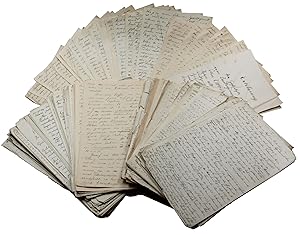
Altogether c. 700 pp., mainly written in Weininger's meticulous handwriting, but also including some more perfunctory pages in Latin script, some shorthand. Numerous corrections and deletions. Some browning and wrinkling, occasional paper flaws to edges. Various formats, but mostly 4to (34:21 cm), as well as a few pieces in-8vo…and small formats. Well preserved altogether. Extensive and previously unknown partial estate of the ill-fated Austrian philosopher. Of outstanding importance for a scholarly study of the textual development of Weininger's principal work as well as for the biography of the controversial philosopher. The present collection mainly comprises preliminary studies and working drafts for his dissertation "Eros und Psyche", as well as for "Geschlecht und Charakter" ("Sex and Character"), the notorious magnum opus which he expanded from his dissertation. Also included are numerous citations and excerpts from Weininger's literary studies, several library order slips, some exercise books and letters, a portrait, and a short autobiographical statement, as well as his father's written permission that Otto learns how to handle a gun. - Weininger's major work, a precocious study of the relationship of sex and character which earned the author his Ph.D. degree, was dismissed at first but gained immediate popularity after he shot himself at the age of 23. The work remains a key document of Vienna fin-de-siècle thinking. In spite of his rabid misogyny and antisemitism, Weininger was considered a genius by the philosopher Ludwig Wittgenstein as well as the writer August Strindberg. - Some browning and wrinkling, occasional paper flaws to edges. Well preserved altogether.

- Signed
- Manuscript
Seller: Herbst-Auktionen, Detmold, , GermanyHerbst-Auktionen
Contact seller4-star sellerCondition: Used
US$ 165.92
US$ 9.78 shippingShips from Germany to U.S.A.Quantity: 1 available
Kleine Briefkarte mit E.ZITAT, Datum, Unterschrift signiert April 1919 , Beilage : Eigenhändiger Briefumschlag dazu Ehe, wie der Dichter verkündete, die Welt vom deutschen Wesen genesen wird, muß das deutsche Wesen erst selber wieder genesen. (ditio zum gleichen Preis : E.Brief (2 S. 8°) in Tinte mit Ort, Datum, Unterschrift sig…niert Halle a.S., 8. Juli 1905 an Verehrtester Herr Kollege (= ungenannt CARL STUMPF (1848-1936) Professor Dr., deutscher Philosoph, Psychologe und Musikforscher, Mitbegründer der funktionalen Psychologie. Er gründete 1894 das Psychologische Institut Berlin), mit dem er aus der Bekanntschaft eine persönliche Freundschaft machen möchte.).


