
Ballet Libretti (1 results)
 More images
Language: French
- Hardcover
- First Edition
Seller: J & J LUBRANO MUSIC ANTIQUARIANS LLC, Syosset, NY, U.S.A.J & J LUBRANO MUSIC ANTIQUARIANS LLC
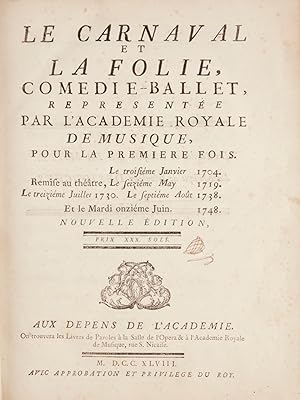
Contact seller5-star sellerQuarto. Full mid-tan mottled calf with coat of arms gilt to both boards, raised bands on spine in decorative compartments gilt, marbled endpapers. With occasional decorative woodcut initials and head- and tailpieces throughout. 1. DESTOUCHES, Andre Cardinal 1672-1749 Le Carnaval et La Folie, Comedie-Ballet, representée par l'Aca…demie Royale de Musique, pour le premiere fois. Le troisième Janvier 1704. Remise au théâtre, Le seizième May 1719. Le treizième Juillet 1730. Le septième Août 1738. Et le Mardi onziéme Juin. 1748. Nouvelle Édition, Prix XXX. Sols. [Paris]: Aux Depens de l'Academie. On trouvera les Livres de Paroles à la Salle de l'Opera & à l'Academie Royale de Musique, rue S. Nicaise. . Avec Approbation et Privilege du Roy. . De l'Imprimerie de la Veuve Delormel, & Fils, 1748. 1f. (recto title, verso "Les Paroles de Monsieur de la Motte. La Musique de Monsieur Destouches."), 1f. (cast list), 5-51, [i] (approbation and imprint). With manuscript paraph to title. Named cast includes: - "Acteurs Chantans dans les Choeurs" for the Côté du Roi performance Mlles. Dun, Toulou, Delorge, Larcher, Cazeau, Rosalie, Le Tourneur, Duperey, and Grimiaux and Messrs. Lefebre, Le Page C, Laubertie, Fel, Bourque, Duchênet, Rochette, and Gratin; and for the Côté de la Reine performance Mlles. Cartou, Masson, Gondré, Rôllet, Delâtre, Lablotiere, Daliere, Victoire, Hery, and Folliot and Messrs. S. Martin, Le Mesle, Bellanger, Levasseur, Belot, Chapotin, Favier, and Le Roy - "Acteurs du Prologue" Mlle. Romainvile; Messrs. Person, Le Page, and de la Tour - Dancers Mlle. Puvigné in Hebé; Mlles. Lyonnois, Courcelle, and Thieri in Les Graces; Messrs. Devisse, Caillez, Laval, Feuillade, and Mion; Mlles. Dazenoncourt, Briseval, Minot, and Puvigné in "Jeux & Plaisirs." A pupil of Campra, Destouches achieved considerable success as a composer of stage music. His Isse was greatly admired by King Louis XIV. "Le carnaval et la folie is one of the first examples of a lyric comedy in France." James R. Anthony in Grove Music Online 2. CAMPRA, André 1660-1744, Monteclair, Bourgeois, and Rameau Fragmens, de Differens Ballets, Représentés par l'Academie Royale de Musique, Le Mardi 10 Séptembre, 1748. Prix XXX. Sols. [Paris]: Aux Depens de l'Academie. On trouvera les Livres de Paroles à la Salle de l'Opera & à l'Academie Royale de Musique, rue S. Nicaise. . Avec Approbation et Privilege du Roy. . De l'Imprimerie de la Veuve Delormel, & Fils, 1748. In a prologue and 3 acts. - 1f. (recto title, verso "Les Paroles de M. Danchet. La Musique de M. Campra."), 3-4 (cast list), [5]-8 ("Prologue, des Amours de Venus") Named cast includes: - "Acteurs Chantans dans les Choeurs" for the Côté du Roi performance Mlles. du, Toulou, Delorge, Larcher, Cazeau, Rosalie, Folliot, Le Tourneur and Grimiau and Messieurs Lefebvre, Le Page C., Laubertie, Fel, Bourque, Duchênet, Rochette, and Gratin; and for the Côté de la Reine performance Mlles. Cartou, Masson, Gondré, Rôllet, Delâtre, Lablotiere, Daliere, Chesdville, Hery, and Duperey and Messieurs S. Martin, Le Mesle, Bellanger, Levasseur, Belog, Chapotin, Favier, and Le Roy - "Acteurs du Prologue" Mlle. Romainville, Jacquet, and Met - Dancers Mlles. Imblot, Sauvage, Parquet, Amedée, Carville, Devaux, Bellot, L., and Bellot, C; Mrs. Le Febvre, Laurent, Laval, Caillé, Feuillade, and Bourgeois; Messieurs Le Lievre and Devisse. Campra was a leading figure in French theatrical and sacred music in the early 18th century. With: MONTECLAIR, Michel Pignolet 1667-1737 [1] (Les Soirées de l'Eté, tirées du ballet Des Festes de l'Eté: Le Paroles d de M. Pellegrin. La Musique de M. Monteclair.), 2 (cast list), 3-22 pp. Named cast includes: - Actors Mlles. Coupée and Chevalier and Messieurs Person, de la Tour, and Le Page - Dancers Mlles. Camargo, Lyonois, Thierry, Dazenoncourt, Sauvage, Beaufort, and Briseval; Mrs. Dupré, Dumay, Matignon, Hamoche, and Caillé; Monsieurs Tessier and Levoir "Although not prolific, Montéclair wrote in most of the genres cultivated during the early 18th century in France, excepting only the keyboard. He was one of the most versatile of the generation between Lully's death (1687) and Rameau's advent as a stage composer (1733); composers of this 'préramiste' period are often described as 'imitators of Lully', but Montéclair and Campra are among those who influenced Rameau's dramatic music. In his stage works, Montéclair was particularly sensitive to the dramatic function of orchestral colour. His operatic scores are much clearer than those of his contemporaries in giving directions for specific instruments, like the off-stage horns 'played very softly to simulate the hunt in the distance' in the second entrée of Les festes de l'été (Montéclair added that 'if no cors de chasse are available, oboes and violins may play the following and remain in the orchestra'). In the same work, a 'Prélude à trois basses' introduces the first scene of the third entrée, where the main roles are sung by basses; the prelude to the second scene, whose main roles are sung by sopranos, is scored for violins and violas without continuo. The parts enter in reverse order, and the melodic material is derived from the earlier prelude (ex.1). Les festes de l'été and Jephté both contain an a cappella chorus and the former has a large-scale double chorus - an operatic counterpart to the choruses in Lalande's grands motets." James R. Anthony in Grove Music Online With: BOURGEOIS, Thomas Louis 1676-1750 or 1751 [1] (L'Estime, tiré Des Amours Déguisés. Les Paroles de Monsieur Fuzelier. La Musique de Monsieur Bourgeois.), 2 (cast list), 3-14 pp. Named cast includes: - Actors Mlles. Fel, Jacquet, and Gondré; Messieurs de Chassé, Poirier, and Person - Dancers Mlles. Dallemand, Thieri, St. Germain, Minot, Sauvage, Briseval, and Himblot; Mrs. Dupré, Lany, Devisse, Lyonnois, Dumat, Matignon, Hamoche, Laval, and Feuillade; Mr. Doumoulin. A French composer and singer, best known for his contributions to the 18th centur.
