
Bargue (16 results)

- Softcover
Seller: Revaluation Books, Exeter, , United KingdomRevaluation Books
Contact seller5-star sellerCondition: New
US$ 23.46
US$ 13.41 shippingShips from United Kingdom to U.S.A.Quantity: 1 available
Paperback. Condition: Brand New. 176 pages. 11.02x8.43x0.39 inches. In Stock.

- Softcover
Seller: Antártica, Madrid, M, SpainAntártica
Contact seller5-star sellerCondition: New
US$ 29.74
US$ 20.83 shippingShips from Spain to U.S.A.Quantity: 1 available
Rústica. Condition: New. Dust Jacket Condition: Nuevo. 1. LIBRO.

- Softcover
Seller: Kennys Bookshop and Art Galleries Ltd., Galway, GY, IrelandKennys Bookshop and Art Galleries Ltd.
Contact seller5-star sellerCondition: New
US$ 45.92
US$ 12.15 shippingShips from Ireland to U.S.A.Quantity: Over 20 available
Condition: New. 2025. paperback. . . . . .

Published by Contentum Ltd., Larnaca, Cyprus
- Art Print
Seller: Contentum, Nicosia, CyprusContentum
Contact seller4-star sellerCondition: New
US$ 21.45
US$ 16.78 shippingShips from Cyprus to U.S.A.Quantity: Over 20 available
Loose Leaf. Condition: New. Reproduction. Original title: Two riders, part of the fries of the Parthenon German: Zwei Fahrer, Teil der Pommes des Parthenon French: Deux coureurs, une partie des frites du Parthénon Spanish: Dos jinetes, parte de las papas fritas del Partenón High-quality fine-art reproduction based on an original… work from the Rijksmuseum. Creation period: 19th century (1866). Professionally printed on premium fine-art paper (Photo Matt Fibre) in size A5. The motif is printed with a white border (museum-style presentation). No.

Published by Contentum Ltd., Larnaca, Cyprus
- Art Print
Seller: Contentum, Nicosia, CyprusContentum
Contact seller4-star sellerCondition: New
US$ 21.45
US$ 16.78 shippingShips from Cyprus to U.S.A.Quantity: Over 20 available
Loose Leaf. Condition: New. Reproduction. Original title: Theseus, part of the fronton of the Parthenon German: Theseus, Teil des Frontons des Parthenons French: Theseus, une partie du fronton du Parthénon Spanish: Teseo, parte del frente del Partenón High-quality fine-art reproduction based on an original work from the Rijksmus…eum. Creation period: 19th century (1866). Professionally printed on premium fine-art paper (Photo Matt Fibre) in size A5. The motif is printed with a white border (museum-style presentation). No.

- Hardcover
Seller: Kennys Bookshop and Art Galleries Ltd., Galway, GY, IrelandKennys Bookshop and Art Galleries Ltd.
Contact seller5-star sellerCondition: New
US$ 54.04
US$ 12.15 shippingShips from Ireland to U.S.A.Quantity: 2 available
Condition: New. . hardcover. . . . . .

- Softcover
- Print on Demand
Seller: PBShop.store US, Wood Dale, IL, U.S.A.PBShop.store US
Contact seller5-star sellerCondition: New
US$ 18.51
Free ShippingShips within U.S.A.Quantity: Over 20 available
PAP. Condition: New. New Book. Shipped from UK. THIS BOOK IS PRINTED ON DEMAND. Established seller since 2000.

- Softcover
Seller: Antártica, Madrid, M, SpainAntártica
Contact seller5-star sellerCondition: New
US$ 57.17
US$ 20.83 shippingShips from Spain to U.S.A.Quantity: 1 available
Rústica. Condition: New. Dust Jacket Condition: Nuevo. 1. LIBRO.
- Softcover
- Print on Demand
Seller: PBShop.store UK, Fairford, GLOS, United KingdomPBShop.store UK
Contact seller5-star sellerCondition: New
US$ 18.35
US$ 4.41 shippingShips from United Kingdom to U.S.A.Quantity: Over 20 available
PAP. Condition: New. New Book. Delivered from our UK warehouse in 4 to 14 business days. THIS BOOK IS PRINTED ON DEMAND. Established seller since 2000.

- Softcover
Seller: Antártica, Madrid, M, SpainAntártica
Contact seller5-star sellerCondition: New
US$ 65.56
US$ 20.83 shippingShips from Spain to U.S.A.Quantity: 1 available
Rústica. Condition: New. Dust Jacket Condition: Nuevo. 1. LIBRO.

Seller: Sage Rare & Collectible Books, IOBA, Livonia, MI, U.S.A.Sage Rare & Collectible Books, IOBA
Contact seller5-star sellerCondition: Used - Near fine
US$ 36.60
US$ 6.50 shippingShips within U.S.A.Quantity: 1 available
Non-Book. Condition: Near Fine. We consider each and every book we sell to be a treasure. That's why we provide accurate individualized condition descriptions; ship in sturdy protective packaging; and offer excellent customer service.; Overall size: 8.5" x 12". This is a vintage illustration reproduced in 1927 (not a modern repr…oduction). It has modest toning, otherwise clean and pristine. Engraved by The Colorplate Engraving Company, New York City. .; 8.5" x 12".

- Hardcover
Seller: Mispah books, Redhill, SURRE, United KingdomMispah books
Contact seller4-star sellerCondition: Used - Fair
US$ 131.18
US$ 33.52 shippingShips from United Kingdom to U.S.A.Quantity: 1 available
hardcover. Condition: Acceptable. Acceptable. Dust Jacket NOT present. CD WILL BE MISSING. SHIPS FROM MULTIPLE LOCATIONS. book.

Published by Sentinella
- Softcover
Seller: Sergio Trippini, Gavirate, VA, ItalySergio Trippini
Contact seller4-star sellerCondition: Used
US$ 47.68
US$ 55.55 shippingShips from Italy to U.S.A.Quantity: 1 available
inserita nella famosa opera "L'ART - Revue Hebdomadaire Illustrée" pubbicata a Paris dal 1875 al 1895, stampata su carta vergellata. Dimensioni del foglio mm 280x420.

Seller: Celler Versandantiquariat, Eicklingen, , GermanyCeller Versandantiquariat
Contact seller5-star sellerCondition: Used
US$ 17.88
US$ 43.98 shippingShips from Germany to U.S.A.Quantity: 1 available
Stahlstich um 1870. Bildgröße: 17,5:13,5 cm, unter Passepartout--- 750 Gramm.
 More images
Published by Paris, Goupil & Cie Editeurs, no date (1868) 1868
Seller: Antiquariaat Fragmenta Selecta, AMSTERDAM, , NetherlandsAntiquariaat Fragmenta Selecta
Contact seller5-star sellerCondition: Used
US$ 3,218.54
US$ 27.78 shippingShips from Netherlands to U.S.A.Quantity: 1 available
[This course taught Vincent van Gogh how to draw human figures.] Loose-leaf plates on grey paper with the original white/grey paper backing. Dimensions: 44 x 59 cm. All plates are numbered. The following plates from the first series (Première partie) are on offer here: 1, 2, 5, 7, 9-12, 15-17, 19-22, 24-26, 28-29, 32, 36, 40, 42…, 46, 49, 52-53, 56. Details: All plates have a small printed colophon in a frame, with the general title, the part number and title, the plate number and the publishers name. In fine print at the bottom of the sheets the name of the printer Lemercier in Paris is mentioned on most plates. 27 plates also have a small blind stamp of the firm Goupil in the lower margin. See for this stamp the French database 'marquesdecollections', stamp no. L.1090. Condition: Mosts lithos are in rather good condition. The plates have evidently been used, a few have tiny pinholes. Some of them have been folded, showing creases. Most of the plates are frayed and worn at the edges, with a few small tears and dog-ears. Several plates are foxed or spotted. Four plates are in lesser condition: plate 2 has large folds, the lower corners are damaged and there is foxing; plate 26 has two long creases and a large tear; plate 36 has a crease, a damaged corner and a tear of six cm.; plate 56 is almost torn through the middle. NOTE: The beautiful plates of the famous Drawing Course (Cours de dessin) by Bargue and Gérome were made for beginning students of drawing schools and art academies to copy. In this way they could become familiar with the principles of contour, light, and shade, and at the same time develop an appreciation for 'good taste' by looking at examples of great art. The drawings of the first part of the course were made after plaster casts of famous classical and renaissance statues. The series starts with simple forms of isolated body-parts and then offers images of gradually increasing complexity. To help the student to manage the essential forms of a head or torso, many plates are divided into two parts. A schematic outline with straight lines and angles stands beside the finished drawing. § The plates of the drawing course are now hard to find. Of the original publication of 197 loose-leaf lithography plates, divided into three parts, there are only a few complete sets known. Our collection is a part of the first volume: 'Modèles d'après la bosse' (Models after casts), which consisted of 70 plates. It was published in 1868. The second series, completed in 1870, was: 'Modèles d'après les Maîtres de toutes les époques et de toutes les écoles' (Models after masters of all periods and all schools). The third series, completed in 1873, was: 'Exercices au fusain pour préparer à l'étude de l'académie d'après nature' (Charcoal exercises in preparation for drawing the academic nude). The first two sections were meant for schools for design and decorative arts. The third section with live models was used only in art academies. There were no instructions published with the plates, that was left to the teachers in the schools. It was common practice in the schools to start with copying prints and drawing from plaster casts of classical statues. As a second stage, students copied old masters. In the art academies, they then went on to live models. This training was part of the tradition of 19th century neoclassicsm. The imitation of nature was the only goal for artists. Objects and human bodies should be drawn and painted meticulously. Works of art were both realistic and idealistic, following the concept of 'good taste'. In France, this resulted in smooth and finished works, influenced by the standards of the French 'Académie des Beaux-Arts'. This so-called 'Academic Art' came under criticism at the end of the 19th century when the concept of art changed radically. The Drawing Course is the last great document of the 19th century tradition of art education. It was widely used in France and England. § Vincent van Gogh writes about it in his letters, he has worked through the whole course at least once. Van Gogh worked very hard on this course because he hoped to gain some income with the sale of his drawings. In a sketchbook owned by the Van Gogh Museum in Amsterdam there are several pencil drawings made after Bargue's plates. Nowadays, the didactic and artistic quality of the course is greatly admired by both amateur and professional artists. § The firm Goupil & Cie was an important publisher of original prints and art reproductions in Paris. They hired skilled engravers and lithographers and used the latest techniques. The firm also developed into a renowned art dealer. The 'Cours de dessin' sold very well for Goupil, and loose plates were still sold until the firm was dissolved around 1920. Charles Bargue (1826-1883) was a French draughtsman, lithographer and painter who has left a small number of paintings. Jean-Léon Gérome (1824-1904) was a French painter and sculptor, an esteemed representative of academic art. The main source for information on the course is: G.M. Ackerman. Charles Bargue with the collaboration of Jean-Léon Gérôme, Drawing Course. Paris, ACR, 2017 (first edition 2003). A copy of this book is added.
- Art Print
Seller: BOTTEGHINA D'ARTE GALLERIA KÚPROS, Rosignano Solvay, LI, ItalyBOTTEGHINA D'ARTE GALLERIA KÚPROS
Contact seller2-star sellerCondition: Used - Good
US$ 298.01
US$ 37.03 shippingShips from Italy to U.S.A.Quantity: 1 available
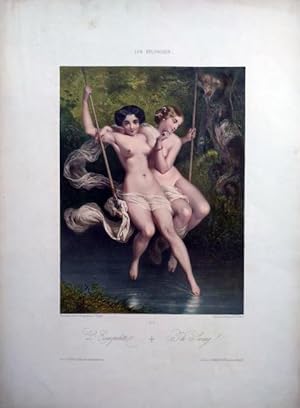
No legatura. Condition: Buono. Imprimé par Bequet frères à Paris, 1880 circa. Litografia in coeva coloritura a mano (N. 11 - Peint d'après nature et lithographié par C. Bargue - Imprimé par Bequet frères à Paris), cm 40 x 55,5 (il foglio). Bella scena con due fanciulle su un'altalena avvolte soltanto da un velo che copre le part…i intime, in un contesto di bosco, sopra uno stagno. Esemplare in piacevole coloritura e in buono stato di conservazione.


