

Order Total (1 Item Items):
Shipping Destination:

Bassingthwaighte James (13 results)
Skip to main search results
Search filters
Product Type
- All Product Types
- Books (13)
- Magazines & Periodicals (No further results match this refinement)
- Comics (No further results match this refinement)
- Sheet Music (No further results match this refinement)
- Art, Prints & Posters (No further results match this refinement)
- Photographs (No further results match this refinement)
- Maps (No further results match this refinement)
- Manuscripts & Paper Collectibles (No further results match this refinement)
Condition Learn more
- New (11)
- As New, Fine or Near Fine (1)
- Very Good or Good (1)
- Fair or Poor (No further results match this refinement)
- As Described (No further results match this refinement)
Binding
Collectible Attributes
- First Edition (No further results match this refinement)
- Signed (No further results match this refinement)
- Dust Jacket (No further results match this refinement)
- Seller-Supplied Images (4)
- Not Print on Demand (9)
Language (1)
Price
- Any Price
- Under US$ 25 (No further results match this refinement)
- US$ 25 to US$ 50 (No further results match this refinement)
- Over US$ 50
Free Shipping
- Free Shipping to U.S.A. (No further results match this refinement)
Seller Location
Seller Rating
-
Condition: New. pp. xxi + 575.
-
Condition: New. pp. xxi + 575.
-
Condition: New. pp. xxi + 575.
-
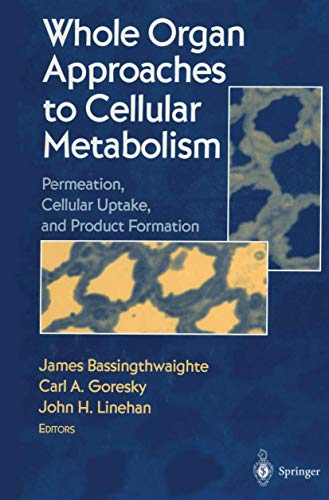
Whole Organ Approaches to Cellular Metabolism: Permeation, Cellular Uptake, and Product Formation (Ecological Studies; 128)
Seller: Phatpocket Limited, Waltham Abbey, HERTS, United Kingdom
Seller rating 5 out of 5 stars

US$ 123.26
US$ 14.31 shipping
Ships from United Kingdom to U.S.A.Quantity: 1 available
Add to basketCondition: Good. Your purchase helps support Sri Lankan Children's Charity 'The Rainbow Centre'. Ex-library, so some stamps and wear, but in good overall condition. Our donations to The Rainbow Centre have helped provide an education and a safe haven to hundreds of children who live in appalling conditions.
-

Whole Organ Approaches to Cellular Metabolism: Permeation, Cellular Uptake, and Product Formation
Seller: Ria Christie Collections, Uxbridge, United Kingdom
Seller rating 5 out of 5 stars
US$ 134.25
US$ 16.12 shipping
Ships from United Kingdom to U.S.A.Quantity: Over 20 available
Add to basketCondition: New. In.
-
US$ 138.57
US$ 33.63 shipping
Ships from United Kingdom to U.S.A.Quantity: 1 available
Add to basketHardcover. Condition: Like New. LIKE NEW. SHIPS FROM MULTIPLE LOCATIONS. book.
-
Whole Organ Approaches to Cellular Metabolism: Permeation, Cellular Uptake, and Product Formation
Language: English
Published by Springer-Verlag New York, 2012
ISBN 10: 1461274494 ISBN 13: 9781461274490
US$ 182.23
US$ 16.82 shipping
Ships from United Kingdom to U.S.A.Quantity: 2 available
Add to basketPaperback. Condition: Brand New. reprint edition. 596 pages. 9.25x6.10x1.20 inches. In Stock.
-

Whole Organ Approaches to Cellular Metabolism : Permeation, Cellular Uptake, and Product Formation
Language: English
Published by Springer New York, Springer New York, 2011
ISBN 10: 1461274494 ISBN 13: 9781461274490
Taschenbuch. Condition: Neu. Druck auf Anfrage Neuware - Printed after ordering - The field of capillary-tissue exchange physiology has been galvanized twice in the past 25 years. A 1969 conference at the National Academy of Sciences in Copenhagen resulted in the book Capillary Permeability: The Transfer of Mole cules and Ions Between the Capillary Blood and the Tissue (Crone and Lassen, 1970). It focused on the physiochemical aspects of transcapillary water and solute transport. The field has matured considerably since. This volume was designed as the successor to the 1970 book, and was created at a gathering of the authors at McGill University. It too captures the breadth of a field that has been dramatically enriched by numerous technical and conceptual advances. In 1970 it was already known that the capillary wall was not merely a 'cellophane bag' exerting steric hindrances on solute particles. Instead, the endothelial surface was recognized as the site of binding reactions and permeation by passive or carrier-mediated trans port. Furthermore, the cells of the blood could traverse evanescent wide openings in the 'zippered' clefts. Today, research priorities have turned more to cell-cell interactions, toward understanding the utility of the gap junctional connections between endothelial cells and neighboring smooth muscle cells, neuronal twigs, and the parenchymal cells of organs. New discoveries in the past few years have revealed the critical importance of the close relationships between the endothelial cells and the parenchymal cells.
-

Fractal Physiology
Language: English
Published by American Physiological Society / Oxford, 1994
ISBN 10: 0195080130 ISBN 13: 9780195080131
Hardcover. Condition: new. New Copy. Customer Service Guaranteed.
-
Condition: new. Questo è un articolo print on demand.
-

Whole Organ Approaches to Cellular Metabolism
Language: English
Published by Springer New York, Springer New York Nov 2011, 2011
ISBN 10: 1461274494 ISBN 13: 9781461274490
Seller: BuchWeltWeit Ludwig Meier e.K., Bergisch Gladbach, Germany
Seller rating 5 out of 5 stars
Taschenbuch. Condition: Neu. This item is printed on demand - it takes 3-4 days longer - Neuware -The field of capillary-tissue exchange physiology has been galvanized twice in the past 25 years. A 1969 conference at the National Academy of Sciences in Copenhagen resulted in the book Capillary Permeability: The Transfer of Mole cules and Ions Between the Capillary Blood and the Tissue (Crone and Lassen, 1970). It focused on the physiochemical aspects of transcapillary water and solute transport. The field has matured considerably since. This volume was designed as the successor to the 1970 book, and was created at a gathering of the authors at McGill University. It too captures the breadth of a field that has been dramatically enriched by numerous technical and conceptual advances. In 1970 it was already known that the capillary wall was not merely a 'cellophane bag' exerting steric hindrances on solute particles. Instead, the endothelial surface was recognized as the site of binding reactions and permeation by passive or carrier-mediated trans port. Furthermore, the cells of the blood could traverse evanescent wide openings in the 'zippered' clefts. Today, research priorities have turned more to cell-cell interactions, toward understanding the utility of the gap junctional connections between endothelial cells and neighboring smooth muscle cells, neuronal twigs, and the parenchymal cells of organs. New discoveries in the past few years have revealed the critical importance of the close relationships between the endothelial cells and the parenchymal cells. 600 pp. Englisch.
-

US$ 110.45
US$ 56.94 shipping
Ships from Germany to U.S.A.Quantity: Over 20 available
Add to basketCondition: New. Dieser Artikel ist ein Print on Demand Artikel und wird nach Ihrer Bestellung fuer Sie gedruckt. An ambitious bringing together a vast amount of information on physiological processes Unique in emphasizing the whole organ-level perspective A lasting tribute to the work and enthusiasm of Carl GoreskyThe field of capillary-tissue exchange physiology .
-

Whole Organ Approaches to Cellular Metabolism
Language: English
Published by Springer New York, Springer New York Nov 2011, 2011
ISBN 10: 1461274494 ISBN 13: 9781461274490
Seller: buchversandmimpf2000, Emtmannsberg, BAYE, Germany
Seller rating 5 out of 5 stars
Taschenbuch. Condition: Neu. This item is printed on demand - Print on Demand Titel. Neuware -The field of capillary-tissue exchange physiology has been galvanized twice in the past 25 years. A 1969 conference at the National Academy of Sciences in Copenhagen resulted in the book Capillary Permeability: The Transfer of Mole cules and Ions Between the Capillary Blood and the Tissue (Crone and Lassen, 1970). It focused on the physiochemical aspects of transcapillary water and solute transport. The field has matured considerably since. This volume was designed as the successor to the 1970 book, and was created at a gathering of the authors at McGill University. It too captures the breadth of a field that has been dramatically enriched by numerous technical and conceptual advances. In 1970 it was already known that the capillary wall was not merely a 'cellophane bag' exerting steric hindrances on solute particles. Instead, the endothelial surface was recognized as the site of binding reactions and permeation by passive or carrier-mediated trans port. Furthermore, the cells of the blood could traverse evanescent wide openings in the 'zippered' clefts. Today, research priorities have turned more to cell-cell interactions, toward understanding the utility of the gap junctional connections between endothelial cells and neighboring smooth muscle cells, neuronal twigs, and the parenchymal cells of organs. New discoveries in the past few years have revealed the critical importance of the close relationships between the endothelial cells and the parenchymal cells.Springer-Verlag GmbH, Tiergartenstr. 17, 69121 Heidelberg 600 pp. Englisch.


