

Order Total (1 Item Items):
Shipping Destination:

Bernbach Bill (4 results)
Skip to main search results
Search filters
Product Type
- All Product Types
- Books (4)
- Magazines & Periodicals (No further results match this refinement)
- Comics (No further results match this refinement)
- Sheet Music (No further results match this refinement)
- Art, Prints & Posters (No further results match this refinement)
- Photographs (No further results match this refinement)
- Maps (No further results match this refinement)
- Manuscripts & Paper Collectibles (No further results match this refinement)
Condition Learn more
- New (No further results match this refinement)
- As New, Fine or Near Fine (1)
- Very Good or Good (1)
- Fair or Poor (No further results match this refinement)
- As Described (2)
Binding
- All Bindings
- Hardcover (3)
- Softcover (No further results match this refinement)
Collectible Attributes
- First Edition (2)
- Signed (No further results match this refinement)
- Dust Jacket (1)
- Seller-Supplied Images (3)
- Not Print on Demand (4)
Language (2)
Price
- Any Price
- Under US$ 25 (No further results match this refinement)
- US$ 25 to US$ 50 (No further results match this refinement)
- Over US$ 50
Free Shipping
Seller Location
Seller Rating
-
Bill Bernbach said.
Language: English
Published by ohne Angaben von Verlag, Ort und Jahr (1989), 1989
Seller: Antiquariat Carl Wegner, Berlin, B, Germany
Association Member: GIAQ
Seller rating 5 out of 5 stars

First Edition
Hardcover. Kl.-8°, Square original linen binding, corners and headbands slightly bumped. Approximately 24 unpaginated pages with a black and white photograph, each page with 3-4 quotations, a parchment leaf with a foreword by Keith Reinhard, dated 1989, is enclosed at the front. The endpaper bears the inscription 'PR Company Stuttgart' in black pen. Otherwise clean, good condition. -- quadratischer originaler Leinenband, Ecken und Kapitale sind leicht bestoßen. Etwa 24 unpaginierte Seiten mit einem s/w Foto, jede Seite mit 3-4 Zitaten, vorn beiliegend ein Pergaminblatt mit einem Geleitwort von Keith Reinhard, datiert 1989. Vorsatz mit dem Vermerk in schwarzem Stift 'PR Company Stuttgart'. Ansonsten sauberer, guter Zustand. -- Bitte Portokosten außerhalb EU erfragen! / Please ask for postage costs outside EU! / S ' il vous plait demander des frais de port en dehors de l ' UE! // Bitte beachten Sie auch unsere Fotos! / Please also note our photos! / Veuillez noter nos photos -- Nehmen Sie sich ein gutes Buch mit auf die Sommerwiese. Bei uns werden Sie fündig! -- Wir kaufen Ihre werthaltigen Bücher! K02906D.
-
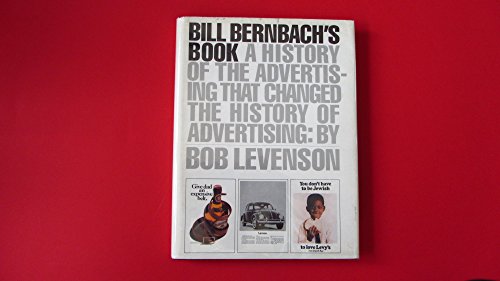
Hardcover. Condition: Used. Moderate sun-yellowing at edges of dust jacket and text, and jacket has light smudging, and small tears at top and bottom of spine.
-

Bill Bernbach said.
Language: English
Published by ohne Angaben von Verlag, Ort und Jahr (1989), 1989
Seller: Rotary Charity Books, Albert Park, VIC, Australia
Seller rating 4 out of 5 stars

First Edition
Condition: As New. No Jacket. 1st Edition. Hardcover. Kl.-8°, Square original linen binding. Approximately 24 unpaginated pages with a black and white photograph, each page with 3-4 quotations. In 1933, Bernbach took a job running the Schenley Distillers mailroom. This was during the Depression, and a family connection got him the job. He pro-actively wrote an ad for Schenley's American Cream Whiskey, which he got into the right hands and the ad ran. He was promoted to the advertising department. He left Schenley in 1939 to ghostwrite for Grover Whalen, the head of the 1939 World's Fair and the following year he entered the advertising industry at the William Weintraub agency. He saw two years' active service in World War II and thereafter had a role at Coty, followed by a position at Grey Advertising. He commenced there as a copywriter but was promoted to creative director by 1947. Soon, Bernbach became frustrated with the sameness he saw in all advertising. In a plea to agency management, he penned a letter expressing that concern. One paragraph in particular revealed Bernbach's desire to change advertising creativity: There are a lot of great technicians in advertising. And unfortunately, they talk the best game. They know all the rules. They can tell you that people in an ad will get you greater readership. They can tell you that a sentence should be this short or that long. They can tell you that body copy should be broken up for easier reading. They can give you fact after fact after fact. They are the scientists of advertising. But there's one little rub. Advertising is fundamentally persuasion and persuasion happens to be not a science, but an art. In 1949, with James Edwin Doyle, whom he had met at Grey, and Maxwell Dane, who was already running a tiny agency, Bernbach founded their eponymous ad agency in Manhattan. His philosophy towards creative advertising was that the creative execution (the way the message is conveyed) is just as important as the message content (what is being said). From its founding Bernbach played an integral role in the writing of advertising, distancing himself from the administrative and promotional aspects of the business which were left to Dane. He served as the creative engine behind the agency helping billings to increase from approximately US$1 million to more than US$40 million by the time he retired. DDB grew to become the 11th largest advertising agency in the United States by 1976, when Bernbach stepped aside as chief executive officer to become chairman of the executive committee. His most notable campaign was for Volkswagen, which included ads such as Think Small and Lemon. Other notable campaigns created by Bernbach's team are: Juan Valdez We Try Harder for Avis Rent a Car System Mikey for Life Cereal You Don't Have to be Jewish to Love Levy's for Levy's Rye Bread It's so simple for Polaroid Bernbach's campaign for Avis Rent-a-Car effectively pioneered "underdog advertising" and was an instant hit with the market. It debuted in 1962, when Avis was losing market share to close rival, Hertz and helped the company's financial position turnaround from a loss to a profit in a single year. The campaign tagline remained unchanged for 50 years and is one of advertising's most enduring campaigns. Legacy Bernbach was noted for his devotion to creativity and offbeat themes, a legacy that has credited him as a major force behind the Creative Revolution of the 1960s and 1970s. His work often was characterized by simplicity. He also is credited with being the first to combine copywriters and art directors into two-person teams, a model that still exists in advertising agencies today. They previously had been in separate departments. The AMC program, Mad Men, which centers on the fictional ad agency of Sterling Cooper in the early 1960s, makes many references to Bernbach; Bernbach's innovative techniques challenge Sterling Cooper's more orthodox style, and DDB often is mentioned as a competitor in the second season.
-
Hardcover. Condition: Good. No Jacket. Dust jacket missing. Shelf and handling wear to cover and binding, with general signs of previous use. Boards betray fading and nicks and other signs of wear and imperfection commensurate with age. Binding is tight and structurally sound. Pages without any extraneous marks. Sealed in plastic for shipping. Secure packaging for safe delivery.


