
Besler Basilus (5 results)
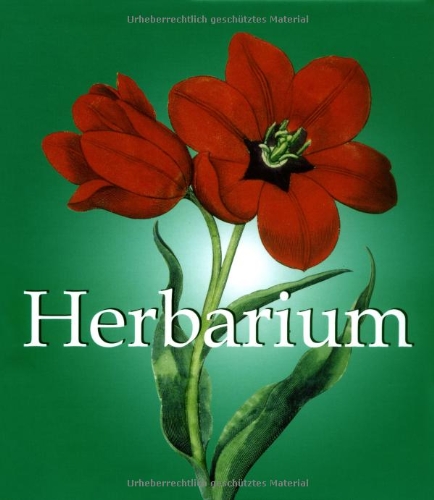
- Hardcover
Seller: Klaus Kuhn Antiquariat Leseflügel, Köln, NRW, GermanyKlaus Kuhn Antiquariat Leseflügel
Contact seller4-star sellerCondition: Used
US$ 25.89
US$ 20.57 shippingShips from Germany to U.S.A.Quantity: 1 available
1. deutsche Auflage.. zahlreiche hochkarätige Pflanzen-Zeichnungen, 255 Seiten, Zustand: excellentes, neuwertiges Exemplar. Sprache: Englisch Gewicht in Gramm: 900 17,0 x 15,0 cm, gebundene Ausgabe, Hardcover/Pappeinband, mit SU.

Seller: FIRENZELIBRI SRL, Reggello, FI, ItalyFIRENZELIBRI SRL
Contact seller5-star sellerCondition: New
US$ 9.42
US$ 20.57 shippingShips from Italy to U.S.A.Quantity: 2 available
Condition: NUOVO. Italiano, English. Presentazione del facsimile.

- Hardcover
Seller: FIRENZELIBRI SRL, Reggello, FI, ItalyFIRENZELIBRI SRL
Contact seller5-star sellerCondition: Used - As new
US$ 2,824.65
US$ 20.57 shippingShips from Italy to U.S.A.Quantity: 2 available
Condition: COME NUOVO. NOTA:L'opera è nuova, imballata, la legatura degli esemplari per loro difetto editoriale tende a rimanereadesa al cartone protettivo e a peerdere lievi minime porzioni di colore. / San Sepolcro, Aboca Tre volumi in folio imperiale. cm.43,5x52, contenenti 367 tavole a colori, di misure e numero di pagine co…nformi all'originale. Copertine con decorazioni in rilievo sui piatti Legatura eseguita artigianalmente a mano, cucitura di tipo antico, colorazione dei tagli, cordonatura, nervatura ed etichettatura sul dorso Ogni volume è custodito in un cofanetto in tela nera con impressioni in oro. Tiratura di 1.450 esemplari. Opera con testo latino. Commentario di pp.286, con 408 illustrazioni, cm.28,5x38. Commentario in Italiano, Tedesco, Inglese. Il facsimile dell'erbario Hortus Eystettensis è la riproduzione fedele dell'esemplare realizzato dal botanico farmacista Basilius Besler nel 1613 e conservato a Eichstätt, in Germania. È un erbario figurato, in tre volumi di straordinaria bellezza, composto di 367 tavole in folio imperiale con 1.084 disegni a colori di piante fiorite di provenienza europea ed esotica. L'Hortus Eystettensis è da considerarsi il più bel florilegio del Seicento: segna il definitivo passaggio dalla tecnica xilografica a quella calcografica e apporta un rilevante contributo alla storia della botanica medicinale. Le piante, per la prima volta al centro dell'attenzione, sono presentate seguendo la fioritura stagionale e ogni giorno dell'anno il lettore ha a disposizione un fiore diverso da ammirare. Le descrizioni delle piante, in lingua latina, mostrano una stupefacente anticipazione del sistema di nomenclatura binomiale. Il Commentarium, parte integrante che accompagna il florilegio, presenta i contributi di studiosi esperti in botanica, farmacologia vegetale e iconografia. Biblioteca Universitaria, Eichstätt, SJ II 2892-2894. Tre volumi in folio imperiale.

Published by Nürnberg 1627
- Signed
- Art Print
Seller: Antiquariat Reinhold Berg eK Inh. R.Berg, Regensburg, , GermanyAntiquariat Reinhold Berg eK Inh. R.Berg
Contact seller5-star sellerCondition: Used
US$ 7,061.63
US$ 27.42 shippingShips from Germany to U.S.A.Quantity: 1 available
Original antique copper engraving. Engraved title by J. Leypold, printed dedication leaf, engraved portrait of Besler and his coat of arms. Dedicated to Joachim Ernest, Duke of Nuremberg, and signed Georg Gärtner, 1612. This very fine fascinating highly decorative flower bouquet was published in Nuremberg 1627 in a small book by… Basilius Besler with the title: Icones sive: Repraesentatio viva, florum et herbarum. This work is of outstanding rarity and only two copies of the book where known so far (see Christies 2001 Sale 6503 Natural History Lot 6). The book is consisting this very fine, rare engraving by Georg Gärtner depicting a vase of flowers for the Markgraf of Ansbach, which is found in a few copies of the Hortus. Hainhofer sent a copy of the engraving to his patron in August 1612, calling it a tour de force of Gärtner's skill (Barker, p.15). The only other copy of the Icones known is at Darmstadt and consists of 93 plates; a third copy, formerly part of Christoph Jacob Trew's collection at Erlangen University Library, has been missing since at least 1961. The book,Icones Icones sive: Repraesentatio.' by Basilius Besler, was issued as a gratitude to those who had assisted him in preparing the "Hortus Eystettensis" but were not acknowledged in the original work in 1613. The,Icones.' included contributions from various individuals, including members of the medical college such as Joachim Camerarius and Ludwig Jungermann. Camerarius had provided advice to Bishop Johann Conrad on the garden before Besler's involvement. Jungermann seems to have had a significant role in the text's preparation, although there appears to have been some dissatisfaction with Besler's handling of the project, as evidenced by a letter from Jungermann to Caspar Hoffmann in 1614. One notable plate included in the,Icones' is the engraving by Georg Gärtner depicting a vase of flowers intended for the Markgraf of Ansbach. This engraving is also found in very few copies of the famous "Hortus Eystettensis". The engraving here in good condition and in a clear, quite strong impression, traces of old folds, some minor small old repairs or tears, but overall only marginal and hardly affecting the actual engraving. Nissen 158; see also the description Robert de Belder (sale Sotheby's, 27 April 1987, lot 26) & Christies 2001 Sale 6503 Natural History Lot 6 In good condition. 49.5 x 33,5 cm (19.5 x 13,25 inches).
Published by Nuremburg 1640
Seller: Antipodean Books, Maps & Prints, ABAA, Garrison, NY, U.S.A.Antipodean Books, Maps & Prints, ABAA
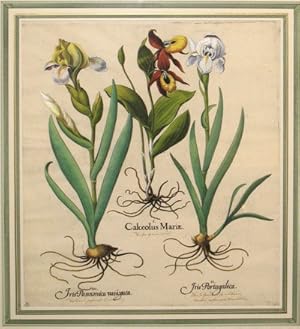
Contact seller4-star sellerSecond & preferred edition. Published in an edition of 300 in 1613, the Hortus Eysttensis is the earliest large folio botanical and is considered one of the greatest botanical books ever created. This is a very strong impression, with an early hand notating the species names in German below the label for each flower. Archivally…framed. The fresh, strong impression & absence of any bleed-through of text from the verso would suggest that this is the second & preferred edition, published in 1640, but it cannot be categorically stated because of the framing.


