Order Total (1 Item Items):
Shipping Destination:

Billing Frederick William (2 results)
Skip to main search results
Search filters
Product Type
- All Product Types
- Books (1)
- Magazines & Periodicals (No further results match this refinement)
- Comics (No further results match this refinement)
- Sheet Music (No further results match this refinement)
- Art, Prints & Posters (No further results match this refinement)
- Photographs (No further results match this refinement)
- Maps (No further results match this refinement)
- Manuscripts & Paper Collectibles (1)
Condition Learn more
- New (No further results match this refinement)
- As New, Fine or Near Fine (1)
- Very Good or Good (No further results match this refinement)
- Fair or Poor (No further results match this refinement)
- As Described (1)
Binding
- All Bindings
- Hardcover (No further results match this refinement)
- Softcover (No further results match this refinement)
Collectible Attributes
- First Edition (No further results match this refinement)
- Signed (2)
- Dust Jacket (No further results match this refinement)
- Seller-Supplied Images (1)
- Not Print on Demand (2)
Language (1)
Price
- Any Price
- Under US$ 25 (No further results match this refinement)
- US$ 25 to US$ 50 (No further results match this refinement)
- Over US$ 50
Free Shipping
Seller Location
Seller Rating
-

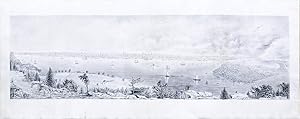
Panorama View of New York City
Published by Drawing, New York, 1856
Seller: Arader Galleries - AraderNYC, New York, NY, U.S.A.
Seller rating 5 out of 5 stars

Signed
Graphite drawing, 19 ¼" x 48 ½" sheet.Biographical data on Frederick Billing is scarce. Born in the German town of Eschwege in October 1835 he developed an interest in painting at a very early age. He attended the local school, but never received a formal education that would have prepared him for a career as a businessman - much wished for by his father. In 1856 he emigrated to the United States. Billing settled in Brooklyn and married an emigree from Dusseldorf, Wilhelmine Sickett with whom he had two daughters. While his creative output adopted the Romantic aesthetics of the Hudson River School, a new stimulus came from his friendship with Thomas Moran who considered Billing the most talented amateur painter he knew. The latter found new ways of expressing the grandeur of nature as the sublime in his canvases and at least one of his paintings, "Empty Cradle", is derived from Moran's etchings. Frederick Billing died in Santa Cruz in 1914. The present drawing must have been executed shortly after Billing's arrival in Brooklyn. It is signed and dated "1856" in the lower right corner - a date which is corroborated by the glass dome of the New York Crystal Palace visible between 41st and 42nd Street. It is safe to assume that it ranks among the first to have been made by Billing after his emigration to the United States. The composition is a charming blend of observation on the one hand and pictorial conventions on the other. Of particular interest is the depiction of Jersey City in the far right corner; views of the settlement from a northwest perspective are very uncommon and despite the great distance numerous buildings remain immediately recognizable when compared to prints by artists like John Bornet. #10162F. Signed by Author(s).
-
Panoramic View of New York City from New Jersey
Publication Date: 1856
Manuscript / Paper Collectible Signed
No binding. Condition: Fine. Graphite drawing on wove paper, signed and dated lower right "F. W. Billing, 1856." Large panorama view (19 ¼ x 48 ½ inches sheet; 25 ½ x 55 inches framed) of Manhattan from across the Hudson River, showing figures standing about the cliffs of the Palisade and Hoboken farmland. Jersey City is seen in the middle ground (right). Landmarks include Trinity Church and the New York Crystal Palace (destroyed in 1858; the Latting Observatory burnt down on August 30, 1856 and is not shown here). Born in Germany in 1835, Billing developed an interest in painting from a very early age, but never received formal training. In 1856, he emigrated to the United States and settled with his wife Wilhelmine Sickett (from Düsseldorf) in Brooklyn. The Civil War Records list Billing as a First Lieutenant and Quartermaster fighting in the 54th Infantry Regiment on the side of the Union. After the War, he opened a brokerage business on Wall Street. "By the mid-1860s Billing turned to landscapes encouraged by a German-American painter named Johann H. Carmienke, with whom he studied. During the 1870s most of his paintings were European landscapes he recalled from earlier travels. He also continued painting scenes in the New York region. He exhibited once at the Brooklyn Academy of Painting" (STEVENS). Billing died in Santa Cruz in 1914. Thomas Moran praised him as the most talented amateur painter he knew.