Order Total (1 Item Items):
Shipping Destination:

Blasius Gerard (6 results)
Skip to main search results
Search filters
Product Type
- All Product Types
- Books (6)
- Magazines & Periodicals (No further results match this refinement)
- Comics (No further results match this refinement)
- Sheet Music (No further results match this refinement)
- Art, Prints & Posters (No further results match this refinement)
- Photographs (No further results match this refinement)
- Maps (No further results match this refinement)
- Manuscripts & Paper Collectibles (No further results match this refinement)
Condition Learn more
- New (No further results match this refinement)
- As New, Fine or Near Fine (1)
- Very Good or Good (3)
- Fair or Poor (No further results match this refinement)
- As Described (2)
Binding
- All Bindings
- Hardcover (4)
- Softcover (No further results match this refinement)
Collectible Attributes
- First Edition (4)
- Signed (No further results match this refinement)
- Dust Jacket (No further results match this refinement)
- Seller-Supplied Images (5)
- Not Print on Demand (6)
Language (2)
Price
- Any Price
- Under US$ 25 (No further results match this refinement)
- US$ 25 to US$ 50 (No further results match this refinement)
- Over US$ 50
Free Shipping
- Free Shipping to U.S.A. (No further results match this refinement)
Seller Location
Seller Rating
-

Anatome Animalium, terrestrium variorum, volatilium, aquatilium, serpentum, insectorum, ovorumque, structuram naturalem ex veterum, recentiorum, propriisque observationibus proponens, figuris variis illustrata.
Published by widow of Johannes van Someren, Hendrik and widow of Dirk Boom, Amsterdam, 1681
Seller: Sanctuary Books, A.B.A.A., New York, NY, U.S.A.
Seller rating 5 out of 5 stars

First Edition
Hardcover. Condition: Very Good+. First Edition. 4to. With full-page engraved frontispiece by J. Luyken, and 60 numbered and 5 unnumbered full-page engravings. Contemporary calf, rebacked. Garrison & Morton 296; Krivatsy 1339; Nissen, ZBI 381; Wellcome II, p. 179; Wood, p. 243. "The first general systematic treatise on comparative anatomy" (Garrison & Morton) and a "well known and important early treatise" (Wood).
-
Anatome Animalium, Terrestrium Variorum, Volatilium, Aquatilium, Serpentum, Insectorum, Ovorumque, Structuram Naturalem. [The Anatomy of Animals, Land, Sea, Air, Serpents, Insects. The Structure of Natural Things From Vertebrae]
Published by Joanis á Someren / Hernrici & Viduæ Theodori Boom, Amstelodami [Amsterdam], 1681
Seller: Barter Books Ltd, Alnwick, NORTH, United Kingdom
Association Member: IOBA
Seller rating 5 out of 5 stars
First Edition
US$ 1,588.66
US$ 10.68 shipping
Ships from United Kingdom to U.S.A.Quantity: 1 available
Add to basketCondition: Good. First Edition. G: in good condition without dust jacket. Heavy rubbing to boards. Shelf-wear. Vellum spine age-darkened. Edge-tear to fep; some loss. Fore and lower page edges untrimmed. Inner hinge cracking. Closed tear to upper edge of frontis engraving (c. 1"). Ink inscription, dated 1751, to ffep. Sporadic marking. Staining to top edge. 290mm x 230mm (11" x 9"). [6pp], 496pp. Engraved frontis plate + 65 engraved anatomical plates. Gerard Blasius (1627-1682) - Dutch physician and anatomist. He was the eldest son of Leonard Blasius, who had worked as an architect in Copenhagen. Gerard started his studies there then moved to Leiden with his family, after his father died. Around 1655 he became a physician in Amsterdam. In October 1659 Blasius was appointed at the Athenaeum Illustre but without being paid. In the next year he became the first Amsterdam professor in medicine. This, his last work is considered the first comprehensive treatise on comparative anatomy. Text in Latin. Heavy item - shipping supplement may apply for overseas. Marbled hardback board cover with vellum spine.
-
Anatome animalium, terrestrium variorum, volatilium, aquatilium, serpentum, infectorum, ovorumque, structuram naturalem
Language: Latin
Published by Johannes van Someren, Amsterdam, 1681
Seller: Milestones of Science Books, Ritterhude, Germany
Seller rating 5 out of 5 stars
First Edition
Hardcover. Condition: Very Good. 1st Edition. 4to (260x210 mm), [8] 1-494 [2] pp., engraved title by Jan Luyken, 5 engraved plates and 60 engraved full-page text illustrations, library stamps, contemporary ink notes to front endpapers, waterstaining to upper edge, title page ruled in red, browning and soiling, p.135 with tear to lower margin. Contemporary calf (worn, spine rebacked). ---- Cole, Comparative Anatomy, pp. 150-55; Garrison-Morton 296 ("Blaes anticipated Cowper in finding the Cowper's glands, which he illustrated in his plate of the genitalia and os penis of the rat"); Nissen ZBI 381; NLM/Krivatsy 1339; Norman 241; Wellcome II, p. 179, Heirs of Hippocrates 361. - First edition of the first comparative manual of comparative anatomy based on the original studies of a working anatomist (cf. Haskell F. Norman, 1998, lot 297).
-

Syntagma Anatomicum, Commentario atque Appendice. FRONTISPIECE TITLE PAGE.
Published by Johanne, Jansonium,, Amsterdam:, 1666
Seller: Dark Parks Books & Collectibles, Fallon, NV, U.S.A.
Seller rating 5 out of 5 stars
Engraved frontispiece only. Slightly trimmed outside borders, no affect. Beautiful engraving, clean and bold. Mounted at corners to larger plain white leaf. Suitable for framing, or perhaps mating with another copy. Illustrates Vesling seated below a swag of surgical instruments, indicating illustrations of the heart in a book being displayed by a skeletal corpse. Vesling?s Syntagma Anatomicum was a very popular anatomical textbook and was generally used in all universities of Europe for over fifty years. Citations: Wellcome 25042i. Choulant p.243.
-
Zootomiae seu anatomes variorum animalium pars prima
Publication Date: 1676
Seller: Librairie Alain Brieux, Paris, France
Association Member: ILAB
Seller rating 5 out of 5 stars
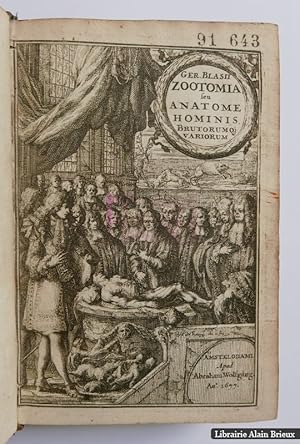
Couverture rigide. Condition: Bon. titre-front., 87 (i.e. 77) Abrahmum Wolgang,Amsterdam, 1676 (1677), in-8, titre-front, 87 (i.e. 77) pp. ; et [1]-292-[4] pp, 51 (sur 53) pl, basane havane de l'époque, dos à nerfs et fleuronné, L'illustration comprend 18 belles planches d'anatomie comprises dans la pagination pour la première partie et 51 planches hors texte pour la seconde : un grand nombre de ces dernières ont été découpées à la cuvette. Gerard Blaes (? 1692) est l'auteur de trois ouvrages sur l'anatomie comparée, celui-ci étant le premier, publié à l'origine en 1673 (Miscellanea anatomica. Amsterdam, Kaspar Commelijn). Ses recherches aboutiront à l'important Anatome animalium de 1681, qui est considéré comme le premier manuel complet d'anatomie comparée basé sur les recherches originales et littéraires d'un anatomiste alors en activité. La présente édition est la seconde, augmentée et ornée d'un titre-frontispice à la date de 1677. Les pages qui concernent l'anatomie comparée sont des réimpressions de l'édition originale. En tout, l'auteur décrit ici l'anatomie de 14 espèces d'animaux (tortue, canard, pigeon, boeuf, mouton, cochon, chien, chat, civette, renard, rat, lapin, lièvre et singe) ; les pages qui concernent l'anatomie du chien constituent le premier traité complet et original sur un vertébré depuis le célèbre ouvrage de Carlo Ruini sur le cheval (1598). Cachets anciens de l'Institut catholique de Paris. Reliure usagée. Il manque 2 planches (se plaçant aux pages 190 et 192). Aussi, nous signalons une erreur dans la pagination sur les 10 premières pages de la première partie, celle-ci est bien complète. Cole, p. 150 et suiv. Nissen ZBI, n° 385.
-
Anatome animalium, terrestrium variorum, volatilium, aquatilium, serpentum, insectorum, overumque, structuram naturalem ex veterum, recentiorum, propriisque observationibus proponens, figuris variis illustrata.
Publication Date: 1681
Seller: Antiq. F.-D. Söhn - Medicusbooks.Com, Marburg, Germany
Seller rating 5 out of 5 stars
First Edition
Amsterdan: A. van Someren and Hendrik and widow Th. Boom, 1681, 4°, (8), 496 pp., w. engr. frontisp. by J. Luyken, num. ills. on 5 engr. plates and 60 full-page engravings, cont. vellum; fine. First Edition! The highly emblematic frontispiece which is the work of the Dutch illustrator and engraver Jan Luyken (1649-1712), preceding the regular title page, contains figures that are of unusual allegorical interest; it shows a personification of science unveiling a personification of nature whose appearance is inspired by the classical goddesses Artemis and Isis. 119 species of animals are selected for treatment, and as many as 78 of them are depicted! "The first comprehensive manual of comparative anatomy based on the original and literary researches of a working anatomist. The book, which is illustrated with over 800 engraved figures on 65 plates, is largely a compendium of previous writers on the subject, but does include Blaes's own investigations. He is particularly interested in embryology and deals with the foetal membranes and development of ruminants, rabbit, cat, horse, and the chick. The illustrated monograph on the chick is a very careful and thorough piece of of compilation, and may be recommended as a competent exposition of contemporary embryology. Blaes was the first to link the production of voice in birds with the lower larynx, and he anticipated Cowper in finding Cowper's glands, which he illustrated in his plate of the genitalia and os penis of the rat. The 85 pages devoted to the anatomy of the dog was the first comprehensive and original treatise on a vertebrate since Ruini's monoghraph of the horse (Bologna 1598). It was Blaes who attacked Steno in the dispute as to which of them had been responsible for the discovery of the duct of the parotid gland." Hagströmer Libr. Blasius first published much of the material in this work, including the treatise on the anatomy of the dog, in his ?'Miscellanea anatomica, hominis, brutorumque variorum, fabricam diversam magna parte exhibentia?' (Amsterdam: Caspar Commelin, 1673.). In that work the 'Anatome canis' appeared on pp. 168-252. Other material previously appeared in Blasius's Observata anatomica in homine, simia, equo, virtulo, ovo.(Leiden, 1674). Garrison-Morton No. 296; Heirs of Hippocrates, 361: Krivatsy, 1339: Norman Coll. 241; Cushing B434; Wellcome II, p. 179; Francis J. Cole, History of comparative anatomy. London, 1944. pp. 150-151.


![Seller image for Anatome Animalium, Terrestrium Variorum, Volatilium, Aquatilium, Serpentum, Insectorum, Ovorumque, Structuram Naturalem. [The Anatomy of Animals, Land, Sea, Air, Serpents, Insects. The Structure of Natural Things From Vertebrae] for sale by Barter Books Ltd](https://pictures.abebooks.com/inventory/md/md17747544417.jpg)