Order Total (1 Item Items):
Shipping Destination:

Book Hours Leaf (22 results)
Skip to main search results
Search filters
Product Type
- All Product Types
- Books (22)
- Magazines & Periodicals (No further results match this refinement)
- Comics (No further results match this refinement)
- Sheet Music (No further results match this refinement)
- Art, Prints & Posters (No further results match this refinement)
- Photographs (No further results match this refinement)
- Maps (No further results match this refinement)
- Manuscripts & Paper Collectibles (No further results match this refinement)
Condition Learn more
- New (No further results match this refinement)
- As New, Fine or Near Fine (No further results match this refinement)
- Very Good or Good (No further results match this refinement)
- Fair or Poor (No further results match this refinement)
- As Described (22)
Binding
- All Bindings
- Hardcover (No further results match this refinement)
- Softcover (No further results match this refinement)
Collectible Attributes
- First Edition (No further results match this refinement)
- Signed (1)
- Dust Jacket (No further results match this refinement)
- Seller-Supplied Images (22)
- Not Print on Demand (22)
Language (1)
Price
- Any Price
- Under US$ 25 (No further results match this refinement)
- US$ 25 to US$ 50 (No further results match this refinement)
- Over US$ 50
Free Shipping
- Free Shipping to U.S.A. (No further results match this refinement)
Seller Location
Seller Rating
-
TEXT FROM THE HOURS OF THE CROSS
Published by late 15th century, France
Seller: Phillip J. Pirages Rare Books (ABAA), McMinnville, OR, U.S.A.
Seller rating 3 out of 5 stars

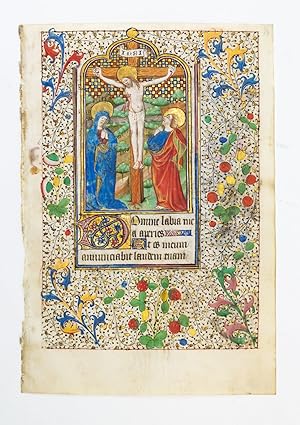
180 x 130 mm. (7 x 5 1/8"). Single column, verso with 20 lines in an attractive bâtarde hand. Rubrics in dark pink, four one-line initials in painted gold on blue or dark pink ground, two two-line initials, on in blue on dark pink ground and one in black on blue ground, both with painted gold embellishments, one three-line initial resembling unfurling scrolls, painted in gold on a blue ground with gold pointillation and filled with a large flower, A LARGE MINIATURE OF THE CRUCIFIXION in a plain red frame surrounded by a three-quarter border filled with blue flowers with long protruding pistils, with numerous hairline vines and gilt bezants, and triangular sections painted gold and filled with strawberries and white flowers. Faint foxing and soiling to margins, light chipping to red frame and one initial, minor fading to painted gold in border, negligible imperfections to miniature (one of Christ's arms slightly rubbed, a couple tiny scuffs), but with strong colors and well-preserved details. Opening the Hours of the Cross (a shorter text sometimes accompanying the Hours of the Virgin), this miniature of the Crucifixion is attractively painted and features a touching depiction of Christ's final moments at the same time that it provides exuberance in an elaborately botanic border. Besides the crucified Christ, there are only two other figures in this intimate and lonely--perhaps even bleak--miniature: the Virgin Mary stands at the left of the composition in a blue dress and long pink veil, while St. John stands at the right, dressed in pink and purple and holding a green book. Blood flows freely from Christ's wounds, including small rivulets from his hands that fall on the heads of the Virgin and St. John, as if to anoint them. Although St. John's attention is focused on Christ, the Virgin fixes her gaze not on her son, but at St. John. Perhaps she is taking in Christ's words as recorded in John 19:26-27: "When Jesus therefore had seen his mother and the disciple standing whom he loved, he saith to his mother: Woman, behold thy son. After that, he saith to the disciple: Behold thy mother." This miniature was probably executed in a provincial atelier, but the work is very competent, and it contains some quietly excellent details: the body of Christ looks natural and well-proportioned, the features of the Virgin and St. John are quite strong, and St. John's hand, raised in the sign of benediction, shows a high level of detail. Despite the somber content of the scene, the artist chose a surprisingly cheerful palette that favors pastel pink, lilac, and light blue. This type of Crucifixion image is quite common iconographically, but the coloring and spirited border give the content freshness that modulates the deep sorrow of the scene, lending it a sense of hope.
-
TEXT FROM THE HOURS OF THE HOLY SPIRIT
Published by ca. 1490, France, 1490
Seller: Phillip J. Pirages Rare Books (ABAA), McMinnville, OR, U.S.A.
Seller rating 3 out of 5 stars
144 x 99 mm. (5 5/8 x 3 3/4"). Single column, recto with 14 lines in a gothic book hand. Attractively matted and framed. Rubrics in red, two two-line initials, one painted pink on blue ground with flowers, the other painted blue and inhabited by a rampant lion on pink and gold ground, recto with a panel border featuring long-stemmed flowers and owls on a pink ground, verso WITH A HALF-PAGE ARCH-TOPPED MINIATURE DEPICTING PENTECOST, WITH A FULL BORDER featuring a plethora of different flowers, berries, greenery, songbirds, an owl, and a butterfly, all ON A RICHLY PAINTED GOLD GROUND. Trimmed close on one side (and just grazing a border on the opposite side), very minor chipping to faces, trivial signs of rubbing or wear, otherwise a fine leaf--colorful, bright, and very pleasing to the eye. This leaf contains the customary Pentecost miniature associated with the Hours of the Holy Spirit, but with several attributes that set it apart from other examples we have encountered. The miniature here depicts a densely crowded scene with the Virgin at the center surrounded by the apostles, each of whom wears a burnished gold halo. Packed tightly together, they gaze up at a white dove who emanates small red tongues of fire above their heads. According to biblical tradition, this visitation by the Holy Ghost in the form of a dove enabled Christ's disciples to start preaching, marking the beginning of the Christian Church. The artist favors an unusual pastel palette, choosing pale pink for the walls and eggshell blue for some of the floor tiles, as well as bright yellow, muted lilac, rose, and lime green for the robes of the apostles. Looking more closely at the figures, we see that each face is carefully individualized, each with its own features and expressions. Although most crane their necks to get a view of the miracle unfolding, one of the apostles looks directly out at the viewer, as if surprised by our presence. Moving outside the miniature, we note that the leaf features a particularly exuberant border with tangles of flowers, fruit, acanthus leaves, and several birds, including an owl in one corner. There is additional interest on the verso, with another bright border painted an intense pink and filled with more flowers and owls.
-
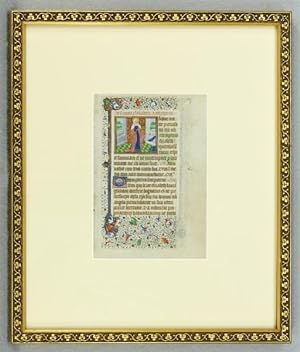
BOOK OF HOURS LEAF [France (Paris), c.1415]
Published by N, N, 1415
Seller: Kay Craddock - Antiquarian Bookseller, Melbourne, VIC, Australia
Association Member: ANZAAB ILAB
Seller rating 5 out of 5 stars

Signed
Illuminated manuscript leaf from a large medieval Book of Hours, 24 cm. x 17 cm, 16 lines of gothic Latin script, written in brown ink with occasional rubrication on vellum, each side featuring two illuminated two-line initials in pink or blue on a burnished gold ground (all with a floral interior in colours including blue, mauve and orange) and two small red, blue & gold fillers, the text surrounded by an attractive rinceaux border with an intricate floral motif containing strawberries (symbol of perfect righteousness), flowers and leaves in blue, mauve, red, green, and burnished gold; presented within a double-sided navy & gilt card mount. *On the upper side the illuminated initial 'P' begins 'Per te dei genitur . . . ' ['Through thee, O Mother of God . . .']. Lower down, the illuminated 'M' begins: 'Mentibus nostris . . .' ['Into our minds, we beseech, Lord, the Holy Spirit benignly pour . . .']. *From the collection of Leona E. Prasse (1897-1984), Curator of Prints and Drawings at the Cleveland Museum of Art from 1925 to 1967. Previously from the collection of Otto F. Ege (1888-1951), lecturer and bookseller (and notorious book breaker!). Signed.
-
TEXT FROM THE HOURS OF THE HOLY SPIRIT
Published by ca. 1470-80, Netherlands, 1470
Seller: Phillip J. Pirages Rare Books (ABAA), McMinnville, OR, U.S.A.
Seller rating 3 out of 5 stars
164 x 123 mm. (6 1/2 x 4 7/8"). Single column, 17 lines, in a gothic hand. Capitals touched with red, rubrics in red, one-line initials in red or blue, one two-line initial in blue, A VERY LARGE HISTORIATED INITIAL (approximately 60 mm. square) DEPICTING PENTECOST, the initial painted blue with white tracery on a burnished gold ground, surrounded by A FULL BORDER decorated with colorful acanthus, large flowers, strawberries, insects (including a grasshopper, fly, moth, and mosquito(?)), all on a liquid gold ground. See: Marrow, et al., "The Golden Age of Dutch Manuscript Illumination," nos. 79-81. âMargins just faintly soiled, gold very slightly rubbed, but IN FINE CONDITION, the initial and border beautifully preserved. This is an extraordinarily handsome leaf, featuring an oversized historiated initial depicting Pentecost, attributed to the circle of the Master of the London Jason. Our artist has made remarkable use of space, fitting 13 clearly defined people within an initial opening measuring 45 x 32 mm. The Virgin sits enthroned directly in the center, encircled by the Apostles dressed in blue, violet, green, and orange robes. Our artist cleverly adds a notch at the top of initial--like a cupola inside a chapel--in order to fit an image of a dove inside the scene. The figures show an impressive degree of individualization and emotional response as they witness the descent of the Holy Spirit; a few gesture in surprise, two lower their gaze, and some look up in awe. The work is stylistically like that of the Master of the London Jason, named for his work on the "Historie van Jason" manuscript now housed at the British Library. As Marrow et al. note, the Master's style is characterized by "somewhat short, heavy figures [that] are well formed and have unusual, slightly broad yet expressive faces with deep sunken eyes." Our leaf's enclosing border is of very considerable interest, featuring as it does naturalistic flowers, strawberry plants, insects, and a small, brightly colored bird, all painted in colors that perfectly complement the main scene. A very fine production all around, this distinctive, energetic leaf would make a notable addition to any collection.
-
TEXT FROM "O INTEMERATA."
Published by ca. 1475, Northern France, 1475
Seller: Phillip J. Pirages Rare Books (ABAA), McMinnville, OR, U.S.A.
Seller rating 3 out of 5 stars
155 x 110 mm. (6 x 4 1/4"). Single column, 16 lines in a gothic book hand. Rubrics in dark pink, ONE EXQUISITE FOUR-LINE INITIAL painted blue with white detailing, filled with red and blue vines and leaves, on a burnished gold ground, with a painted and gilt bar border on one side, each end capped with a flower, the text surrounded on three sides with a border of acanthus leaves, dense rinceaux, colorful flowers, gold ivy leaves, and bezants. A couple negligible imperfections, but IN VERY FINE CONDITION, One of the most popular optional prayers in the 15th century Book of Hours, "O Intemerata" ("Oh, immaculate virgin") is a brief supplication in which the Virgin is glorified for her purity as the "unspotted and forever blessed, singular and incomparable Virgin Mary, Mother of God." The present leaf is given special emphasis with the presence of a three-quarter rinceaux border surrounding the text, and the opening of the prayer is marked by an especially pretty and finely detailed initial that glitters with burnished gold. The leaf is unusually beautiful, precisely rendered, and in very fine condition.
-
TEXT FROM COMPLINE, FROM THE HOURS OF THE PASSION
Published by third quarter of 15th century, Southern Netherlands (Bruges?)
Seller: Phillip J. Pirages Rare Books (ABAA), McMinnville, OR, U.S.A.
Seller rating 3 out of 5 stars
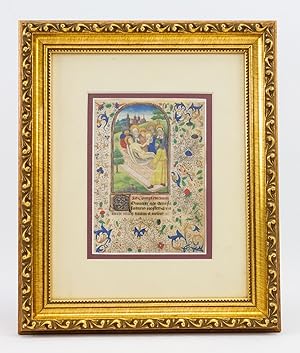
Matted leaf: 150 x 150 mm. (5 7/8 x 4 3/8"). Frame: 307 x 258 mm. (12 x 10 1/4"). Single column, with four lines below the miniature (and the obverse with 17 lines) in a batarde hand. Attractively matted and framed (the leaf slightly shifted in the mat, revealing top and side edges, but in no danger of damage). Rubrics in red, four one-line initials and three three-line initials all but one in burnished gold on blue and red ground with white tracery, the initial beneath the miniature painted pink on a burnished gold ground and filled with painted ivy vines, AN ARCH-TOPPED LARGE MINIATURE DEPICTING THE ENTOMBMENT, the body of Christ surrounded by seven other people, depicted in an outdoor setting with the turrets of a walled city in the background, the miniature in a double frame of gold and pink, surrounded by A FULL BORDER composed of hairline vines, acanthus, colorful flowers, and gilt bezants, and inhabited by a small bird. Minor soiling and a faint thumb print to borders, but IN VERY FINE CONDITION, THE MINIATURE BEAUTIFULLY PRESERVED. This is a beautifully rendered and deeply touching scene depicting the entombment of the crucified Christ and the pathos experienced by those at his side. Holding the sheet on which the body is lowered into the sarcophagus are (on the far left) the richly clothed Joseph of Arimathea and (on the far right) Nicodemus, who dons an especially lovely yellow garment with delicate embroidery. Between the two men in the foreground but behind the body are the Virgin Mary, who presses the hand of her deceased son to her lips; John the Evangelist, whose body is turned toward the Virgin in a gesture of support, but whose gaze is focused on the Savior; and Mary Magdalene, who holds a small ointment jar. Two other women with halos stand closely behind them, consoling one another. The artist has done a masterful job at creating a composition that captures the emotional gravity of the scene: Christ's body, gently cradled in a white sheet, is on full display, with blood still trickling from the wounds on his head and side. Despite there being seven people crowded around him, our attention is drawn to the action between Christ and the Virgin, who gently grasps his hand with motherly affection, and bids him a final farewell. Flickers of different emotions appear on the faces of his followers, including pity, sorrow, stoicism, and disbelief--echoing, perhaps, the viewer's own range of feelings upon viewing this image. The level of detail, excellence of composition, care seen in the molded bodies and faces, and the convincing setting suggest that the artist was quite practiced, and that the original manuscript from which the leaf comes was of very high quality.
-
TEXT PRESUMABLY FROM THE HOURS OF THE CROSS
Published by ca. 1440, Metz, 1440
Seller: Phillip J. Pirages Rare Books (ABAA), McMinnville, OR, U.S.A.
Seller rating 3 out of 5 stars
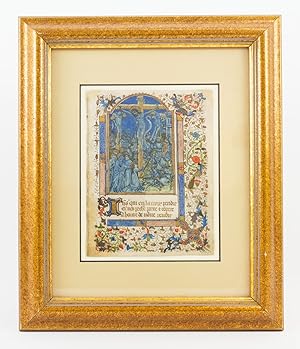
Leaf: 162 x 124 mm. (6 3/8 x 4 7/8"). Frame: 308 x 258 mm. (12 1/8 x 10 1/8"). Single column, three lines of text under the miniature (obverse with 18 ruled lines, five of which contain text), in a gothic book hand. Attractively matted and framed. Recto with one three-line initial in gold on pink and blue ground, WITH A LARGE MINIATURE OF THE CRUCIFIXION WASHED IN BLUE, Christ on a painted gold cross, flanked by two thieves on painted gold crosses, surrounded by throngs of people including the Virgin, St. John, Mary Magdalene, and numerous soldiers, all in an arched gold frame inside a three-sided painted and gilt baguette and a FULL BORDER of colorful vine sprays and flowers inhabited by a peacock. See: "The Jeanne Miles Blacburn Collection of Manuscript Illuminations" nos. 29-38; Avril & Reynaud, pp. 182 & 190. Minor soiling/browning right at inner edge (away from border and image), otherwise IN VERY FINE CONDITION, THE MINIATURE REMARKABLY WELL PRESERVED, WITHOUT ANY LOSS OF PAINT. This stunning miniature with its memorable nocturnal scene comes from a very fine Book of Hours probably executed by Henri d'Orquevaulz (or d'Orquevaulx) or a member of his workshop. D'Oquevaulz was active during the second quarter of the 15th century in Metz, the cultural and commercial capital of Lorraine during the period, and the center of a growing book trade. According to the catalogue of the Jeanne Miles Blackburn Collection in the Cleveland Museum of Art, which owns 10 leaves from the original manuscript, the parent Book of Hours can be localized based on the Lorraine dialect found in the French text on some of the leaves (including the present example), and because the calendar singled out two bishop-saints of Metz (Clement and Arnoul). Although little is known about d'Orquevaulz, his dated signature in the colophon of a Livy manuscript that he illuminated for an alderman of Metz indicates that he was active in that city in 1440. Artistic affinities with northern European styles make it possible that d'Orquevaulz had emigrated from the Netherlands or Germany to Lorraine; another possibility, one that Avril and Renaud suggest, is that the master himself was from Metz, but that he had German associates, perhaps from the Rhineland area. According to these two scholars, the painter's use of large flat areas of colors is more typical of the Rhineland, the Netherlands, or Bohemia than of France; in any case, they praise his "exquisite color harmonies." The artist has outdone himself in the present miniature, rising to the height of pathos and making it one of the most extraordinary leaves we have ever offered for sale. In contrast to the bright colors used in Books of Hours even to depict the most serious scenes, the present leaf presents a remarkable visual nocturne, with the figures and buildings painted in the same shades of blue as the sky, suggesting that heaven itself is darkening at the death of Christ. Mary Magdalen kneels at the foot of the cross, while St. John supports the devastated Virgin as a soldier pierces the Savior's side with a lance. The miniature is crowded with figures (we see well-defined faces of no fewer than 18 persons and two horses), but the artist has not lost his dramatic focus, as Christ on his cross of brushed gold dominates the scene. In choosing to make this a darkened composition, the artist has risked obscuring detail, but his skill has been equal to his concept here, as he has used a diluted blue paint that allows for a very successful delineation in various shades, almost like grisaille (this technique, not incidentally, has prevented the cracking and erosion so commonly seen with the normal thick applications of typical cobalt blue). The result of the decision to show the world in eclipse at Christ's death is to heighten and universalize the drama here to such an extent that the scene leaves a powerful and lasting impression. The text on this leaf is entirely in French in rhyming verse. Roughly it transla.
-
TEXT FROM THE MONTH OF AUGUST
Published by second half of 15th century, France (probably Rouen)
Seller: Phillip J. Pirages Rare Books (ABAA), McMinnville, OR, U.S.A.
Seller rating 3 out of 5 stars
162 x 117 mm. (6 3/8 x 4 5/8"). Single column, 17 ruled lines, text in a bâtarde hand. Text in gold, blue, and red, "KL" in scrolling white letters on a gold ground with small blue and red blossoms, both sides with panel border of acanthus, flowers, small ink dots, and gold bezants, WITH TWO SMALL MINIATURES showing the labor of the month (Threshing) on recto, and the zodiac sign (Virgo) on verso. âSmall wrinkle in lower margin just touching the lower edge of the miniatures, trivial smudging, but IN VERY FINE CONDITION, the vellum especially clean and bright, the paint quite rich, and the miniatures extremely well preserved. With clean, white vellum, small but appealing miniatures, and attractive lettering and decoration, this is a desirable example of a calendar leaf from a high-quality Book of Hours likely made in Rouen. According to Roger Wieck, far fewer than half the Books of Hours of the period contain illustrated calendars, "even in manuscripts with otherwise lavish cycles of miniatures"; when they do appear, they are invariably charming, as is the case here. In the lower margin of the recto is a small miniature depicting the typical labor for August, "Threshing," in which a young layman brings down his grain flail (two hinged pieces of wood, the longer one called a helve, and the other a beater, joined by a thong) in an effort to separate the grain, while neatly stacked unprocessed clumps of straw appear just behind it. On the verso we see a representation of Virgo as a young woman holding, appropriately, a long sheaf of grain in her hand. While most of the feast days that appear in the calendar are typical for the period, the inclusion of St. Sauveur (i.e. Transfiguratio Domini) on 6 August is characteristic of a calendar for the use of Rouen, suggesting that the parent manuscript may have been produced in that place or the region around it.
-
WITHOUT TEXT, BUT PROBABLY OPENING PRIME
Published by ca. 1470, Delft, 1470
Seller: Phillip J. Pirages Rare Books (ABAA), McMinnville, OR, U.S.A.
Seller rating 3 out of 5 stars
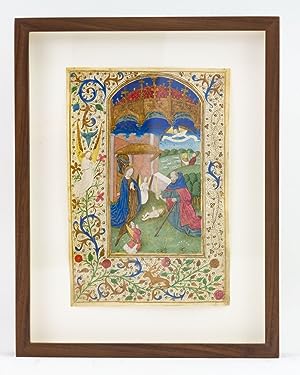
Leaf: 172 x 115 mm. (6 3/4 x 4 1/2"). Frame: 242 x 190 mm. (9 1/2 x 7 1/2"). In an attractive wooden frame. A FINELY PAINTED MINIATURE OF THE NATIVITY within an arch-topped compartment, the parents of the Christ Child kneeling before him as he lies on the ground outside the stable, Joseph (uncharacteristically) supporting himself with a cane in his left hand and holding a long burning candle in his right, two diminutive angels in attendance, the head of an ass sticking out of the stable window in the background to the left, AND, IN THE RIGHT BACKGROUND, A CHARMING DEPICTION OF THE ANNUNCIATION TO THE SHEPHERDS, ALL OF THIS BENEATH A VERY DETAILED ARCHITECTURAL CANOPY suspended in the sky, AND THE WHOLE WITHIN A FULL BORDER of acanthus leaves and other foliage and flowers in reds, blues, greens, yellows, and brushed gold, along with very many small burnished gold ivy leaves and buds on hairline stems, a small stag in the bottom border and a large delicately shaded angel, who mirrors the Virgin's pose, in the left border (verso blank). âA hint of soiling to edges of vellum, but IN VERY FINE CONDITION, without any paint erosion, with the colors rich and true, and with the burnished gold still shimmering. Notable for its attractive color scheme, fine craftsmanship, and unusual composition, this vibrant leaf was produced by a talented artist belonging to the stylistic group known as the Masters of the Delft Half-Length Figures. The lack of text and blank back of this leaf clearly suggest that it was produced as a singleton intended for insertion in a Book of Hours, and its subject matter indicates that it would have faced the opening for the third hour of the day, Prime. The present depiction of the Nativity is out of the ordinary in that it is combined with another scene, the Annunciation to the Shepherds, a subject that usually begins Terce in the Hours of the Virgin. It is a testament to the artist's ingenuity and compositional skills that he has managed to incorporate these two scenes so seamlessly; in fact, rather than pulling focus from the main subject celebrating the birth of Christ, this secondary scene adds additional interest to the picture and amplifies the storyline. Though the Annunciation to the Shepherds takes place at a distance from the Nativity, we immediately grasp their connection and can see how arrival of humanity's savior was felt far beyond the manger. It is also interesting to note how much the artist has emphasized the figure of Joseph. Not only does he take up as much space as the Virgin, but the candle and cane he holds frame the Christ child and communicate a strong suggestion of a protective parent (the Virgin is doing her part by praying hard, but she is more passive). In addition to its engaging subject matter, there is a high level of artistic achievement here, including delicately molded figures, impressively detailed architectural elements, and a lovely color palette. The elegant hand seen in this miniature manifests a quiet sophistication that distinguishes this artist as a particularly talented member of his circle. Active from about 1450-80, the Masters of the Delft Half-Length Figures were named by James Marrow after the angels and other figures whose upper bodies are typically found emerging from a cloud within the borders. Although the present leaf uncharacteristically contains a full-length angel in the border, it shares other stylistic similarities, such as the elaborate architectural canopy hovering over the main composition; and it particularly resembles the work of the artist of Keble College MS 77, an illuminator described in "The Golden Age of Dutch Manuscript Illumination" as "one of the more articulate of the group" whose "figures are more fully modelled and his palette . . . deeper and brighter" than that of his contemporaries. Because of the complexity of the subject matter and the high level of artistic accomplishment seen here, this leaf was probably part of an elaborate Book.
-

TEXT OPENING THE PASSION ACCORDING TO ST. JOHN
Published by ca. 1415-20, Paris, 1415
Seller: Phillip J. Pirages Rare Books (ABAA), McMinnville, OR, U.S.A.
Seller rating 3 out of 5 stars
Leaf: 160 x 110 mm. (6 1/4 x 3/8"); Frame: 232 x 185 mm. (9 1/8 x 7 1/4"). Recto with three lines, single column, in a gothic book hand (verso not inspected due to frame). Mounted in a wooden frame. Recto with a three-line initial in blue on gold ground embellished with ivy leaves, A HALF-PAGE MINIATURE DEPICTING THE MASS OF ST. GREGORY, the recently crucified Christ depicted emerging from a tomb supported by an angel and surrounded by the Arma Christi, St. Gregory kneeling at the corner of the image, the text and miniature framed by thick bar borders of pink, blue, and gold on three sides, all SURROUNDED BY A FULL BORDER of hairline vines, gilt ivy leaves and bezants, and a few colorful flowers and acanthus. A little faint smudging in top and bottom borders, very small (scarcely noticeable) area of blue background retouched (not affecting the figures), but A BEAUTIFUL LEAF, the colors bright and the detail in the miniature very well preserved. Featuring carefully realized detail, intriguing iconography, and artistry that shows a very high degree of skill, this is an important and early example of the work of the Master of the Harvard Hannibal. The subject of the present work is a well-known story about the sixth century Pope Gregory (ca. 540-604), commonly known as St. Gregory the Great. According to legend, Gregory was saying Mass when one of his deacons expressed a doubt in the doctrine of Transubstantiation, whereby the communion bread actually becomes the body of Christ. Gregory prayed to God for a verifying sign, whereupon Christ appeared in the guise of the Man of Sorrows, clad in a loincloth and displaying the bloody wounds he incurred during the Crucifixion. Most Medieval miniatures depict Gregory kneeling before an altar as he says Mass, accompanied by one or more deacons or assistants who bear witness to the miraculous event. In a notable departure from this norm, the present miniature depicts the saint alone at the edge of the picture plane; in place of the chalice, host, and altar that would normally occupy the center of the scene is a considerable, open tomb from which a larger-than-life-size Christ emerges. With blood still rushing from his wounds, he places one hand on the edge of the tomb to steady himself while an angel supports him from behind. Christ's expression conveys both physical and mental pain as he struggles to support his own bodyweight; the angel who assists him spreads his wings protectively around the body of Christ, while looking down at Gregory with a sorrowful expression knitted into his brow. The fine detail work seen in the figures' faces, the angel's wings, and the careful delineation of each slender finger is also carried over into more than a dozen objects crammed into the spaces in and around the tomb (the rope is especially remarkable in the representation of its detail). Known as the "Arma Christi," or "Instruments of the Passion," these objects are meant to symbolize Christ's suffering. Seen here are: the cross, nails, and hammer that were used to crucify Christ, the ladder used in the Deposition, the disembodied hand symbolizing the one which slapped Christ's face, the dice used by soldiers to see who would claim his seamless robe, a lantern used by the soldiers who arrested Christ, the 30 pieces of silver from Judas' betrayal, a purple robe used in the mockery of Christ, and other items that appear as part of the Passion narrative. It is also interesting to note that although a St. Gregory miniature usually appears at the beginning of the Hours of the Cross, the Penitential Psalms, or before the Seven Prayers of St. Gregory, here, rather unusually, it opens a reading from John chapter 19 (beginning "In illo tempore adprehendit Pilatus Iesum et flagellavit"), describing the events of the Passion. This miniature can be attributed to an artist known as the Master of the Harvard Hannibal, so-named for a splendid miniature painting of the "Coronation of Hannibal" prefacing a Livy in the.
-
TEXT FROM HYMNS TO THE PASSION OF CHRIST
Published by ca. 1465, Bruges, 1465
Seller: Phillip J. Pirages Rare Books (ABAA), McMinnville, OR, U.S.A.
Seller rating 3 out of 5 stars
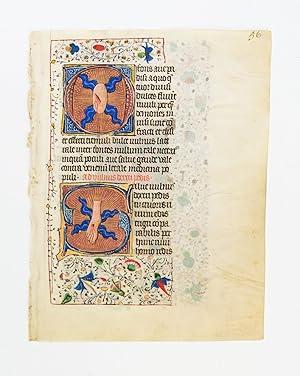
193 x 145 mm. (7 5/8 x 5 3/4"). Single column, 21 lines in a gothic book hand. Rubrics in red, one two-line initial in gold filled with blue on pink ground, WITH THREE LARGE HISTORIATED INITIALS: ONE FEATURING AN OVAL-SHAPED PIECE OF FLESH WITH A GASH IN THE CENTER, AND TWO WITH CHRIST'S DISEMBODIED FOOT, SHOWING THE PUNCTURE WOUND FROM THE CRUCIFIXION, each initial in pink or blue with white tracery, filled with dark pink and thin gilt lines and dots, four wavy blue rays radiating from behind each appendage, all within a thin gilt frame, both sides with a three-quarter border consisting of hairline vines, gold bezants, and a few colorful flowers. âVellum a shade less than bright, faint marginal rumpling, trivial paint transfer on one initial, BUT IN FINE CONDITION, the initials richly painted and extremely well preserved. From a manuscript probably produced in Bruges for the English market, this leaf contains arresting initials that direct the viewer's attention to the wounds endured by Christ during the Passion. According to Roger Wieck, Passion Cycle images enjoyed a particular vogue in 15th century Dutch, Flemish, and English Books of Hours, including those that were exported to England. In the present example, the strikingly unusual imagery includes the wounds of the left and right foot, as well as the spear injury to Christ's side, depicted as an oval piece of flesh with a laceration across the center. A sister leaf to the present item features three additional initials showing a portrait of Christ wearing the Crown of Thorns, his gaze fixed directly at the viewer, and in separate initials his left and right hands appear disembodied and displaying the stigmata. The parent manuscript containing the present leaf sold at Christie's on 15 November 2006 (lot 16), the description for which gives us additional information about the book's contents and provenance: it was made for the Use of Sarum, included a calendar with the English saint Thomas Becket and Popes Gregory and Silvester (with their names crossed out, indicating that it was in England through at least the time of the Reformation), and contained an early ownership inscription of a woman named Bridget Lowe with a Middle English inscription on the pastedown. Christie's also attributed the parent manuscript to the workshop of William Vrelant, with miniatures possibly by his chief assistant, the Master of the "Vraie Cronique Descoce." They note that this work is "of higher quality than many of the works that satisfied the English demand for Netherlandish illumination" and that it "demonstrates why Vrelant appealed to the great bibliophiles of the Burgundian Netherlands." Vrelant was the leading purveyor of books of private devotion in Bruges during the third quarter of the 15th century, and his prominent position among Flemish illuminators of the time is indicated by the considerable number of manuscripts illustrated in his manner by other miniaturists both in Bruges and in nearby cities in Flanders. Similar examples to the present leaf can be found in intact Books of Hours at the Philadelphia Free Library (MS Widener 3) and the Huntington (HM 1086)--both of which were produced in Flanders or the Netherlands around the same time as the present work. The present leaf surpasses both of these examples in terms of excellence of the artistic hand and attention to detail.
-
TEXT FROM HYMNS TO THE PASSION OF CHRIST
Published by ca. 1465, Bruges, 1465
Seller: Phillip J. Pirages Rare Books (ABAA), McMinnville, OR, U.S.A.
Seller rating 3 out of 5 stars
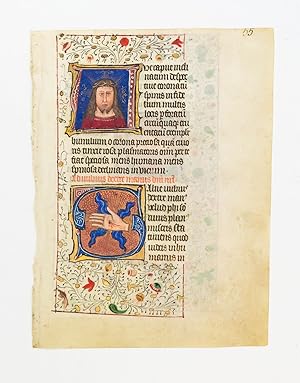
193 x 145 mm. (7 5/8 x 5 3/4"). Single column, 21 lines in a gothic book hand. Rubrics in red, WITH THREE LARGE HISTORIATED INITIALS: ONE WITH A PORTRAIT OF CHRIST WEARING THE CROWN OF THORNS, AND TWO WITH DISEMBODIED HANDS SHOWING THE STIGMATA, each initial in pink or blue with white tracery, filled with dark pink or blue with thin gilt lines and dots, hands with wavy blue rays radiating from behind the appendage, all within a thin gilt frame, both sides with a three-quarter border consisting of hairline vines, gold bezants, and a few colorful flowers. âMargins with a little light soiling, BUT IN FINE CONDITION, THE PAINT OF THE INITIALS ESPECIALLY RICH AND WELL PRESERVED. From a manuscript probably produced in Bruges for the English market, this leaf contains arresting initials that direct the viewer's attention to the wounds endured by Christ during the Passion. According to Roger Wieck, Passion Cycle images enjoyed a particular vogue in 15th century Dutch, Flemish, and English Books of Hours, including those that were exported to England. In the present example, the strikingly unusual imagery includes a portrait of Christ wearing the Crown of Thorns, his gaze fixed directly at the viewer, and in separate initials, his left and right hands appear disembodied and displaying the stigmata. A sister leaf to the present item features three additional initials showing the wounds of the left and right foot, as well as the spear injury to Christ's side, depicted as an oval piece of flesh with a laceration across the center. The parent manuscript containing the present leaf sold at Christie's on 15 November 2006 (lot 16), the description for which gives us additional information about the book's contents and provenance: it was made for the Use of Sarum, included a calendar with the English saint Thomas Becket and Popes Gregory and Silvester (with their names crossed out, indicating that it was in England through at least the time of the Reformation), and contained an early ownership inscription of a woman named Bridget Lowe with a Middle English inscription on the pastedown. Christie's also attributed the parent manuscript to the workshop of William Vrelant, with miniatures possibly by his chief assistant, the Master of the "Vraie Cronique Descoce." They note that this work is "of higher quality than many of the works that satisfied the English demand for Netherlandish illumination" and that it "demonstrates why Vrelant appealed to the great bibliophiles of the Burgundian Netherlands." Vrelant was the leading purveyor of books of private devotion in Bruges during the third quarter of the 15th century, and his prominent position among Flemish illuminators of the time is indicated by the considerable number of manuscripts illustrated in his manner by other miniaturists both in Bruges and in nearby cities in Flanders. Similar examples to the present leaf can be found in intact Books of Hours at the Philadelphia Free Library (MS Widener 3) and the Huntington (HM 1086)--both of which were produced in Flanders or the Netherlands around the same time as the present work--but the present leaf surpasses both of these examples in terms of excellence of the artistic hand and level of detail depicted.
-
TEXT FROM THE MONTH OF MARCH
Published by mid-15th century, France (possibly Rouen)
Seller: Phillip J. Pirages Rare Books (ABAA), McMinnville, OR, U.S.A.
Seller rating 3 out of 5 stars
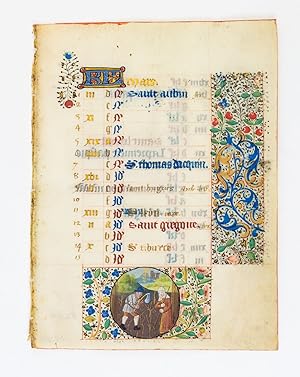
173 x 130 mm. (6 3/4 x 5 1/8"). Single column, 16 ruled lines, text in a gothic book hand. Text in gold, blue, and dark pink, "KL" in blue with white tracery on a gold ground decorated with dark pink baubles and leaves and with a floral spray extension, both sides with panel border composed of densely packed acanthus, flowers, and hairline vines with gold bezants, WITH A SMALL ROUNDEL MINIATURE at the bottom depicting the labor of the month (Pruning) set on a panel of flowers, hairline vines, and gold bezants. With numbering to the left of the golden numbers and a few calendar entries in a later hand. âLight soiling to vellum, a few small smudges in the borders, a little paint transfer affecting a couple lines of text and margins of the verso, but these issues all very minor, and on the whole in fine condition with a particularly well-preserved miniature with rich, uneroded paint. With lovely panel borders and a particularly charming roundel miniature showing the labor of the month, this leaf likely comes from a high-quality manuscript made for a person of means. Though miniatures depicting the labors of the month are often illustrated with just a single person performing the task, here we are treated to two laypeople--a man and a woman--working together to prune and break ground in their field. The man appears to be carrying an axe for trimming branches, while the woman carries a long stick to loosen dirt for spring plantings. The names of several saints have been added to the calendar by a later hand, though it would appear that they were erroneously placed in March: St. Hugh belongs on 9 April, Pope Leo on 11 April, and St. Tiburtius on 14 April. While almost all of these feast days are commonly found in Books of Hours of this period, Hugh (Bishop of Rouen) is slightly unusual, suggesting that the manuscript may have been made in, or at least ended up in, Rouen.
-
TEXT FROM THE HOURS OF THE CROSS
Published by 3rd quarter of 15th century, France (probably Besançon)
Seller: Phillip J. Pirages Rare Books (ABAA), McMinnville, OR, U.S.A.
Seller rating 3 out of 5 stars
239 x 165 mm. (9 3/8 x 6 1/2"). Single column, 15 lines in an elegant gothic book hand. Rubrics in dark pink, line-enders in dark pink and blue highlighted with a gilt bezant, several one-line initials and one two-line initial in burnished gold on dark pink and blue ground with white tracery, one three-line initial in pink with white tracery, filled with trefoils painted red or blue, all on a gold ground, verso with panel border of delicate hairline vines terminating in gilt bezants and ivy and with acanthus and flowers, recto with A HALF-PAGE MINIATURE OF THE CRUCIFIXION in an arch-topped gilt frame, Christ in the center of the composition with the mocking inscription "I N R I" ("Iesus Nazarenus Rex Iudaeorum") on a banner above him, the Virgin standing on the left and St. John on the right, the landscape behind them filled with hills and trees under a tessellated sky, SURROUNDED BY A FULL BORDER consisting of hairline vines terminating in gold bezants and ivy, colorful acanthus, strawberries, and flowers, the text and image further framed by a "U"-shaped bar of gold, pink, and blue extending the full height of the miniature. âVirgin's robe a little mottled and chipped, minor chipping elsewhere, borders with slight smudging to some of the hairline vines, small marginal stain, but, in all, in excellent condition, with wide margins, with the colors very bright, and the miniature well preserved. Opening the Hours of the Cross (a shorter text that is sometimes found in addition to the Hours of the Virgin), this touching miniature of the Crucifixion is richly painted and features a particularly emotional depiction of Christ, his head slightly bowed with an expression of pain. Blood flows freely from his wounds, partly merging with the orange in the sky and partly forming rivulets at the base of the cross. This exsanguination stands in contrast to the more typically restrained indications in other Crucifixion scenes and serves to emphasize the cruel suffering of the execution. His mother stands to the left in a blue cloak, hands knitted together and with a look of weary resignation on her face; to the right stands St. John, whose lips are slightly parted as he looks directly at the crucified Christ as if searching his face for signs of life. Our artist has made an unusual choice for the background, with the lower two thirds devoted to a naturalistic landscape with many hills and trees, and the sky entirely tessellated with squares of red, blue and gold. While the Virgin and St. John are both firmly situated within the earthy realm, the body of Christ occupies both spaces, perhaps emphasizing his dual nature as both human and divine. Stylistically, this leaf can be localized to the Franche-Comté region in eastern France, and is closely related (if not directly attributable) to an atelier specializing in Books of Hours made for the Use of Besançon and most likely situated in that city (see Avril and Reynaud, p. 197). The similarities are especially apparent in the figures' faces, which are slightly puffy in appearance and have distinct, slit-like eyes. As noted by Avril and Reynaud, the unnamed master of this atelier was deeply indebted to the Master of Morgan 293, a talented Burgundian illuminator active in the second quarter of the 15th century, whose name derives from a particularly lovely Book of Hours made for the Use of Besançon. In fact, there are certain consonant details between this miniature and the Crucifixion in the Morgan manuscript: Christ's position and physicality are nearly identical, as is the pattern of blood as it moves down the cross, and both artists create a division in the landscape, with the Morgan artist using gold rather than tessellation for his sky. Whoever the artist responsible for the present miniature, the work here is clearly accomplished, both quietly powerful and an excellent representation of a distinct regional style.
-
PROBABLY FROM THE OFFICE OF THE DEAD
Published by ca. 1470, Delft, 1470
Seller: Phillip J. Pirages Rare Books (ABAA), McMinnville, OR, U.S.A.
Seller rating 3 out of 5 stars
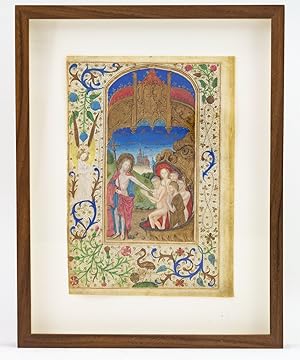
Leaf: 175 x 122 mm. (6 7/8 x 4 3/4"); Frame: 250 x 195 mm. (9 3/4 x 7 3/4"). No text on recto or verso. In an attractive wooden frame. A FINELY PAINTED MINIATURE OF THE HARROWING OF HELL within an arch-topped compartment, the mouth of hell depicted on the left with a fiery red interior and five people emerging from it, the figure of Christ on the left, holding a cross on a long staff and half-clothed in a pink and blue robe, the background with a castle in the distance, ALL OF THIS BENEATH A VERY DETAILED ARCHITECTURAL CANOPY suspended in the sky, AND THE WHOLE WITHIN A FULL BORDER of acanthus leaves and other foliage and flowers in reds, blues, greens, yellows, and brushed gold, along with very many small burnished gold ivy leaves and buds on hairline stems, a small stork in the bottom border and a large delicately shaded angel in the left border. âLeft margin trimmed very close to decoration (just escaping loss, and the other three margins ample), mild darkening right at fore and tail edge (but not reaching into borders), otherwise IN FINE CONDITION, the colors rich and true, and the burnished gold still shimmering. This extraordinary miniature, notable for its uncommon subject matter, memorable imagery, and fine workmanship, was produced by a talented artist belonging to the stylistic group known as the Masters of the Delft Half-Length Figures. The subject here is infrequently depicted in Books of Hours: the Harrowing of Hell appears as a full-page miniature in only three of the 119 prayer books described by Roger Wieck in his "Time Sanctified" (and three others contain a Harrowing depiction inside an initial). Christian theological tradition tells us that after his crucifixion, Christ went to liberate souls from Limbo--a location inhabited by those barred from entry into Heaven because they died before the Redemption. In our scene, Christ, wrapped in a regal cloak and carrying a long staff, his hands and feet still bleeding from the wounds he received on the Cross, reaches into an absolutely wonderful Hellmouth to extricate Adam and Eve and other naked souls, while the recently deceased and original saint, John the Baptist, still clad in an animal skin garment, waits patiently for his turn to emerge. The great maw of Hell as depicted here has bulging eyes, a distended snout, thickly matted hair, and a bad complexion; his gaping mouth, punctuated by sharp gray teeth, glows red hot, and one can tell from the creature's expression that he is loath to comply with this rescue of souls. In addition to its compelling subject matter, there is a high level of artistic achievement here, including delicately molded figures, impressively detailed architectural elements, and a lovely color palette. The elegance and quiet sophistication observed in this miniature distinguishes the artist responsible for this work as a particularly talented member of his circle. Active from about 1450-80, the Masters of the Delft Half-Length Figures were named by James Marrow after the angels and other figures whose upper bodies are typically found emerging from a cloud within the borders. Although the present leaf uncharacteristically contains a full-length angel in the border, it shares other stylistic similarities, such as the elaborate architectural canopy hovering over the main composition; and it particularly resembles the work of the artist of Keble College MS 77, an illuminator described in "The Golden Age of Dutch Manuscript Illumination" as "one of the more articulate of the group" whose "figures are more fully modelled and his palette . . . deeper and brighter" than that of his contemporaries. Because the subject of the present miniature goes beyond the standard image program seen in routine productions, and because of the high level of artistic accomplishment seen here, this leaf was almost certainly part of an elaborate Book of Hours produced in response to an important commission.
-
TEXT FROM THE OFFICE OF THE DEAD
Published by 3rd quarter of 15th century, France [probably Besançon]
Seller: Phillip J. Pirages Rare Books (ABAA), McMinnville, OR, U.S.A.
Seller rating 3 out of 5 stars
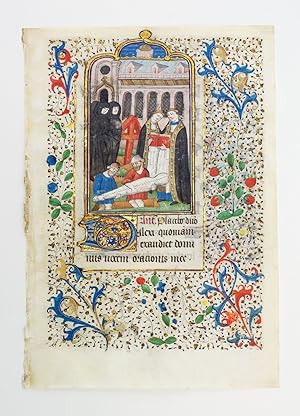
239 x 165 mm. (9 3/8 x 6 1/2"). Single column, 15 lines in an elegant gothic book hand. Rubrics in dark pink, line-enders in dark pink and blue with a gilt bezant, several one-line initials in burnished gold on dark pink and blue ground with white tracery, one three-line initial in blue with white tracery, filled with flowers painted pink or blue, all on a gold ground, verso with panel border of delicate hairline vines terminating in gilt bezants and ivy, and with a spray of blue flowers and a red bud, recto with A FULLY-REALIZED HALF-PAGE MINIATURE OF A BURIAL in an arch-topped gilt frame, with two laymen lowering a shrouded corpse into the ground, a small group of hooded monks to the left and two ecclesiastical figures reading from a book to the right, all in front of a gothic church painted pink with a blue roof, SURROUNDED BY A FULL BORDER consisting of hairline vines terminating in gold bezants and ivy, colorful acanthus, strawberries, and blue flowers, the text below the miniature further framed with a thin "U"-shaped line extending the full height of the miniature. A very few trivial imperfections (quite minor wear to paint on clothing, a little insignificant smudging, one small, light stain in the blank margin of verso), but these defects not the least distracting, and overall the miniature in fine condition, with rich, well-preserved color. This is a splendid miniature from a particularly large Book of Hours, showing a detailed rendering of a scene from contemporary Medieval life--that of a burial in a churchyard involving clergy, mourners, and laymen. Apart from those relatively few copies with illustrated calendars, the miniatures found in Books of Hours are almost entirely devoted to retrospective Bible scenes that are obviously outside the experience of the illuminator; it is only in the present kind of scene at the beginning of the Office of the Dead that we can see a contemporaneous image that would have come directly from the Medieval experience. While our painting is fairly typical in subject matter and design, it offers a number of interesting details about the Medieval rites and rituals surrounding death. The present scene represents the final stage (preceded by the funeral procession, Requiem Mass, prayers, Absolution, and the procession into the graveyard) in which the body is actually laid to rest in the ground. Though the corpse would have been encased in a coffin during the aforementioned rites and processions, it was customary to bury the dead in only a shroud (in the present example, the artist has even thought to show the stitching along the length of the shroud). Three groups of people, each serving a different function, appear in this miniature: in the foreground are two laborers lowering the body into an earthen grave, a small group of mourners in black cloaks stand off to the left, and a duo of clergy members stand to the right. The latter have tonsured heads, and each wears a black cope (donned prior to administering Absolution to the deceased); together, they hold a manuscript containing the Rites for Burial. The background is composed of a grand church or cathedral containing a number of fine architectural details, including several windows (including a clerestory level), an arched entrance, a dome, and decorative touches. Stylistically, this leaf can be localized to the Franche-Comté region in eastern France, and is closely related (if not directly attributable) to an atelier specializing in Books of Hours made for the Use of Besançon and most likely situated in that city (see Avril and Reynaud, p. 197). The similarities are especially apparent in the figures' faces, which are slightly puffy in appearance and have distinct, slit-like eyes. As noted by Avril and Reynaud, the unnamed master of this atelier was deeply indebted to the Master of Morgan 293, a talented Burgundian illuminator active in the second quarter of the 15th century, whose name derives from a particularly lovely Book of Hour.
-
TEXT FROM THE SUFFRAGES
Published by late 15th century, Northeastern France, probably Arras
Seller: Phillip J. Pirages Rare Books (ABAA), McMinnville, OR, U.S.A.
Seller rating 3 out of 5 stars
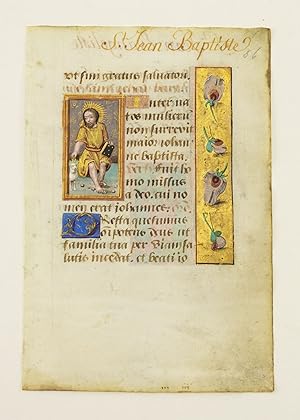
146 x 95 mm. (5 3/4 x 3 3/4"). Single column, 15 lines in a pleasing bâtarde hand. Rubrics in red, one- and two-line initials in brushed gold on a red or blue ground, EACH SIDE OF LEAF WITH A BRUSHED GOLD PANEL BORDER, WITH VERY PRETTY ILLUSIONISTIC FLOWERS AND FRUITS, and intricate strapwork design in colors; WITH TWO SMALL MINIATURES (measuring approximately 40 x 25 mm.) depicting John the Baptist and John the Evangelist, shown with their attributes. Headlines written in French in a later (18th century?) calligraphic hand. âLight soiling, a touch of paint loss to frames and background (not very noticeable and not affecting the figures, otherwise an excellent specimen, generally clean and smooth, with ample margins, winning decoration, and shining gold. From a charmingly decorated 15th century prayer book, this leaf offers the opportunity to acquire two particularly nice miniatures, each depicting an important saint. The recto shows St. John the Baptist with a lamb at his side and a book balanced on his knee; and the verso depicts St. John the Evangelist as a young man, holding a chalice with what ought to be snakes emerging from it (in reference to the poisoned cup he was invited to drink as a test of faith), but which instead look more like tendrils of smoke. For other leaves from this same manuscript, please check our website.
-
TEXT FROM A PRAYER TO THE TRINITY IN FRENCH
Published by ca. 1460, Paris, 1460
Seller: Phillip J. Pirages Rare Books (ABAA), McMinnville, OR, U.S.A.
Seller rating 3 out of 5 stars
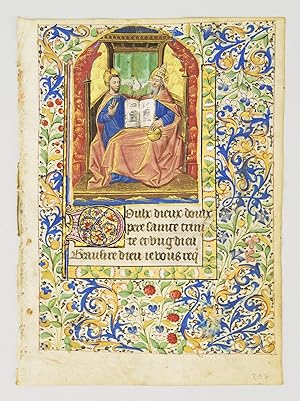
153 x 110 mm. (6 x 4 3/8"). Single column, 14 lines of text in a fine gothic book hand. One-line initial in burnished gold on a pink and blue ground with white tracery, a two-line initial and a three-line initial in pink with white tracery on a ground of burnished gold, the center filled with twining blue vines bearing pink and scarlet flowers, verso with a rinceau panel border featuring twining hairline stems bearing burnished gold ivy leaves and fruit, blue and gold acanthus leaves, and flowers, recto WITH AN ARCH-TOPPED MINIATURE OF THE HOLY TRINITY SURROUNDED BY THE HEAVENLY HOST, this and the accompanying text enclosed by a pink, blue, and burnished gold bar border on one side, and a brushed gold bar border with pink lotus flowers on two sides, the whole surrounded by A FULL RINCEAU BORDER DENSE WITH ACANTHUS LEAVES, FOLIAGE, FRUIT, FLOWERS, AND TINY GOLD BERRIES on hairline stems. âA little paint flaked from the book held by the Trinity, a couple of small spots in the margin, otherwise in fine condition--clean and smooth, with comfortable margins, and bright gold. The Trinity is shown here seated on a canopied throne, with God the Son, his hand raised in blessing, to the left of the Father. The latter, in a towering crown, holds a gold orb, and the Father and Son together support a large book opened between them. The dove of the Holy Spirit hovers above the book, radiating golden beams. The Trinity is flanked on both sides by cherubim and seraphim in rich red and soft yellow. It is the rendering of this angelic ambiance that elevates the level of aesthetic achievement here: both red and yellow celestial beings are given a ghostly appearance, as if appearing out of a filmy yellow or a densely red fog. The artistic qualities as a whole suggest that this leaf comes from a manuscript commissioned by a person of significant means.
-
TEXT FOR THE MONTH OF OCTOBER
Published by ca. 1460, Paris, 1460
Seller: Phillip J. Pirages Rare Books (ABAA), McMinnville, OR, U.S.A.
Seller rating 3 out of 5 stars
195 x 143 mm. (7 3/4 x 5 1/2"). Single column, 16 lines in a gothic book hand. Minor feast days in red and blue, major feasts in gold, numerous gold and painted line fillers, the five "A" initials and the "KL" highly decorative and painted pink and blue against a gold background, gold and pink bar surrounding the text on three sides, BOTH SIDES OF THE LEAF WITH EXTRAVAGANTLY DECORATIVE BOTANICAL FULL BORDERS with two small birds hidden within, and INCORPORATING TWO MEDALLION MINIATURES DEPICTING THE LABOR OF THE MONTH (SOWING) AND THE SIGN OF THE ZODIAC (SCORPIO) FOR OCTOBER. âIN VERY FINE, FRESH CONDITION, with gold and paint extraordinarily bright. The extraordinarily lavish and animated full borders, coupled here with extensive use of brushed and burnished gold--for major feast days, for decorative border elements, and even for the hundreds of seeds being sown(!)--suggests that this calendar folio comes from a Book of Hours that was commissioned for a person or persons of high rank, since it would have been very costly. The leaf comes from a manuscript that included numerous roundels depicting the lives of St. Catherine and the more obscure St. Alexius, and it is possible that the Book of Hours belonged to a husband and wife for whom these saints served as patrons. The style of the delicately painted figures, especially in the roundels, indicates an artist who was familiar with the early output of the Coëtivy Master, who, according to Avril and Renaud, can be identified with Colin d'Amiens, who made a great name for himself in Paris (not, as was previously thought, with Henri de Vulcop, who made a great name for himself in the Loire region). The master takes his name from the Book of Hours (now in the Austrian national library) that he painted for Olivier de Coëtivy and his wife, Marie de Valois, one of some 30 works that have been identified as his. Although there is considerable Flemish influence that can be seen in his work (he has links, for example, with Simon Marmion), Colin d'Amiens was active in Paris during the third quarter of the 15th century, and, with Barthélmy van Eyck and Jean Fouquet, was among the three great artists of this period patronized by the French court--Avril and Renaud says flatly that our master was "the most important artist practising in Paris in the third quarter of the century, from about 1450 to 1485." For more on the Coëtivy Master, see Avril and Reynaud, pp. 58-69.
-
TEXT FROM THE OPENING OF VESPERS
Published by ca. 1450, Paris, 1450
Seller: Phillip J. Pirages Rare Books (ABAA), McMinnville, OR, U.S.A.
Seller rating 3 out of 5 stars
159 x 108 mm. (6 1/4 x 4 1/4"). Single column, four lines of text on the verso, 15 on the recto, in a very pleasing gothic book hand. Attractively matted. Recto with a line filler in colors and gold, verso with a one-line initial in burnished gold on a maroon and blue background with white tracery and a three-line "D" in blue and white enclosing a spray of violets in the same colors, the capital on a burnished gold ground, the same side WITH A FULL SWIRLING BORDER of acanthus leaves, flowers, and berries, and many burnished gold ivy leaves ENCLOSING A BLOODY ILLUMINATED MINIATURE OF THE MASSACRE OF THE INNOCENTS (measuring approximately 78 x 54 mm.). Fore and lower margins on the side with the miniature a bit rubbed and with a faint patina reflecting frequent use (also, minor fading and loss of paint and gold in the same place), otherwise in fine condition, THE MINIATURE itself REMARKABLY WELL PRESERVED, WITHOUT ANY EROSION OF PIGMENT. This leaf comes from a Book of Hours decorated by extremely skilled members of what must have been a first-class workshop. The Massacre of the Innocents cannot help but be a moving subject, and the composition here as well as the painter's considerable ability add to the emotional impact in the present miniature. The center of the scene is dominated by the gold-armored, gray-bearded soldier whose sword is raised over the head of a woman clinging to her son. The blood-spattered foreground is littered with the dismembered bodies of infants, looking like so many broken dolls. On the left, we see a row of modest cottages, providing considerable depth as they recede toward distant hills. On the right stands a crowd of grim-faced soldiers, all as elderly as their commander, and seemingly following orders that are unwelcomed; it is perhaps the acute sadness in their faces that makes this scene especially memorable. The clear sky, green fields, and serene blue mountains in the distance contrast markedly with the horrific events unfolding.
-
USE OF SAINTES. TEXT FROM THE HOURS OF THE CROSS
Published by ca. 1420, France [probably Paris], 1420
Seller: Phillip J. Pirages Rare Books (ABAA), McMinnville, OR, U.S.A.
Seller rating 3 out of 5 stars
210 x 146 mm. (8 1/4 x 5 3/4"). Single column, recto with five lines of text, verso with 16 lines, all in a very pleasing, very regular gothic book hand. Attractively matted. Rubrics in red, verso with a one-line and two two-line initials as well as a line filler in colors and burnished gold, recto with a one-line initial and a line filler in the same style, and with a quite large five-line "D" in pink and white with enclosed floral diapering, all on a burnished gold ground, the same side WITH A LOVELY FULL BORDER of swirling hairline stems bearing numerous leaves and berries of burnished gold and with sprays of acanthus leaves and flowers in multiple colors spilling from the corners, this ENCLOSING A POIGNANT ARCH-TOPPED MINIATURE OF THE REMOVAL OF CHRIST FROM THE CROSS (measuring approximately 85 x 60 mm.), the miniature within a thin gold frame and enclosed, in turn, on three sides by bars in colors and gold, the scene showing two men on ladders unfastening Christ's lifeless body from the cross, while Joseph of Arimathea waits below, clutching cloth to be used for a burial shroud as the Madonna, at the lower left of the picture, reaches up to clasp her son's bloody arm. With a small cross stitched in white thread in each upper corner. âA little soiling right along hinge edge, a few smudges in the border, a couple of tiny flakes of paint missing from the cross and the sky, otherwise fine, the vellum clean and fresh, the colors rich, and the gold lustrous. This is an especially sorrowful scene, depicted with power, grace, and sensitivity by an artist demonstrating very considerable skill in composition and execution. The scene is well designed, with the cross providing a device for focus at the center of the miniature. Nicodemus (identified by his expensive attire) is atop a ladder behind the cross, lowering Christ's limp body onto the shoulder of another man, probably a servant, whose ladder is set against the front. Despite the fact that the corpse is more bones than flesh, the artist has made it seem a heavy burden draped over the shoulder of the man as he walks backward down his ladder. Fully stretched out, Christ's left arm is held for balance by Nicodemus at the top right, while the other arm hangs down toward the Virgin. While we can only see her back, her image evokes great pathos, as she reaches up with both hands to grasp the mangled arm of her son, his blood running from his hand onto hers. Joseph of Arimathea, whose position anchors the right side of the picture, looks on with concern, tightly holding linen to shroud the body. (St. John and Mary Magdalen, conventional participants in the Deposition, are not present in this miniature.) While it is possible and even likely that the same artist produced this scene and the miniature of Christ Carrying the Cross, this one is better, as the faces are more deftly painted and the folds in the various garments are more clearly defined.
-
TEXT FROM THE SUFFRAGES
Published by ca. 1465, Bruges, 1465
Seller: Phillip J. Pirages Rare Books (ABAA), McMinnville, OR, U.S.A.
Seller rating 3 out of 5 stars
181 x 127 mm. (7 1/8 x 5"). Single column, 19 lines in a careful, pleasing gothic book hand. In a very attractive new gilt wooden frame. Rubrics in pink (or faded red), one two-line initial in blue, magenta, and burnished gold, two lines with undulating line fillers in blue and gold, both sides of the leaf with a three-quarter panel border incorporating foliage, blossoms, and ivy leaves on hairline stems, the vertical part of this frame with a bar border composed of colors and burnished gold terminating at top and bottom in colorful acanthus leaves, and WITH TWO SMALL BUT VERY PLEASING MINIATURE PAINTINGS, SAINT ELIZABETH ON THE RECTO AND SAINT GERTRUDE ON THE VERSO. âTiny worm(?)hole in fore edge (where it has done negligible damage), small portions of the blue paint in the Elizabeth miniature eroded (gray paint slightly smeared as well, but apparently at the time of painting), otherwise in fine, clean, fresh condition. This leaf is characteristic work from the circle of Willem Vrelant, the leading purveyor of books of private devotion in Bruges during the third quarter of the 15th century. His leading position among Flemish illuminators of the time is indicated by the considerable number of manuscripts illustrated in his manner by other miniaturists both in Bruges and in nearby cities in Flanders. The illuminator of our Book of Hours shows a number of distinctive stylistic traits. Among these are a preference for boldly patterned cloth backdrops, tessellated flooring, landscapes filled with stylized bushes and trees, and persisting prominent architectural constructions that frame the subject, frequently in a corner (in these leaves, it is a waist-high outdoor wall or an indoor feature resembling wainscoting). The inclination for strong geometrical patterning is manifested in the artist's angular treatment of human figures and their garments. Dressed in pink and blue, Elizabeth is depicted with a sweet, round face. She is saluted here as the woman worthy to be the mother of John the Baptist, the forerunner of the Redeemer. Gertrude is dressed in monastic black, although a pink undergarment is visible, and her inky habit is trimmed in gold. This shimmering feature is a reminder that Gertrude (626-59) was the daughter of Pepin I of Landen, Mayor of the Palace for the Frankish realm of Austrasia and the forebear of Charlemagne. Gertrude is a natural choice for illustration by an artist of Bruges, since she was the patron of nearby Nivelles. The saint was routinely invoked for aid in coping with mice, and is here shown surrounded by four animated rodents as black as her habit. No legend survives to explain why she had such power over the creatures, who seem here to be more her pets (one climbs her staff of office) than her victims.


![Seller image for BOOK OF HOURS LEAF [France (Paris), c.1415] for sale by Kay Craddock - Antiquarian Bookseller](https://pictures.abebooks.com/inventory/md/md32077942409.jpg)