Order Total (1 Item Items):
Shipping Destination:

Brisebare (1 results)
Author:
brisebare
Refine with Advanced Search
Skip to main search results
Search filters
Product Type
- All Product Types
- Books (1)
- Magazines & Periodicals (No further results match this refinement)
- Comics (No further results match this refinement)
- Sheet Music (No further results match this refinement)
- Art, Prints & Posters (No further results match this refinement)
- Photographs (No further results match this refinement)
- Maps (No further results match this refinement)
- Manuscripts & Paper Collectibles (No further results match this refinement)
Condition Learn more
- New (No further results match this refinement)
- As New, Fine or Near Fine (No further results match this refinement)
- Very Good or Good (No further results match this refinement)
- Fair or Poor (No further results match this refinement)
- As Described (1)
Binding
- All Bindings
- Hardcover (1)
- Softcover (No further results match this refinement)
Collectible Attributes
- First Edition (No further results match this refinement)
- Signed (1)
- Dust Jacket (No further results match this refinement)
- Seller-Supplied Images (1)
- Not Print on Demand (1)
Language (1)
Price
- Any Price
- Under US$ 25 (No further results match this refinement)
- US$ 25 to US$ 50 (No further results match this refinement)
- Over US$ 50
Free Shipping
- Free Shipping to U.S.A. (No further results match this refinement)
Seller Location
Seller Rating
-
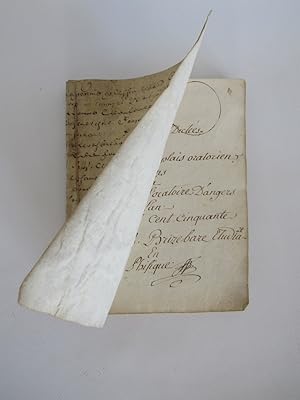
Cayer des mathématiques dictées par monsieur Duplay oratorien dans la salle de l'oratoire d'Angers l'an 1750. J. p. Brisebare Etudiant en phisique
Publication Date: 1750
Seller: Librairie Le Feu Follet, Paris, France
Association Member: ILAB
Seller rating 5 out of 5 stars

Signed
Couverture rigide. 1750 | 14 x 17.70 cm | relié | Cahier de mathématique autographe d'un étudiant angevin comportant deux parties : l'algèbre et la géométrie. L'algèbre comprend des leçons sur la multiplication, la division, le signes algébriques, la réduction, l'addition et la soustraction, l'extraction de la racine. La géométrie contient des chapitres sur la ligne, la droite, les angles, le triangle, la circonférence, la tangente. L'ensemble des chapitres est accompagné de problèmes, théorèmes et démonstrations. Nombreux diagrammes présents dans la partie Géométrie, des opérations dans la partie Algèbre. Reliure en plein parchemin de réemploi, avec une écriture à la plume noire couvrant les plats. Coutures apparentes. Rien ne rigidifiant le parchemin, ce dernier gondole. Le collège de l'Oratoire d'Angers fonctionne comme un établissement municipal, c'est le collège du corps de ville, opposé au collège d'université. Au XVIIe le collège était fréquenté par 1000 à 1200 élèves et développera jusqu'à la Révolution un enseignement novateur et en pointe par rapport à une université repliée sur elle-même et scérosée. Les oratoriens d'Angers étaient avant tout des enseignants. A partir de 1680, le collège d'Anjou est un grand établissement scientifique. La classe de mathématique fondée en 1681 est un des grands foyers de mathématique de l'oratoire, et la plupart des plus importants mathématiciens de l'Oratoire ont enseigné à Angers. L'enseignement diffusé se trouve bien en phase avec l'actualité scientifique, il s'adresse à des écoliers ayant terminé leurs études normales. Intéressant témoignage de l'enseignement mathématique en 1750. | [ENGLISH DESCRIPTION FOLLOWS] Autograph mathematics notebook of a student from Angers comprising two parts: algebra and geometry. The algebra includes lessons on multiplication, division, algebraic signs, reduction, addition and subtraction, root extraction. The geometry contains chapters on lines, straight lines, angles, triangles, circumference, tangents. All chapters are accompanied by problems, theorems and demonstrations. Numerous diagrams present in the Geometry section, operations in the Algebra section. Full reused parchment binding, with black ink writing covering the boards. Visible stitching. Nothing stiffening the parchment, which warps. The Oratory college of Angers functioned as a municipal establishment, it was the city corporation college, opposed to the university college. In the 17th century the college was attended by 1000 to 1200 students and would develop innovative and cutting-edge teaching until the Revolution compared to a university withdrawn into itself and sclerosed. The Oratorians of Angers were above all teachers. From 1680, the college of Anjou was a great scientific establishment. The mathematics class founded in 1681 was one of the great mathematical centers of the oratory, and most of the most important mathematicians of the Oratory taught at Angers. The teaching disseminated was well in phase with scientific current events, it was addressed to schoolchildren who had completed their normal studies. Interesting testimony of mathematical teaching in 1750. * 93pp.