Order Total (1 Item Items):
Shipping Destination:

Buddhist Manuscript (5 results)
Skip to main search results
Search filters
Product Type
- All Product Types
- Books (2)
- Magazines & Periodicals (No further results match this refinement)
- Comics (No further results match this refinement)
- Sheet Music (No further results match this refinement)
- Art, Prints & Posters (No further results match this refinement)
- Photographs (No further results match this refinement)
- Maps (No further results match this refinement)
- Manuscripts & Paper Collectibles (3)
Condition Learn more
- New (No further results match this refinement)
- As New, Fine or Near Fine (No further results match this refinement)
- Very Good or Good (No further results match this refinement)
- Fair or Poor (No further results match this refinement)
- As Described (5)
Binding
- All Bindings
- Hardcover (5)
- Softcover (No further results match this refinement)
Collectible Attributes
- First Edition (No further results match this refinement)
- Signed (No further results match this refinement)
- Dust Jacket (No further results match this refinement)
- Seller-Supplied Images (5)
- Not Print on Demand (5)
Language (1)
Price
- Any Price
- Under US$ 25 (No further results match this refinement)
- US$ 25 to US$ 50 (No further results match this refinement)
- Over US$ 50
Free Shipping
- Free Shipping to U.S.A. (No further results match this refinement)
Seller Location
Seller Rating
-
Burmese Kammavaca [Buddhist Palm Leaf Manuscript].
Published by (19th Century)., (Burma).
Seller: Asia Bookroom ANZAAB/ILAB, Canberra, ACT, Australia
Association Member: ANZAAB ILAB
Seller rating 5 out of 5 stars

Heavily gilded and red and black lacquered kammavaca with shwezawa work, 13 round-edged leaves loose in gilt-decorated red lacquered wooden boards (rubbed), each board punctured but lacking the binding pin or cord, 10 x 54.4 cms; the leaves 9.2 x 53.5 cms, five lines of black lacquered text in Pali (using Burmese script) on each double-sided finely gilt decorated leaf, the text on the inner face only of the terminal leaves, the outer face of each elaborately gilt, a central panel featuring seven floral medallions (the central three medallions rubbed and only partly visible), the edges of a few leaves chipped with loss, each leaf double punctured (lacking the cords), in good condition. Highly attractive traditional canonical Buddhist manuscript.
-
[Theravada Buddhist prayer book].
Published by [Burma (Myanmar), likely Shan State, early 20th century].
Seller: Antiquariat INLIBRIS Gilhofer Nfg. GmbH, Vienna, A, Austria
Association Member: ILAB PADA VDA VDAO
Seller rating 5 out of 5 stars
Manuscript / Paper Collectible
Folding book (pap tup, or parabaik), 394 x 180 mm. 69 ff. Manuscript in Burmese script, with certain words and phrases in Burmese and the rest likely in Sanskrit or Pali, on accordion-folded undyed paper. Contemporary red boards decorated with gold-painted floral borders. A Buddhist folding book, decorated with floral designs and golden paint, in the style most often found in Shan manuscripts. The work includes a collection of Buddhist prayers, introduced by the chant "Namo Tassa Bhagavato Arahato Samma Sambuddhassa", a popular Theravada veneration of Buddha, Dharma, and Sangha, often used to begin a chant or prayer. Folding books like these (parabaik in Burmese, pap tup in Shan) often preserve selections of the canonical texts of Theravada Buddhism, drawing both on the official Pali-language canon (the Tipitaka) and more locally popular, non-canonical exegesis in Shan and Pali. - Such manuscripts were prepared for wealthy families, with the finest being commissioned by Buddhist kings. This example would likely have been commissioned by a family or individual as an offering to a local Buddhist temple, often donated in the name of a deceased family member, who would then acquire merit from the deed. - Folding books have an ancient history in southeast Asia and in Buddhism especially, where they preserve major canonical texts as well as local Buddhist prayers, practices, and stories. - A few chips to covers, one resulting in minor damage to the corner of one opening; light dampstaining. In good condition.
-
[Theravada Buddhist prayer book].
Published by [Burma (Myanmar), likely Shan State, early 20th century].
Seller: Antiquariat INLIBRIS Gilhofer Nfg. GmbH, Vienna, A, Austria
Association Member: ILAB PADA VDA VDAO
Seller rating 5 out of 5 stars
Manuscript / Paper Collectible
Folding book (pap tup, or parabaik), 441 x 185 mm. 69 ff. Likely Shan-language and Pali manuscript in Burmese script, on accordion-folded undyed paper. Contemporary embossed gold covers studded with multi-coloured pieces of mirror glass and lavish floral decoration in high relief. A large example of a Buddhist folding book, painted gold and studded with mirror-glass in the style most often found in Shan manuscripts. The work includes a collection of Buddhist prayers, introduced by the chant "Namo Tassa Bhagavato Arahato Samma Sambuddhassa", a popular Theravada veneration of Buddha, Dharma, and Sangha, often used to begin a chant or prayer. Folding books like these (parabaik in Burmese, pap tup in Shan) often preserve selections of the canonical texts of Theravada Buddhism, drawing both on the official Pali-language canon (the Tipitaka) and more locally popular, non-canonical exegesis in Shan and Pali. - Such manuscripts were prepared for wealthy families, with the finest being commissioned by Buddhist kings. This example would likely have been commissioned by a family or individual as an offering to a local Buddhist temple, often donated in the name of a deceased family member, who would then acquire merit from the deed. - Folding books have an ancient history in southeast Asia and in Buddhism especially, where they preserve major canonical texts as well as local Buddhist prayers, practices, and stories. - Some rubbing and chipping to covers; text in excellent condition.
-
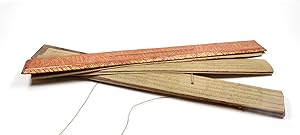
600 x 65 mm. 21 palm leaves between two painted wooden boards with cord. Burmese manuscript in Pali, most likely a register of Buddhist monastic rules. - Signs of age.
-
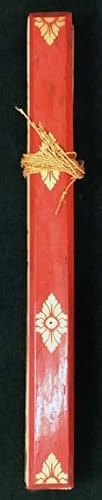
A FINE BUDDHIST MANUSCRIPT FROM BURMA.
Published by Burma Handwritten Manuscript [Likely 19th century but possibly late 1700s to early 1900s], 1900
Seller: Buddenbrooks, Inc., Newburyport, MA, U.S.A.
Association Member: ABAA ILAB SNEAB
Seller rating 5 out of 5 stars
A long and fine manuscript written in fine Pali in black on palm leaves. The palm leaves with text in black, with red lacquered wooden boards. Each leaf measures 23" x 2.5"., original protective covers of red lacquered wooden boards decorated in gold, all edges gilt, tied with braided cords. 78 palm leaves written in black. A handsome and well preserved example, one tie cord lacking. A FINE BURMESE MANUSCRIPT WELL PRESERVED AND QUITE HANDSOME.
![Seller image for Burmese Kammavaca [Buddhist Palm Leaf Manuscript]. for sale by Asia Bookroom ANZAAB/ILAB](https://pictures.abebooks.com/inventory/md/md32429620478.jpg)

![Seller image for [Theravada Buddhist prayer book]. for sale by Antiquariat INLIBRIS Gilhofer Nfg. GmbH](https://pictures.abebooks.com/inventory/md/md32085548602.jpg)
![Seller image for [Theravada Buddhist prayer book]. for sale by Antiquariat INLIBRIS Gilhofer Nfg. GmbH](https://pictures.abebooks.com/inventory/md/md32085545716.jpg)