
Central Narcotics Intelligence Bureau (2 results)
 More images
Annual report for the year 1932.
CENTRAL NARCOTICS INTELLIGENCE BUREAU - RUSSELL, Thomas Wentworth (or RUSSELL PASHA).
Published by Government Press,, Cairo, 1933
- Softcover
- Signed
Seller: Antiquariaat FORUM BV, Houten, , NetherlandsAntiquariaat FORUM BV
Contact seller5-star sellerCondition: Used
US$ 10,164.57
US$ 29.03 shippingShips from Netherlands to U.S.A.Quantity: 1 available
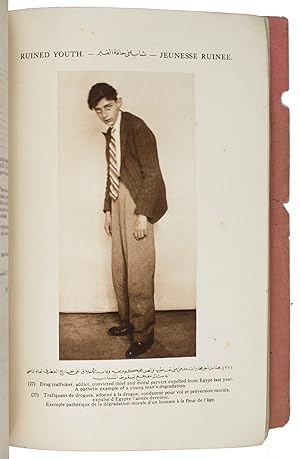
Rare work on drug trafficking in Egypt in the 1930s and an important example of the author's "war on drugs": he was director of the Central Narcotics Intelligence Bureau. Thomas Wentworth Russell (1879-1954), sometimes better known as Russell Pasha, was a police officer in service of Egypt who was appalled by the increasing drug… trafficking in Egypt and the large number of drug addicts in the country. He founded the Central Narcotics Intelligence Bureau (CNIB), making it his mission to rid Egypt of drugs, especially what he called "white drugs" (cocaine, morphine, heroin), but also of "black drugs" (hashish, opium). Russell was one of the most important anti-drug campaigners in Egypt in his time and after, greatly raising awareness of the rising problem. Here he describes how drugs are smuggled in large quantities from abroad to Egypt. In many chapters, he extensively describes the foreign sources of supply (discussing not only important drug barons, but also mentioning specific ships and other means of transport used to smuggle drugs), notes cases where weapons were used by traffickers, discusses people involved in the trade, traffickers and their methods of smuggling (in shoes, camel saddles, etc.), addiction and its social effects and death rates, and much more. Although 3000 copies were printed (the printer's code for the job is printed on the back of the title-page: "10506-1932-3000 ex.") it is a scarce and outstanding example of Russell's anti-drug campaign, extensively describing drug trafficking in Egypt in the 1930s, being well-illustrated with photographs of drug barons, users, traffickers and methods of concealment. We have located only four other copies, but due to ambiguity between the year covered (1932) and the year of publication (1933), three further locations are uncertain.Author's presentation copy for the English poet and dramatist John Drinkwater with an inscription by Russell on the front wrapper ("John Drinkwater | With compliments from the director | Tho Russell | 24/3/33" | [insciption in Arabic script]") and his red stamp next to the inscription.Spine of wrapper damaged and front wrapper detached and with light water stain. A rare survival.l KVK (1 copy); WorldCat 1780146 (3-6 copies). Original publisher's pink paper wrappers, printed letterpress. Although the book is in quires of 8 leaves (unwatermarked wove paper), they are not sewn but stapled through the side (3 staples). With 14 rotogravure(?) plates, printed in sepia, 1 folding facsimile letter, 2 folding graphs, a plate with 6 pie charts and 1 illustration (also in red) showing schematically a smuggling box. Pages: XVII, [1 blank], 170 pp. (pp. VI and XVIII blank).
 More images
Annual report for the year 1932.
(Central Narcotics Intelligence Bureau). Russell, Thomas Wentworth (or Russell Pasha).
Published by Cairo, Government Press, 1933. 1933
- Softcover
- Signed
Seller: Antiquariat INLIBRIS Gilhofer Nfg. GmbH, Vienna, A, AustriaAntiquariat INLIBRIS Gilhofer Nfg. GmbH
Contact seller5-star sellerCondition: Used
US$ 10,164.57
US$ 34.83 shippingShips from Austria to U.S.A.Quantity: 1 available
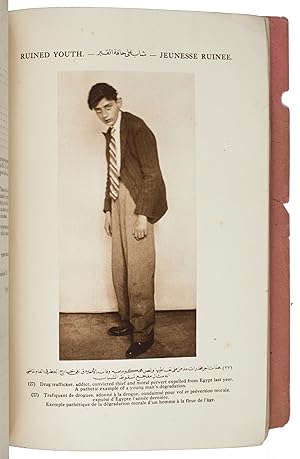
Small folio (27 x 18 cm). XVIII, 170 pp. (pp. VI and XVIII blank). With 14 sepia photographic plates, 1 folding facsimile letter, 2 folding graphs, a plate with 6 pie charts and 1 illustration (also in red) showing schematically a smuggling box. Original pink paper wrappers. Exceptionally rare work on drug trafficking in Egypt i…n the 1930s and an important example of the "war on drugs" of the author, who was director of the Central Narcotics Intelligence Bureau. Thomas Wentworth Russell (1879-1954), sometimes better known as Russell Pasha, was a police officer in service of Egypt who was appalled by the increasing drug trafficking in Egypt and the high amount of drug addicts in the country. He founded the Central Narcotics Intelligence Bureau (CNIB), making it his mission to rid Egypt especially of what he called "white drugs" (cocaine, morphine, heroin), but also of "black drugs" (hashish, opium). Russell can be considered one of the most important anti-drug campaigners in Egypt in his time and after, raising awareness of a growing problem. In this work, Russell describes how drugs are smuggled in large quantities from abroad to Egypt. In many chapters, he extensively describes the foreign sources of supply (discussing not only important drug barons, but also mentioning specific ships and other means of transport which smuggled drugs), cases in which weapons were used by traffickers, people involved in the trade, traffickers and their methods of smuggling (among others in shoes, camel saddles, etc.), addiction and the social effects and death rates, and much more. It is a scarce and outstanding example of Russell's anti-drug campaign, extensively describing drug trafficking in Egypt in the 1930s, being well-illustrated with photographs of drug barons, users, traffickers and methods of concealment. - Presentation copy to the English poet and dramatist John Drinkwater with an inscription by Russell on the front wrapper ("John Drinkwater / With compliments from the director / Tho Russell / 24/3/33" / [Arabic script]") and his red stamp next to the inscription. - Spine worn, front wrapper detached, covers with light residual dampstain. A highly uncommon survival. - Not in WorldCat.

