
Chinel Pauly (7 results)

Published by Hachette
Seller: Librairie Histoire d'en lire, Lorient, , FranceLibrairie Histoire d'en lire
Contact seller4-star sellerCondition: Used
US$ 23.84
US$ 46.29 shippingShips from France to U.S.A.Quantity: 1 available
in- 16 agrafé de 12p, couverture illustrée, qques illustrations couleurs, Ouvrages et Albums pour les Enfants bel état x3.
Published by Hachette
Seller: Librairie Histoire d'en lire, Lorient, , FranceLibrairie Histoire d'en lire
Contact seller4-star sellerCondition: Used
US$ 23.84
US$ 46.29 shippingShips from France to U.S.A.Quantity: 1 available
in- 16 agrafé de 12p, couverture illustrée, qques illustrations couleurs, Ouvrages et Albums pour les Enfants bel état raciste.
Published by Hachette
Seller: Librairie Histoire d'en lire, Lorient, , FranceLibrairie Histoire d'en lire
Contact seller4-star sellerCondition: Used
US$ 23.84
US$ 46.29 shippingShips from France to U.S.A.Quantity: 1 available
in- 16 agrafé de 12p, couverture illustrée, qques illustrations couleurs, Ouvrages et Albums pour les Enfants bel état.
Published by Hachette
Seller: Librairie Histoire d'en lire, Lorient, , FranceLibrairie Histoire d'en lire
Contact seller4-star sellerCondition: Used
US$ 23.84
US$ 46.29 shippingShips from France to U.S.A.Quantity: 1 available
in- 16 agrafé de 12p, couverture illustrée, qques illustrations couleurs, Ouvrages et Albums pour les Enfants bel état x2.
Published by Hachette
Seller: Librairie Histoire d'en lire, Lorient, , FranceLibrairie Histoire d'en lire
Contact seller4-star sellerCondition: Used
US$ 29.80
US$ 46.29 shippingShips from France to U.S.A.Quantity: 1 available
in- 16 agrafé de 12p, couverture illustrée, qques illustrations couleurs, Ouvrages et Albums pour les Enfants bel état raciste.
 More images
Published by Hachette & Companie ca. 1914, Paris 1914
Seller: Editio Altera, Bronxville, NY, U.S.A.Editio Altera
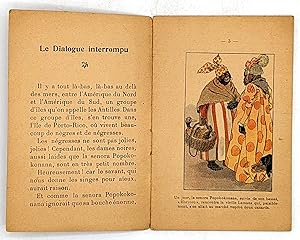
Contact seller2-star seller(12) pp including illustrated card covers. With 4 full-page colored illustrations. Clean and fresh, an excellent copy. Unrecorded (in OCLC and the CCFr) tale inflected by a particularly callous racism, ostensibly aimed at children. Chinel's story is set in Puerto Rico, "where a lot of black men and black women live", and focuses… on a particularly ugly Black woman named Popokokonana. The focus of much of Chinel's text is on the grotesque physical features of his subject, described in terms which were evidently meant to titillate young French children during the height of late 19th century European colonialism. Not content with her physical appearance alone, Chinel also mocks her loose-fitting robes and even her pet dog, Horroro, "wicked as a pest". However Popokokonana is a wealthy woman with a heart of gold, whose husband owns a sugar cane plantation on the island. One day she meets an acquaintance, 'Old Lamana' on the road, who is carrying two ducks in a basket. While they are deep in conversation, with Popokokonana generously offering to help Old Lamana with feeding her twelve children, Horroro attempts to liberate the ducks for his own pleasure, and ends up being carried out to sea by the airborne birds. Untraced in any bibliographical database known to us; but, Google Books reveals an Hachette catalogue dated June, 1914 advertising the present title (p. 179, "Ouvrages et Albums pour les Enfants").
 More images
Published by Hachette & Companie ca. 1914, Paris 1914
Seller: Editio Altera, Bronxville, NY, U.S.A.Editio Altera
Contact seller2-star seller(12) pp including illustrated card covers. With 4 full-page colored illustrations. Unobtrusive dampstain to outer blank margin throughout, otherwise excellent. Unrecorded (in OCLC and the CCFr) tale inflected by a particularly callous racism, infantilizing Africans and intended to indoctrinate children into the French colonial m…indset. Our protagonist, a young orphan named Yacoub, is taken in by "good French soldiers stationed in the Congo, who took pity on this charming little being, lively as a marmoset". The sergeant "a very white man, very large, with a fine blond moustache", amuses his fellow soldiers by feeding the "little savage" like a cat, and dressing him in an improvised tricolor uniform. The platoon's prized goose, adored by all of the soldiers and reserved for Christmas, is given to Yacoub to guard over. One day, Yacoub is watching the goose when he is startled by the menacing head of an ostrich; terrified, he believes his charge has been transformed into a gigantic version of itself, and he scales a palm tree for protection while pleading with the ostrich for clemency. The sergeant commands the entire platoon to assemble and witness the spectacle, "and they still laugh about it in the Congo to this day". Untraced in any bibliographical database known to us; but, Google Books reveals an Hachette catalogue dated June, 1914 advertising the present title (p. 179, "Ouvrages et Albums pour les Enfants").

