
Commonplace (20 results)

- Softcover
Seller: Speedyhen LLC, Hialeah, FL, U.S.A.Speedyhen LLC
Contact seller2-star sellerCondition: New
US$ 19.10
Free ShippingShips within U.S.A.Quantity: 2 available
Condition: NEW.

The Library. Transactions of the Bibliographical Society. Seventh Series, Volume 17, No 3, September 2016 / Maximiliaan Van Woudenberg "The Gottingen Library Borrowings of English Matriculants 1798-1801" / Jennie Challinor "A New Manuscript Compilation of Katherine Philips: The Commonplace Book of Robert Mathewes" / Peter Blayney "The Printers of the 'Ajax' Pamphlets of 1596-97"
William Poole & James Willoughby (Editors) / Maximiliaan Van Woudenberg "The Gottingen Library Borrowings of English Matriculants 1798-1801" / Jennie Challinor "A New Manuscript Compilation of Katherine Philips: The Commonplace Book of Robert Mathewes" / Peter Blayney "The Printers of the 'Ajax' Pamphlets of 1596-97"
Published by Oxford University Press 2016
- Softcover
- Periodical
Seller: Shore Books, London, United KingdomShore Books
Contact seller5-star sellerCondition: Used - Very good
US$ 13.82
US$ 14.76 shippingShips from United Kingdom to U.S.A.Quantity: 1 available
Soft cover. Condition: Very Good. 128 pages. Maximiliaan Van Woudenberg "The Gottingen Library Borrowings of English Matriculants 1798-1801" / Jennie Challinor "A New Manuscript Compilation of Katherine Philips: The Commonplace Book of Robert Mathewes" / Peter Blayney "The Printers of the 'Ajax' Pamphlets of 1596-97" (U.P.).

- Softcover
Seller: Speedyhen LLC, Hialeah, FL, U.S.A.Speedyhen LLC
Contact seller2-star sellerCondition: New
US$ 43.36
Free ShippingShips within U.S.A.Quantity: 6 available
Condition: NEW.

Published by CAMBRIDGE UNIVERSITY PRESS, CAMBRIDGE. 2010
- Hardcover
- First Edition
Seller: clifford milne books pbfa, Aberdeen, , United Kingdomclifford milne books pbfa
Contact seller5-star sellerCondition: Used - Near fine
US$ 27.64
US$ 43.13 shippingShips from United Kingdom to U.S.A.Quantity: 1 available
Hardcover. Condition: Near Fine. 1st Edition. 8 VO , 1ST ED 2010 , BLACK CLOTH , 306 PAGES , SOME PENCIL HIGHTLIGHTING , NEAR FINE IN SL TORN DUSTWRAPPER .
 More images
Language: English
- Hardcover
- Manuscript
Seller: Austern & Co/ BrooklynBooks, Brooklyn, NY, U.S.A.Austern & Co/ BrooklynBooks
Contact seller5-star sellerCondition: Used - Good
US$ 175.00
US$ 9.00 shippingShips within U.S.A.Quantity: 1 available
Hardcover. Condition: Good. 13.25"x10". Re-backed. 30+ leaves, many tipped in pieces. Written with an oversized clear cursive hand. Majority of the entries center on contemporary women's issues in Victorian England. 20% of the top edge of the text block has eroded occasionally affecting some of the entries. The erosion has been…stanched and the album is now in nice condition.
 More images
Published by No place, ca. 1810. 1810
- Hardcover
- Manuscript
Seller: Antiquariat INLIBRIS Gilhofer Nfg. GmbH, Vienna, A, AustriaAntiquariat INLIBRIS Gilhofer Nfg. GmbH
Contact seller5-star sellerCondition: Used
US$ 179.09
US$ 34.78 shippingShips from Austria to U.S.A.Quantity: 1 available
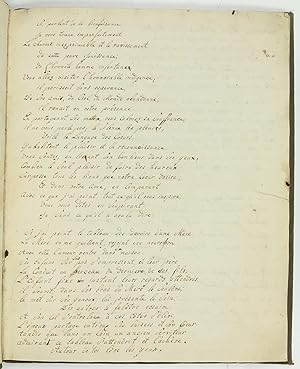
4to. French manuscript on paper. 68, 37 (but: 38) pp. Contemporary full cloth with blank spine-label. Extracts from the works of great philosophers, writers and historical personalities, jointly composed by several hands, probably bound together soon after completion. Includes passages from Seneca quoted by C. A. Demoustier in h…is "Cours de Morale" (1804), Esprit Flechier's "Oraison funèbre de Monsieur de Turenne" (1676), and Chateaubriand's "Martyrs" (1809), as well as an extract from the Gazette de France from 9 April 1808 about the writer Germaine de Stael (1766-1817). Other sources include Voltaire, Jean-Baptiste Massillon, Fréderic César de La Harpe, Marie Jeanne Riccoboni, Jacques Necker, François de Neufchâteau, Jean-François Marmontel, and the Marquis de Bonnay. With the transcript of a description of Prince Potemkin given by Catherine the Great in one of her letters edited by Madame de Stael, as well as a "Recette de faire une Tragédie moderne" by Monsieur Hayley. - Some corrections and deletions. Binding a little soiled. Paper occasionally browned and brownstained; a few marginal tears rebacked with paper. An uncommon survival reflecting the reading habits of what appears to have been a group of students.
The Faces of My Friends [Collection of Artist's Pencil Sketches, Portraits]
H. S. F. R. (arranged by); Carey, Eleanor (artist); [MANUSCRIPT, FRIENDSHIP BOOK, COMMONPLACE BOOK, SKETCHBOOK]
Published by Frederick A. Stokes [1908-1928], New York 1908
- Hardcover
Seller: Sanctuary Books, A.B.A.A., New York, NY, U.S.A.Sanctuary Books, A.B.A.A.
Contact seller5-star sellerHardcover. Original navy blue cloth, gilt-stamped lettering on upper board and spine, illustration mounted to upper board; approx. pp. 80, with 28 pencil portraits (one per page, with many pages left blank, one portait tipped-on). A cute little gift book, each page with a printed heading making a pun on the face, with two lines…for a name and date at the bottom -- on the verso only, inviting 40 portraits (or thereabouts). The artist has filled most of them and, in many cases, invited her subject to sign and date their own portrait. An adept artist, she's sketched numerous members of her family and friends -- young and old, male and female, frontal or in profile. A nice item, just a bit scuffed at spine tips and corners. Lightly finger-smudged throughout (as one would expect), and two pages neatly torn away.
 More images
Published by Avignon Pierre Chaillot Jeune 1834
- Hardcover
Seller: Shapero Rare Books, London, United KingdomShapero Rare Books
Contact seller5-star sellerCondition: Used
US$ 690.91
US$ 20.12 shippingShips from United Kingdom to U.S.A.Quantity: 1 available
16mo (15 x 9 cm); engraved frontispiece, text in French in four sections, each with its own Table de Matià res, torn with small loss to fore-edge margin pp81-82 just into text-block, minor spotting; contemporary calf-backed marbled boards, contrasting red morocco lettering-piece, loss to spine ends and corners rubbed, but boards… are firmly attached; vi (including frontis), 7-390pp. A scarce Avignon-printed commonplace book containing 900 secret recipes and remedies, ranging from instructions on making sulphuric acid to the preservation of artichokes. Rare. We can trace just once copy in institutional collections worldwide, at the Bibliothà que National de France.
 More images
Published by Northern Germany, ca. 1770-1867. 1867
- Hardcover
- Manuscript
Seller: Antiquariat INLIBRIS Gilhofer Nfg. GmbH, Vienna, A, AustriaAntiquariat INLIBRIS Gilhofer Nfg. GmbH
Contact seller5-star sellerCondition: Used
US$ 3,343.10
US$ 34.78 shippingShips from Austria to U.S.A.Quantity: 1 available
4to (172 x 202 mm). German manuscript on paper by various hands. 298 written pp. on 180 ff. (including flyleaves). Contemporary half calf over marbled boards. An extensive German commonplace book, continuously expanded for nearly a century by a family of merchants, farmers, and mariners, one of whom sailed to Virginia on the HMS… Lion to join the fleet of Admiral Cornwallis, probably in 1779 during the American Revolutionary War. - The first part (comprising some 40 ff.) offers an anthology of maxims, aphorisms, and anecdotes about the Vienna Court Theatre, about Garrick and Hogarth, King George III and Voltaire, etc., apparently mainly compiled in the 18th century, with a few later additions by other hands. The second part, begun by the same writer and considerably expanded by several later owners of the book, contains a vast miscellany of historical and historico-cultural themes. Items include a piece about verbal responses to sneezing, another about wigs and elaborate hairstyles throughout history, about the history of playing cards; and tables for housewives with which to calculate their annual expenses. Later entries focus more strongly on household remedies against illnesses (such as cholera and dropsy) and agricultural advice (how to get rid of weevils, how to increase the fertility of fruit trees). - Occasionally, the notes will provide a more immediate glimpse of the life of the writer: underneath a discussion of how to calculate the deadweight tonnage of a ship of 100 cannons with a crew of 1000 men, an early 19th century owner who signs his name "Bindseil" states that he himself "sailed on an English ship of the 2nd line, blue flag, of 64 cannons, named Lion, under Captain Fox, which was taking us to the English general Cornwallis in Virginia. On this ship were 1375 souls, 4 live oxen, 12 large pigs, the same number of rams, and 4 horses, which are not taken into account by the above calculation, as little as the minimum two anchors are, each of which weighs some 600 pounds and yet is quite indispensable [.]" (transl.). Not infrequently, an entry will cite the source from which it is drawn: newspapers and journals mentioned include the "Hamburgischer Correspondent", "Holzmindisches Wochenblatt", "Hannoverscher Anzeiger" and "Braunschweigische Zeitung", pointing to a Northern German origin. - Occasional light brownstaining; binding somewhat rubbed. A fine survival worthy of detailed study.
 More images
Published by Altdorf, Weingarten, etc. [Germany] 1862
- Hardcover
- Signed
Seller: James Cummins Bookseller, ABAA, New York, NY, U.S.A.James Cummins Bookseller, ABAA
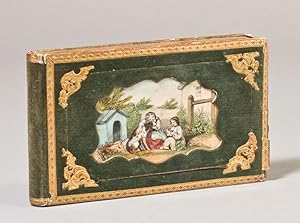
Contact seller5-star sellerHandcolored scene of two children tending a sick dog within scalloped window on upper cover, chromolithograph pictorial sentiments on inside front cover and interior lid. Six printed sentiments (colored), one with embossed gilt floral decorations. 23 autograph verse quotations and sentiments in ink, in various neat hands, includ…ing two love poems (one with a colored floral border and one with a pencil portrait of a young man). 1 vols. Obling 16mo. Charming and decorative mind-nineteenth-century German album of sentiments, most dated variously between 1852 and 1854. On the verso of a poem headed Trennung (Separation) and inscribed "Tobis seiner liebsten Anna" is a portait of a pensive young man and the caption "Jetzt bin ich's nicht mehr." One other note is signed and dated, "Anna Hehrner, im Weingarten, den 13 Mai 1862". Green velvet book book box with gilt-metal ornamental borders and corner pieces. Some minor rubbing. Contents generally fine Handcolored scene of two children tending a sick dog within scalloped window on upper cover, chromolithograph pictorial sentiments on inside front cover and interior lid. Six printed sentiments (colored), one with embossed gilt floral decorations. 23 autograph verse quotations and sentiments in ink, in various neat hands, including two love poems (one with a colored floral border and one with a pencil portrait of a young man). 1 vols. Obling 16mo. Signed.
 More images
Published by c 1853
- Manuscript
Seller: Blackwell's Rare Books ABA ILAB BA, Oxford, United KingdomBlackwell's Rare Books ABA ILAB BA
Contact seller5-star sellerCondition: Used
US$ 652.92
US$ 33.54 shippingShips from United Kingdom to U.S.A.Quantity: 1 available
manuscript in ink on paper, in 2, or 3, hands beginning at both ends, paper watermarked 1853, small pencil vignette on rear fly-leaf, pp. [56], [78], with numerous blanks between, 8vo, original roan backed boards, spine lettered in gilt 'MSS', a little rubbed and worn, headcaps defective, but solid. A curious common-place book,…in that it seems to be a combined operation, with the passages at the beginning being of a mainly religious nature, and apparently written by a woman, while those at the end are apparently the work of a man, and mainly light hearted (first text: A Bachelor's Soliloquy). At the front, most of the named authors are women (Jane Taylor and Anne Gilbert favourites), while those at the back are are men (Longfellow a favourite). At the front, one extract is a sermon by Rev. Thomas Stratten, of the Fish Street Congregational Church in Hull. Stratten was a graduate of Hoxton College. A vessel bearing his name was sunk by a U-boat mine off the Butt of Lewis in 1917.
[An extraordinary and intriguing shipboard artist's commonplace/autograph book reflecting the interactions between First Officer & Chief Officer Freeman and passengers on the SS Maine, SS American Trader, and the SS President Roosevelt from 1906 into the 1930's. Featuring a few pen & ink, watercolour paintings, and pencil sketches by Freeman himself, he managed to secure nearly 50 pieces of original artwork either to be tipped-in by his passenger artists, or, they themselves contributed during the transatlantic voyages artwork, or signed pieces directly on the artist's book pages].
[MARITIME -- COMMONPLACE ARTIST'S BOOK]. [FREEMAN, Chief Officer W.S. (Compiler & Artist).]
Published by W.S. Freeman, SS Maine, SS American Trader, ca. 1906-1935]., [New York, NY & Philadelphia, PA: 1906
- Signed
Seller: Zephyr Used & Rare Books, Vancouver, WA, U.S.A.Zephyr Used & Rare Books
Contact seller5-star sellerOblong 4to. 9.5 x 7 in. [140 pp (unpaginated).], filled w/ 55 original pen & ink sketches, oil paintings, watercolour paintings, cartoons, etchings, pencil sketches, decorated autograph pages, poems, 2 photographs (1 - 8 x 6 in.), some tipped-in and mounted, others directly rendered on the pages of this artist's book by the indi…vidual passenger artist, along with autographs, personal notes, and more. Polished padded calf, hand-tooled monogram and decorative border of W.F. on front cover, lion rampant armorial w/ Latin motto Liber et audax on back cover, decorated endpapers (rebacked, some edgewear, scuffing, slight splitting to fore-edges in a couple spots), still a VG exemplar, w/ nearly all the original art in excellent condition. This wonderful commonplace/autograph book opens with a well-executed floral design signed by Freeman, with watercolour landscape in the upper left corner. Two of Freeman's pen & ink sketches are devoted to his heroic actions as First Officer on the Atlantic Transport ocean liner SS Maine Jan. 10, 1906 leading four men in a life boat to carry out a harrowing rescue of sailors from the derelict Nova Scotian schooner Kipling, which had been battered by North Atlantic storms for 3 weeks since leaving Liverpool in December. The NY Times reported that First Officer Freeman was ordered by Captain Prager of the Maine to take the rescue, and after hard rowing they were able to reach the Kipling, where Captain Webber and his men jumped into the lifeboat, and also rescuing the mongrel terrier Dick. After being smashed by the Kipling's jib boom and holing of the lifeboat, the injured Freeman bailed as fast as possible while to the Maine and rescued all hands. The second of his pen & ink sketches of the incident, he succeeded in having all of those saved from the sinking sign in his autograph book.His others include a watercolour painting seascape entitled "Quiet Meditation," pen & ink sketch of "Honey Lane" Hertford, England in 1906, a pen & ink of naval ship firing upon a fort dated Jan. 11, and a humorous cartoon of a sailor being chased by a polar bear "A Dash for the Pole." The majority of the passenger artwork Freeman managed to secure, encompass those traveling on the SS American Trader, a steamship liner built by Sun Shipbuilding & Dry Dock in Philadelphia, and sailed under the American Merchant Lines following the failure of the Dollar Lines in 1923, and proved popular with budget-minded "one class" line passengers. Several of the contacts took place on the SS President Roosevelt where he served as Chief Officer, which was a United States Line passenger liner until 1940 when taken by the War Department and designated as the USS Joseph T. Dickman (APA-13) troop transport through the War.Notable artists which lovingly created works for Freeman include such names as:Towar Bates (1874-1938), featuring here a watercolour painting of ship's stack & mast dated Nov. 18, 1927, noted New Jersey landscape and maritime painter.Ray Bethers (1902-1973) very young American Impressionist and later Modern Artist painter who gave Freeman an original colour pencil sketch of "Indians in Southern Arizona" dated June 22, 1929.Roy Brown (1879-1956), noted landscape painter who studied at the Art Students League, and Julian Academy in Paris, who here features a pastoral pencil sketch scene dedicated to Chief Officer Freeman March 28, 1929.Paul Brown (1893-1958) famed equestrian artist and commercial artist has included a signed printed sketch of hunting scene, and etching of thoroughbred steeplechase races, and is perhaps best remembered for his Brooks Brothers catalogues, and cover art for Morrow's edition of Bagnold's "National Velvet."Fred Buchanan (1879-1941) humorist, cartoonist, and Tuck postcard artist has drawn a wonderful pen & ink cartoon of 'Jack Ashore" of a sailor with Pig & Whistle sign in the background. Still more artist's feature encompass a wonderful painted landscape scene and Chaucer quote with calligraphy by Bristol artist, Clifford H. Henley; a wonderful signed woodcut engraving of "The North Rose of Notre Dame" tipped-in by George W. Hibbitt; two splendid watercolour paintings executed onboard the SS American Trader in August, 1929 showing a seaman painting a spar, and the other a deck scene by noted landscape and watercolour artist Walter Kumme (1895-1975); an allegorical partial-nude pencil drawing by noted British-American artist Gerald Leake (1884-1975); Pittsburgh, PA artist Jean Thoburn's (1887-1934) pencil sketch drawing of Canterbury through Christchurch Gate - Mercury Lane," and even a wonderful drawing with small photo from Dora Weisbaum, and Heinrich Heine quotation. Other artist's are just initials, or this cataloguer was unable to specifically identify them, but they have added sketches, paintings, and drawing of stuffed animals, flapper girls playing tennis, a wonderful small portrait of an Edwardian girl in her stylish hat, and many others.
Published by [s.n.], [s.d.], [s.i.]
Seller: Antiquates Ltd - ABA, ILAB, Wareham, Dorset, United KingdomAntiquates Ltd - ABA, ILAB
Contact seller5-star sellerCondition: Used
US$ 1,727.28
US$ 33.54 shippingShips from United Kingdom to U.S.A.Quantity: 1 available
Manuscript on paper. 145 leaves of text, the remainder blank. Contemporary blind-ruled vellum. Extremities marked and discoloured. Scattered spotting. A choice eighteenth-century manuscript commonplace with extensive transcriptions, in a single legible hand, of passages from notable authors, including Milton, Ovid, Pliny, Locke…and Shakespeare (Othello, Merchant of Venice, Macbeth etc.) gathered under appropriate headings concerned with emotional and moral states (honesty, virtue, hope etc.) In addition, there are a number of apparently original verse compositions referencing, and indeed possibly by, Church of England clergyman, and Chaplain to the Earl of Suffolk and Berkshire, Matthew Frampton (fl. 1747-1782); though if not seemingly by an anonymous author who knew him intimately Size: Quarto.
 More images
[Manuscript:] [Extracts from l'Encyclopédie, &c].
(Dictionary-cum-commonplace book. French.) HINARD (Constantien)
Published by -19 1806
- Manuscript
Seller: Blackwell's Rare Books ABA ILAB BA, Oxford, United KingdomBlackwell's Rare Books ABA ILAB BA
Contact seller5-star sellerCondition: Used
US$ 2,756.74
US$ 60.37 shippingShips from United Kingdom to U.S.A.Quantity: 1 available
French manuscript in ink on paper (the hand is sometimes hard to read, but generally yields), several 'cahiers', lettered A-L (but not in date order), followed by a number of leaves with pencil drawings, a few leaves excised; c. [ff.] 250, folio; contemporary vellum over boards, using an old MS, splits in upper joint, about half… the vellum torn off lower cover. An intriguing manuscript, part text, part illustration. It is not clear whether this intriguing manuscript is a school exercise book, or the work of an autodidact: the period of time taken to write the various parts suggests the latter. The first 3 'cahiers' - roughly half the text contents of the volume - comprise extracts from l'Encyclopédie, with a few interpolations from other sources, such as Voltaire. The later notebooks are thematically arranged: Freemasons, 'phrases détachées' from 'Déisme réfuté', and mathematics (including dialling, these with diagrams). The 'Cahier de lettres', has numerous examples of formal epistolary style, and the last - 'Manuel de santé' - contains definitions and cures. The final section is a series of pencil drawings (on different paper), which are charming if somewhat naive. Hinard took the pains to sign some of them, these ones being character studies and caricatures - in the latter category 'Un anglais à Paris', a stout man, apparently oblivious to his surroundings, with a huge umbrella tucked under his left arm. Other subjects include French historical figures (from statues, &c) including a sketch of Napoleon at St. Cyr. The last several represent characters and scenes from French classical drama (Molière, Racine), with appropriate quotations from the plays. Perhaps the most interesting, and as it happens best executed, is 'Turner peintre de marine': 'mort 1851' which seems to have been added later. It shows Turner somewhat advanced in years; as in Edward Bird's depiction of him in the British Museum (1819). While Bird's likeliness of the great painter takes the form of a bust; here, he is standing by an easel, brush and palette in hand.
 More images
Published by [England] 1867
Seller: Whitmore Rare Books, Inc. -- ABAA, ILAB, Pasadena, CA, U.S.A.Whitmore Rare Books, Inc. -- ABAA, ILAB
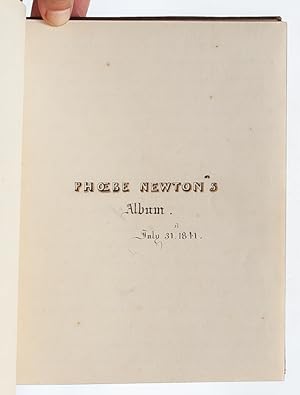
Contact seller5-star sellerFull sheep embossed in blind with gilt to front board, measuring 200 x 160mm and comprised of 155 manuscript pages. A gift inscription to the front pastedown reads "Frances Phoebe Newton, A Present from her Mother, Mrs. A. Morley. July 31st, 1841." On the first page, Phoebe has created a formal title page: "Phoebe Newton's Album…. July 31st, 1841." A dense and research-rich piece, in which a young woman documents her reading from a variety of sources including collections of poetry, popular magazines and circulars, church sermons, and oral stories within her community. Potential projects include but are not limited to Victorian reading practices, women's reading, the intersection of popular and evangelical literatures, genealogy, and paleaography. Within her commonplace book, Phoebe gravitates toward poetry and short anecdotes in which the narrating voice calmly uses rhetoric and logic to undermine non-believers or convert doubters. Her faith is the underlying basis for each selection -- even when celebrating a royal marriage or waxing on Queen Victoria's leadership. Early selections such as Doctor Watts and Collins the Freethinker focus on how Christians unshaken in their faith can lead by calm example, responding to criticism or even outright scorn by gesturing to the value of their interior relationship to God rather than to any external possessions. Doctor Watts, for example, responds to a coffeehouse stranger's "contempt at his diminutive appearance" with a short verse concluding "I must be measured by my soul -- The mind's the standard of the man." Similarly, Collins the Freethinker "once met a plain countryman going to church" and attempted to confound him by asking about God's size. The countryman's participation in the dialogue -- and his embrace of contradiction -- impress and convert the Freethinker. "He is so great that the heaven of heaven cannot contain Him; and so little that He can dwell in my heart." In this sense, Phoebe reveals in addition to her evangelical beliefs an attraction to literary realism. Rather than gravitating to soaring sentimentalism and romance, the works gathered here often rely on dialogue and daily settings, presenting a realistic world with idealized social outcomes. Phoebe's selections come from a variety of sources, which speaks to the array of material she had contact with. Some uncredited pieces appear to be stories from sermons or overheard among family. Many include Victorian writers such as Cowper and Toplady. Still others come from popular regional magazines such as the Norfolk Chronicle and the Gospel Standard. More work could be done to identify where she and her family resided and what schooling she had access to. Additional work could be done on at least one other hand in the book, several times signed John Newton and potentially her husband (given that her mother, Mrs. Morley, gifts her the book under the name Newton).
 More images
Published by [n.p.] 1830
Seller: Whitmore Rare Books, Inc. -- ABAA, ILAB, Pasadena, CA, U.S.A.Whitmore Rare Books, Inc. -- ABAA, ILAB
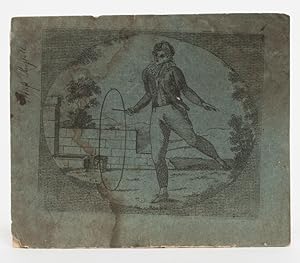
Contact seller5-star sellerComprised of 7 pages in ink in a single hand, containing six works of poetry. Dark blue printed wraps over lined paper, measuring 7x 6 inches. Ownership signature of Mrs. Russell to header of front wrap. Scattered foxing and some dampstaining not affecting text. Text block loose but holding. In all, an intriguing glimpse into a…woman's use of literature to express her own preoccupations with humans' place between nature and the divine. The six poems contained in this slim volume appear to have been thoughtfully selected and carefully copied out. Indeed, among them exist several thematic threads that teach us about the elusive Mrs. Russell, who leaves no identifying information except her ownership signature. The first poem, The Silent Expression of Nature, first appeared in the religious collection Musae Biblicae (1819) before being reprinted in Pierpont's National Reader of 1829, which was designed to provide teachers with reading exercises in class and copy exercises out of class. From its opening line, it places the narrator and reader at the center of the earth and heavens, emphasizing how nature moves before "my wondering eyes," "fills my heart," and "around me falls." Not copied in full, the opening selection of the poem emphasizes the senses in these lines, and encourages the individual to experience the cosmos. The second work, titled simply Hymn, is drawn from John Bowring's 1823 Matins and Vespers, critiqued the same year by the Monthly Review which praised its "sentiments as pure and excellent, and the language is elegant and often poetical," though the editors note "we could have wished for the occasional display of a higher spirit" (Griffiths). The poem in question is pulled out as an example of a more simplistic, childlike poem of wonder. Indeed, it shows the narrator turning to the reliable comfort of sunrise and sunset to push away existential doubts. Notably, Blue Stocking Anna Laetitia Barbauld's poem Tomorrow (1773) is included within the selection. While Baurbauld had herself written a poem in praise of Bowring, this particular piece undercuts the sentiments of his, warning the reader not to trust nature because while the sun rises and sets, no individual lives to see the process without end. Across the selections, one experiences a push and pull of humanity between nature and the divine. One also sees the carefully formed letters created by Mrs. Russell, and the care she has placed into copying out these specific pieces. With research possibilities including but not limited to paleography, gender studies, poetic publication and transmission, the role of Blue Stocking writers within the poetic community, and the use of literature to explore science and theology.
Published by c 1810
- Manuscript
Seller: Blackwell's Rare Books ABA ILAB BA, Oxford, United KingdomBlackwell's Rare Books ABA ILAB BA
Contact seller5-star sellerCondition: Used
US$ 3,264.57
US$ 60.37 shippingShips from United Kingdom to U.S.A.Quantity: 1 available
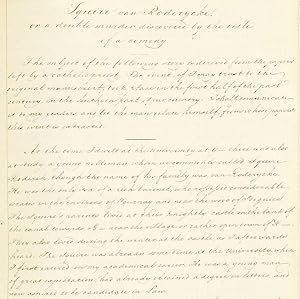
Manuscript in ink on paper watermarked J. Kool & Comp (see below) in a single, neat, extraordinarily regular and legible sloping copper-plate hand, inner margins ruled in red, the play, and succeeding pieces, in double columns with a double red rule dividing them, one section with top outer corners sliced off, the paper in the l…atter part shorter at the outer margin, textblock nearly split at centre, pp. 90, [65], folio, contemporary, non-professional, half calf over canvas covered boards, some abrasions, text block edged a bit forward, detached from headbands but by no means loose, good. Commonplace Book is perhaps not entirely apposite in describing this intriguing volume. Rather, it would seem to be an exercise book for a Dutch person perfecting their English (the English is pretty good, good Regency English, but it sometimes goes awry). The paper is Dutch, J. Kool & Comp being paper makers not far from Amsterdam, who flourished 1774-1836; the handwriting might be from any date within the period, but the mid-point seems about right. People and places are usually introduced just with an initial, but the people often have a 'van' or 'van der' before the initial, and the places have Burgomasters. All this suggests a Dutch provenance, and though literarily and calligraphically accomplished, the 'primitive' binding lends the volume a rather charming domesticity. Contents:- "Squire van Roderycke or a Double Murder Discovered by the Title of a Comedy." Pages 1-27. "The Blue Horseman and his Family or a Process of Singular Connexion Resolve by the Final Discovery of a Capital Crime." Pages 27-56. "The Coach Man James or a Remarkable Instance of Possible Innocence Notwithstanding an Accumulation of Apparent Charges." Pages 56-72. "The Enigmatical Stranger or Remarkable Discovery of a Committed Murderer after a Lapse of Eleven Years." Pages 73-90. "Fables." Eight fables, with moral instructions; at least one, "The Dog and the Wolf," is from Aesop. The others are: "The Cock and the Precious Stone"; "The Lion and the Rat"; "The Fox and the Wolf"; "The Dog, the Cock and the Fox"; "A Countryman and His Children"; "The Animals"; and "The Two Foxes." Pages [91-97]. "Tales." Eight instructive anecdotes and sketches: "The Released Galley Slave"; "Alphonsus, King of Naples and His Bufoon"; "Filial Love"; "The Innocent Treason"; "The Algerine Slave"; "The Discovery of the Island of Madeira"; "On Human Distresses"; and "Magnanimity and Gratitude." Pages [97-109]. "The Mathematicians or the Eloped Lady." A play in double columns. Pages [111-128]. "Peter, A German Tale." From the French of Jean-Pierre Claris de Florian. In double columns with the French and English versions side-by-side. Pages [129-140]. Not the translations published by T. Becket, 1786 (ESTC N25864: 1 copy in the UK, Bristol; and 4 in Noth America). "Sophronimus, a Grecian Tale." From the French of De Florian. In double columns with the French and English versions side-by-side. Pages [141-155]. A curious mixture then of the improving, and the Gothic.
- Hardcover
Seller: Sanctuary Books, A.B.A.A., New York, NY, U.S.A.Sanctuary Books, A.B.A.A.
Contact seller5-star sellerCondition: Used - Very good
US$ 850.00
US$ 5.00 shippingShips within U.S.A.Quantity: 1 available
Condition: Very Good. Burgundy cloth over boards (6.5" x 8") with "Writing Album" stamped in gilt on upper board, all edges gilt; contains over 100 pages of poems, quotations, drawings, photographs, and more by numerous contributors, and entirely by hand (numerous hands, at that). Cloth chipped along spine, with signatures expos…ed (binding remains tight); some light scuffing along the edges; internally bright and clean. Wonderful. It begins with a group portrait (b/w photograph) of May and Lily Barnes, Annie Shea, and May Rowan, dated 1904. May Rowan's name is handsomely embellished on the first page, and she's featured in many of the photographs, so it seems that she owned the book and organized its circulation. It traveled widely amongst the students at Lark Hill in Preston, though the entries span a decade (they are not chronological), and are contributed by more than 50 different people from England, Ireland, Australia, and New York mostly in English, but also in Gaelic, in French, and in musical score! Remarkable for the time and care each person took with it (only a few were satisfied with a quickly dashed bon mot and a signature), entries appear in lovely script, with hand-colored illustrations and embellishments, and demonstrate tremendous creativity and humor. An absolute treasure, through and through. Also contains more than 50 tipped-on b/w photographs mostly little thumbnail portraits, labeled and (sometimes) dated by hand featuring all sorts of handsome and/or cumbersome hats of the period.

Seller: Fokas Holthuis, Den Haag, , NetherlandsFokas Holthuis
Contact seller4-star sellerCondition: Used
US$ 71.64
US$ 31.30 shippingShips from Netherlands to U.S.A.Quantity: 1 available
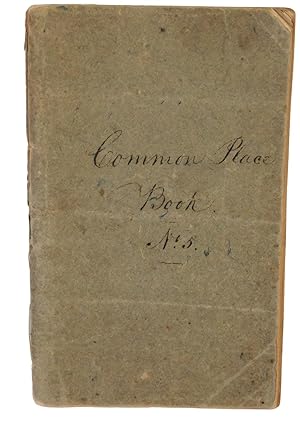
Boekband bekleed met paarsrood fluweel, waarop een metalen schild is aangebracht. 20 x 13 cm. Het eerste schutblad en een aantal bladzijden is verwijderd. 57 beschreven bladzijden met korte gedichten en citaten, voor de helft in het Nederlands, bijna de helft in het Frans en enkele in het Duits. Goed leesbaar in cursief schrift.… Aan het eind is één bladzijde in een later handschrift beschreven (met 'Hij droech onse smerten' van Revius, mogelijk uit de jaren 1930 of 1940). Met enkele jaartallen: 1883, 1889 en 1891. Afgezien van de gemelde beschadiging in goede staat. 'Commonplace Book.' De citaten zijn vaak vroom van aard, maar ook: 'Daar is een telephoon des harten/ Die ons met hen die verre zijn/ Te zamen brengt in vreugd en smarten. En dit verzacht het verre zijn'. Het woord 'telephoon' kwam vanaf 1877 algemeen in de kranten voor. Vanaf 1881 konden Nederlanders en Belgen over een openbare telefoon beschikken. Geen enkele aanwijzing in de richting van de samensteller. Man, vrouw? Welke plaats.
 More images
- Manuscript
Seller: Max Rambod Inc, Woodland Hills, CA, U.S.A.Max Rambod Inc
Contact seller5-star sellerNew York Commonplace book manuscript, 1824, compiling quotations, reflections, and informational notes that document intellectual habits and reading practices in early nineteenth-century England, with direct relevance to the study of manuscript culture, informal education, and transatlantic knowledge exchange. The anonymous comp…iler records a range of material, including political aphorisms such as "Kings have no right to enter the tabernacle of the human mind," philosophical observations, and moral reflections, alongside literary excerpts and personal selections of verse. The volume also incorporates factual data concerning the United States, including population figures for New York, indicating engagement with contemporary geographic and statistical knowledge beyond Britain. Entries such as "We live no longer in an age when fairy kings and queens bring riches to mortals." and "From the path of blood. I cannot refuse to turn aside to gather some flower of science or virtue" reflect the blending of Enlightenment-influenced thought with literary sentiment, illustrating how individuals curated and internalized ideas through handwritten compilation. Commonplace book. England, 1824. Manuscript volume comprising 38 handwritten pages, measuring approximately 6 x 4 inches, written in ink with entries organized as discrete quotations, aphorisms, and notes rather than continuous narrative. The content ranges from political commentary and moral philosophy to observational statements and copied statistics, including references to American geography and population. The notebook reflects common nineteenth-century practices of excerpting and preserving texts considered instructive or memorable. Thirty-eight manuscript pages with expected tanning to the paper; covers loose from the textblock; otherwise intact and legible; overall very good condition. A compact manuscript record of intellectual life and reading culture in the early nineteenth century.


