Order Total (1 Item Items):
Shipping Destination:

Cook John Webber (23 results)
Skip to main search results
Search filters
Product Type
- All Product Types
- Books (23)
- Magazines & Periodicals (No further results match this refinement)
- Comics (No further results match this refinement)
- Sheet Music (No further results match this refinement)
- Art, Prints & Posters (No further results match this refinement)
- Photographs (No further results match this refinement)
- Maps (No further results match this refinement)
- Manuscripts & Paper Collectibles (No further results match this refinement)
Condition Learn more
- New (No further results match this refinement)
- As New, Fine or Near Fine (No further results match this refinement)
- Very Good or Good (8)
- Fair or Poor (No further results match this refinement)
- As Described (15)
Binding
Collectible Attributes
- First Edition (4)
- Signed (No further results match this refinement)
- Dust Jacket (1)
- Seller-Supplied Images (20)
- Not Print on Demand (23)
Language (2)
Price
- Any Price
- Under US$ 25 (No further results match this refinement)
- US$ 25 to US$ 50
- Over US$ 50
Free Shipping
- Free Shipping to U.S.A. (No further results match this refinement)
Seller Location
Seller Rating
-

A VIEW OF THE TOWN AND HARBOUR OF ST. PETER AND ST. PAUL, IN KAMTSCHATKA
Language: English
Published by Alexander Hogg, London, 1784
Soft cover. Condition: Very Good. John Webber (illustrator). Engraving from Captain Cook's 3rd voyage. Measures 9x13"/23x33cm. Matted up and ready for framing.
-
Captain Cook - The Three Voyages, First Editions with Folio Atlas, Uniform Richly Gilt Spines, 1773-1784
Language: English
Published by W. Strahan and T. Cadell; W. and A. Strahan for G. Nicol and T. Cadell, London, 1773
First Edition
US$ 52,643.07
US$ 5.51 shipping
Ships from United Kingdom to U.S.A.Quantity: 1 available
Add to basketHardcover. Condition: Very Good. Webber, John; Hodges, William (illustrator). 1st Edition. COOK, Captain James; HAWKESWORTH, John; KING, James; WEBBER, John. The Three Voyages of Captain James Cook. First Editions, with the Folio Atlas to the Third Voyage. London: W. Strahan and T. Cadell, 1773; W. Strahan and T. Cadell, 1777; W. and A. Strahan for G. Nicol and T. Cadell, 1784. First editions of the three official accounts of Captain James Cook's voyages, with the folio atlas to the third and final voyage. Nine volumes: eight quarto text volumes and one folio atlas. An imposing set recording Cook's three voyages, which transformed European knowledge of the Pacific, Australasia, the Antarctic seas, Hawaii and the northwest coast of North America. Hawkesworth's First Voyage records Cook in HMS Endeavour, including Tahiti, New Zealand and the eastern coast of Australia. Cook's Second Voyage follows HMS Resolution and Adventure into the southern oceans, crossing the Antarctic Circle. The Third Voyage, completed by James King after Cook's death, records the search for a northern passage, the northwest coast of America and Hawaii. The folio atlas preserves the engraved visual record after John Webber. BINDING: Uniform, richly gilt spines, expertly restored and finished in an eighteenth-century style, with raised bands, contrasting morocco lettering pieces, numbered labels and elaborate tooling. The five volumes of the First and Second Voyages retain their earlier boards. The three volumes of the Third Voyage and the folio atlas are in sympathetic later boards bound in keeping with the period style of the set. The nine volumes have exceptional shelf presence. FIRST VOYAGE: HAWKESWORTH, John, editor. An Account of the Voyages undertaken by the Order of His Present Majesty for Making Discoveries in the Southern Hemisphere. London: W. Strahan and T. Cadell, 1773. First edition. Three volumes, quarto. Engraved portrait of Cook by J. K. Sherwin after Nathaniel Dance-Holland, with maps, charts and folding plates, including the frequently absent Chart of the Straits of Magellan. Provenance: Castle Goring; armorial bookplate of John Belts and ownership inscription of John F. Bullar. Condition: Some foxing, more evident in Volumes II and III, occasional offsetting, minor staining and light marginal worming in Volume II. Boards with light spotting and age-related wear. SECOND VOYAGE: COOK, Captain James. A Voyage Towards the South Pole, and Round the World. London: W. Strahan and T. Cadell, 1777. First edition. Two volumes, quarto. With Cook portrait and maps, charts, views and portraits, including Man of Easter Island and Man of the Island of Tanna, after William Hodges. Condition: Plates and maps notably clean. Previous owner's signature and bookplate to pastedowns, with minor pencil notes. Folding map and frontispiece professionally repaired at original folds. THIRD VOYAGE: COOK, Captain James, and KING, Captain James. A Voyage to the Pacific Ocean. London: W. and A. Strahan for G. Nicol and T. Cadell, 1784. First edition. Three volumes, quarto. Cook's final voyage in HMS Resolution and Discovery, exploring the northwest coast of North America and northern Pacific in search of a passage to Europe. Cook reached Hawaii and was killed there in 1779; the narrative was completed by King. Condition: Some offsetting, otherwise clean and strongly presented. ATLAS: WEBBER, John, and others. Atlas to A Voyage to the Pacific Ocean. London, 1784. First edition. Folio. Large-format engraved atlas to the Third Voyage, after John Webber, official artist aboard HMS Resolution, recording landscapes, portraits and coastal views. Condition: Some foxing and damp staining, with wear towards the edges of the final section; the plates remain imposing.
-

Sledge of Kamtschatka
Published by John Stockdale, Scatcherd and Whitaker, John Fielding, and John Hardy, London, 1779
Seller: Back of Beyond Books, Moab, UT, U.S.A.
Association Member: RMABA
Seller rating 5 out of 5 stars

Engraving, large print. Light foxing, one-inch tear off bottom edge; in good condition. According to the National Maritime Museum in Greenwich: "This sledge, in the Russian language, is named a Sandkey. Captain Cook brought one of the sledges away with him (along with 14 dogs) when he left Kamchatka." Captain James Cook made three voyages throughout the Pacific. He made first contact between European & Pacific cultures. Somewhat infamously, Cook was killed in Hawaii in 1779.; 22" x 16.5".
-
Wittgenstein, empiricism, and language.
Seller: SomeThingz. Books etcetera., Averbode, Belgium
Seller rating 5 out of 5 stars
Oxford University Press 2000 Bound, hardcover with original dustjacket, xv+224pp., 16.5x24cm., in very good condition. ISBN 9780195132984. This provocative study exposes the ways in which Wittgenstein's philosophical views have been misunderstood, including the failure to recognize the reductionist character of Wittgenstein's work. Author John Cook provides well-documented proof that Wittgenstein did not hold views commonly attributed to him, arguing that Wittgenstein's later work was mistakenly seen as a development of G. E. Moore's philosophy--which Wittgenstein in fact vigorously attacked. He also points to an underestimation of Russell's influence on Wittgenstein's thinking. Cook goes on to show how these misunderstandings have had grave consequences for philosophy at large, and proposes that a more subtle appreciation of linguistic philosophy can yield valuable results.
-
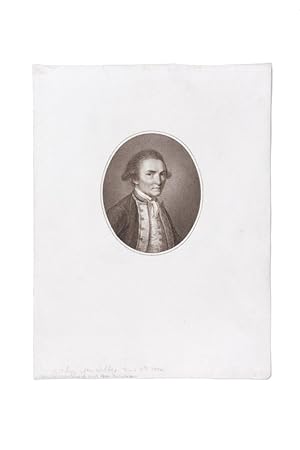
Sepia Portrait of Capt. James Cook
Published by J.Webber, June 4, London, 1784
Seller: Hordern House Rare Books, Potts Point, NSW, Australia
Association Member: ANZAAB ILAB
Seller rating 4 out of 5 stars

Condition: Very good. Stipple engraving, oval 120 x 95 mm, printed in sepia; a proof before letters; mounted. Rare proof impression before letters of John Webber's and Francesco Bartolozzi's fine oval portrait of Captain Cook. This portrait has a very large margin, unusual for this decorative oval shape, which is perhaps more often seen clipped to fit an oval frame. The original portrait of Cook was painted by Webber in 1776 and has been in London's National Portrait Gallery since 1858. Webber had collaborated with Bartolozzi earlier in 1784 to execute his famous depiction of the death of Cook, and the relationship was evidently a happy one, as they also issued the rare oval version of the depiction of Cook's death as well as this portrait. It is fair to say that the original painting of Cook has not met with universal acclaim: Beaglehole claims that on first viewing Mrs Cook exclaimed 'Who is that low villain?' (Beaglehole, On the Character of Captain James Cook, p. 418). Born in Florence in 1728, Bartolozzi arrived in 1764 in England where he worked for the next three decades. He introduced the vogue of "stippled" engraving and this portrait is a particularly good example of his work. .
-
[A View of the Town and Harbour of St Peter and St Paul, in Kamtschatka]
Published by London, 1784
Seller: Hordern House Rare Books, Potts Point, NSW, Australia
Association Member: ANZAAB ILAB
Seller rating 4 out of 5 stars
Engraving, 253 x 533 mm. to plate mark, paper size 290 x 540 mm.; a little light old creasing at right side; in fine condition. Rare proof impression of one of the most atmospheric views made by Webber to illustrate Cook's third voyage: the St Peter and Paul ostrog as seen during the expedition's first visit to Avacha Bay. This wonderful panorama of St Peter and St Paul, with Cook's ships at anchor in the bay, would later appear as plate 74 in the atlas to the official account of the third voyage. Webber's image depicts the small Kamchatkan settlement with its inhabitants fishing in front of their distinctive dwellings, all in an untouched landscape with wooded coastline and distant snow-covered mountains. It offers an arcadian vision of the place wildly at variance with what it would become: modern Petropavlovsk-Kamchatsky, now a major commercial port and the home of Russia's nuclear submarine fleet. It was at St Peter and St Paul that the battered vessels called in late April 1779, and here that Major Behm agreed to take the news of Cook's death overland to St. Petersburg. This is an early state of the print, before letters. The temporary credits here scratched into the plate are differently worded to the final version that would appear in the publication: here there is no caption identifying the view and the image is identified as "Drawn from Nature by J. Webber" and "Engraved by B.T. Pouncy". In the finished version these would be differently expressed as "J. Webber del." and "B.T. Pouncy sc.". The proof engraving is printed on a noticeably different paper and its inking is distinctly finer than the examples of the finished version with which we have compared it. The result is a greater tonal quality. Joppien and Smith discuss the Kamchatkan visit at some length in both text and catalogue volumes of their study of the art of Cook's third voyage. In their description of the related watercolour view now in the Dixson Library in Sydney they note that the original version has probably been lost and that the Dixson watercolour is probably related to the engraving process. This is a desirable and rare version of one of Webber's most successful images from Cook's third voyage. ` .
-

Inhabitants of Norton Sound, and Their Habitations
Published by John Stockton, Scatcherd and Whitaker, John Fielding, and John Hardy, London, 1778
Seller: Back of Beyond Books, Moab, UT, U.S.A.
Association Member: RMABA
Seller rating 5 out of 5 stars
Engraving, large print. Light foxing; overall in very good condition. According to the National Maritime Museum in Greenwich: "Descriptions of the inhabitants of Norton Sound, who were only encountered briefly, are sparse. The family whom Webber has drawn may be the one which Cook met on the afternoon of 13 September 'a family of the Natives came near to the place where we were taking off wood I saw no more than a Man, his wife, and child" Captain James Cook made three voyages throughout the Pacific. He made first contact between European & Pacific cultures. Somewhat infamously, Cook was killed in Hawaii in 1779.; 22" x 16.5".
-
Various Articles at Nootka Sound
Published by London, 1785
Seller: Antipodean Books, Maps & Prints, ABAA, Garrison, NY, U.S.A.
Association Member: ABAA ANZAAB ESA ILAB
Seller rating 3 out of 5 stars

Captain James Cook's third and last voyage culminated in his death in Hawaii. This ethnographic art is from the Northwest coast of Vancouver Island. From the folio atlas accompanying his voyage. 9 3/4 x 8" image on paper approx 15 3/8 x 21", some light marginal foxing.
-
A Woman of Nootka Sound on the North West Coast of America [with] A Savage of Nootka Sound
Published by London, 1795
Seller: Antipodean Books, Maps & Prints, ABAA, Garrison, NY, U.S.A.
Association Member: ABAA ANZAAB ESA ILAB
Seller rating 3 out of 5 stars
Condition: Good condition. From Hogg's Geography, a pair of portraits of natives in traditional garb, head and shoulders. Some light fox spotting. Each measures 5 x 7" and is tipped on to a plate out of Hogg's Geography, 'View of Matavia Bay in Otaheite'.
-

A View of the Habitations at Nootka Sound
Published by London, 1785
Seller: Antipodean Books, Maps & Prints, ABAA, Garrison, NY, U.S.A.
Association Member: ABAA ANZAAB ESA ILAB
Seller rating 3 out of 5 stars
Copper engraved view from the folio atlas to Captain Cook's third voyage, this classic view of the natives and their dwellings in Nootka Sound. Light general foxing around edges, slightly visible inside the impression line, otherwise good + condition.
-
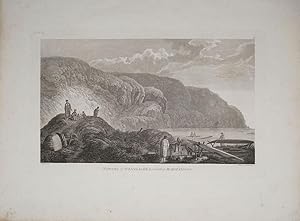
Natives of Oonalashka and their Habitations
Published by London, 1785
Seller: Antipodean Books, Maps & Prints, ABAA, Garrison, NY, U.S.A.
Association Member: ABAA ANZAAB ESA ILAB
Seller rating 3 out of 5 stars
Condition: Very good condition. Copper engraved view of natives in traditional garb tending their kayaks at the water's edge. Drawn by John Webber and published in James Cook's third voyage around the world. 15 x 9 1/2" on large paper.
-

Woman of Prince William's Sound
Published by John Stockdale, Scatcherd and Whitaker, John Fielding, and John Hardy, London, 1778
Seller: Back of Beyond Books, Moab, UT, U.S.A.
Association Member: RMABA
Seller rating 5 out of 5 stars
Engraving, large print. Light foxing, overall in very good condition. Captain James Cook made three voyages throughout the Pacific. He made first contact between European & Pacific cultures. Somewhat infamously, Cook was killed in Hawaii in 1779.; 22" x 16.5".
-

Canoes of Oonalashka
Published by John Stockdale, Scatcherd and Whitaker, John Fielding, and John Hardy, London, 1778
Seller: Back of Beyond Books, Moab, UT, U.S.A.
Association Member: RMABA
Seller rating 5 out of 5 stars
Engraving, large print, depicting three Aleuts kayaks. Very good condition. According to the National Maritime Museum in Greenwich, "The people encountered were ready to trade and invited the English into their houses. The countryside provided many herbs such as wild peas or celery and plenty of fowl. Most of Webber's field drawings of Alaskan subject matter can be dated to Cook's first stay at Samgoonoodha harbour. " Captain James Cook made three voyages throughout the Pacific. He made first contact between European & Pacific cultures. Somewhat infamously, Cook was killed in Hawaii in 1779.; 22" x 16.5".
-

Man of Oonalashka
Published by John Stockdale, Scatcherd and Whitaker, John Fielding, and John Hardy, London, 1778
Seller: Back of Beyond Books, Moab, UT, U.S.A.
Association Member: RMABA
Seller rating 5 out of 5 stars
Engraving, large print. Light foxing, small one-inch tear in bottom edge; overall in very good condition. According to the National Maritime Museum in Greenwich, Unalaska was first sightedon June 27, 1778. Captain James Cook made three voyages throughout the Pacific. He made first contact between European & Pacific cultures. Somewhat infamously, Cook was killed in Hawaii in 1779.; 22" x 16.5".
-

Man of Prince William's Sound
Published by John Stockdale, Scatcherd and Whitaker, John Fielding, and John Hardy, London, 1778
Seller: Back of Beyond Books, Moab, UT, U.S.A.
Association Member: RMABA
Seller rating 5 out of 5 stars
Engraving, large print. Light foxing; overall in very good condition. According to the National Maritime Museum in Greenwich, the Resolution, Cook's ship, made its journey to Prince William Sound in May 1778. "The sitter may possibly be the man who came aboard the Resolution on 14 May 1778. Cook called him a 'good looking middle aged man . . . He was cloathed in a dress made of the Sea beaver skin and on his head such a cap as is worn by the people of King Georges Sound, Ornamented with sky blue glass beads about the size of a large pea.' " Captain James Cook made three voyages throughout the Pacific. He made first contact between European & Pacific cultures. Somewhat infamously, Cook was killed in Hawaii in 1779.; 22" x 16.5".
-

A View of Christmas Harbour in Kerguelen's Land
Published by London, 1785
Seller: Antipodean Books, Maps & Prints, ABAA, Garrison, NY, U.S.A.
Association Member: ABAA ANZAAB ESA ILAB
Seller rating 3 out of 5 stars
First Edition
Condition: Very good condition. First edition. A view of this Sub-Antarctic island, so named by Capt Cook, who spent Chritmas Day there in 1776 with resident penguins. Cook's ships Resolution and Discovery are pictured at anchor. A member of the crew hunts penguins, who appear not to be afraid of him, and why would they be. From the folio atlas to Cook's 3rd voyage Pacific Ocean exploration. Copper engraving from the folio atlas accompanying the publication of the voyage. A very crisp image, large margins, with some slight dusting around edges. Paper 16 3/8 x 22".
-

A White Bear
Published by London, 1785
Seller: Antipodean Books, Maps & Prints, ABAA, Garrison, NY, U.S.A.
Association Member: ABAA ANZAAB ESA ILAB
Seller rating 3 out of 5 stars
Copper engraved portrait of a polar bear on ice, from the folio atlas accompanying the last voyage of Captain Cook. Very good + condition, extra wide margins. 9 3/4 x 8" image on paper approx 16 x 21.5".
-
5 images from the Pacific Islands from James Cook's folio atlas of the Third Voyage including A View at Anamooka; The Reception of Captain Cook in Hapaee; A Human Sacrifice in a Morai in Otaheite; A Dance in Otaheite; A View of Huaheine
Published by London, 1785
Seller: Antipodean Books, Maps & Prints, ABAA, Garrison, NY, U.S.A.
Association Member: ABAA ANZAAB ESA ILAB
Seller rating 3 out of 5 stars
Copper engraved images of Tonga, Tahiti & the Society Islands from the folio atlas of Cook's 3rd voyage Pacific Ocean exploration. The images illustrate the native islanders rowing out to receive Cook; a reception with warriors demonstrating their strength; a human sacrifice; famous image of Tahitian women dancing and the harbour at Huaheine, with Cook's ships Resolution and Discovery in the harbor. Plate numbers included are #13,14, 25, 28 & 31. All with very wide margin. Paper sizes 21 5/8 x 16". Some light marginal dusting, overall very good condition.
-
7 images from the Pacific Northwest from James Cook's folio atlas of the Third Voyage including Various Articles at Nootka Sound; A View of the Habitations in Nootka Sound; A Man of Oonalashka; A Woman of Oonalashka; Sea Horses; Native of Oonalashka and their Habitations; A White Bear
Published by London, 1785
Seller: Antipodean Books, Maps & Prints, ABAA, Garrison, NY, U.S.A.
Association Member: ABAA ANZAAB ESA ILAB
Seller rating 3 out of 5 stars
Copper engraved images of Alaska & Vancouver Island from the folio atlas of Cook's 3rd voyage Pacific Ocean exploration. The plate numbers included are #40, 41, 48, 49. 52, 57 & 73. Two images are of Alaskan natives, their boats and huts, going about their daily lives. Sea Horses refers to seals and the white polar bear is majestic. Two with a corner waterstain, one with a slight brown circle in the margin, one with marginal foxing. Paper sizes 21.5 x 16.25" and one is 22 7/8, all with wide margins. Some light marginal dusting, overall very good condition.
-
2 images of Hawaii from James Cook's folio atlas of the Third Voyage including Various Articles at the Sandwich Island & An Inland View in Atooi
Published by London, 1785
Seller: Antipodean Books, Maps & Prints, ABAA, Garrison, NY, U.S.A.
Association Member: ABAA ANZAAB ESA ILAB
Seller rating 3 out of 5 stars
Condition: Very good overall. Copper engraved images of Hawaii from the folio atlas of Cook's 3rd voyage Pacific Ocean exploration. The images illustrate the native Hawaiians at their village on the island now called Kauai (plt. 35). The ethnographic items include featherwork, carving and weapons embedded with shark teeth (plt. 67). Both with very wide margin. Paper sizes 21.5 x 16.25". The Atooi print with light marginal dusting and a small closed tear ikn the margin lower left.
-
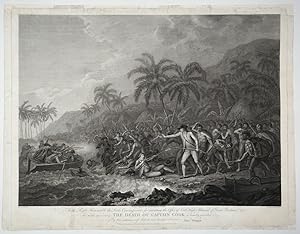
The Death of Captain Cook. To the Right Honourable the Lords Commissioners for executing the Office of Lord High Admiral of Great Britain & c. This Plate representing The Death of Captain Cook is humbly inscribed. By their Lordship's most obedient and devoted Servant, John Webber
Published by W. Byrne, No. 79 Titchfield Street & J. Webber, No. 312 Oxford St., London, 1784
Seller: Antipodean Books, Maps & Prints, ABAA, Garrison, NY, U.S.A.
Association Member: ABAA ANZAAB ESA ILAB
Seller rating 3 out of 5 stars
First Edition
Print. Condition: Very good condition. First printing. The separately published image by Webber of one of the iconic images of the 18th century. Cook, already a successful navigator, was immortalized after his death at the hands of Hawaiian natives at Karakakoa Bay. Cook had spent two months on the Big Island in 1779 and was well received, the natives believing he was a god. When he was forced to return due to a damaged mast, he was viewed as a mortal who had already sorely stretched the supplies of the Hawaiians. It is also thought that his handling of the natives was uncharacteristically brusque, leading to conjecture that this consummate traveler's judgment was somehow impaired. Copper engraving, published as the Act Directs 1st Jan. 1784, by J. Webber, No. 312, Oxford Street, and W. Byrne, No. 19, Titchfield Street, London. 22 3/4 x 18 1/4" image size. A very crisp impression on laid, watermarked paper. With the impression mark. A very nice bright clean copy of an important separately published engraving. Some cracking of edges outside the impression mark restored and the print is laid on archival paper.
-

The Death of Captain Cook. To the Right Honourable the Lords Commissioners for executing the Office of Lord High Admiral of Great Britain & c. This Plate representing The Death of Captain Cook is humbly inscribed. By their Lordship's most obedient and devoted Servant, John Webber
Published by W. Byrne, No. 79 Titchfield Street & J. Webber, No. 312 Oxford St., London, 1784
Seller: Antipodean Books, Maps & Prints, ABAA, Garrison, NY, U.S.A.
Association Member: ABAA ANZAAB ESA ILAB
Seller rating 3 out of 5 stars
First Edition
Print. Condition: Very good condition. First printing. The separately published image by Webber of one of the iconic images of the 18th century. Cook, already a successful navigator, was immortalized after his death at the hands of Hawaiian natives at Karakakoa Bay. Cook had spent two months on the Big Island in 1779 and was well received, the natives believing he was a god. When he was forced to return due to a damaged mast, he was viewed as a mortal who had already sorely stretched the supplies of the Hawaiians. It is also thought that his handling of the natives was uncharacteristically brusque, leading to conjecture that this consummate traveler's judgment was somehow impaired. Copper engraving, published as the Act Directs 1st Jan. 1784, by J. Webber, No. 312, Oxford Street, and W. Byrne, No. 19, Titchfield Street, London. 22 3/4 x 18 1/4" image size. A very crisp impression on laid, watermarked paper. Without the impression mark, with an archival border added to aid in framing. A very nice copy of an important separately published engraving.
-

The Death of Captain Cook, In February 1779 by the murdering Dagger of a Barbarian at Carakakooa, in one of the Sandwich Isles. He having there become a Victim to his own Humanity. The Distressing Scene, is Part of the Original Plate after Webber by Messrs Bartolozzi & Byrne
Published by Sold in Spur Street, Leicester Square, London, 1784
Seller: Hordern House Rare Books, Potts Point, NSW, Australia
Association Member: ANZAAB ILAB
Seller rating 4 out of 5 stars
Oval engraving, 350 x 265 mm. (image size); mounted. Rare variant of the famous engraving of Cook's death showing, as the caption notes, "Part of the Original Plate after Webber" and presumably quite literally printed from an oval cut from the fuller engraved copper. This is only very rarely seen: the single example noted by Joppien and Smith was in the British Museum. The full-size engraving was first issued early in 1784. Based on the oil painting executed by Webber soon after he returned to London in 1780, the figures were engraved by Francesco Bartolozzi and the landscape by William Byrne. Quickly becoming the most famous of all eighteenth-century depictions of the massacre, the view appeared at about the same time as the official third voyage account was published. This was no coincidence: although lavishly illustrated by Webber, the official account did not include any depiction of the most famous scene of the entire voyage, the death of Captain Cook. As a result, the iconic engraving is often seen bound into extra-illustrated editions of the third voyage account. Reflecting the general opinion prevailing in published accounts of the voyage, the original image, as Joppien and Smith argue, appeared to show Cook as 'an innocent victim, killed in the act of pleading for peace'. This is here heightened by the changed composition, as the oval shape dictates a radically different impact to that of the original engraving, omitting the dramatic conflict between the British sailors and the Hawaiians and thus implying a scene in which Cook, his arm raised in supplication to his men offstage, stands alone and is overwhelmed by a seething crowd. The only copy noted among Australian holdings appears to be the heavily clipped copy in the National Library of Australia, part of the Nan Kivell collection. . Small crease in lower corner, in good condition.



![Seller image for [A View of the Town and Harbour of St Peter and St Paul, in Kamtschatka] for sale by Hordern House Rare Books](https://pictures.abebooks.com/inventory/md/md13245438682.jpg)