
Daniel Conner Library (5 results)
 More images
The Poems of Ossian, Translated by James MacPherson, Esq. With The Translator's Dissertations on the Era and Poems of Ossian ; Dr.Blair's Critical Dissertation; And An Inquiry into the Genuineness of These Poems, Written Expressly for this Edition, by the Rev. Alex[ander] Stewart.
[Daniel Conner Library (Manch House)] - [Ossian] McPherson, James.
Published by Edinburgh, Oliver & Boyd, High-Street, no year [c.]. 1820
- Hardcover
Seller: Inanna Rare Books Ltd., Skibbereen, CORK, IrelandInanna Rare Books Ltd.
Contact seller5-star sellerCondition: Used
US$ 152.61
US$ 32.41 shippingShips from Ireland to U.S.A.Quantity: 1 available
Duodecimo. Frontispice and engraved Titlepage, VIII, 590, 2 pages. Hardcover. Very good condition with only minor signs of wear. Binding slightly shaky but still holding. From the library of Daniel Conner (Connerville / Manch House), with his name in ink to endpaper. James Macpherson (Gaelic: Seumas MacMhuirich or Seumas Mac a'…Phearsain; 27 October 1736 17 February 1796) was a Scottish writer, poet, literary collector, and politician. He is known for the Ossian cycle of epic poems, which he claimed to have discovered and translated from Gaelic. In 1761, Macpherson announced the discovery of an epic on the subject of Fingal supposedly written by Ossian, which he published in December. Like the 1760 Fragments of Ancient Poetry, it was written in musical measured prose. The full title of the work was Fingal, an Ancient Epic Poem in Six Books, together with Several Other Poems composed by Ossian, the Son of Fingal, translated from the Gaelic Language. The narrative was related to the Irish mythological character Fionn mac Cumhaill/Finn McCool. The figure of Ossian was based on Fionn's son Oisín. Fingal takes his name from Fionnghall, meaning "white stranger". Another related poem, Temora, followed in 1763, and a collected edition, The Works of Ossian, in 1765. The authenticity of these translations from the works of a 3rd-century bard was immediately challenged by Irish historians, especially Charles O'Conor, who noted technical errors in chronology and in the forming of Gaelic names, and commented on the implausibility of many of Macpherson's claims, none of which Macpherson was able to substantiate. More forceful denunciations were later made by Samuel Johnson, who asserted (in A Journey to the Western Islands of Scotland, 1775) that Macpherson had found fragments of poems and stories, and then woven them into a romance of his own composition. Further challenges and defences were made well into the nineteenth century, but the issue was moot by then. Macpherson's manuscript Gaelic "originals" were published posthumously in 1807;[8] Ludwig Christian Stern was sure they were in fact back-translations from his English version. (Wikipedia) Sprache: english.
 More images
Sammelband with Greek Cambridge-Bible, Psalms of David [Book of Psalms] and Apocryphs, printed by John Field in 1665. Bibliography (Transliterated from the original Greek): Volume I: "Biblos tes demosias euches kai teleseos mysterion kai ton allon thesmon kai teleton tes ekklesias, kata to eth[os] tes Agglikanes Ekklesias. Pros [de] t[ou]tois typos k[ai] tropos tes katagaseos, cheirotonias, kai kathieroseos episkopon, presbyteron, k[ai] diakonon". / [Bound with Volume II: "Psalterion toy Dabid kata tous Hebdomekonta eis ta tmemata, ta en te tes Agglikanes Ekkesias leitourgia nomizomena, diegemenon"]. / [Bound with: Volume III: ["Apocrypha" - No Titlepage, as issued in all known editions].
[Daniel Conner Library - Manch House] - [Greek Cambridge Bible / Church of Ireland] Phieldou, Ioannou [John Field].
Published by En te Kantabrigia [Cambridge], Ioannou Phieldou [John Field]. 1665
- Softcover
Seller: Inanna Rare Books Ltd., Skibbereen, CORK, IrelandInanna Rare Books Ltd.
Contact seller5-star sellerCondition: Used
US$ 453.05
US$ 32.41 shippingShips from Ireland to U.S.A.Quantity: 1 available
Duodecimo (8,5 cm x 15 cm). Pagination: Volume I: [36], 126, [2] pages / Volume II: [2], 115, [3], 11771, [1] pages / Volume III: 1-273, [1] pages. Hardcover / Original, 17th century leather with tooled ornaments to spine and boards. Firm and in very good condition with only minor signs of external wear and only very minor damag…e to pastedown. Interior in unusually clean and bright condition. From the library of Daniel Conner (Connerville / Manch House), with his Exlibris / Bookplate loosely attached to endpaper. This is an example of the rare, original John Field - Edition, not the long undetected John Hayes Reprint of the Bible / Septuagint after the Vatican Edition, which is mentioned in an important article in the Journal of Theological tudies, Vol. 6, No. 24 (July, 1905), pp. 611-614 (4 pages). [Darlow & Moule 4702] Sprache: english.
 More images
Ancient Irish Histories - The Works of Spencer, Campion, Hanmer and Marleburrovgh [sic] - In Two Volumes. Volume I: Containing Spencer's View of the State of Ireland and Campion's Historie of Ireland / Volume II: Containing Doctor Meredith Hanmer's and Henry Marlebvrrough's 'Chronicles of Ireland'.
[Provenance: Manch House - Daniel Conner & Henry Langfield Conner Library] - [Spenser, Edmund / Campion, Edmund / Hanmer, Meredith / Marlborough, Henry of].
Published by Dublin, Printed by the Society of Stationers / Reprinted at the Hibernia Press, for the Proprietors, by John Morrison. 1809
- Hardcover
Seller: Inanna Rare Books Ltd., Skibbereen, CORK, IrelandInanna Rare Books Ltd.
Contact seller5-star sellerCondition: Used
US$ 572.27
US$ 32.41 shippingShips from Ireland to U.S.A.Quantity: 1 available
First Hibernia Press Edition in the year 1809 of the original 1633-Edition. Two Volumes [complete set]. Large Octavo. Pagination: Volume I: [2], 22, [4] pages, including the rare, engraved dedication-leaf with allegorical vignette for the "Dublin Society" [showing the Irish Harp etc.], [10], 266, [8], 204 pages plus one errata-l…eaf / Volume II: [4], 410, [II], 32 pages. Hardcover / Original, 19th century publisher's binding. Now professionally restored by a professional bookbinder. Very good condition with only minor signs of wear. Binding with some staining. Deckled edges. Name of pre-owner, H.L.Conner. to both title-pages. Sprache: english.
 More images
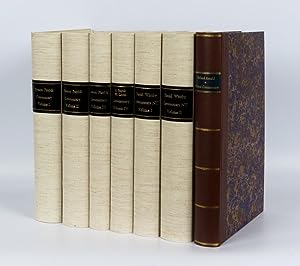
"A Commentary upon the Historical Books of the Old Testament, Viz. Genesis - Exodus - Leviticus - Numbers - Deuteronomy - Joshua - Judges - Ruth - I. Samuel - II. Samuel - I. Kings - II. Kings - I. Chronicles - II. Chronicles - Ezra - Nehemiah - Esther. In Two Volumes. By the Right Reverend Father in God, Dr. Symon Patrick, Late Lord Bishop of Ely. The Sixth Edition Corrected. To wich is added a compleat Alphabetical Table." / Plus: [Volume III: "The Books of Job, Psalms, Proverbs, Ecclesiastes and the Song of Solomon, Paraphrased: With Arguments to each Chapter, and Annotations thereupon". / Plus: [Volume IV: "A Commentary upon the Three Lesser Prophets: Being a Continuation of Bishop [Symon] Patrick by William Lowth, B.D. Prebendary of Wi
[Provenance: Daniel Conner of Manch House-Library (Dunmanway, County Cork)] - Patrick, Symon [Simon Patrick, Late Lord Bishop of Ely] / Whitby, Daniel / Lowth, William / Arnald, Richard / Johannes Millii.
Published by London, Printed for A. Millar, J.Beecroft, W.Strahan, J.Hinton etc. / And for the Richard Arnald publication: "Printed for the Author" by W.Bowyer, 1744-1765. 1765
- Hardcover
Seller: Inanna Rare Books Ltd., Skibbereen, CORK, IrelandInanna Rare Books Ltd.
Contact seller5-star sellerCondition: Used
US$ 2,265.24
US$ 32.41 shippingShips from Ireland to U.S.A.Quantity: 1 available
Set of Nine Volumes (bound in Seven). Folio (24,5 cm x 36 cm). Volume I: Portrait-Frontispiece of Symonis Patrick by Godfrey Kneller & Gerard Vandergucht, [2], 908 pages / Volume II: [2], 755 pages plus 28 unnumbered pages of an Alphabetical Index / Volume III: [6], 544 pages / [Volume IV]: [2], IV, 540 pages including an Index.… / [Volume V (Being Volume I of Daniel Whitby's "Paraphrase": [2], L, 736, [5], pages / [Volume VI (Being Volume II of Daniel Whitby's "Paraphrase": [4], XXXIV, 854 pages / [Volume VII (Being the "Critical Commentary of the Book of The Wisdom of Solomon" by Richard Arnald): [1], XXXII, 148 pages / [Volume VIII: (Being the "Critical Commentary upon the Book of the Wisdom of Jesus the Son of Sirach"): IX, [7], IV, 248 pages / [Volume IX: (Being "A Critical Commentary upon the Books of Tobit Judith etc.")XII, 128 pages.// Recently rebound set in Hardcover (Modern cloth and one modern half leather). All Volumes in protective Collector's Mylar and with new endpapers and new spine-labels. Excellent condition with some minor signs of wear only. The Interior in very good, rather excellent condition with only some very few sections with some browning. The paper-quality of this set is magnificent ! From the library of Daniel Conner (Connerville / Manch House), with his name and date of his studies in Oxford on all titlepages. A very rare set of the important Commentary by Symon Patrick, Bishop of Ely. With all the original illustrations by Gerard Vandergucht. The set includes the continuations of Simon Patrick's works by William Lowth, Daniel Whitby and Richard Arnald. Please see the numerous, detailed photographs for this set on our website. The price does NOT include shipping / Extra shipping-costs required. Simon Patrick (8 September 1626 31 May 1707) was an English theologian and Bishop. He was born at Gainsborough, Lincolnshire, on 8 September 1626, and attended Boston Grammar School. He entered Queens' College, Cambridge, in 1644, and after taking orders in 1651 became successively chaplain to Sir Walter St. John and vicar of Battersea, Surrey. He was afterwards (1662) preferred to the rectory of St. Paul's, Covent Garden, London, where he continued to labor during the plague. He was appointed Dean of Peterborough in 1679, and Bishop of Chichester in 1689, in which year he was employed, along with others of the new bishops, to settle the affairs of the Church in Ireland. In 1691 he was translated to the see of Ely, which he held until his death on 31 May 1707. He was buried in Ely Cathedral. He had Dalham Hall built. His sermons and devotional writings are numerous, and his Commentary on the Historical and Poetical Books of the Old Testament, in 10 vols., going as far as the Song of Solomon, was reprinted in the 1810 Critical Commentary on the Old and New Testaments and Apocrypha, along with works of Richard Arnald, Moses Lowman, William Lowth, and Daniel Whitby. Patrick's Friendly Debate between a Conformist and a Nonconformist was a controversial tract, defending the Five Mile Act. It excited considerable feeling at the time of its publication in 1668. Among replies was one from Samuel Rolle as Philagathus. He also contributed to a volume of Poems upon Divine and Moral Subjects (1719). The first collected edition of his works appeared at Oxford in 1858 (9 vols.), edited by Alexander Taylor; a small Autobiography was published also at Oxford in 1839. He is the author of the anti-semitic pamphlet, "Jewish Hypocrisie, A Caveat To The Present Generation." Simon Patrick, was influenced by prominent Arminian theologians as Henry Hammond, and the Cambridge Platonists; and was criticized for his Arminian belief. He is described by historians as an influential Arminian Anglican. (Wikipedia) Sprache: english.
 More images
Published by London, Printed for D. Browne, without Temple-Bar; A.Millar, in the Strand; and J.Whiston and B.White, in Fleet-Street. 1754
Seller: Inanna Rare Books Ltd., Skibbereen, CORK, IrelandInanna Rare Books Ltd.
Contact seller5-star sellerCondition: Used
US$ 2,146.02
US$ 32.41 shippingShips from Ireland to U.S.A.Quantity: 1 available
Quarto (24 cm x 29 cm). Collation [complete as called for by Index]: Title, 11 unnumbered pages, 327 pages plus 18 plates (partly folded) with Weights, Measures and Values of Several Foreign Coins explained. Original 18th-century binding, recently rebacked in 18th-century-style by two english master-bookbinders. Excellent condit…ion with only minor signs of external wear. Front free endpaper with faded dampstain. Only very minor signs of foxing. Some minor wormhole - damage to the inner margins but not effecting the text. Wide margins. Extremely Rare Publication, now beautifully restored ! From the library of Daniel Conner (Connerville / Manch House), with his Exlibris / Bookplate to pastedown. Includes the following chapters: A Dissertation containing the Principles and Authorities upon which the Tables are founded / The Antiquity and Inventors of Money Of the Metals and other Materials that were commonly stamped into Money and of some of the most common Impresses / Of Roman Coins (Of the AS or AES) / Of the Sestertius / Of the Nummus, Denarius and Roman Pondo / Of the Graecian Coins / Of the Jewish Coins in which their weights are likewise considered / Of the Proportion of the Value of Gold to Silver amongst the Ancients and of their their Gold Coins / Of Roman, Greek and Arabian Weights / Roman Weights / Greek Weights / Arabian Weights / Of Measures of Length and Superficial Roman Measures / Of Superficial Measures and some Terms of Husbandry / Greek Measures / Jewish Measures of Length / Of Measures of Capacity for things dry (Roman) / Greek Measures of Capacity / Greek Measures of things dry / The Jewish Measures of Capacity / Jewish Measures for things liquid / The Account of the Hebrew Vessels according to Josephus, taken from Bishop Hooper / Of the Measures of Capacity of the most noted Eastern Nations / A Dissertaion of Roman Money Affairs / Of Roman Estates / Of the Prices of Bread-Corn / Of the Price of Wine / Of the Price of Cattle / Of the Roman Expenses in Eating / Of the Price of Cloaths / Of the Prices of Houses / Of the Price of Land / The Price current of Drugs, as they stood at Rome, most of them in Pliny's Time per Roman Pound, which is 3/4 of the English Averdupois / Of the Price of Slaves / Of the Prices of Pictures, Statues and other Pieces of Workmanship, of Arts, Professions &c. / Of Plate and Jewels / Of Gaming and Funeral Expences / Of Soldier's Pay / Of the Donatives given to the Soldiers / Of the Congiaria of the Emperors or Gifts to the People / Of the Revenues of the Roman Empire / Some Observations upon the Grecian Money Affairs / Some Examples of the Application of the Tabels relating to the Money-Affairs of the Jews / Of the Cost of the Temple and the Riches of David and Solomon / Of the Interest of Money / A Dissertation concerning the Navigation of the Ancients / A Dissertation concerning the Doses of Medicines given by Ancient Physicians / A Short Account of the Prescriptions of Celsus / Some Example of the Manner of Prescribing and Doses of Medicines taken from Scribonius Largus / Some Examples of Prescriptions taken out of Marcellus / The Simple Doses of purging Medicines, according to Ruffus Ephesius / The Doses of simple purging Medicines, according to Paulus Aegineta [Paul of Aegina]/ The Doses of compound purging Medicines, from Paulus Aegineta [Paul of Aegina] / Some Instances of the Practice of Aretaeus [Aretaeus Of Cappadocia]/ Shekel to Maneh etc./ John Arbuthnot FRS (baptised 29 April 1667 27 February 1735), often known simply as Dr Arbuthnot, was a Scottish physician, satirist and polymath in London. He is best remembered for his contributions to mathematics, his membership in the Scriblerus Club (where he inspired both Jonathan Swift's Gulliver's Travels book III and Alexander Pope's Peri Bathous, Or the Art of Sinking in Poetry, Memoirs of Martin Scriblerus, and possibly The Dunciad), and for inventing the figure of John Bull. (Wikipedia) Sprache: english.


