
Dibuzhinsky (1 results)
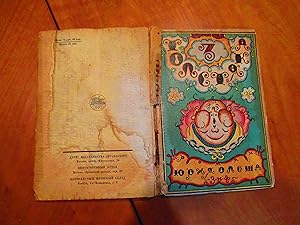
Tri Tolstya︡ka : Roman Dli︠a︡ Deteĭ / Три Толстяка : Роман Для Детей
I︠u︡riĭ / Iuri Karlovich Olesha; 25 Color Plates By Mstislav Valerianovich Dobuzhinskii / Dibuzhinsky
Language: Russian
Published by Земля И Фабрика / Zemli︠a︡ I Fabrika,, Moskva / Moscow Leningrad 1930
- Hardcover
Seller: Arroyo Seco Books, Pasadena, Member IOBA, Pasadena, CA, U.S.A.Arroyo Seco Books, Pasadena, Member IOBA
Contact seller4-star sellerCondition: Used - Good
US$ 435.00
US$ 8.00 shippingShips within U.S.A.Quantity: 1 available
Hardcover. Condition: Good. 2nd Edition. 191 Pp. Illustrated Boards. Second Edition. Spectacular Color Plates Tipped In. Covers Worn, Spine Half Chipped Away And Remaining Half Mostly Detached, Pages With Some Waviness And 1/2" Deep Dampstain Along Bottom Edges, Not Affecting Text Or Plates. Mstislav Valerianovich Dobuzhinsky Or… Dobujinsky (Lithuanian: Mstislavas Dobužinskis, 1875 -1957) Was A Russian And Lithuanian Artist Noted For His Cityscapes Conveying The Explosive Growth And Decay Of The Early Twentieth-Century City. In Munich, He Came To Be Influenced By The Jugendstil. On His Return To Russia, He Joined The Mir Iskusstva". Dobuzhinsky Was Distinguished From Other Miriskusniki By His Expressionist Manner And Keen Interest In Modern Industrial Cityscapes. He Often Painted Seedy Or Tragic Scenes From Urban Life Which Expressed The Nightmarish Bleakness And Loneliness Of Modern Times. Among His Works Were Also Humorous Vignettes And Sketches With Demon-Like Creatures Which Seemed To Embody The Monstrosities Of Urbanization. Like Other Members Of The Mir Iskusstva, Dobuzhinsky Also Experimented With Scenic Design. At First He Worked For Constantin Stanislavski At The Moscow Arts Theatre, But Later On Also Contributed Sets To Several Diaghilev Productions. He Was Renowned As An Excellent Art Teacher; Among His Young Pupils Was Vladimir Nabokov, With Whom He Maintained Correspondence For Decades. During The First World War Dobuzhinsky Went With Eugene Lanceray To The Front Lines To Sketch. In 1918, He Supervised The Theatrical Workshop At The State Educational Workshops Of The Decorative. In 1920, He Took Part In The Second Congress Of The Communist International. Among His Later Works Are Series Of Masterful And Dramatic Illustrations, Notably For Dostoyevsky's White Nights (1923) And Yuri Olesha's Three Fat Men (1925). Dobuzhinsky Contributed Sets For Theatre Productions In Paris, Brussels, Amsterdam, And Düsseldorf. In 1923-24, He Went Abroad To Study Developments In European Art And To Arrange One-Man Shows. In 1924, Dobuzhinsky Followed The Advice Of Jurgis Baltrusaitis And Withdrew To Lithuania. He Was Naturalized There In 1924 And Lived In Kaunas Until 1925. Between 1925 And 1929 Lived In Paris Where He Designed Sets For Nikita Balieff's The Bat. He Returned To Lithuania In 1929. In Lithuania He Worked At A State Theatre As Scenographer And Created Scenography For 38 Plays, Besides Running A Private Painting School (1930-1933).He Then Emigrated To England In 1935, And Moved To The United States In 1939 Where He Stayed For The Duration Of The War. During World War Ii, Dobuzhinsky Painted Imaginary Landscapes Of The Besieged Leningrad. He Spent The Last Ten Years Of His Life In Europe, Occasionally Returning To New York For Theatrical Work.
