
Diepenbeke Abraham (6 results)

Engraved Portrait of Van Diepenbeke, Half Length, French inscription, after Van Diepenbeck by Paul Pontius.
ABRAHAM VAN DIEPENBEKE [1599-1675] Flemish Painter and Draughtsman.
Published by published J. Meyssens, 1662. 6.5in x 4.5in 1662
Seller: R.G. Watkins Books and Prints, Ilminster, SOMER, United KingdomR.G. Watkins Books and Prints
Contact seller5-star sellerCondition: Used
US$ 24.89
US$ 37.59 shippingShips from United Kingdom to U.S.A.Quantity: 1 available
Engraving, from C. de Bie's, "Het Guilden Cabinet", trimmed and tipped onto backing sheet.
 More images
Published by Chez Jean Brindley, Libraire de S. A. R. Monseigeur le Prince de Galles, dans New Bond-street, London 1737
- Hardcover
- First Edition
Seller: Donald A. Heald Rare Books (ABAA), New York, NY, U.S.A.Donald A. Heald Rare Books (ABAA)
Contact seller5-star sellerCondition: Used
US$ 12,000.00
US$ 25.00 shippingShips within U.S.A.Quantity: 1 available
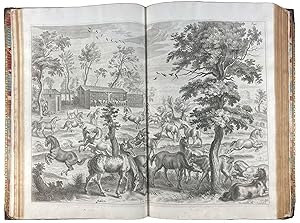
Folio. (20 3/4 x 14 1/4 inches). Second edition deluxe large paper issue with wide margins. 43 double-page engravings after Abraham van Diepenbeke including 42 numbered 1-42, and the unnumbered 1658 title with Anvers imprint. Engraved head-piece to first dedication. Numerous woodcut illustrations throughout the text, and woodcut… historiated and inhabited initials, head- and tail-pieces, and printer's ornaments. [12] [1]-236. 248 pp. Letterpress title with London imprint and four dedications to Henriette Cavendishe-Holles, the King of Grande-Bretagne, Charles Vicomte de Mansfield, and to Cavaliers. Avertissement, avant-propos, four livres plus an Abbrege de la Cavalerie, conclusion, additions, table des chapitres. With incisive manuscript commentary pencilled in the margins in both French and English. Text in French. Bound to style in eighteenth-century half leather over eighteenth-century comb marbled paper-covered boards and marbled endpapers Deluxe large paper issue of Cavendish's classic 1737 treatise on equestrianism, with 43 splendid double-page engravings: "The illustrations are among the most beautiful to ever grace equestrian literature." [Ramsay] Though considered a country of horse lovers, England only produced one early master of classical riding: William Cavendish, Duke of Newcastle, who was a Royalist living in exile until the restoration of King Charles II. During his exile, Cavendish opened a riding school in Belgium and wrote the present work, La Méthode et Invention Nouvelle de Dresser les Chevaux. This text was the first of Cavendish's two important books on breeding and training horses, and was translated into French from his English manuscript and published in Antwerp in two issues: 1657 and 1658, though many of the 1657 title-pages have been altered by hand to read 1658. The first printing was largely incinerated by a fire in the bookseller's shop and is all but impossible to acquire. [Brunet] Offered here is the deluxe large paper issue of the second edition of Cavendish's first book, a work long cherished by bibliophiles for its typographical excellence and the masterful quality of its illustrations. It is a work that has been esteemed by countless generations of horsemen and revered by such master riders as La Guérinière, Comte d'Aure, and Steinbrecht. It is a landmark of equestrianism. [Steinkraus] Cavendish's book has been called the only really outstanding work on the subject written by an Englishman. [Toole-Stott] In it Cavendish discusses a wide variety of equine subjects, including the recognition of the age and disposition of a horse; the characteristics of various types of horses, such as the Spanish, the Barb, the English horse, and the Arabian; methods of maintenance; and instructions on proper riding: "You must in all Airs follow the strength, spirit, and disposition of the horse, and do nothing against nature; for art is but to set nature in order, and nothing else." Of the 43 wonderful double-page engraved plates after Abraham van Diepenbeke, 24 depict the multiple stages Cavendish and his assistant Captain Mazin employed in training horses in complicated maneuvers. The quality of the impressions in the present 1737 edition surpasses even those of the original edition. [Steinkraus] This was the first edition of La Méthode et Invention Nouvelle de Dresser les Chevaux to be published in England, with engravings pulled from the original 1658 copperplates, which were acquired by the publisher Jean Brindley. Brunet I, 1700. Graesse II, 93. Huth 23. Lowndes 1663. Mennessier de la Lance II, p. 250. Nissen ZBI 848. Podeschi, Mellon Books on the Horse and Horsemanship, pp. 26, 49. Ramsay, "Early Dressage Literature to 1800," IOBA, 6.9.03. Steinkraus, Introduction to A General System of Horsemanship, 2000. Toole-Stott, Circus and the Allied Arts: A World Bibliography 84. Wing N884-87.
 More images
Published by Chez Jean Brindley, Libraire de S. A. R. Monseigeur le Prince de Galles, dans New Bond-street, London 1737
- Hardcover
- First Edition
Seller: Donald A. Heald Rare Books (ABAA), New York, NY, U.S.A.Donald A. Heald Rare Books (ABAA)
Contact seller5-star sellerCondition: Used
US$ 16,000.00
US$ 25.00 shippingShips within U.S.A.Quantity: 1 available
Folio. (17 7/8 x 11 1/4 inches). Complete second edition. 43 double-page engravings after Abraham van Diepenbeke including 42 numbered 1-42, and the unnumbered 1658 title with Anvers imprint. Engraved head-piece to first dedication. Numerous woodcut illustrations throughout the text, and woodcut historiated and inhabited initial…s, head- and tail-pieces, and printer's ornaments. [12] [1]-236. 248 pp. Letterpress title with London imprint and four dedications to Henriette Cavendishe-Holles, the King of Grande-Bretagne, Charles Vicomte de Mansfield, and to Cavaliers. Avertissement, avant-propos, four livres plus an Abbrege de la Cavalerie, conclusion, additions, table des chapitres. Text in French. Contemporary brown full morocco paneled blind with gilt filets on board edges and gilt dentelles, seven raised bands forming eight compartments on a richly gilt spine, with gilt-lettered red morocco titling-pieces in second and third compartments and gilt foliate tooling in rest, marbled endpapers, on laid paper, all edges gilt Cavendish's classic 1737 treatise on equestrianism, with 43 splendid double-page engravings: "The illustrations are among the most beautiful to ever grace equestrian literature." [Ramsay] Though considered a country of horse lovers, England only produced one early master of classical riding: William Cavendish, Duke of Newcastle, who was a Royalist living in exile until the restoration of King Charles II. During his exile, Cavendish opened a riding school in Belgium and wrote the present work, La Méthode et Invention Nouvelle de Dresser les Chevaux. This text was the first of Cavendish's two important books on breeding and training horses, and was translated into French from his English manuscript and published in Antwerp in two issues: 1657 and 1658, though many of the 1657 title-pages have been altered by hand to read 1658. The first printing was largely incinerated by a fire in the bookseller's shop and is all but impossible to acquire. [Brunet] Offered here is the second edition of Cavendish's first book, a work long cherished by bibliophiles for its typographical excellence and the masterful quality of its illustrations. It is a work that has been esteemed by countless generations of horsemen and revered by such master riders as La Guérinière, Comte d'Aure, and Steinbrecht. It is a landmark of equestrianism. [Steinkraus] Cavendish's book has been called the only really outstanding work on the subject written by an Englishman. [Toole-Stott] In it Cavendish discusses a wide variety of equine subjects, including the recognition of the age and disposition of a horse; the characteristics of various types of horses, such as the Spanish, the Barb, the English horse, and the Arabian; methods of maintenance; and instructions on proper riding: "You must in all Airs follow the strength, spirit, and disposition of the horse, and do nothing against nature; for art is but to set nature in order, and nothing else." Of the 43 wonderful double-page engraved plates after Abraham van Diepenbeke, 24 depict the multiple stages Cavendish and his assistant Captain Mazin employed in training horses in complicated maneuvers. The quality of the impressions in the present 1737 edition surpasses even those of the original edition. [Steinkraus] This was the first edition of La Méthode et Invention Nouvelle de Dresser les Chevaux to be published in England, with engravings pulled from the original 1658 copperplates, which were acquired by the publisher Jean Brindley. Brunet I, 1700. Graesse II, 93. Huth 23. Lowndes 1663. Mennessier de la Lance II, p. 250. Nissen ZBI 848. Podeschi, Mellon Books on the Horse and Horsemanship, pp. 26, 49. Ramsay, "Early Dressage Literature to 1800," IOBA, 6.9.03. Steinkraus, Introduction to A General System of Horsemanship, 2000. Wing N884-87.

Published by 18th cent.
- Art Print
Seller: Wittenborn Art Books, San Francisco, CA, U.S.A.Wittenborn Art Books
Contact seller5-star sellerCondition: Used - Good
US$ 125.00
US$ 10.00 shippingShips within U.S.A.Quantity: 1 available
Condition: Good. Engraving by an unknown artist after a drawing by Abraham Diepenbeke. Text in French. "Chavelier Anglois à agé 60, 1656". Image: 180 x 135 mm.

- First Edition
Seller: Henry Sotheran Ltd, London, United KingdomHenry Sotheran Ltd
Contact seller5-star sellerCondition: Used
US$ 546.21
US$ 53.70 shippingShips from United Kingdom to U.S.A.Quantity: 1 available
Original engraving for 'La Methode Nouvelle pour Dresser les Chevaux Invente par Guillaume Duc de Newcastle', pl.43, first German edition published by Johann Michael Sporlin for Zieger and Lehmann, Nuremberg, 1700. 285 x 370 mm. DIEPENBEKE, Abraham van. Die halbe volta linets. Passaden in der Carrera. Original engraving for 'La…Methode Nouvelle pour Dresser les Chevaux Invente par Guillaume Duc de Newcastle', pl.43, first German edition published by Johann Michael Sporlin for Zieger and Lehmann, Nuremberg, 1700. 285 x 370 mm. PS395.

- First Edition
Seller: Henry Sotheran Ltd, London, United KingdomHenry Sotheran Ltd
Contact seller5-star sellerCondition: Used
US$ 601.52
US$ 53.70 shippingShips from United Kingdom to U.S.A.Quantity: 1 available
Original engraving for 'La Methode Nouvelle pour Dresser les Chevaux Invente par Guillaume Duc de Newcastle', pl.34, first German edition published by Johann Michael Sporlin for Zieger and Lehmann, Nuremberg, 1700. 300 x 360 mm. DIEPENBEKE, Abraham van. Redop den Kopff gegen der Mauer Rechts. Original engraving for 'La Methode N…ouvelle pour Dresser les Chevaux Invente par Guillaume Duc de Newcastle', pl.34, first German edition published by Johann Michael Sporlin for Zieger and Lehmann, Nuremberg, 1700. 300 x 360 mm. PS435.


