

Order Total (1 Item Items):
Shipping Destination:

Dufton John (2 results)
Skip to main search results
Search filters
Product Type
- All Product Types
- Books (2)
- Magazines & Periodicals (No further results match this refinement)
- Comics (No further results match this refinement)
- Sheet Music (No further results match this refinement)
- Art, Prints & Posters (No further results match this refinement)
- Photographs (No further results match this refinement)
- Maps (No further results match this refinement)
- Manuscripts & Paper Collectibles (No further results match this refinement)
Condition Learn more
- New (No further results match this refinement)
- As New, Fine or Near Fine (1)
- Very Good or Good (1)
- Fair or Poor (No further results match this refinement)
- As Described (No further results match this refinement)
Binding
- All Bindings
- Hardcover (No further results match this refinement)
- Softcover (1)
Collectible Attributes
- First Edition (2)
- Signed (No further results match this refinement)
- Dust Jacket (No further results match this refinement)
- Seller-Supplied Images (2)
- Not Print on Demand (2)
Language (1)
Price
- Any Price
- Under US$ 25 (No further results match this refinement)
- US$ 25 to US$ 50
- Over US$ 50
Free Shipping
- Free Shipping to U.S.A. (No further results match this refinement)
Seller Location
Seller Rating
-
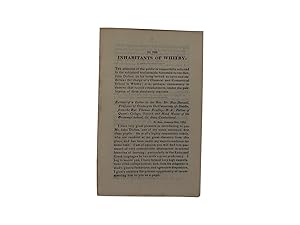
To the Inhabitants of Whitby
Published by R. Kirby, Whitby, 1831
Seller: Zetetic Books, Berkhamsted, United Kingdom
Association Member: PBFA
Seller rating 5 out of 5 stars

First Edition
US$ 48.49
US$ 40.35 shipping
Ships from United Kingdom to U.S.A.Quantity: 1 available
Add to basketPaper Covers. Condition: Good. First Edition. 4pp, disbound, drophead title. Slightly browned to edges, generally fairly bright and clean. Testimonials for John Dufton on his being invited to open and undertake the charge of a Classical and Commercial School in Whitby. The printer was R.[obert] Kirby, fl. 1828-1834 and described in the BBTI as being a bookseller, stationer, printer, and librarian/owner of circulating library (subscription). Scarce, BL only in COPAC Size: 8vo. Pamphlet.
-
National Education. What it is, and What it Should Be
Published by John W. Parker, London, 1847
Seller: Whitmore Rare Books, Inc. -- ABAA, ILAB, Pasadena, CA, U.S.A.
Seller rating 5 out of 5 stars
First Edition
Condition: Fine. First edition. Recent paper wraps. 72 pages complete with both half and full titles bound in. Handwritten numbers to upper right corners and one small marginal notation. In all, a clean and complete copy of this important part of the debate on national education in England. With no other copies on the market, and OCLC reporting only 2 held at institutions in the US and 13 across Europe and Canada, this is a title that has become quite scarce. Leading up to the 1870 Education Act, which became "the very first piece of legislation to deal specifically with the provision of education in Britain," activists concerned about education and income disparity began rallying around the idea of increasing the public's access to schools (Parliament Living Heritage). 1847 saw a rise in the number of lectures, debates, and publication on the topic, with particular concern focused on how the lack of education for poor children and women in urban areas created economic hardship and related health and housing crises. The present work contributes to the debate by arguing that a national system of education would be beneficial to "the prosperity of the country," because "education affords the most certain means of National advancement." Drawing on Biblical narratives, contemporary novels like Dickens' Oliver Twist, and recent crime statistics in London and other metropolitan areas, Dufton urges his audience to see that a lack of education leads to the mis-direction of people's skill and energy. Individuals who might contribute their talents in meaningful ways across fields of education and industry instead focus on survival by any means, even when it poses danger to others or society at large. "The most disquieting feature of these details [relating to statistical comparisons of arrests to school enrollments] is the large amount of criminality found in persons of tender years, and who may be considered victims of the evil influences to which they have been exposed." The rise of convictions and recidivism in both boys and girls under the age of 16, Dufton shows, is related to dropping school enrollments among the poorer classes in London, where children were forced into crime or labor as a result of families being unable to financially support them. By taking collective responsibility for the education of youth in all classes, religions, and genders, Dufton asserts, England can improve its conditions overall; and it can avoid being guilty of training children to delinquency and then punishing them for that behavior. There must be a national system in place to ensure access to education, and he urges the privileged especially to recognize and contribute to filling the need. "The option is forced upon us; we are all bound to a decision. To be silent at such a crisis is to be eloquent in the advocacy of evil.we make our appeal to ALL classes of our countrymen, and more especially to that class which has hitherto viewed the question as one of little importance to themselves individually, or to their 'order' collectively, to consider the state of their countrymen with a strong purpose for its amelioration." A powerful and important argument for the shared financial and social responsibility to educate a nation. Fine.

