

Order Total (1 Item Items):
Shipping Destination:

Edited Deepak Kumar Joseph Bara (1 results)
Skip to main search results
Search filters
Product Type
- All Product Types
- Books (1)
- Magazines & Periodicals (No further results match this refinement)
- Comics (No further results match this refinement)
- Sheet Music (No further results match this refinement)
- Art, Prints & Posters (No further results match this refinement)
- Photographs (No further results match this refinement)
- Maps (No further results match this refinement)
- Manuscripts & Paper Collectibles (No further results match this refinement)
Condition Learn more
- New (1)
- As New, Fine or Near Fine (No further results match this refinement)
- Very Good or Good (No further results match this refinement)
- Fair or Poor (No further results match this refinement)
- As Described (No further results match this refinement)
Binding
- All Bindings
- Hardcover (1)
- Softcover (No further results match this refinement)
Collectible Attributes
- First Edition (1)
- Signed (No further results match this refinement)
- Dust Jacket (1)
- Seller-Supplied Images (No further results match this refinement)
- Not Print on Demand (1)
Language (1)
Price
- Any Price
- Under US$ 25 (No further results match this refinement)
- US$ 25 to US$ 50
- Over US$ 50 (No further results match this refinement)
Free Shipping
- Free Shipping to U.S.A. (No further results match this refinement)
Seller Location
Seller Rating
-
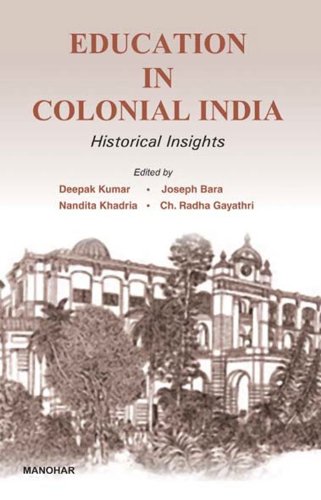
Education in Colonial India : Historical Insights
First Edition
Hardcover. Condition: New. Dust Jacket Condition: New. 1st Edition. Questions like what to teach, how to teach and whom to teach have been central to debates on education in India. Colonialism has left several facts and questions open, which can be interpreted in multiple ways.Knowledge is essentially a contested term, as much as education itself is a contested terrain. Education is an important constituent dimension of knowledge society as it empowers people with requisite skills and knowledge to access productive employment. The transition from the pre-colonial, local systems to a colonial education system was, however, a multi-dimensional process, with many actors playing active roles in it. The pace of knowledge diffusion has increased particularly over the last century, but the education system in India even today is basically a legacy of the two centuries of colonial rule, with still limited and uneven access to knowledge. The collection of essays in this volume tries to address some of the issues and developments in the making of an inclusive knowledge society in colonial India, and the transmission of knowledge through agents and institutions of education in modern India from a historical perspective. The volume traces the growth of knowledge in India in modern times and its conflict with the existing societal and religious expectations, as also of the conflict between individual and institutional ideas. It has also attempted to address the issue of social exclusion be it sectional, regional or gender oriented. Despite apparent diversity and exclusivity of the themes they are interwoven and reflect an overarching interest in broader issues, with the primary focus being on growth of a new system of education in modern India. (jacket).
