Order Total (1 Item Items):
Shipping Destination:

Edited Tim Cross (2 results)
Skip to main search results
Search filters
Product Type
- All Product Types
- Books (2)
- Magazines & Periodicals (No further results match this refinement)
- Comics (No further results match this refinement)
- Sheet Music (No further results match this refinement)
- Art, Prints & Posters (No further results match this refinement)
- Photographs (No further results match this refinement)
- Maps (No further results match this refinement)
- Manuscripts & Paper Collectibles (No further results match this refinement)
Condition Learn more
- New (1)
- As New, Fine or Near Fine (1)
- Very Good or Good (No further results match this refinement)
- Fair or Poor (No further results match this refinement)
- As Described (No further results match this refinement)
Binding
Collectible Attributes
- First Edition (1)
- Signed (No further results match this refinement)
- Dust Jacket (No further results match this refinement)
- Seller-Supplied Images (1)
- Not Print on Demand (2)
Language (1)
Price
- Any Price
- Under US$ 25 (No further results match this refinement)
- US$ 25 to US$ 50 (No further results match this refinement)
- Over US$ 50
Free Shipping
Seller Location
Seller Rating
-
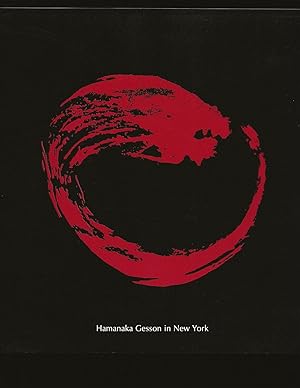
Hamanaka Gesson in New York, May 7- June 6, 1992, Gallery Zero, the Quilted Giraffe (Only copy for sale)
Language: English
Published by Hamanaka Gesson, Yamaguchi-ken, Japan, 1992
First Edition
Soft cover. Condition: Near Fine. 1st Edition. This may have been Hamanaka Gesson's first exhibition in New York, possibly in the United States. I'm looking at the 'chronology' at the end of the book and prior to this one it references exhibitions only in Japan. What I know for sure is that once listed, this will be the Only copy of 'Hamanaka Gesson in New York' for sale anywhere on the Internet. And, happily, it is in very nice condition. You can see the covers in the photos provided. They are very clean. They have little to no wear, a bit of light surface scratching, only speck-sized edge wear. The catalog is perfectly bound, nicely tight pages. The pages are perfectly clean. Perhaps surprisingly, given the glossy paper, they are not toned. The art is beautiful, unusual. The photography is excellent. There is only one imperfection with regard to the pages (and it is quite minor), a vague semi-crease or light impression at some of the bottom corners, coming from a very light bump to the bottom corner of the front cover which itself is only visible when the light hits it from a specific angle. There are no markings in the book. There are no attachments of any kind. And no one has written their name or anything else anywhere. The pages are unnumbered. I counted 36 which includes 27 photographs of his work. The one-line descriptions are in English. There is a one page text by Junko Koshino about the interpretation of 'utsuwa' (recipient, container, tableware) and about Hamanaka Gesson's utsuwa. There is also a white textured page inserted just in front of this page. It is in Japanese. Fair likelihood that it is the same description of utsuwa in Japanese. Also included with the book on a similarly white textured page is a description of the exhibition, the date, the time, and the place. Both of these separate pages are in perfect condition. 'Born into a Hagi family of doctors, Hamanaka Gesson returned to his family's village in his teens to begin his career in Japanese ceramics. After apprenticing with Yoshiga Taibi, he built his own kiln in 1969 and later adopted the artistic name Gesson, meaning "moon village." Hamanaka believes that local Japanese clays should be used only to create works that reflect that region's style. In order to maintain the integrity of the works as well as allow for creative freedom, he began experimenting with a mixture of local styles to create his own unique forms and glazes. His experiments with hybrid Hagi works, such as the use of Shigaraki clay and oribe glaze, have earned him worldwide acclaim.' From a New York Times piece: Hamanaka Gesson stands apart from other Hagi potters both in his work and in the location of his kiln, Oyagama, which is a couple of miles south and west of Higashi-hagi Station. Mr. Hamanaka says that he preserves the Hagi tradition more than most Hagi potters, deriving his inspiration from the simple Korean wares of the Yi Dynasty. He trained at Senryuzan for seven years before opening Oyagama, where he works on a small scale, firing only twice a year. Three artisans work under him, producing the pottery bearing the Oyagama mark sold in town. In the showroom that is part of the elegant Japanese-style house that he himself designed, there are plates of various sizes, from a great round platter to condiment dishes, and vases and bowls. Mr. Hamanaka's work is sometimes described as folk art, meaning that he works outside the Hagi tradition, using glazes he finds elsewhere, like the clear green (bluish in sunlight) derived from ashes he received from a nearby farmhouse. "This is the kind of accidental meeting I make use of in my work," he said.'.
-

US$ 212.47
US$ 16.54 shipping
Ships from United Kingdom to U.S.A.Quantity: 2 available
Add to basketHardcover. Condition: Brand New. 312 pages. 9.25x6.10x0.83 inches. In Stock.