Order Total (1 Item Items):
Shipping Destination:

Election 1828 (6 results)
Skip to main search results
Search filters
Product Type
- All Product Types
- Books (6)
- Magazines & Periodicals (No further results match this refinement)
- Comics (No further results match this refinement)
- Sheet Music (No further results match this refinement)
- Art, Prints & Posters (No further results match this refinement)
- Photographs (No further results match this refinement)
- Maps (No further results match this refinement)
- Manuscripts & Paper Collectibles (No further results match this refinement)
Condition Learn more
- New (No further results match this refinement)
- As New, Fine or Near Fine (No further results match this refinement)
- Very Good or Good (No further results match this refinement)
- Fair or Poor (No further results match this refinement)
- As Described (6)
Binding
- All Bindings
- Hardcover (No further results match this refinement)
- Softcover (No further results match this refinement)
Collectible Attributes
- First Edition (No further results match this refinement)
- Signed (No further results match this refinement)
- Dust Jacket (No further results match this refinement)
- Seller-Supplied Images (6)
- Not Print on Demand (6)
Language (1)
Price
- Any Price
- Under US$ 25 (No further results match this refinement)
- US$ 25 to US$ 50 (No further results match this refinement)
- Over US$ 50
Free Shipping
- Free Shipping to U.S.A. (No further results match this refinement)
Seller Location
Seller Rating
-
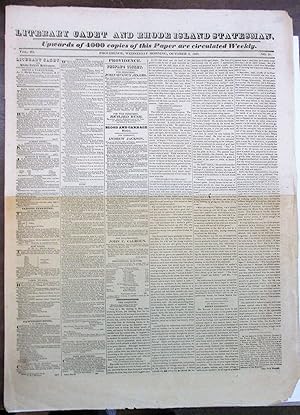
LITERARY CADET AND RHODE ISLAND STATESMAN. UPWARDS OF 4000 COPIES OF THIS PAPER ARE CIRCULATED WEEKLY. WEDNESDAY MORNING, OCTOBER 8, 1828
Published by Providence, 1828
Seller: David M. Lesser, ABAA, Woodbridge, CT, U.S.A.
Association Member: ABAA ESA ILAB SNEAB
Seller rating 5 out of 5 stars

Elephant folio sheet, folded to [4] pp, each 15-1/4" x 22-1/2." Old folds, toned, several small holes and a fold split affecting a few letters. Good+ Issued only a month before the presidential election, this paper leaves no doubt about where it stands. The Jackson-Calhoun ticket is the "BLOOD AND CARNAGE TICKET," condemning Jackson's duel with Dickinson, his attempt "to assassinate" Senator Benton, charging that he "he sheltered and caressed the infamous BURR at his house in 1806, and noting as well his tyranny in New Orleans and his butchery in Florida. Calhoun is "the head of the attempted rebellion in the South, in 1828" [a reference to Nullification]. The paper endorses John Quincy Adams for a second term, his first having been "singularly prosperous.".
-
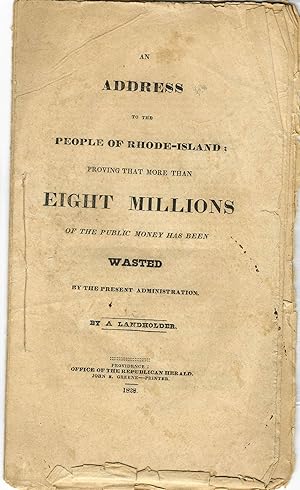
AN ADDRESS TO THE PEOPLE OF RHODE-ISLAND: PROVING THAT MORE THAN EIGHT MILLIONS OF THE PUBLIC MONEY HAS BEEN WASTED BY THE PRESENT ADMINISTRATION. 1828. BY A LANDHOLDER
Published by Office of the Republican Herald, Providence, 1828
Seller: David M. Lesser, ABAA, Woodbridge, CT, U.S.A.
Association Member: ABAA ESA ILAB SNEAB
Seller rating 5 out of 5 stars
28pp, stitched, untrimmed, lightly worn, Very Good. American Imprints, but not Bartlett, attributes authorship to Wilkins Updike. This is a high-pitched attack on the alleged profligacy of the Adams administration and a call for the election of Andrew Jackson. "A suffering people cry for reform," the author says. "Did one of you ever dream that the funds of this Government were expended in the purchase of BILLIARD TABLES, BILLIARD BALLS, CHESS BOARDS AND CHESS MEN, and other toys to gratify the gambling propensities of the cabinet?" A Jackson presidency will bring back "the days of good old President Jefferson." FIRST EDITION. AI 36986 [7]. Bartlett 8.
-

PROCEEDINGS OF THE ANTI-JACKSON CONVENTION, HELD AT THE CAPITOL, IN THE CITY OF RICHMOND: WITH THEIR ADDRESS TO THE PEOPLE OF VIRGINIA: (ACCOMPANIED BY DOCUMENTS.)
Published by Printed by Samuel Shepherd & Co., Richmond, 1828
Seller: David M. Lesser, ABAA, Woodbridge, CT, U.S.A.
Association Member: ABAA ESA ILAB SNEAB
Seller rating 5 out of 5 stars
38, [2 blanks] pp. Stitched, untrimmed, partly uncut. Browned and lightly to moderately foxed. Good+, in its unsophisticated state. This Virginia Convention of more than 200 delegates, listed by County, "feared the most pernicious consequences from the election of General Jackson, and we have come to consult about the means of averting this calamity from our country." Although "many of you strongly disapprove some of the leading measures of the present Administration," President Adams's faults and errors are as nothing against the defects of Jackson's character, which render him "altogether unfit for the presidency." An Appendix prints correspondence from Jackson's Florida military adventure, demonstrating his disregard for civilian authority and his arbitrary exercise of power. Swem 137. Sabin 100496. Not in Wise & Cronin or Miles.
-
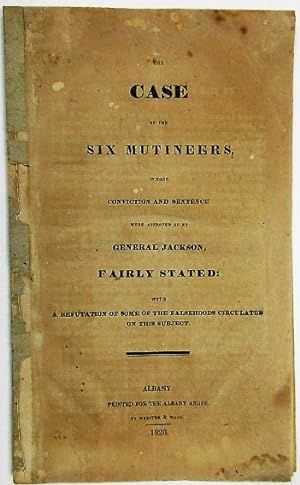
THE CASE OF THE SIX MUTINEERS, WHOSE CONVICTION AND SENTENCE WERE APPROVED OF BY GENERAL JACKSON, FAIRLY STATED: WITH A REFUTATION OF SOME OF THE FALSEHOODS CIRCULATED ON THIS SUBJECT
Published by Printed for the Albany Argus, Albany, 1828
Seller: David M. Lesser, ABAA, Woodbridge, CT, U.S.A.
Association Member: ABAA ESA ILAB SNEAB
Seller rating 5 out of 5 stars
32pp, disbound and stitched. Title and several other leaves browned, widely scattered foxing. Good+. This is one of three 1828 issues, all scarce, printed in the heated presidential race of that year. Anti-Jackson forces charged that his unrestrained, martial personality-- highlighted by executing six militia men after the Battle of New Orleans-- unfitted him for the presidency. New York Democrats defend Jackson, denounce the falsehoods surrounding that incident, and call the official record of the inquiry "useless rubbish." Howes J4. Wise & Cronin 232. Sabin 56778.
-
![Seller image for THE CASE OF JOHN WOODS [caption title]. for sale by William Reese Company](https://pictures.abebooks.com/inventory/md/md32116809019.jpg)
THE CASE OF JOHN WOODS [caption title].
Published by [N.p. 1828]., 1828
Seller: William Reese Company, New York, NY, U.S.A.
Association Member: ABAA ESA ILAB SNEAB
Seller rating 5 out of 5 stars
A rare broadside recounting Andrew Jackson's infamous execution of Private John Woods, published in 1828 by Jackson's opponents during the 1828 election. There was considerable mud-slinging between the Jackson and Adams camps during that campaign, which eventually saw the defeat of incumbent John Quincy Adams and the election of Andrew Jackson. This dense broadside recounts the events of March 1814 at Fort Strother during the Creek Campaign, when Jackson charged John Woods, an eighteen-year-old militiaman, with disobedience, disrespect, and mutiny. According to the text, the trial itself only occurred because Jackson's soldiers would not shoot Woods at the moment of the offense, despite Jackson's cries to "Shoot the damned rascal!.blow ten balls through the damned rascal!" The court martial followed soon after; Woods was found guilty and sentenced to die. Some testimonies here state that Jackson offered to spare Woods' life if he would enlist in the regular army, but Woods refused; others disagree. He was executed thirty-six hours later. Then follows the sworn testimony of several witnesses: Thomas Couch, Robert Ferguson, Samuel Hanna, George A. Brock, Isaac Roberts, James Harris, William Stewart, Joseph Alexander, Isaac Anderson, Abm. Whitney, and John Williams, all fellow soldiers of Woods who witnessed or had personal knowledge of the facts in the case. Their accounts of Woods' supposed mutiny substantially downplay the severity of Woods' disobedience, suggesting that it was likely a misunderstanding; they also emphasize the draconian nature of the punishment, and make several mentions of Woods' aging and infirm parents. Williams' account closes: "It is not true that Woods, on the ground of Execution, with oaths and defiance, refused to promise obedience. On the contrary, he wept loud and bitterly." All of the testimonies are datelined in Tennessee in the first few months of 1828. The nature of the printing lends itself to the possibility of a Tennessee press. Though not as famous as the "Coffin Handbills" that appeared at the same time, listing Woods' execution among many other crimes by Jackson, this was definitely addressed to the same audiences. John Spencer Bassett, in his Life of Andrew Jackson, notes that the "execution of mutinous militiamen in the campaigns of 1813 and 1814 was recalled to show [Jackson's] ferocious temper; and when a Philadelphia editor published a hand-bill showing a coffin with the victims standing by its side, the idea was caught up eagerly and repeated in all parts of the country." Not in Wise & Cronin, and we could find no listing for this broadside in OCLC, or in American Imprints. It has only appeared at auction twice, and then not since 1925, when Anderson Galleries offered a copy as part of the sale of the Henry De Puy collection, which was strong in Andrew Jackson material. The only copy in the trade seems to be one offered by the Eberstadts in 1939. Broadsheet, 19 x 9 inches, text printed in two columns on both sides. Old folds, some chips to edges, minor loss to upper left corner and closed tear to bottom edge (no text affected). Two small holes (affecting just one word), a few areas of soiling, light foxing, even tanning. Manuscript annotations to verso. About very good.
-
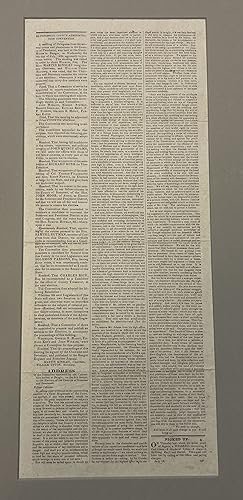
PENOBSCOT COUNTY ADMINISTRATION CONVENTION
Published by [Bangor?, 1828
Seller: David M. Lesser, ABAA, Woodbridge, CT, U.S.A.
Association Member: ABAA ESA ILAB SNEAB
Seller rating 5 out of 5 stars
Folio broadside, 9-1/4" x 20". Matted, hinged at upper edge. Printed in three full columns. A few old folds, Very Good. The Convention met in Bangor on July 9, 1828. After endorsing candidates for various State offices, the Convention issued and printed its 'Address. to the Electors of the Counties of Somerset and Penobscot', focusing on the upcoming presidential contest. Praising the incumbent, John Quincy Adams, the Address proclaims, "It is sufficient to say of him, that talents of the highest order are joined to uncommon attainments. We would ask you to turn from the rantings of demagogues, the bold fictions of an irresponsible press. Is not our country moving on peacefully and prosperously in the great march of improvement?" Adams's opponent, General Jackson, is unsuited for the presidency: "His character has been formed as a military chieftain. He is rash, headstrong, impetuous and unreflecting-- that he knows no law but his own will." Example after example demonstrates Jackson's unfitness Not in American Imprints, Sabin, Wise & Cronin [Jackson, Adams], or on the online sites of OCLC, AAS, Harvard, Boston Athenaeum, Bowdoin, U Maine as of October 2023.