

Order Total (1 Item Items):
Shipping Destination:

Ernst Max Painter (5 results)
Skip to main search results
Search filters
Product Type
- All Product Types
- Books (2)
- Magazines & Periodicals (No further results match this refinement)
- Comics (No further results match this refinement)
- Sheet Music (No further results match this refinement)
- Art, Prints & Posters (No further results match this refinement)
- Photographs (No further results match this refinement)
- Maps (No further results match this refinement)
- Manuscripts & Paper Collectibles (3)
Condition Learn more
- New (No further results match this refinement)
- As New, Fine or Near Fine (No further results match this refinement)
- Very Good or Good (No further results match this refinement)
- Fair or Poor (No further results match this refinement)
- As Described (5)
Binding
Collectible Attributes
- First Edition (No further results match this refinement)
- Signed (2)
- Dust Jacket (No further results match this refinement)
- Seller-Supplied Images (5)
- Not Print on Demand (5)
Language (1)
Price
- Any Price
- Under US$ 25 (No further results match this refinement)
- US$ 25 to US$ 50 (No further results match this refinement)
- Over US$ 50
Free Shipping
- Free Shipping to U.S.A. (No further results match this refinement)
Seller Location
Seller Rating
-

Målningar, collage, frottage, teckningar, Grafik, böcker, skulpturer 1917-1969.
Published by Stockholm, Moderna Museet, 1969., 1969
Seller: Antiquariat INLIBRIS Gilhofer Nfg. GmbH, Vienna, A, Austria
Association Member: ILAB PADA VDA VDAO
Seller rating 5 out of 5 stars

83, (1) pp. Printed original wrappers. 4to. Title page with autograph dedication, signature, and small hand-drawn sketch to Karin Bergqvist-Lindegren (19242012), widow of the Swedish poet and translator Erik Lindegren (19101968). A few years later, in 1977, Karin Lindegren herself became director of the Moderna Museet in Stockholm, where the Max Ernst exhibition had been shown from 13 Sept. to 2 Nov. 1969. - Binding loose.
-
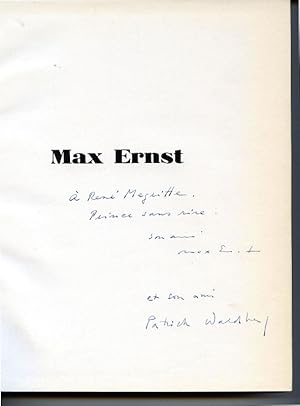
Autograph inscription signed. In: Patrick Waldberg: Max Ernst.
Published by (Paris), Jean-Jacques Pauvert, (1958)., 1958
Seller: Antiquariat INLIBRIS Gilhofer Nfg. GmbH, Vienna, A, Austria
Association Member: ILAB PADA VDA VDAO
Seller rating 5 out of 5 stars
Manuscript / Paper Collectible Signed
443, (5) pp. 4to. Contemporary cloth. "À René Margritte. Prince san rire. / son ami / Max Ernst". With another inscription signed by the author Patrick Waldberg.
-

Autograph quotation signed.
Published by Niederpoyritz, 26. IX. 1917., 1917
Seller: Antiquariat INLIBRIS Gilhofer Nfg. GmbH, Vienna, A, Austria
Association Member: ILAB PADA VDA VDAO
Seller rating 5 out of 5 stars
Manuscript / Paper Collectible
Oblong 8vo (postcard). 1 page. Inscribed to the German dermatologist Alwin Scharlau: "Heiter sei das Leben, Ernst die Kunst! [.]". - A member of the artists' colony in Goppen near Dresden, Pietschmann specialized in plein air painting, spent several years studying nude painting in Italy and Paris, and created popular chromolithographs of landscapes and genre scenes under the pseudonym "François Laubnitz" which were frequently used for interior decorations during the first half of the 20th century. - Traces of a postmark near upper left corner; small brown stain at lower margin; postmark on verso slightly showing through. Self-addressed by the collector on the reverse. The Mecklenburg physician Scharlau (b. 1888) assembled a collection of artists' autographs by personal application.
-

GROßE GRAPHIK (mit Hut und Schirm ein Bild betrachtend, auf Karton, 32,5 x 25 cm, gedruckt) bezeichnet ATELIER-URSTELLIG mit am Unterrand in brauner Tinte 3-zeiliger Widmung, UNTERSCHRIFT Ernst Max Musfeld signiert.
-
1 autograph letter signed and 1 typed letter signed.
Published by , 1.6.1969 and 8.3.1971, 1971
Seller: Kotte Autographs GmbH, Roßhaupten, Germany
Association Member: ILAB PADA VDA
Seller rating 5 out of 5 stars
Manuscript / Paper Collectible
4to. 2 pp. Enclosed is one handwritten envelope. To Jean Leymarie of the Musée National d'Art Moderne in Paris.1.6.1969 (ALS with signature Max Ernst"):Autograph letter to Monsieur Jean Leymarie of the Musée National d'Art Moderne: [] Vous me faites grand plaisir de consentir à preter Capricorne' pour Stockholm et Amsterdam et je vous remercie. Voici en change de bons procédés" le No. de ma retraite: le 41 à Seillans. Je vous prie de recommander aux emballeurs de prendre bons soins du con de Mme Capricorne. []" Max Ernst agrees to send his painting Capricorn to Amsterdam and to Stockholm. He asks the packers to take good care of Mrs. Capricorn as she is very fragile.Capricorn was Max Ernst's sculptural masterpiece, which he finished while living in Sedona, Arizona, where he lived with his wife Dorothea Tanning (1910-2012) from 1946 till 1953. They built the small, secluded house in the desert that they called Capricorn Hill. The plastic Capricorn came about when they got electricity and running water a year after they moved there. The concrete mixer they purchased was not only used to build houses. Max Ernst came into contact with the indigenous people, the Hopi, and studied their art. He was particularly interested in the kachina dolls and the ceremonial masks. He created a larger-than-life cement sculpture in 1948, inspired by folk art. When Chagall moved back to Europe in 1953 he took a copy of his work, which was the base for Capricorn.8.3.1971 (typed letter with signature Max Ernst"):[] J'étais enchanté de l'avant-propos que vous avez fait pour l'Orangerie. Je vous verrai surement dans cet endroit aux environs du 2 avril. Je me réjouis d'avance, de vous remercier de vive voix. []" Max Ernst writes that he was delighted with Jean Leymarie's foreword for the Orangerie, he is looking forward seeing him in April to thank him in person.A retrospective of 104 works spanning the years 19201968, drawn entirely from the Menil Collection, toured Europe from 1970 to 1972 and also were shown at Musée de l'Orangerie. The opening of the exhibition in Paris was augmented with 44 pieces from various collations and opened on 2 April 1971, Max Ernst's 80th birthday.


