

Order Total (1 Item Items):
Shipping Destination:

Eversteijn Nadia (6 results)
Skip to main search results
Search filters
Product Type
- All Product Types
- Books (6)
- Magazines & Periodicals (No further results match this refinement)
- Comics (No further results match this refinement)
- Sheet Music (No further results match this refinement)
- Art, Prints & Posters (No further results match this refinement)
- Photographs (No further results match this refinement)
- Maps (No further results match this refinement)
- Manuscripts & Paper Collectibles (No further results match this refinement)
Condition Learn more
- New (5)
- As New, Fine or Near Fine (No further results match this refinement)
- Very Good or Good (1)
- Fair or Poor (No further results match this refinement)
- As Described (No further results match this refinement)
Binding
- All Bindings
- Hardcover (No further results match this refinement)
- Softcover (6)
Collectible Attributes
- First Edition (No further results match this refinement)
- Signed (1)
- Dust Jacket (No further results match this refinement)
- Seller-Supplied Images (6)
- Not Print on Demand (2)
Language (2)
Price
- Any Price
- Under US$ 25 (No further results match this refinement)
- US$ 25 to US$ 50 (No further results match this refinement)
- Over US$ 50
Free Shipping
- Free Shipping to U.S.A. (No further results match this refinement)
Seller Location
Seller Rating
-

"All at once" | Language choice and codeswitching by Turkish-Dutch teenagers
Language: English
Published by LAP LAMBERT Academic Publishing, 2012
ISBN 10: 3844381082 ISBN 13: 9783844381085
Taschenbuch. Condition: Neu. "All at once" | Language choice and codeswitching by Turkish-Dutch teenagers | Nadia Eversteijn | Taschenbuch | 388 S. | Englisch | 2012 | LAP LAMBERT Academic Publishing | EAN 9783844381085 | Verantwortliche Person für die EU: BoD - Books on Demand, In de Tarpen 42, 22848 Norderstedt, info[at]bod[dot]de | Anbieter: preigu.
-
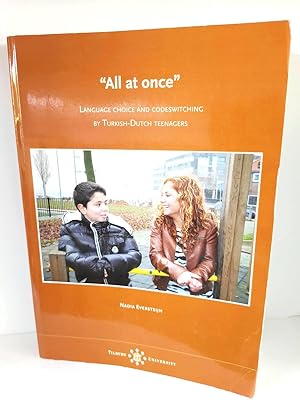
"All at Once": Language Choice and Codeswitching By Turkish-Dutch Teenagers
Published by Tilburg University, Tilburg, Netherlands, 2011
Seller: PsychoBabel & Skoob Books, Didcot, United Kingdom
Seller rating 5 out of 5 stars

Signed
US$ 67.66
US$ 16.76 shipping
Ships from United Kingdom to U.S.A.Quantity: 1 available
Add to basketPaperback. Condition: Very Good. Paperback, signed and dedicated by author on half-title page ("To Penelope, who has been my inspiration for 12 years, Nadia Eversteijn"). Covers are a little shelfworn; lower corners of front cover and first few pages are slightly creased; two or three dog-eared page corners further in. Page block is very faintly marked. Text is clear throughout on sound, clean pages. Remains a very good copy. TS. Signed by Author. Used.
-

All at once
Language: English
Published by LAP LAMBERT Academic Publishing Jun 2011, 2011
ISBN 10: 3844381082 ISBN 13: 9783844381085
Seller: BuchWeltWeit Ludwig Meier e.K., Bergisch Gladbach, Germany
Seller rating 5 out of 5 stars
Taschenbuch. Condition: Neu. This item is printed on demand - it takes 3-4 days longer - Neuware -This book pictures how fluently bilingual Turkish-Dutch teenagers, who are free to choose from among the rich resources in their linguistic repertoires, come to the language choices they make in their everyday conversations. It is shown that socio-cultural orientation and language dominance affect these choices, but not in the linear way one would expect. Rather, it turns out that a stronger orientation to aspects of Turkish culture, and a high proficiency in Turkish, go hand in hand with a strong orientation to Dutch culture, and high proficiency in Dutch. These findings cast an interesting light on the widely discussed phenomenon of ethnic minority integration. Special attention goes to how and why codeswitching is used. A broad range of reasons is documented and illustrated with examples,such as: 'symbolising one particular part of one s bicultural identity'. Speakers are also shown to be using a third code now and then: a mixed lect in which the contrasting effect between Turkish and Dutch seems to be absent. In describing the intriguing, ever changing processes of codeswitching, an important role is attributed to the reports and intuitions of bilingual speakers themselves. 388 pp. Englisch.
-

All at once
Language: English
Published by LAP LAMBERT Academic Publishing, 2011
ISBN 10: 3844381082 ISBN 13: 9783844381085
Condition: New. Dieser Artikel ist ein Print on Demand Artikel und wird nach Ihrer Bestellung fuer Sie gedruckt. Autor/Autorin: Eversteijn NadiaNadia Eversteijn (Eindhoven, 1973), studied Arts in Tilburg and specialized in intercultural communication. She did a traineeship at Mersin University, and a PhD at the Babylon Research Institute of Tilburg University.
-

"\"All at once\"
Language: English
Published by LAP LAMBERT Academic Publishing Jun 2011, 2011
ISBN 10: 3844381082 ISBN 13: 9783844381085
Seller: buchversandmimpf2000, Emtmannsberg, BAYE, Germany
Seller rating 5 out of 5 stars
Taschenbuch. Condition: Neu. This item is printed on demand - Print on Demand Titel. Neuware -This book pictures how fluently bilingual Turkish-Dutch teenagers, who are free to choose from among the rich resources in their linguistic repertoires, come to the language choices they make in their everyday conversations. It is shown that socio-cultural orientation and language dominance affect these choices, but not in the linear way one would expect. Rather, it turns out that a stronger orientation to aspects of Turkish culture, and a high proficiency in Turkish, go hand in hand with a strong orientation to Dutch culture, and high proficiency in Dutch. These findings cast an interesting light on the widely discussed phenomenon of ethnic minority integration. Special attention goes to how and why codeswitching is used. A broad range of reasons is documented and illustrated with examples,such as: 'symbolising one particular part of one's bicultural identity'. Speakers are also shown to be using a 'third code' now and then: a mixed lect in which the contrasting effect between Turkish and Dutch seems to be absent. In describing the intriguing, ever changing processes of codeswitching, an important role is attributed to the reports and intuitions of bilingual speakers themselves.VDM Verlag, Dudweiler Landstraße 99, 66123 Saarbrücken 388 pp. Englisch.
-

"All at once" : Language choice and codeswitching by Turkish-Dutch teenagers
Language: English
Published by LAP LAMBERT Academic Publishing, 2012
ISBN 10: 3844381082 ISBN 13: 9783844381085
Taschenbuch. Condition: Neu. nach der Bestellung gedruckt Neuware - Printed after ordering - This book pictures how fluently bilingual Turkish-Dutch teenagers, who are free to choose from among the rich resources in their linguistic repertoires, come to the language choices they make in their everyday conversations. It is shown that socio-cultural orientation and language dominance affect these choices, but not in the linear way one would expect. Rather, it turns out that a stronger orientation to aspects of Turkish culture, and a high proficiency in Turkish, go hand in hand with a strong orientation to Dutch culture, and high proficiency in Dutch. These findings cast an interesting light on the widely discussed phenomenon of ethnic minority integration. Special attention goes to how and why codeswitching is used. A broad range of reasons is documented and illustrated with examples,such as: 'symbolising one particular part of one s bicultural identity'. Speakers are also shown to be using a third code now and then: a mixed lect in which the contrasting effect between Turkish and Dutch seems to be absent. In describing the intriguing, ever changing processes of codeswitching, an important role is attributed to the reports and intuitions of bilingual speakers themselves.
