
Falloppio Gabrielle (2 results)

- Hardcover
- Print on Demand
Seller: True World of Books, Delhi, , IndiaTrue World of Books
Contact seller5-star sellerLeatherBound. Condition: New. BOOKS ARE EXEMPT FROM IMPORT DUTIES AND TARIFFS; NO EXTRA CHARGES APPLY. LeatherBound edition. Condition: New. Reprinted from 1900 edition. Leather Binding on Spine and Corners with Golden leaf printing on spine. Bound in genuine leather with Satin ribbon page markers and Spine with raised gilt band…s. A perfect gift for your loved ones. Pages: 35 NO changes have been made to the original text. This is NOT a retyped or an ocr'd reprint. Illustrations, Index, if any, are included in black and white. Each page is checked manually before printing. As this print on demand book is reprinted from a very old book, there could be some missing or flawed pages, but we always try to make the book as complete as possible. Fold-outs, if any, are not part of the book. If the original book was published in multiple volumes then this reprint is of only one volume, not the whole set. Sewing binding for longer life, where the book block is actually sewn (smythe sewn/section sewn) with thread before binding which results in a more durable type of binding. Pages: 35.
 More images
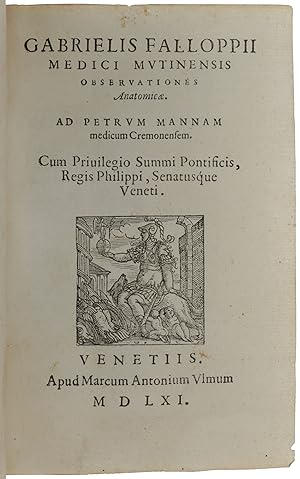
Published by Marco Antonio Ulmo and Gratioso Perchachino, Venice 1561
- First Edition
Seller: SOPHIA RARE BOOKS, Koebenhavn V, , DenmarkSOPHIA RARE BOOKS
Contact seller5-star sellerCondition: Used
US$ 30,000.00
Free ShippingShips from Denmark to U.S.A.Quantity: 1 available
First edition. THE MOST IMPORTANT ITALIAN ANATOMICAL TEXT OF THE 16TH CENTURY . First edition, first issue, very rare, of the greatest Italian anatomical book of the sixteenth century, a detailed critical commentary on Vesalius' De humani corporis fabrica. This is a pristine copy in an untouched contemporary binding. "The large…amount of new material [in the present work] included Falloppio's investigations of primary and secondary centers of ossification, the first clear description of primary dentition, numerous contributions to the study of the muscles (especially those of the head), and the famous account of the uterine ("Falloppian") tubes, which he correctly described as resembling small trumpets (tubae). He also gave to the placenta and vagina their present scientific names, provided a superior description of the auditory apparatus (including the first clear accounts of the chorda tympani and semicircular canals), and was the first to clearly distinguish the trochlear nerve of the eye. Vesalius responded positively to Falloppio's work with his posthumously published Examen on Falloppio (1564)" (Norman). "He was a careful dissector, a great observer, and an accurate recorder. He discovered and first described the chorda tympani and semicircular canals, correctly described the structure and course of the cerebral vessels, knew the circular folds of the small intestines. He enumerated all the nerves of the eye, and introduced a number of anatomical names. He is eponymously remembered by the Fallopian tube and the Fallopian aqueduct" (Garrison-Morton). ABPC/RBH record only five copies sold in the last 40 years, of which only the Norman copy was in an untouched contemporary binding (Christie's, March 18, 1998, $21,850). "Of the various works by and attributed to Falloppio only the Observations anatomicae (1561) was published during his lifetime and can be said with certainty to be fully authentic. It is not, however, a general and systematic textbook of anatomy but an unillustrated commentary or series of observations on the De humani corporis fabrica of Vesalius, in which Falloppio sought to correct errors committed by his illustrious predecessor and to present new material hitherto overlooked. His criticism, contrary to a characteristic of that age, is temperate and friendly, so that it is not uncommon to find the object of the criticism referred to as the "divine Vesalius," upon whose scientific foundations Falloppio, as a worthy successor, was willing to admit that he had based his own work. Since the Observationes anatomicae is not an all-inclusive study of anatomy, it never received the popular acclaim given, for example, to the De re anatomica (1559) of Colombo. It is, nevertheless, a work of greater originality. "Falloppio's investigations were the consequence of dissection not only of adult human bodies but also of fetuses, newborn infants, and children "up to the first seven months, and in several beyond" (fol. 17v). He was thus able to make a number of observations and contributions to knowledge of primary and secondary centers of ossification. His most notable contributions of this nature were his descriptions of the ossification of the occiput (fols. 21r ff.), of the sternum (fols. 5l r-52v), and of the primary centers of the innominate bone (fols. 59r-60r). In his studies of the teeth Falloppio provided for the first time a clear description of primary dentition, the follicle of the tooth bud, and the manner of growth and replacement of the primary by the secondary tooth, as well as the first denial of the belief that teeth and bones are derived from the same tissues (fols. 39r-42v). Falloppio's description of the auditory apparatus was superior to that of Vesalius and includes the first clear account of the round and oval windows, the cochlea, the semicircular canals, and the scala vestibuli and tympani (fols. 27r-30v). He also referred to the third ossicle of the ear, the stapes, actually already mentioned in print (Pedro J.

