

Order Total (1 Item Items):
Shipping Destination:

Fouser Beth (6 results)
Skip to main search results
Search filters
Product Type
- All Product Types
- Books (6)
- Magazines & Periodicals (No further results match this refinement)
- Comics (No further results match this refinement)
- Sheet Music (No further results match this refinement)
- Art, Prints & Posters (No further results match this refinement)
- Photographs (No further results match this refinement)
- Maps (No further results match this refinement)
- Manuscripts & Paper Collectibles (No further results match this refinement)
Condition Learn more
- New (5)
- As New, Fine or Near Fine (No further results match this refinement)
- Very Good or Good (1)
- Fair or Poor (No further results match this refinement)
- As Described (No further results match this refinement)
Binding
- All Bindings
- Hardcover (No further results match this refinement)
- Softcover (6)
Collectible Attributes
- First Edition (1)
- Signed (No further results match this refinement)
- Dust Jacket (No further results match this refinement)
- Seller-Supplied Images (3)
- Not Print on Demand (6)
Language (1)
Free Shipping
- Free Shipping to U.S.A. (No further results match this refinement)
Seller Location
Seller Rating
-

The Lord of the Golden Tower
Language: English
Published by White Lotus Company, Limited, 1996
ISBN 10: 9748496597 ISBN 13: 9789748496597
Condition: New. pp. 152.
-
The Lord of the Golden Tower
Language: English
Published by White Lotus Company, Limited, 1996
ISBN 10: 9748496597 ISBN 13: 9789748496597
Condition: New. pp. 152.
-
The Lord of the Golden Tower
Language: English
Published by White Lotus Company, Limited, 1996
ISBN 10: 9748496597 ISBN 13: 9789748496597
Condition: New. pp. 152.
-

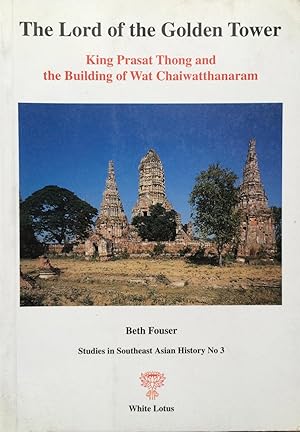
The Lord of the Golden Tower: King Prasat Thong and the Building of Wat Chaiwatthanaram
Language: English
Published by White Lotus, Bangkok, 1996
ISBN 10: 9748496597 ISBN 13: 9789748496597
Seller: Orchid Press, Trinity East, NL, Canada
Association Member: IOBA
Seller rating 5 out of 5 stars

First Edition
Soft Cover. Condition: New. First Edition. This book is a study of symbols of power and legitimacy. King Prasat Thong, a usurper, attempted to justify his claim to the throne of Ayutthaya by reviving at Wat Chaiwatthanaram the Khmer-influenced prang in a form that had not been used for two hundred years. The author explores the cultural, historic, political and religious context from which Wat Chaiwatthanaram emerged. She describes its functions on religious and political levels and the interrelationships between Buddhism and kingship and related conceptions of legitimacy. Prasat Thong followed King Ramathibodhi, the venerated founder of Ayutthaya, who had used the prang in his architecture. At Wat Chaiwatthanaram the prang, along with other unusual features, such as the eight conical men (meru), the large crowned Buddha images, and the twelve stucco relief panels, together created a unified visual statement designed to proclaim his ultimate right to reign as King. 152 pp., 20 pp. color illus. Size: 21 x 15 cm.
-
The Lord of the Golden Tower: King Prasat Thong and the Building of Wat Chaiwatthanaram
Language: English
Published by Bangkok : White Lotus Press, 1996
ISBN 10: 9748496597 ISBN 13: 9789748496597
Seller: Joseph Burridge Books, Dagenham, United Kingdom
Seller rating 5 out of 5 stars
US$ 27.48
US$ 30.68 shipping
Ships from United Kingdom to U.S.A.Quantity: 1 available
Add to basketSoft cover. Condition: Very Good. xvi, 135 p. : ill. (some col.) ; 22 cm. 'Study chiefly on art and architecture of Wat Chaiwatthanaram at Phra Nakhon Si Ayutthaya, ancient capital of Thailand with reference to its builder King Prasat Thong's relation with Cambodia.'.
-
Lord of the Golden Tower, The
Language: English
Published by White Lotus Press, Bangkok, 1996
ISBN 10: 9748496597 ISBN 13: 9789748496597
Paperback. Condition: New. Dust Jacket Condition: no dj. This book is a study of symbols of power and legitimacy. King Prasat Thong, a usurper, attempted to justify his claim to the throne of Ayutthaya by reviving at Wat Chaiwatthanaram the Khmer-influenced prang in a form that had not been used for two hundred years. The author explores the cultural, historic, political and religious context from which Wat Chaiwatthanaram emerged. She describes its functions on religious and political levels and the interrelationships between Buddhism and kingship and related conceptions of legitimacy. Prasat Thong followed King Ramathibodhi, the venerated founder of Ayutthaya, who had used the prang in his architecture. At Wat Chaiwatthanaram the prang, along with other unusual features, such as the eight conical men (meru), the large crowned Buddha images, and the twelve stucco relief panels, together created a unified visual statement designed to proclaim his ultimate right to reign as King. Book.


