

Order Total (1 Item Items):
Shipping Destination:

Friedlander Isaac (3 results)
Skip to main search results
Search filters
Product Type
- All Product Types
- Books (3)
- Magazines & Periodicals (No further results match this refinement)
- Comics (No further results match this refinement)
- Sheet Music (No further results match this refinement)
- Art, Prints & Posters (No further results match this refinement)
- Photographs (No further results match this refinement)
- Maps (No further results match this refinement)
- Manuscripts & Paper Collectibles (No further results match this refinement)
Condition Learn more
- New (No further results match this refinement)
- As New, Fine or Near Fine (1)
- Very Good or Good (1)
- Fair or Poor (No further results match this refinement)
- As Described (1)
Binding
Collectible Attributes
- First Edition (No further results match this refinement)
- Signed (1)
- Dust Jacket (No further results match this refinement)
- Seller-Supplied Images (2)
- Not Print on Demand (3)
Language (2)
Price
- Any Price
- Under US$ 25 (No further results match this refinement)
- US$ 25 to US$ 50
- Over US$ 50
Free Shipping
- Free Shipping to U.S.A. (No further results match this refinement)
Seller Location
Seller Rating
-
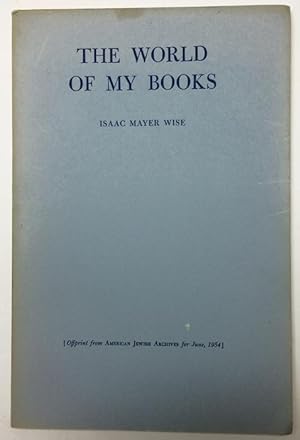
Soft cover. Condition: Fine. No Jacket. Fine, soft cover brochure, 42 pps, frontispiece of Isaac Mayer Wise. Very tight publication, without writing, spine sunned, light shelf wear, esge fade. Interior clean and bright. Please see our photo. Rare, autobiographical account of Rabbi Wises' spiritual and intellectual growth and development through his readings of books.
-

Hardcover. Condition: Very Good. Isaac Friedlander (illustrator). Text in Yiddish; Dark green cloth, spine label, decorative two color paper label covers front board, & several woodcut illustrations in the text; A just very good clean solid copy with small ownership stamp, & a bit of sunning to spine; 127 pages.
-
Sonnets to the Onlie Begetter of These Insuing Sonnets Mr. W. H. All happinesse And That Eternitie Promised By Our Ever Living Poet Wisheth The Well Wishing Adventurer In Setting Forth. T. T. [11 woodcuts from 12 Woodcuts for Shakespeare's Sonnets]
Published by No printer, No place
Seller: Ken Sanders Rare Books, ABAA, Salt Lake City, UT, U.S.A.
Association Member: ABAA ILAB IOBA RMABA
Seller rating 5 out of 5 stars

Signed
Prints only, no sonnets. Folio [34 cm] Illustrated dedication/title page plus 11 mounted woodcut prints [images 5 1/2 x 7 1/2"; on paper 7 3/8 x 9 1/2"] on loose bifolia sheets [13"]. Each with a loose tissue guard. All prints are signed by Isaac Friedlander in pencil in the bottom right corner. The Sonnet number is written in pencil in the bottom left corner. The prints are in a folder with a mounted illustrated dedication page on the front wrap (1 1/2" closed tear to the front folder wrap at the foot of the spine). All contents housed in a black paper chemise portfolio with a paper title label on the front of the portfolio. The portfolio is in very good condition, with light rubbing and edge wear. Short closed tear to top edge. Light stain along top edge of one bifolium. Prints fine. It is commonly agreed upon that the author of the dedication, "T. T." is the publisher Thomas Thorpe, however the identity of the dedicatee W. H. has been the matter of widespread and often bitter dispute, and is considered to be one of the most elusive figures in literary history. With striking images illustrating the following Sonnets by Shakespeare: Sonnet 7 (traces the path of the sun across the sky); Sonnet 12 (the poet realizes that the young man's beauty will be destroyed by Time); Sonnet 27 (the poet laments that the night, which should be a time of rest, is instead a time of continuing labor as, in his imagination he wrestles to reach his beloved); Sonnet 34 (the sun is overtaken by clouds, and the sun/beloved is accused of having betrayed the poet by promising what is not delivered); Sonnet 53 (the poet praises the beloved as not only the essence of beauty, but also as the epitome of constancy; Sonnet 66 (the poet gives examples of the societal wrongs that have driven him to become weary of life and long to die, except that he would thereby desert the beloved); Sonnet 97 (the poet remembers his separation from his beloved as a period as bleak as winter); Sonnet 116 (the poet meditates on what he views as the truest and strongest form of love, that between minds); Sonnet 123 (the poet muses that there is nothing new under the sun); Sonnet 127 (the poet defends his love of a mistress who does not fit the standard conventional definition of beauty); Sonnet 144 (reflects an allegory of a person tempted by a good and a bad angel). Missing Sonnet 106 (?). Eleven powerful images by Isaac Friedlander. Prolific etcher and wood engraver Isaac Friedlander (1890-1968) was born in Mitau, Latvia. Friedlander, a fervent opponent of Czarist rule, was sentenced to death at the age of 16- a fate he managed to narrowly escape. He moved to Italy in 1912, where he befriended Russian artist Maxim Gorky. During this time, he studied etching, drawing, and relief printing at the Academy of Rome. He emigrated to the United States in 1929, eventually settling in New York where he worked as a full-time artist until his death. His work often emphasizes his native Riga, the urban drama of Depression-era New York, and the horror of the Holocaust. Friedlander's works are represented in numerous museums, including the Smithsonian, Bibliotheque Nationale, and the Brooklyn Museum.


![Seller image for Sonnets to the Onlie Begetter of These Insuing Sonnets Mr. W. H. All happinesse And That Eternitie Promised By Our Ever Living Poet Wisheth The Well Wishing Adventurer In Setting Forth. T. T. [11 woodcuts from 12 Woodcuts for Shakespeare's Sonnets] for sale by Ken Sanders Rare Books, ABAA](https://pictures.abebooks.com/inventory/md/md32025147960.jpg)
