Order Total (1 Item Items):
Shipping Destination:

Gamow Teller (5 results)
Skip to main search results
Search filters
Product Type
- All Product Types
- Books (5)
- Magazines & Periodicals (No further results match this refinement)
- Comics (No further results match this refinement)
- Sheet Music (No further results match this refinement)
- Art, Prints & Posters (No further results match this refinement)
- Photographs (No further results match this refinement)
- Maps (No further results match this refinement)
- Manuscripts & Paper Collectibles (No further results match this refinement)
Condition Learn more
- New (No further results match this refinement)
- As New, Fine or Near Fine (1)
- Very Good or Good (3)
- Fair or Poor (No further results match this refinement)
- As Described (1)
Binding
Collectible Attributes
Language (2)
Price
- Any Price
- Under US$ 25 (No further results match this refinement)
- US$ 25 to US$ 50 (No further results match this refinement)
- Over US$ 50
Free Shipping
- Free Shipping to U.S.A. (No further results match this refinement)
Seller Location
Seller Rating
-
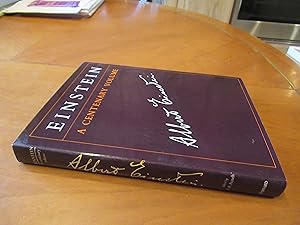
Einstein: A Centenary Volume
Language: English
Published by Harvard University Press, Cambridge, 1979
ISBN 10: 0674242300 ISBN 13: 9780674242302
Seller: Arroyo Seco Books, Pasadena, Member IOBA, Pasadena, CA, U.S.A.
Association Member: IOBA
Seller rating 4 out of 5 stars

First Edition
Hardcover. Condition: Fine. Dust Jacket Condition: Fine. Photographs And Diagrams (illustrator). 1st Edition. Xx, 332 Pp. Red Cloth Printed In Orange, With Orange Endpapers. First Printing. Fine In Fine Dust Jacket Priced $20.00. Gift Quality.
-

On the Origin of Great Nebulae. SS. 654-657. In: Physical Review. Vol. 55, No. 7.
Language: English
Published by Lancaster, 1939
Seller: Antiquariat Gerhard Gruber, Heilbronn, Germany
Seller rating 4 out of 5 stars
First Edition
(26,5 x 20 cm). SS. 609-686. Mit Abbildungen. Original-Broschur. Erste Ausgabe. - "Gamow's work with Teller of 1939 was based on the expanding universe but did not presuppose any explosive event in the past, what ten years later would be coined the big bang. All they had to say about the state of the universe before the separation of the nebulae about 1.8 billion years ago was, 'Before that time, space must have been uniformly populated by stars, or by gas molecules, if we suppose that the formation of stars took place after the separation of nebulae.' Although still in the pre-big-bang tradition, the paper was in several respects to serve as a kind of blueprint for Gamow's later contributions to cosmology" (Kox/ Eisenstaedt: The Universe of General Relativity). - Mit senkrechtem Knick, sonst gut erhalten.
-

"Selection Rules for the [Beta] Disintegration" in Physical Review
Published by American Institute of Physics, 1936
Seller: JF Ptak Science Books, Hendersonville, NC, U.S.A.
Seller rating 5 out of 5 stars

Soft cover. Condition: Very Good. GAMOW, George and Edward Teller. Gamow, G. and E. Teller. "Selection Rules for the [Beta] Disintegration" in Physical Review, volume 49, 15 June 1936, pp. 895-899 in the issue of pp 895-971. Original wrappers with two small dabs of red on the spine, ow/VG. $100.
-

Perspectives in Modern Physics - Essays in Honor of Hans A. Bethe *****SIGNED BY HANS BETHE****
Published by Interscience, 1966
First Edition Signed
Hardcover. Condition: Very Good. Dust Jacket Condition: Good. 1st Edition. VERY GOOD/GOOD; FIRST EDITION; SIGNED BY HANS BETHE ON THE PAGE BEFORE THE TITLE PAGE; the pages are clean and unmarked and the binding is tight; the dust jacket has edge wear, chipping and browning to the spine and a tear on the front cover at the bottom; Size: 8vo - over 7¾" - 9¾" tall. Signed by Author(s).
-
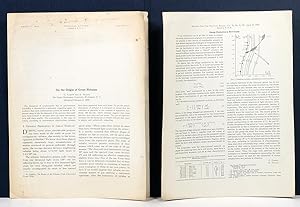
On the Origin of Great Nebulae. WITH: Energy Production in Red Giants
Published by American Institute of Physics, Lancaster and New York, 1939
Seller: Manhattan Rare Book Company, ABAA, ILAB, New York, NY, U.S.A.
Seller rating 5 out of 5 stars
First Edition
nb. Condition: Very Good. FIRST EDITION OFFPRINTS. RARE FIRST EDITION OFFPRINTS of Gamow and Teller's early papers on cosmology, including "a kind of blueprint" for Gamow's later theory of the Big Bang. In "On the Origin of Great Nebulae," "written jointly with Edward Teller, his friend and colleague at George Washington University, Gamow dealt for the first time explicitly with the Friedmann-Lemaitre equations. The two authors concluded that, 'our theory of nebular formation requires that the velocity of expansion remains nearly constant while the distances between nebulae increase by a factor of 600.' In the last section, they considered the cosmological consequences which they discussed from the form of the fundamental (Friedmann-Lemaitre) equation for the expanding universe as given by Richard Tolman in his important textbook of 1934? [and concluded]: 'Thus in order to understand the formation of great nebulae and to satisfy the condition of continuity at the moment of their separation, it is necessary to accept the hypothesis that space is infinite and ever expanding.' As they noted, this went against the conclusion that Edwin Hubble and Tolman had reached in 1935, namely that the universe must be closed and uncomfortably small. However, Gamow and Teller argued that the discrepancy might be resolved if it was admitted that the absolute luminosities of very distant (hence young) galaxies were higher than those nearer by. This idea was to play an important role in cosmology in the 1950s, but in 1939 it was merely a suggestion that lacked independent support. "Gamow's work with Teller of 1939 was based on the expanding universe but did not presuppose any explosive event in the past, what ten years later would be coined the big bang. All they had to say about the state of the universe before the separation of the nebulae about 1.8 billion years ago was, 'Before that time, space must have been uniformly populated by stars, or by gas molecules, if we suppose that the formation of stars took place after the separation of nebulae.' Although still in the pre-big-bang tradition, the paper was in several respects to serve as a kind of blueprint for Gamow's later contributions to cosmology" (Kox and Eisenstaedt, The Universe of General Relativity). In "Energy Production in Red Giants," published two weeks after "On the Origin of Great Nebulae," Gamow and Teller "carried out one of the earliest studies of the temperature dependence of thermonuclear reaction rates and applied their ideas to an investigation of energy production in red giant stars" (Libby and Bibber, Edward Teller Centennial Symposium). On the Origin of Great Nebulae. Offprint from: Physical Review, Vol. 55, April 1, 1939, pp. 654-657. Four pages, as issued without wrappers. Light edgewear, a little foxing. Energy Production in Red Giants. Offprint from: Physical Review, Vol 55, April 15, 1939. One page, as issued without wrappers. Small closed tear to margin, otherwise fine. Lancaster and New York: American Institute of Physics, 1939. Housed together in custom cloth case. RARE.