Order Total (1 Item Items):
Shipping Destination:

Gelbart Editor Yiddish Section (1 results)
Skip to main search results
Search filters
Product Type
- All Product Types
- Books (1)
- Magazines & Periodicals (No further results match this refinement)
- Comics (No further results match this refinement)
- Sheet Music (No further results match this refinement)
- Art, Prints & Posters (No further results match this refinement)
- Photographs (No further results match this refinement)
- Maps (No further results match this refinement)
- Manuscripts & Paper Collectibles (No further results match this refinement)
Condition Learn more
- New (No further results match this refinement)
- As New, Fine or Near Fine (No further results match this refinement)
- Very Good or Good (1)
- Fair or Poor (No further results match this refinement)
- As Described (No further results match this refinement)
Binding
- All Bindings
- Hardcover (1)
- Softcover (No further results match this refinement)
Collectible Attributes
- First Edition (1)
- Signed (No further results match this refinement)
- Dust Jacket (No further results match this refinement)
- Seller-Supplied Images (1)
- Not Print on Demand (1)
Language (1)
Price
- Any Price
- Under US$ 25 (No further results match this refinement)
- US$ 25 to US$ 50 (No further results match this refinement)
- Over US$ 50
Free Shipping
- Free Shipping to U.S.A. (No further results match this refinement)
Seller Location
Seller Rating
-
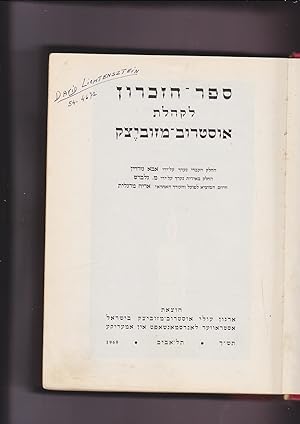
Sefer Hazikaron Lekehilat Ostrow-Mazowieck; Yizkor Buch Fun Der Yiddisher Kehile in Ostrow-mazowieck [Ostrow Mazowieck Memorial book[
Language: Hebrew
Published by Irgun Oley Otrow Mazowieck beIsrael, Tel Aviv, 1960
First Edition
Hardcover. Condition: Good. No Jacket. First Edition. In Yiddish and Hebrew. More Yiddish than Hebrew. 9.5 x 7 inches. 655 pages. Printed on good quality paper. Dozens of photos. Title page and front blank has the name of a former owner, David Lichtensztein. Underneath the name he wrote a number that may have been the one the Germans tattooed on his arm in Auschwitz, the only camp where numbers were tattooed (for those marked for death through overwork, as opposed to being murdered upon arrival). The book was written by former residents of Ostrow-Mazowieck who survived the Holocaust (Shoah) or emigrated before World War II. It contains the history of the community in addition to descriptions of the synagogues, cultural activities, rabbis, leaders, prominent people, etc. It also describes the events of the Shoah in the town and lists the victims. All information is either first-hand accounts or based upon first-hand accounts and therefore serves as a primary resource for research and for individuals seeking information about the town from which their ancestors came. Ostrow Mazowiecka, Poland is also known as: Ostrow Mazowiecka [Polish], Ostrov-Mazovyetsk [Yiddish], Ostrova [Yiddish], Ostrow, Ostrov, Ostrova, Ostrove, Ostreve, Mazovyetska, Ostrov-Mazovetskiy, Ostrow Mazowiecki. The book also includes information about these towns: Andrzejewo, Bialystok, Brok, Ciechanowiec, Czyzewo, Dlugosiodlo, Goworowo, Komorowo, Kosow-Lacki, Lomza, Malkinia, Nowogrod, Nur, Ostroleka, Poreba, Pultusk, Rozan, Siedlce, Slonim, Sokolow-Podlaski, Szumowo, Tykocin, Warszawa, Wasewo, Wysokie Mazowieckie, Wyszkow, Zambrow, and Zareby Koscielne. Ostrow Mazowiecka is 54 miles North-East of Warsaw.