

Order Total (1 Item Items):
Shipping Destination:

Genick Albert (22 results)
Skip to main search results
Search filters
Product Type
- All Product Types
- Books (4)
- Magazines & Periodicals (No further results match this refinement)
- Comics (No further results match this refinement)
- Sheet Music (No further results match this refinement)
- Art, Prints & Posters (18)
- Photographs (No further results match this refinement)
- Maps (No further results match this refinement)
- Manuscripts & Paper Collectibles (No further results match this refinement)
Condition Learn more
- New (1)
- As New, Fine or Near Fine (5)
- Very Good or Good (No further results match this refinement)
- Fair or Poor (No further results match this refinement)
- As Described (16)
Binding
- All Bindings
- Hardcover (2)
- Softcover (No further results match this refinement)
Collectible Attributes
- First Edition (No further results match this refinement)
- Signed (No further results match this refinement)
- Dust Jacket (No further results match this refinement)
- Seller-Supplied Images (22)
- Not Print on Demand (22)
Language (2)
Price
- Any Price
- Under US$ 25 (No further results match this refinement)
- US$ 25 to US$ 50 (No further results match this refinement)
- Over US$ 50
Free Shipping
- Free Shipping to U.S.A. (No further results match this refinement)
Seller Location
Seller Rating
-

Griechische Keramik. Von Albert Genick und Adolf Furtwängler. Unveränderter Faksimile-Reprint der Ausgabe von 1883. 30,5 x 44 cm, 24 S. und 40 kolorierte Tafeln, geb.
Published by Froelich Und Kaufmann
ISBN 13: 4251831553036
gebunden. Condition: Neu. Neu -Adolf Furtwängler war Archäologe mit dem Schwerpunkt Klassische Archäologie. Seine Arbeiten waren bedeutsam für die Erforschung der Geschichte der archaischen Kunst und der griechischen Kunst des 2. Jahrtausends v. Chr. Bedeutend sind seine systematischen Kataloge archäologischer Fundstücke. Albert Genick war Architekt in Berlin und eine der führenden Kapazitäten in der grafischen Darstellung antiker Keramik. Das Werk umfasst etwa 24 Seiten Einleitung und Beschreibung und ist mit 40 kolorierten Tafeln reichhaltig illustriert. Unveränderter Faksimile-Reprint, bibliophil gebunden. Der Einband erfolgte in einem strapazierfähigen Bibliotheksleinen mit einer im Stil der Zeit gehaltenen Titelillustration. Das eingelegte Leseband und das alterungsbeständige säurefreie Papier sind benutzer- und lesefreundlich. Ein wichtiges Stück Archäologiegeschichte! 30,5 x 44 cm, 24 S. und 40 kolorierte Tafeln, geb. 0 pp. Deutsch.
-

Griechische Keramik
Language: German
Published by Fines Mundi GmbH Saarbrücken, 2013
Seller: Versandantiquariat Nussbaum, Bernkastel-Kues, RP, Germany
Seller rating 5 out of 5 stars

Condition: Wie neu. 24 Seiten Einleitung und Beschreibung 40 colorierte Tafeln mit zahlreichen Abbildungen tadellos neuwertig / Modernes Schriftbild / Mit Tafeln, ausgewählt und aufgenommen von Albert Genick. Einleitung und Beschreibung von Adolf Furtwängler Sprache: Deutsch Gewicht in Gramm: 2450 44,3 x 30,5 cm, gebundene Ausgabe Faksimile-Reprint der Ausgabe 1883 Ernst Wasmuth.
-

Griechische Keramik
Published by Ernst Wasmuth, Berlin, 2021
Seller: Antiquariat Fines Mundi, Saarbruecken, Germany
Seller rating 5 out of 5 stars
-24 Seiten Einleitung und Beschreibung-40 colorierte Tafeln mit zahlreichen Abbildungen --- Albert Genick und Adolf Furtwängler:Griechische KeramikMit Tafeln, ausgewählt und aufgenommen von Albert Genick.Einleitung und Beschreibung von Adolf Furtwängler Verlagsfrischer, bibliophil ausgestatteter Faksimile-Reprint:Gedruckt auf einem schönen alterungsbeständigen und säurefreien Werkdruckpapier, das den Originaleindruck am besten wiedergibt.Gebunden als robuste Bibliotheksversion in Ganzleinen mit Rückenprägung.Bibliophil ausgestattet mit rundem Rücken und Lesebändchen.Ein dem Stil der Zeit entsprechender Umschlag wurde auf dem Vorderdeckel aufgezogen. --- 44,3 x 30,5 cm.
-

Griechische Keramik - Halblederausgabe
Published by Ernst Wasmuth, Berlin, 2021
Seller: Antiquariat Fines Mundi, Saarbruecken, Germany
Seller rating 5 out of 5 stars
-24 Seiten Einleitung und Beschreibung-40 colorierte Tafeln mit zahlreichen Abbildungen --- Albert Genick und Adolf Furtwängler:Griechische KeramikMit Tafeln, ausgewählt und aufgenommen von Albert Genick.Einleitung und Beschreibung von Adolf Furtwängler Verlagsfrischer, bibliophil ausgestatteter Faksimile-Reprint:Gedruckt auf einem schönen alterungsbeständigen und säurefreien Werkdruckpapier, das den Originaleindruck am besten wiedergibt.Hier vorliegend die auf 300 Exemplare limitierte Luxusedition in Halbleder mit unechten Bünden.Der Überzug wurde aus einem historischen Kleisterpapier hergestellt.Auf dem vorderen Umschlag ist eine dekorative Vignette aufgebracht.Diese Ausgabe wird nur auf Bestellung hergestellt, die Lieferzeit beträgt etwa 3 Wochen. --- 44,3 x 30,5 cm.
-

Kannen (XXXVI)
Published by Ernst Wasmuth, Berlin, 1883
Seller: Donald A. Heald Rare Books (ABAA), New York, NY, U.S.A.
Seller rating 5 out of 5 stars
Art / Print / Poster
Colour-printed lithograph by Ernst Wasmuth. Very good condition apart from a few minor remnants of an ink stamp in the top margin and a skillfully repaired 1/2" tear at the edge of the bottom margin. From "Griechische Keramik", Genick's superb work on Greek ceramics. This beautiful plate depicts several jugs of various sizes and shapes, including angelic and human forms, animal forms and abstract geometric patterns The revival of interest in Greek ceramics was led by the travellers and cognoscenti who visited Greece and southern Italy in the mid to late-18th century. The Greek vase as an art form was first brought to the attention of an appreciative wider audience with the publication of a number of well-illustrated works on the collections of these dilettantes. The most notable of this group was Sir William Hamilton (1730-1803), whose collection catalogue was published over a number of years starting in 1769. However, it was not until a century later that art historians felt they understood the full scope and history of ancient Greek ceramics in general and the superb work produced using the red-figure technique in particular. Genick was one of the leading authorities of his day on the red-figure vases: an architect by training, he had a passionate love for and deep understanding of this great Athenian pottery. His study, brought to realization by Wasmuth's superb chromolithographs, illustrates for the first time these masterpieces of the potter's life-size art.
-

Flaschen und Kännchen
Published by Ernst Wasmuth, Berlin, 1883
Seller: Donald A. Heald Rare Books (ABAA), New York, NY, U.S.A.
Seller rating 5 out of 5 stars
Art / Print / Poster
Colour-printed lithograph by Ernst Wasmuth. Very good condition apart from a few skillfully repaired small tears at the edge of the bottom margin. From "Griechische Keramik", Genick's superb work on Greek ceramics. This beautiful plate depicts several red-figure bottles and jugs of various sizes and shapes. The revival of interest in Greek ceramics was led by the travellers and cognoscenti who visited Greece and southern Italy in the mid to late-18th century. The Greek vase as an art form was first brought to the attention of an appreciative wider audience with the publication of a number of well-illustrated works on the collections of these dilettantes. The most notable of this group was Sir William Hamilton (1730-1803), whose collection catalogue was published over a number of years starting in 1769. However, it was not until a century later that art historians felt they understood the full scope and history of ancient Greek ceramics in general and the superb work produced using the red-figure technique in particular. Genick was one of the leading authorities of his day on the red-figure vases: an architect by training, he had a passionate love for and deep understanding of this great Athenian pottery. His study, brought to realization by Wasmuth's superb chromolithographs, illustrates for the first time these masterpieces of the potter's life-size art.
-

Hydrien / Giessgefässe
Published by Ernst Wasmuth, Berlin, 1883
Seller: Donald A. Heald Rare Books (ABAA), New York, NY, U.S.A.
Seller rating 5 out of 5 stars
Art / Print / Poster
Colour-printed lithograph by Ernst Wasmuth. Very good condition apart from some mild rippling and a skillfully repaired 1/2" tear in the left margin. From "Griechische Keramik", Genick's superb work on Greek ceramics. This beautiful plate depicts a two hydria, flared-lip water jars with three handles, and three types of pouring vessels. The revival of interest in Greek ceramics was led by the travellers and cognoscenti who visited Greece and southern Italy in the mid to late-18th century. The Greek vase as an art form was first brought to the attention of an appreciative wider audience with the publication of a number of well-illustrated works on the collections of these dilettantes. The most notable of this group was Sir William Hamilton (1730-1803), whose collection catalogue was published over a number of years starting in 1769. However, it was not until a century later that art historians felt they understood the full scope and history of ancient Greek ceramics in general and the superb work produced using the red-figure technique in particular. Genick was one of the leading authorities of his day on the red-figure vases: an architect by training, he had a passionate love for and deep understanding of this great Athenian pottery. His study, brought to realization by Wasmuth's superb chromolithographs, illustrates for the first time these masterpieces of the potter's life-size art.
-

Flaschen / Becher
Published by Ernst Wasmuth, Berlin, 1883
Seller: Donald A. Heald Rare Books (ABAA), New York, NY, U.S.A.
Seller rating 5 out of 5 stars
Art / Print / Poster
Colour-printed lithograph by Ernst Wasmuth. Very good condition apart from a few skillfully repaired tears in the top margin and several minor remnants of an ink stamp in the top left corner of the sheet. From "Griechische Keramik", Genick's superb work on Greek ceramics. This beautiful plate depicts several bottles and cups of various sizes and shapes. The revival of interest in Greek ceramics was led by the travellers and cognoscenti who visited Greece and southern Italy in the mid to late-18th century. The Greek vase as an art form was first brought to the attention of an appreciative wider audience with the publication of a number of well-illustrated works on the collections of these dilettantes. The most notable of this group was Sir William Hamilton (1730-1803), whose collection catalogue was published over a number of years starting in 1769. However, it was not until a century later that art historians felt they understood the full scope and history of ancient Greek ceramics in general and the superb work produced using the red-figure technique in particular. Genick was one of the leading authorities of his day on the red-figure vases: an architect by training, he had a passionate love for and deep understanding of this great Athenian pottery. His study, brought to realization by Wasmuth's superb chromolithographs, illustrates for the first time these masterpieces of the potter's life-size art.
-

Schalen (Kylix)
Published by Ernst Wasmuth, Berlin, 1883
Seller: Donald A. Heald Rare Books (ABAA), New York, NY, U.S.A.
Seller rating 5 out of 5 stars
Art / Print / Poster
Colour-printed lithograph by Ernst Wasmuth. Very good condition apart from yellowing at margins where it was matted and wave-like pattern of rippling in paper on the right half of the print. From "Griechische Keramik", Genick's superb work on Greek ceramics. The revival of interest in Greek ceramics was led by the travellers and cognoscenti who visited Greece and southern Italy in the mid to late-18th century. The Greek vase as an art form was first brought to the attention of an appreciative wider audience with the publication of a number of well-illustrated works on the collections of these dilettantes. The most notable of this group was Sir William Hamilton (1730-1803), whose collection catalogue was published over a number of years starting in 1766. However, it was not until a century later that art historians felt they understood the full scope and history of ancient Greek ceramics in general and the superb work produced using the red-figure technique in particular. Genick was one of the leading authorities of his day on the red-figure vases: an architect by training, he had a passionate love for and deep understanding of this great Athenian pottery. His study, brought to realization by Wasmuth's superb chromolithographs, illustrates for the first time these masterpieces of the potter's life-size art.
-

Kannen (XXXIII)
Published by Ernst Wasmuth, Berlin, 1883
Seller: Donald A. Heald Rare Books (ABAA), New York, NY, U.S.A.
Seller rating 5 out of 5 stars
Art / Print / Poster
Colour-printed lithograph by Ernst Wasmuth. Very good condition apart from a skillfully repaired tear in the top margin, skillfully repaired tears at the left and right edges, some marginal soiling, and several minor remnants of an ink stamp in the top left corner of the sheet. From "Griechische Keramik", Genick's superb work on Greek ceramics. The revival of interest in Greek ceramics was led by the travellers and cognoscenti who visited Greece and southern Italy in the mid to late-18th century. The Greek vase as an art form was first brought to the attention of an appreciative wider audience with the publication of a number of well-illustrated works on the collections of these dilettantes. The most notable of this group was Sir William Hamilton (1730-1803), whose collection catalogue was published over a number of years starting in 1769. However, it was not until a century later that art historians felt they understood the full scope and history of ancient Greek ceramics in general and the superb work produced using the red-figure technique in particular. Genick was one of the leading authorities of his day on the red-figure vases: an architect by training, he had a passionate love for and deep understanding of this great Athenian pottery. His study, brought to realization by Wasmuth's superb chromolithographs, illustrates for the first time these masterpieces of the potter's life-size art.
-

Vases or Urns
Published by Berlin, 1876
Seller: Trillium Antique Prints & Rare Books, Franklin, TN, U.S.A.
Seller rating 2 out of 5 stars

Art / Print / Poster
Condition: Fine. This large folio color chromolithograph is from Albert Genick's "Griechische Keramik". The work was published in Berlin in 1876 by Genick and Wasmuth. Ernst Wasmuth also completed the color-printed lithography. Genick's superb work was on Greek Ceramics with each plate illustrating various vases, urns, jugs, and other vessels. Interest in Greek ceramics and art was revived in the late 1700s with renewed travel to Italy and Greece as well as the publication of collections such as Sir William Hamilton. --- The work is in very good to excellent condition overall. There may be a few minor imperfections to be expected with age. Please review the image carefully for condition and contact us with any questions. --- Paper Size ~ 26" by 17 3/4".
-

Vases or Urns
Published by Berlin, 1876
Seller: Trillium Antique Prints & Rare Books, Franklin, TN, U.S.A.
Seller rating 2 out of 5 stars
Art / Print / Poster
Condition: Fine. This large folio color chromolithograph is from Albert Genick's "Griechische Keramik". The work was published in Berlin in 1876 by Genick and Wasmuth. Ernst Wasmuth also completed the color-printed lithography. Genick's superb work was on Greek Ceramics with each plate illustrating various vases, urns, jugs, and other vessels. Interest in Greek ceramics and art was revived in the late 1700s with renewed travel to Italy and Greece as well as the publication of collections such as Sir William Hamilton. --- The work is in very good to excellent condition overall. There may be a few minor imperfections to be expected with age. Please review the image carefully for condition and contact us with any questions. --- Paper Size ~ 26" by 17 3/4".
-

Vases or Urns
Published by Berlin, 1876
Seller: Trillium Antique Prints & Rare Books, Franklin, TN, U.S.A.
Seller rating 2 out of 5 stars
Art / Print / Poster
Condition: Fine. This large folio color chromolithograph is from Albert Genick's "Griechische Keramik". The work was published in Berlin in 1876 by Genick and Wasmuth. Ernst Wasmuth also completed the color-printed lithography. Genick's superb work was on Greek Ceramics with each plate illustrating various vases, urns, jugs, and other vessels. Interest in Greek ceramics and art was revived in the late 1700s with renewed travel to Italy and Greece as well as the publication of collections such as Sir William Hamilton. --- The work is in very good to excellent condition overall. There may be a few minor imperfections to be expected with age. Please review the image carefully for condition and contact us with any questions. --- Paper Size ~ 26" by 17 3/4".
-

Vases or Urns
Published by Berlin, 1876
Seller: Trillium Antique Prints & Rare Books, Franklin, TN, U.S.A.
Seller rating 2 out of 5 stars
Art / Print / Poster
Condition: Fine. This large folio color chromolithograph is from Albert Genick's "Griechische Keramik". The work was published in Berlin in 1876 by Genick and Wasmuth. Ernst Wasmuth also completed the color-printed lithography. Genick's superb work was on Greek Ceramics with each plate illustrating various vases, urns, jugs, and other vessels. Interest in Greek ceramics and art was revived in the late 1700s with renewed travel to Italy and Greece as well as the publication of collections such as Sir William Hamilton. --- The work is in very good to excellent condition overall. There may be a few minor imperfections to be expected with age. Please review the image carefully for condition and contact us with any questions. --- Paper Size ~ 26" by 17 3/4".
-

Kannen (XXXVI)
Published by Ernst Wasmuth, Berlin, 1883
Seller: Donald A. Heald Rare Books (ABAA), New York, NY, U.S.A.
Seller rating 5 out of 5 stars
Art / Print / Poster
Colour-printed lithograph by Ernst Wasmuth. Very good condition. From "Griechische Keramik", Genick's superb work on Greek ceramics. The revival of interest in Greek ceramics was led by the travellers and cogniscenti who visited Greece and southern Italy in the mid to late-18th century. The Greek vase as an art form was first brought to the attention of an appreciative wider audience with the publication of a number of well-illustrated works on the collections of these dilletants. The most notable of this group was Sir William Hamilton (1730-1803), whose collection catalogue was published over a number of years starting in 1769. However, these early pioneers, working with a relatively small number of examples and using primitive techniques, were only able to begin to piece together the intricate story of this unique art form. It was not until a century later that art historians felt that they were understood the full scope and history of ancient Greek ceramics in general and the superb work produced using the red-figure technique in particular. The red-figure technique first came into use in about 530 B.C. and was the dominant type by about 500 B.C. With this technique, images are traced in outline and the background filled in with black glaze. Details are then drawn in by the painter with a black or brownish glaze. Red figure vases continued to be produced in Athens until about 320 B.C. Genick was one of the leading authorities of his day on the red-figure vases: an architect by training, he had a passionate love for and deep understanding of this great Athenian pottery. His study, brought to realization by Wasmuth's superb chromolithographs, illustrates for the first time these masterpieces of the potter's life-size art.
-

Amphora (XVI)
Published by Ernst Wasmuth, Berlin, 1883
Seller: Donald A. Heald Rare Books (ABAA), New York, NY, U.S.A.
Seller rating 5 out of 5 stars
Art / Print / Poster
Colour-printed lithograph by Ernst Wasmuth. Very good condition. From "Griechische Keramik", Genick's superb work on Greek ceramics. The revival of interest in Greek ceramics was led by the travellers and cognoscenti who visited Greece and southern Italy in the mid to late-18th century. The Greek vase as an art form was first brought to the attention of an appreciative wider audience with the publication of a number of well-illustrated works on the collections of these dilettantes. The most notable of this group was Sir William Hamilton (1730-1803), whose collection catalogue was published over a number of years starting in 1769. However, it was not until a century later that art historians felt they understood the full scope and history of ancient Greek ceramics in general and the superb work produced using the red-figure technique in particular. Genick was one of the leading authorities of his day on the red-figure vases: an architect by training, he had a passionate love for and deep understanding of this great Athenian pottery. His study, brought to realization by Wasmuth's superb chromolithographs, illustrates for the first time these masterpieces of the potter's life-size art.
-

Lekythen
Published by Ernst Wasmuth, Berlin, 1883
Seller: Donald A. Heald Rare Books (ABAA), New York, NY, U.S.A.
Seller rating 5 out of 5 stars
Art / Print / Poster
Colour-printed lithograph by Ernst Wasmuth. Very good condition. From "Griechische Keramik", Genick's superb work on Greek ceramics. The revival of interest in Greek ceramics was led by the travellers and cogniscenti who visited Greece and southern Italy in the mid to late-18th century. The Greek vase as an art form was first brought to the attention of an appreciative wider audience with the publication of a number of well-illustrated works on the collections of these dilletants. The most notable of this group was Sir William Hamilton (1730-1803), whose collection catalogue was published over a number of years starting in 1769. However, these early pioneers, working with a relatively small number of examples and using primitive techniques, were only able to begin to piece together the intricate story of this unique art form. It was not until a century later that art historians felt that they were understood the full scope and history of ancient Greek ceramics in general and the superb work produced using the red-figure technique in particular. The red-figure technique first came into use in about 530 B.C. and was the dominant type by about 500 B.C. With this technique, images are traced in outline and the background filled in with black glaze. Details are then drawn in by the painter with a black or brownish glaze. Red figure vases continued to be produced in Athens until about 320 B.C. Genick was one of the leading authorities of his day on the red-figure vases: an architect by training, he had a passionate love for and deep understanding of this great Athenian pottery. His study, brought to realization by Wasmuth's superb chromolithographs, illustrates for the first time these masterpieces of the potter's life-size art.
-

1-4 Flaschen/5Becher
Published by Ernst Wasmuth, Berlin, 1883
Seller: Donald A. Heald Rare Books (ABAA), New York, NY, U.S.A.
Seller rating 5 out of 5 stars
Art / Print / Poster
Colour-printed lithograph by Ernst Wasmuth. Very good condition. From "Griechische Keramik", Genick's superb work on Greek ceramics. The revival of interest in Greek ceramics was led by the travellers and cogniscenti who visited Greece and southern Italy in the mid to late-18th century. The Greek vase as an art form was first brought to the attention of an appreciative wider audience with the publication of a number of well-illustrated works on the collections of these dilletants. The most notable of this group was Sir William Hamilton (1730-1803), whose collection catalogue was published over a number of years starting in 1769. However, these early pioneers, working with a relatively small number of examples and using primitive techniques, were only able to begin to piece together the intricate story of this unique art form. It was not until a century later that art historians felt that they were understood the full scope and history of ancient Greek ceramics in general and the superb work produced using the red-figure technique in particular. The red-figure technique first came into use in about 530 B.C. and was the dominant type by about 500 B.C. With this technique, images are traced in outline and the background filled in with black glaze. Details are then drawn in by the painter with a black or brownish glaze. Red figure vases continued to be produced in Athens until about 320 B.C. Genick was one of the leading authorities of his day on the red-figure vases: an architect by training, he had a passionate love for and deep understanding of this great Athenian pottery. His study, brought to realization by Wasmuth's superb chromolithographs, illustrates for the first time these masterpieces of the potter's life-size art.
-
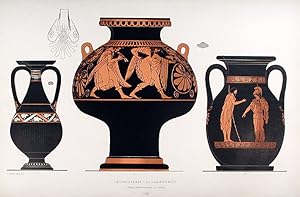
1. Kühlgefäss / 2. u. 3. Amphoren
Published by Ernst Wasmuth, Berlin, 1883
Seller: Donald A. Heald Rare Books (ABAA), New York, NY, U.S.A.
Seller rating 5 out of 5 stars
Art / Print / Poster
Colour-printed lithograph by Ernst Wasmuth. Very good condition apart from faint marginal soiling and tears at the bottom corners. From "Griechische Keramik", Genick's superb work on Greek ceramics. The revival of interest in Greek ceramics was led by the travellers and cognoscenti who visited Greece and southern Italy in the mid to late-18th century. The Greek vase as an art form was first brought to the attention of an appreciative wider audience with the publication of a number of well-illustrated works on the collections of these dilettantes. The most notable of this group was Sir William Hamilton (1730-1803), whose collection catalogue was published over a number of years starting in 1769. However, it was not until a century later that art historians felt they understood the full scope and history of ancient Greek ceramics in general and the superb work produced using the red-figure technique in particular. Genick was one of the leading authorities of his day on the red-figure vases: an architect by training, he had a passionate love for and deep understanding of this great Athenian pottery. His study, brought to realization by Wasmuth's superb chromolithographs, illustrates for the first time these masterpieces of the potter's life-size art.
-

Krater (XIX)
Published by Ernst Wasmuth, Berlin, 1883
Seller: Donald A. Heald Rare Books (ABAA), New York, NY, U.S.A.
Seller rating 5 out of 5 stars
Art / Print / Poster
Colour-printed lithograph by Ernst Wasmuth. Very good condition. From "Griechische Keramik", Genick's superb work on Greek ceramics. The revival of interest in Greek ceramics was led by the travellers and cogniscenti who visited Greece and southern Italy in the mid to late-18th century. The Greek vase as an art form was first brought to the attention of an appreciative wider audience with the publication of a number of well-illustrated works on the collections of these dilletants. The most notable of this group was Sir William Hamilton (1730-1803), whose collection catalogue was published over a number of years starting in 1769. However, these early pioneers, working with a relatively small number of examples and using primitive techniques, were only able to begin to piece together the intricate story of this unique art form. It was not until a century later that art historians felt that they were understood the full scope and history of ancient Greek ceramics in general and the superb work produced using the red-figure technique in particular. The red-figure technique first came into use in about 530 B.C. and was the dominant type by about 500 B.C. With this technique, images are traced in outline and the background filled in with black glaze. Details are then drawn in by the painter with a black or brownish glaze. Red figure vases continued to be produced in Athens until about 320 B.C. Genick was one of the leading authorities of his day on the red-figure vases: an architect by training, he had a passionate love for and deep understanding of this great Athenian pottery. His study, brought to realization by Wasmuth's superb chromolithographs, illustrates for the first time these masterpieces of the potter's life-size art.
-

1u.2Hydrien/3-5 Giessgefasse
Published by Ernst Wasmuth, Berlin, 1883
Seller: Donald A. Heald Rare Books (ABAA), New York, NY, U.S.A.
Seller rating 5 out of 5 stars
Art / Print / Poster
Colour-printed lithograph by Ernst Wasmuth. Very good condition. From "Griechische Keramik", Genick's superb work on Greek ceramics. The revival of interest in Greek ceramics was led by the travellers and cogniscenti who visited Greece and southern Italy in the mid to late-18th century. The Greek vase as an art form was first brought to the attention of an appreciative wider audience with the publication of a number of well-illustrated works on the collections of these dilletants. The most notable of this group was Sir William Hamilton (1730-1803), whose collection catalogue was published over a number of years starting in 1769. However, these early pioneers, working with a relatively small number of examples and using primitive techniques, were only able to begin to piece together the intricate story of this unique art form. It was not until a century later that art historians felt that they were understood the full scope and history of ancient Greek ceramics in general and the superb work produced using the red-figure technique in particular. The red-figure technique first came into use in about 530 B.C. and was the dominant type by about 500 B.C. With this technique, images are traced in outline and the background filled in with black glaze. Details are then drawn in by the painter with a black or brownish glaze. Red figure vases continued to be produced in Athens until about 320 B.C. Genick was one of the leading authorities of his day on the red-figure vases: an architect by training, he had a passionate love for and deep understanding of this great Athenian pottery. His study, brought to realization by Wasmuth's superb chromolithographs, illustrates for the first time these masterpieces of the potter's life-size art.
-

Amphoren (IV)
Published by Ernst Wasmuth, Berlin, 1883
Seller: Donald A. Heald Rare Books (ABAA), New York, NY, U.S.A.
Seller rating 5 out of 5 stars
Art / Print / Poster
Colour-printed lithograph by Ernst Wasmuth. Very good condition. From "Griechische Keramik", Genick's superb work on Greek ceramics. The revival of interest in Greek ceramics was led by the travellers and cogniscenti who visited Greece and southern Italy in the mid to late-18th century. The Greek vase as an art form was first brought to the attention of an appreciative wider audience with the publication of a number of well-illustrated works on the collections of these dilletants. The most notable of this group was Sir William Hamilton (1730-1803), whose collection catalogue was published over a number of years starting in 1769. However, these early pioneers, working with a relatively small number of examples and using primitive techniques, were only able to begin to piece together the intricate story of this unique art form. It was not until a century later that art historians felt that they were understood the full scope and history of ancient Greek ceramics in general and the superb work produced using the red-figure technique in particular. The red-figure technique first came into use in about 530 B.C. and was the dominant type by about 500 B.C. With this technique, images are traced in outline and the background filled in with black glaze. Details are then drawn in by the painter with a black or brownish glaze. Red figure vases continued to be produced in Athens until about 320 B.C. Genick was one of the leading authorities of his day on the red-figure vases: an architect by training, he had a passionate love for and deep understanding of this great Athenian pottery. His study, brought to realization by Wasmuth's superb chromolithographs, illustrates for the first time these masterpieces of the potter's life-size art.

