Order Total (1 Item Items):
Shipping Destination:

Gilbert Burton Wright (1 results)
Skip to main search results
Search filters
Product Type
- All Product Types
- Books (1)
- Magazines & Periodicals (No further results match this refinement)
- Comics (No further results match this refinement)
- Sheet Music (No further results match this refinement)
- Art, Prints & Posters (No further results match this refinement)
- Photographs (No further results match this refinement)
- Maps (No further results match this refinement)
- Manuscripts & Paper Collectibles (No further results match this refinement)
Condition Learn more
- New (No further results match this refinement)
- As New, Fine or Near Fine (No further results match this refinement)
- Very Good or Good (No further results match this refinement)
- Fair or Poor (No further results match this refinement)
- As Described (1)
Binding
- All Bindings
- Hardcover (No further results match this refinement)
- Softcover (1)
Collectible Attributes
- First Edition (No further results match this refinement)
- Signed (1)
- Dust Jacket (No further results match this refinement)
- Seller-Supplied Images (1)
- Not Print on Demand (1)
Language (1)
Price
- Any Price
- Under US$ 25 (No further results match this refinement)
- US$ 25 to US$ 50 (No further results match this refinement)
- Over US$ 50
Free Shipping
- Free Shipping to U.S.A. (No further results match this refinement)
Seller Location
Seller Rating
-
Hints on the Art of Oriental Painting
Published by Printed for the Author by Messrs. Reeves and Son, 150 Cheapside, London, 1831
Seller: Donald A. Heald Rare Books (ABAA), New York, NY, U.S.A.
Seller rating 5 out of 5 stars

Signed
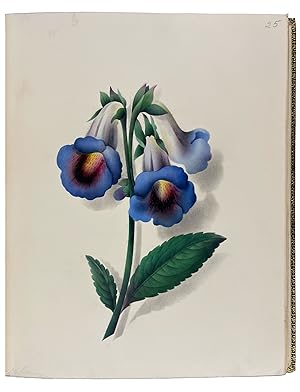
4to. (10 1/4 x 8 1/4 inches). Unpaginated, 148 pp. Pencilled foliation to 70 that skips four leaves: between 20 and 21, 29 and 30, 48 and 49, and 50 and 51, ff. 74. 20 hand-colored plates. 62 subjects in the text with the "easiest method of painting them." Title page signed by author in ink. Dedicated to Charles Beatty of Lincoln in "grateful remembrance of early kindness, patronage." Sections: title, dedication, preface, index, material list, "Tints Made by Mixture," "Examples for Practice," "Methods of working," "Hints on Oriental painting," "Rules for Painting Fruit, Flowers, Birds, Insects," and "Shells, a Study from Nature, Flowers from Nature" Green morocco, brown spine with raised bands in six compartments each with decorative gilt motif. [Oriental Painting - Gilbert] gilt-tooled in second compartment, gilt double fillets on covers, top edge gilt, other edges uncut, marbled red and blue endpapers A fascinating, signed instructional book on natural science illustration using "theorems," the author's 20 color drawings are marvelous and in remarkable condition, as bright as the day they were painted. The only other copy found is in the British Library, which has just 8 drawings. Burton Wright Gilbert (B. W. Gilbert) was born in Peterborough, England, and was active in the 1820s, 30s, and 40s, as an itinerant profilist, touring Ireland and England with his wife and the Lancashire-born portraitist Edward Barnes (1807-1873). "Gilbert and Barnes," as they were marketed, offered portrait paintings in profile and lessons in "Oriental Painting," alternatively referred to as the "Theorem Method" or "Mezzotinto Pencilling" for its likeness to mezzotint prints. "Oriental Painting" used drawings and watercolors "made with theorems, a kind of stencil produced by placing a design on transparent paper and cutting out the pattern." This technique, as expounded on in Hints on the Art of Oriental Painting, seems expressly aimed at young women, intended to be part of their education at finishing school. The resulting illustrations Gilbert produced using the method are remarkably bold and bright, popping off the page nearly two hundred years later with the aid of subtle shadowing. In the newspaper advertisements Gilbert and Barnes placed to promote their painting tours, they claimed to be able to teach the Oriental Painting method to 12-year-old children and artless adults alike in just six easy lessons. Gilbert and Barnes, and an occasional third partner named Rowlatt, painted portraits on card with "Frame and Glass included for 1 shilling" in the summer of 1825 as they toured Lancashire, Cheshire, Yorkshire, Birmingham, Liverpool, and Sheffield. In an advertisement in the Carlisle Journal on December 17th, 1842, Gilbert boasted that "twenty years' practice enables [him] to warrant an EXACT LIKENESS with splendid finish." Hints on the Art of Oriental Painting is a treatise on botanical illustration: how it should be done, and to what end. The book is exceedingly rare. The only other copy to be found is in the British Library. A comparison with the British Library's copy shows that Hints was custom-produced with different plates for each copy. The British Library's copy has just 5 flower illustrations, while this copy has 17. A few of the textual leaves vary between the two copies as well. A companion volume to Hints on the Art of Oriental Painting titled A Treatise on the Art of Mezzotinto Pencilling: Also Observations on Painting on Glass, Satin, Velvet and Wood, is found at the Yale Center for British Art's library. Hints and A Treatise are both instructional books intended for solitary study for "pupils in the absence of the master, for governesses, and families who reside in the country." This "Gilbertian System," which relied on so-called "theorems," or cut stencils, supposedly did away with the "tedious old method of poring over a leaf for days to the great injury of the health of the Pupil." The partnership of Gilbert and Barnes likely en.