

Order Total (1 Item Items):
Shipping Destination:

Graffin Walter (5 results)
Skip to main search results
Search filters
Product Type
- All Product Types
- Books (5)
- Magazines & Periodicals (No further results match this refinement)
- Comics (No further results match this refinement)
- Sheet Music (No further results match this refinement)
- Art, Prints & Posters (No further results match this refinement)
- Photographs (No further results match this refinement)
- Maps (No further results match this refinement)
- Manuscripts & Paper Collectibles (No further results match this refinement)
Condition Learn more
- New (1)
- As New, Fine or Near Fine (No further results match this refinement)
- Very Good or Good (3)
- Fair or Poor (No further results match this refinement)
- As Described (1)
Binding
- All Bindings
- Hardcover (No further results match this refinement)
- Softcover (5)
Collectible Attributes
- First Edition (1)
- Signed (No further results match this refinement)
- Dust Jacket (No further results match this refinement)
- Seller-Supplied Images (2)
- Not Print on Demand (4)
Language (3)
Free Shipping
- Free Shipping to U.S.A. (No further results match this refinement)
Seller Location
Seller Rating
-

Perspectives for the Seventies
Published by Dodd Mead, 1971
Seller: Hammonds Antiques & Books, St. Louis, MO, U.S.A.
Seller rating 3 out of 5 stars

Softcover. good condition with minor soiling xlibrary with usual markings; xlibrary with usual markings; LIB2958011719; (C149).
-

Condition: good. Befriedigend/Good: Durchschnittlich erhaltenes Buch bzw. Schutzumschlag mit Gebrauchsspuren, aber vollständigen Seiten. / Describes the average WORN book or dust jacket that has all the pages present.
-
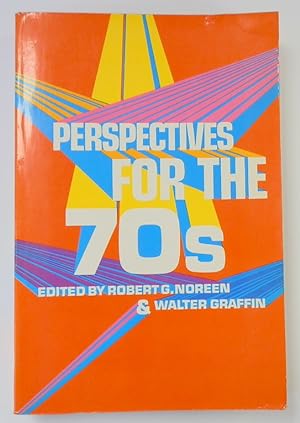
Perspectives for the 70's
Language: English
Published by Dodd, Mead and Company, New York, 1971
ISBN 10: 0396063128 ISBN 13: 9780396063124
Seller: PsychoBabel & Skoob Books, Didcot, United Kingdom
Seller rating 5 out of 5 stars

US$ 34.65
US$ 16.82 shipping
Ships from United Kingdom to U.S.A.Quantity: 1 available
Add to basketPaperback. Condition: Good. Paperback in good condition. Covers are creased, and edges and corners are slightly bumped and rubbed, with more notable bumpe to the spine head and upper leading edge corners. Page block is tanned and blemised. Previous owner's name penned to FEP. Binding is sound and pages are clear. LW. Used.
-

Perspectives for the 70s
Language: English
Published by Dodd, Mead & Company, Inc, New York, 1971
ISBN 10: 0396063128 ISBN 13: 9780396063124
Seller: Ground Zero Books, Ltd., Silver Spring, MD, U.S.A.
Seller rating 5 out of 5 stars
First Edition
Mass market paperback. Condition: Very good. Presumed First Edition, First Printing. [1], vii, [3], 369, [3], pages. Footnotes. A stimulating collection of contemporary essays dealing with the significant issues of our day. By culling from recent popular and scholarly periodicals, the editors attempt to provide opposing points of view concerning problems of life style education, race, science, and technology. Represented are the conservative and liberal positions as well as reactionary and radical. Professor Noreen is a member of the Department of English, San Fernando Valley State College; Professor Graffin is a member of the Department of English, University of Wisconsin--Parkside. Dr. Robert G. Noreen was born in Gresham, OR in 1938. He received his BA, MA, and Ph.D. degrees from the University of Chicago. He taught at Northwestern University for three years before accepting a position in the English Department at California State University, Northridge (CSUN), where he spent the majority of his professional career as both a professor and chair of the department. He retired from teaching at CSUN in 2003, but continued to work in his department until 2008. From encyclopediadotcom In the 1970s, one encouraging development in American foreign policy was the thaw of the cold war (period of extreme political tension between the United States and the Soviet Union following World War II). President Richard M. Nixon recognized that the enormous military spending of the United States and the Soviet Union was bankrupting both countries. Sensing the growing hostilities between the Soviet Union and China, Nixon decided to play the interest of one superpower against the other. He hoped this would lessen the possibility of confronting the Soviets on the battlefield. By 1972, Nixon had negotiated an arms-control agreement with the Soviet Union and had begun diplomatic talks with China. Presidents Gerald R. Ford and Jimmy Carter tried to continue these initiatives, and for a while they worked. Ultimately, however, the cordial relations among the superpowers cooled yet again as they accused one another of trying to extend their influence around the world. By 1978, Carter was calling for massive increases in military spending, and the world settled in for another decade of the cold war. The decade found Americans as troubled by domestic issues as by foreign affairs. Their faith in the federal government, already badly shaken by the Vietnam War, was almost completely lost over the events surrounding the 1972 burglary of the Democratic National Committee's headquarters in the Watergate office complex. The arrest of five men in the break-in led to the uncovering of a trail that went all the way to the White House, and right to the Oval Office. Try as he might, Nixon could not hide his involvement in the illegal activities surrounding the case. Faced with mounting evidence and certain impeachment, Nixon created history one last time by resigning from the presidency. The U.S. Supreme Court played a decisive role in the downfall of the Nixon presidency, and it also was instrumental in resolving conflicts confronting American society in the 1970s. Rapidly growing prison populations and frequent riots raised questions about prison conditions and stricter sentencing to try to reduce rising crime rates. Debates about school busing and school desegregation were conducted in courtrooms and in the streets. And environmental groups and businesses fought legal battles to protect the environment. The most far-reaching Supreme Court ruling in the decade came in the 1973 Roe v. Wade case. Many Americans believed that control over childbearing was an important element of women's privacy and equality. Some argued for a constitutional right to preserve a woman's right to choose to have an abortion. The Court's decision, which established a woman's legal right to choose an abortion during the first trimester of pregnancy, created an ongoing debate that changed the course of national politics.
-

Anarchie und Evolution
Language: German
Published by Münchner Verlagsgruppe GmbH, 2011
ISBN 10: 3868839097 ISBN 13: 9783868839098
Kartoniert / Broschiert. Condition: New. Dieser Artikel ist ein Print on Demand Artikel und wird nach Ihrer Bestellung fuer Sie gedruckt. Steve Olson ist ein preisgekroenter Wissenschaftsautor und Verfasser des Buches Herkunft und Geschichte des Menschen: Was die Gene ueber unsere Vergangenheit verraten, das 2002 auf der Shortlist fuer den National Book Award stand. Olson ist Autor fuer die Natio.


