

Order Total (1 Item Items):
Shipping Destination:

Grosse Stanley (3 results)
Skip to main search results
Search filters
Product Type
- All Product Types
- Books (No further results match this refinement)
- Magazines & Periodicals (No further results match this refinement)
- Comics (No further results match this refinement)
- Sheet Music (No further results match this refinement)
- Art, Prints & Posters (3)
- Photographs (No further results match this refinement)
- Maps (No further results match this refinement)
- Manuscripts & Paper Collectibles (No further results match this refinement)
Condition Learn more
- New (No further results match this refinement)
- As New, Fine or Near Fine (No further results match this refinement)
- Very Good or Good (3)
- Fair or Poor (No further results match this refinement)
- As Described (No further results match this refinement)
Binding
- All Bindings
- Hardcover (No further results match this refinement)
- Softcover (No further results match this refinement)
Collectible Attributes
- First Edition (No further results match this refinement)
- Signed (3)
- Dust Jacket (No further results match this refinement)
- Seller-Supplied Images (3)
- Not Print on Demand (3)
Language (1)
Price
- Any Price
- Under US$ 25 (No further results match this refinement)
- US$ 25 to US$ 50 (No further results match this refinement)
- Over US$ 50
Free Shipping
- Free Shipping to U.S.A. (No further results match this refinement)
Seller Location
Seller Rating
-
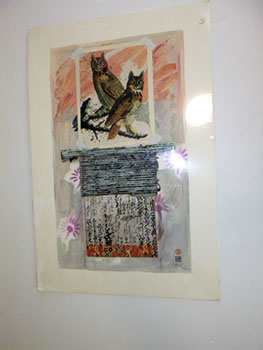
Pajaro Series. Two Owls with Asian writing on scroll. Original mixed media.
Published by Sedona, AZ: late 20th Century.
Seller: Wittenborn Art Books, San Francisco, CA, U.S.A.
Seller rating 5 out of 5 stars

Art / Print / Poster Signed
Condition: Good. Mixed media. 40 x 26.5 inches sheet size.Signed with pencil and color chops. Annotated "Pajaro Series A-50," verso.Provenance Suzy Locke, Piedmont, CA.Stanley "Flat Stanley" Gordon Grosse, 87, died on July 19, 2017, in Scottsdale, Arizona, but he left his heart and soul in Kahana, Maui, where he lived with his beloved Pamela until earlier this year. Stanley was preceded in death by his parents, Sam and Edith Grosse, and is survived by his wife, Pamela, his sons, Chris and Keith, and his beautiful grandchildren, Shannie, Sean, and Sienna, and great grandchildren, Callem and Emerson. Stanley was a passionate art teacher and artist, creating art all over the world and sharing it with all he loved. He will be deeply missed by his family, friends, and students. A memorial service will be held on July 28, 2017, at 11 am, at Hansen Desert Hills Mortuary, in Scottsdale, Arizona.
-

Pajaro Series. Hawk with Asian writing on scroll. Original mixed media.
Published by Sedona, AZ: late 20th Century.
Seller: Wittenborn Art Books, San Francisco, CA, U.S.A.
Seller rating 5 out of 5 stars
Art / Print / Poster Signed
Condition: Good. Mixed media. 40 x 26.5 inches sheet size.Signed with pencil and color chops. Annotated "Pajaro Series A-27," verso.Provenance Suzy Locke, Piedmont, CA.Stanley "Flat Stanley" Gordon Grosse, 87, died on July 19, 2017, in Scottsdale, Arizona, but he left his heart and soul in Kahana, Maui, where he lived with his beloved Pamela until earlier this year. Stanley was preceded in death by his parents, Sam and Edith Grosse, and is survived by his wife, Pamela, his sons, Chris and Keith, and his beautiful grandchildren, Shannie, Sean, and Sienna, and great grandchildren, Callem and Emerson. Stanley was a passionate art teacher and artist, creating art all over the world and sharing it with all he loved. He will be deeply missed by his family, friends, and students. A memorial service will be held on July 28, 2017, at 11 am, at Hansen Desert Hills Mortuary, in Scottsdale, Arizona.
-

Collage and Mixed media from Fuji Series- Night. Original Aquatint.
Published by Circa 1950s., 1950
Seller: Wittenborn Art Books, San Francisco, CA, U.S.A.
Seller rating 5 out of 5 stars
Art / Print / Poster Signed
Condition: Good. Collage and Mixed media. 20 x 14 inches.Signed in various ways.There are about 45 pieces in this series, using Mt. Fuji, the patinas of Japan, Kimono patterns, calligraphy in a general cruciform composition. This collage painting is 20 x 27 inches. Many from this series are larger, using a full sheet of 40 x 27 inches and then larger diptychs, 40 x 54 inches.The materials used are varied, creamy Stucco Patch, Paper Tape with asphalt center, corrugated and folded Construction Siding Paper. The siding paper is three layers with tan craft paper sheets on either side, and a asphalt film sandwiched in between. You can buy this at any construction material output or many hardware stores. (Great for doing large figure drawings. It comes in a roll, so you can make it any length.)Hard to find now is the Craft Packaging Tape, approximately 2 1/2 inches wide, with a water-based glue backing. It comes in a big roll. It too is made up of paper on either side, with asphalt, and, thin pieces of nylon string crisscrossing in between for strength. (It's almost phased out now and being substituted with clear box tape.) Both of these paper materials will leach the asphalt, when you coat them with mineral spirits thinned down oil-based paints. The corrugated cardboard has been impregnated with the asphalt using a milky consistency white oil paint wash over it.Stanley Grosse was born in St. Louis, Missouri in 1930 and began his art education in 1950 at Los Angeles Trade Tech/commercial art division. In 1952 to 1954, Mr. Grosse was stationed at the Army language school, Monterey, California where he was noncom in charge of the Printing Lab and Art Department.In 1954, Stanley entered the California College of Arts and Crafts and graduated cum laude. In 1956 he began his teaching career on the San Francisco Peninsula. Grosse was awarded three sabbatical leaves, the first on a scholarship, finishing his masters in painting at the Instituto Allende, San Miguel Allende, Mexico in 1964.A second sabbatical leave took him to Europe using a small town in Spain as a hub. He worked in the studio there, producing two series of works and traveled 14,000 miles through Europe and North Africa. Photographing,
