Order Total (1 Item Items):
Shipping Destination:

Heinsius D (52 results)
Skip to main search results
Search filters
Product Type
- All Product Types
- Books (52)
- Magazines & Periodicals (No further results match this refinement)
- Comics (No further results match this refinement)
- Sheet Music (No further results match this refinement)
- Art, Prints & Posters (No further results match this refinement)
- Photographs (No further results match this refinement)
- Maps (No further results match this refinement)
- Manuscripts & Paper Collectibles (No further results match this refinement)
Condition Learn more
- New (30)
- As New, Fine or Near Fine (4)
- Very Good or Good (2)
- Fair or Poor (No further results match this refinement)
- As Described (16)
Binding
Collectible Attributes
- First Edition (1)
- Signed (No further results match this refinement)
- Dust Jacket (1)
- Seller-Supplied Images (34)
- Not Print on Demand (31)
Language (6)
Free Shipping
Seller Location
Seller Rating
-

Condition: As New. Unread book in perfect condition.
-

-

-

Eloge du pou, traduit du latin
Language: French
Published by HACHETTE LIVRE-BNF 2018-02, 2018
ISBN 10: 2013616260 ISBN 13: 9782013616263
US$ 13.43
US$ 20.70 shipping
Ships from United Kingdom to U.S.A.Quantity: 10 available
Add to basketPF. Condition: New.
-
Éloges du pou, de la boue et de la paille et autres pièces. Traduit du latin (French Edition)
Seller: Ria Christie Collections, Uxbridge, United Kingdom
Seller rating 5 out of 5 stars

US$ 20.54
US$ 16.01 shipping
Ships from United Kingdom to U.S.A.Quantity: Over 20 available
Add to basketCondition: New. In.
-

Publius Ovidius Naso
Language: English
Published by Kessinger Publishing, 2009
ISBN 10: 1104369605 ISBN 13: 9781104369606
Condition: New.
-
Eloges du pou, de la boue et de la paille et autres pieces. Traduit du latin
Language: French
Published by HACHETTE LIVRE-BNF 2018-02, 2018
ISBN 10: 2019945479 ISBN 13: 9782019945473
US$ 16.90
US$ 20.70 shipping
Ships from United Kingdom to U.S.A.Quantity: 10 available
Add to basketPF. Condition: New.
-

Éloges du pou, de la boue et de la paille et autres pièces. Traduit du latin -Language: french
Seller: GreatBookPricesUK, Woodford Green, United Kingdom
Seller rating 5 out of 5 stars
US$ 20.31
US$ 20.04 shipping
Ships from United Kingdom to U.S.A.Quantity: Over 20 available
Add to basketCondition: New.
-

Publius Ovidius Naso
Language: English
Published by Kessinger Publishing, 2009
ISBN 10: 1104369605 ISBN 13: 9781104369606
Condition: As New. Unread book in perfect condition.
-

Éloges du pou, de la boue et de la paille et autres pièces. Traduit du latin -Language: french
Seller: GreatBookPricesUK, Woodford Green, United Kingdom
Seller rating 5 out of 5 stars
US$ 23.50
US$ 20.04 shipping
Ships from United Kingdom to U.S.A.Quantity: Over 20 available
Add to basketCondition: As New. Unread book in perfect condition.
-
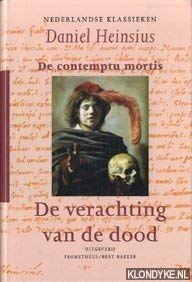
De contemptu mortus. De verachting van de dood (Nederlandse Klassieken)
Language: Multiple languages
Published by Amsterdam, Prometheus 2005, 2005
ISBN 10: 9035126807 ISBN 13: 9789035126800
Seller: Antiquariaat Schot, Hendrik-Ido-Ambacht, Netherlands
Seller rating 5 out of 5 stars
514 p. Hardcover met stofomslag.
-

Publius Ovidius Naso
Language: English
Published by Kessinger Publishing, 2009
ISBN 10: 1104369605 ISBN 13: 9781104369606
Seller: GreatBookPricesUK, Woodford Green, United Kingdom
Seller rating 5 out of 5 stars
US$ 60.26
US$ 20.04 shipping
Ships from United Kingdom to U.S.A.Quantity: Over 20 available
Add to basketCondition: New.
-

Publius Ovidius Naso
Language: English
Published by Kessinger Publishing, 2009
ISBN 10: 1104369605 ISBN 13: 9781104369606
Seller: GreatBookPricesUK, Woodford Green, United Kingdom
Seller rating 5 out of 5 stars
US$ 60.34
US$ 20.04 shipping
Ships from United Kingdom to U.S.A.Quantity: Over 20 available
Add to basketCondition: As New. Unread book in perfect condition.
-

Bacchus en Christus. Twee Lofzangen. Opnieuw uitg. door L. Ph. Rank, J.D.P. Warners en F.L. Zwaan.
Published by Zwolle, 1965, 1965
Seller: Antiquariaat De Keerkring, Malden, Netherlands
Seller rating 5 out of 5 stars
Zwolle, 1965. Ingenaaid. 352 pp. (ZDH; 53).
-
De verachting van de dood. De contemptu mortis. Vertaling door J. Bloemendal en J.W. Steenbeek. Tekst, inleiding en commentaar door J. Bloemendal. Met een woord vooraf door R. Steenbeek.
Language: Multiple languages
Published by Uitgeverij Prometheus, 2005
ISBN 10: 9035126807 ISBN 13: 9789035126800
Seller: Scrinium Classical Antiquity, Aalten, Netherlands
Seller rating 5 out of 5 stars
Prometheus / Bert Bakker, Amsterdam, 2005. 515p. Bound with pictorial dust wrps.
-
-
PAP. Condition: New. New Book. Shipped from UK. THIS BOOK IS PRINTED ON DEMAND. Established seller since 2000.
-
Daniel Heinsius and the Textus Receptus of the New Testament. A study of his contributions to the editions of the Greek Testament printed by the Elzeviers at Leiden in 1624 and 1633.
Seller: Antiquariaat Rashi, Gorinchem, Netherlands
Seller rating 5 out of 5 stars
Leiden, Brill, 1971. Or.wrps. 69 pp. In good condition.
-
?loges du pou, de la boue et de la paille et autres pi?ces. Traduit du latin
Seller: PBShop.store UK, Fairford, GLOS, United Kingdom
Seller rating 5 out of 5 stars
US$ 22.38
US$ 5.56 shipping
Ships from United Kingdom to U.S.A.Quantity: Over 20 available
Add to basketPAP. Condition: New. New Book. Delivered from our UK warehouse in 4 to 14 business days. THIS BOOK IS PRINTED ON DEMAND. Established seller since 2000.
-
Stoff zu Ausarbeitungen, freien Vorträgen und Reden, in einer Menge wissenschaftlich geordneter Aufgaben, Stylproben und Dispositionen. Ein Handbuch für Lehrer.
Language: German
Published by Berlin, Duncker u. Humboldt, 1830
Condition: Gut. 4.,verm u. verb. Aufl. XVI, 348 S. -Bö5- (Einband stärker berieben)[Aus der Bibliothek von Prof. Dr. Helmut Böhme (1936-2012), Historiker und Präsident der TU Darmstadt von 1971-1995) Ich versende mit der Deutschen Post (Büchersendung) und der DHL (Pakete). Die Lieferzeit ist abhängig von der Versandart und beträgt innerhalb Deutschlands 3-5 Tage, in der EU 5 - 14 Tage. Sprache: Deutsch Gewicht in Gramm: 300 Ledereinband mit geprägter Rückenbeschriftung.
-
Disputatio juridica de jure infantum.
Published by Frankfurt/O Zeitler, 1686
Seller: Zentralantiquariat Leipzig GmbH, Leipzig, Germany
Seller rating 5 out of 5 stars
66 S., 1 Bl. Ohne Einbd. Gebräunt. VD17 12:149226F. - Anton Daniel Sonnemann (um 1650-1699), Rechtswissenschaftler in Frankfurt a.d. Oder. la.
-
POEMATUM NOVA EDITIO, prioribus longe auctior. Accedunt Johannis Rutgersii postuma, et adoptivorum carminum libri II. Ad illustrissimum & excellentissimum Virum Carolum Sancta-Mauraerum, ducem Montozerium.
Language: Latin
Published by Amstelodami, Apud Danielem Elzevirium, Amstelodami (Amsterdam - HOLANDA), 1666
Seller: Librería de Lance La Dulcinea, MADRID, Calle Hermosilla Nº, 132, Spain
Seller rating 4 out of 5 stars

Encuadernación de tapa dura. Condition: Muy Bien. Dust Jacket Condition: Bien. POEMAS LATINOS. Obra muy importante de Nikolaes Heinsius el Viejo ( Leiden,1620-La Haya,1681), uno de los más originales y elegantes poetas latinistas. Estudió y tradujo autores clásicos como Claudiano, Ovídio, Prudencio, Virgílio y Valerius Flaccus. Escolástico y neerlandés hijo de Daniel Heinsius del que fue discípulo en la Universidad de Leiden y padre de Nicolaas Heinsius el Joven. Tras el éxito de su poema Breda expugnata en 1637, en 1642, visitó Inglaterra a fin de investigar manuscritos clásicos. Investigó códices antiguos por Lovaina, Bruselas, Malinas y Amberes antes de regresar a Leiden. Más tarde bajó a París, Lyon, Marsella, Pisa, Florencia (donde editó una nueva versión de un texto de Ovidio) y Roma. En 1647, huyó de Nápoles durante el reinado de Masaniello; y continuó sus investigaciones en Livorno, Bolonia y Venecia. Trabajó mucho tiempo en Milán en la Biblioteca Ambrosiana. Fue historiador oficial de la ciudad de Ámsterdam. Todo un bibliófilo, llegó a atesorar una de las más grandes bibliotecas privadas de Europa; a su muerte, 13000 ejemplares fueron vendidos en 1683. Preciosa letra tipográfica sobre excelente papel de la época, con MARCA XILOGRÁFICA de ilustre familia de impresores, DANIELEM ELZEVIRIUM -año1666-. Muy buen estado general de conservación para su antigüedad. Bella encuadernación en media piel holandesa roja con dorados. 8+352+150+2 págs. Textos en latín. Obra rara y escasa.
-
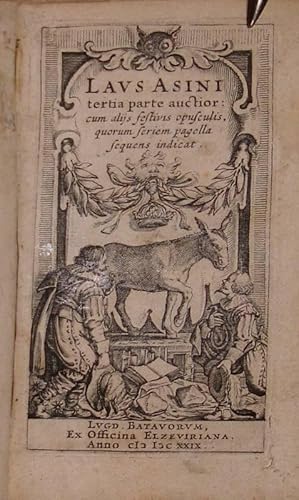
Laus asini. Tertia parte auctior, cum aliis festivis opusculis.
Published by Leiden (Lugd. Batavorum), Ex Officina Elzeviriana, 1629., 1629
Seller: Antiquariaat Fragmenta Selecta, AMSTERDAM, Netherlands
Seller rating 5 out of 5 stars
24mo. (XX),438,(2 blank) p. Overlapping vellum 11.5 cm (Ref: STCN ppn 832854379; Willems 315; Berghman 1247; Rahir 286; Brunet 3,84; Graesse 3,233) (Details: 5 thongs laced through the joints. Engraved title, depicting 2 learned gentlemen, perhaps Ewaldus Schrevelius, to whom the book is dedicated, and Heinsius' friend Aldoph Vorstius, who doff their hats for an ass) (Condition: Vellum soiled and scratched. Front board slightly damaged at the upper edge. All four ties gone. Front flyleaf removed. Right edge of the title thumbed, very tiny and almost invisible hole in the title) (Note: The 'Laus asini (ad Senatum Populumque eorum, qui ignari omnium, scientias hoc tempore contemnunt) was published anonymously for the first time in 1623. An augmented edition appeared in 1629. The author is according to all critics the Dutch classical scholar and neolatin poet Daniel Heinsius, 1580-1655. It pokes fun at people in an Erasmian spirit, and seems to have lost none of its topicality. The aim is, Heinsius tells in the 'ad lectorem', to vindicate men of letters and those who love to learn, from the contempt of ignorant people, who not only heartily ridicule (liberrime. illudunt) them, but also culture (eruditioni) and the sciences. (leaf *6 recto & verso) This eulogy is a satire on ignorance and voluntary servitude. It is hard to fathom, because of the complexity of its style, and the overabundance of erudition (or put more positively, the veritable fireworks of learned allusions), which often obscures matters. The first edition of 1623, which contained the 'Laus Asini' only, is augmented in this second edition with 6 other pieces, 1: an Menippean satire 'Cras credo, hodie nihil', 2: 'Epistola, qua agitur an, & qualis viro literato sit ducenda uxor', 3: 'Laus pediculi, ad Conscriptos Mendicorum Patres', 4: 'Epistola de poetarum ineptiis & saeculi vitio', 5: 'Argumentum Batrachomyomachiae', 6: 'Viro Nobilissimo Ioanni Milandro, Domino de Poederoeye, Principi a Secretis: de Graeculis, quos illi commendaverat'. At the end Heinsius added a short letter to H. Grotius, and a consolation poem for his friend Baudius, on the occasion of the death of his wife) (Collation: *6, 2*4, A-2N6, 2O4 (leaf 2O4 blank) (Photographs on request) 500 gr.
-
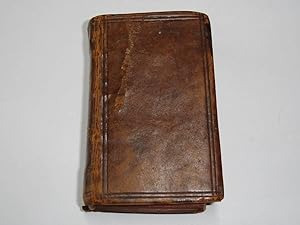
Laus asini. Tertia parte auctior, cum aliis festivis opusculis, quorum seriem pagella sequens indicat.
Published by Leiden (Lugd. Batavorum), Ex Officina Elzeviriana, 1629., 1629
Seller: Antiquariaat Fragmenta Selecta, AMSTERDAM, Netherlands
Seller rating 5 out of 5 stars
24mo. (XX),438,(2 blank) p. Contemporary calf 10.5 cm (Ref: Willems 315; Berghman 1247; Rahir 286; Brunet 3,84; Graesse 3,233) (Details: Binding ruled blind. Engraved title, depicting 2 learned gentlemen, perhaps Ewaldus Schrevelius, to whom the book is dedicated, and Heinsius' friend Adolph Vorstius, who both doff their hats for an ass) (Condition: Binding scuffed and with a few scratches, corners bumped. Small piece of leather gone at the foot of the spine. Both pastedowns detached) (Note: The 'Laus asini' (ad Senatum Populumque eorum, qui ignari omnium, scientias hoc tempore contemnunt) was published anonymously for the first time in 1623. An augmented edition appeared in 1629. The author is according to all critics the Dutch classical scholar and neolatin poet Daniel Heinsius, 1580-1655. It makes fun of people in an Erasmian spirit, and seems to have lost none of its topicality. The aim is, Heinsius tells in the 'ad lectorem', to vindicate men of letters and those who love to learn, from the contempt of ignorant people, who not only heartily ridicule (liberrime. illudunt) them, but also culture (eruditioni) and the sciences. (leaf *6 recto & verso) This eulogy is a satire on ignorance and voluntary servitude of the ass. It is hard to fathom, because of the complexity of its style, and the overabundance of erudition, (or put more positively, the veritable fireworks of learned allusions) which often obscures matters. The first edition of 1623, which contained the 'Laus Asini' only, is augmented in this second edition with 6 other pieces, 1: an Menippean satire 'Cras credo, hodie nihil', 2: 'Epistola, qua agitur an, & qualis viro literato sit ducenda uxor', 3: 'Laus pediculi, ad Conscriptos Mendicorum Patres', 4: 'Epistola de poetarum ineptiis & saeculi vitio', 5: 'Argumentum Batrachomyomachiae', 6: 'Viro Nobilissimo Ioanni Milandro, Domino de Poederoeye, Principi a Secretis: de Graeculis, quos illi commendaverat'. At the end Heinsius added a short letter to H. Grotius, and a consolation poem for his friend Baudius, on the occasion of the death of his wife) (Collation: *6, 2*4, A-2N6, 2O4 (leaf 2O4 blank) (Photographs on request) 300 gr.
-
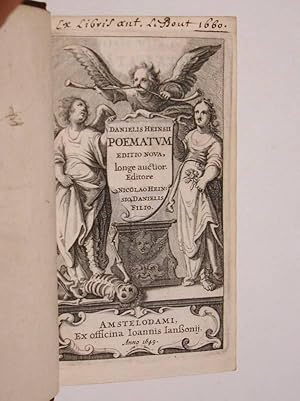
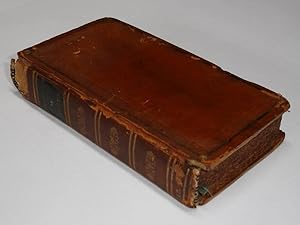
Danielis Heinsii Poemata Latina et Graeca; Editio post plurimas postrema longe auctior.
Published by Amsterdam (Amstelodami), Apud Joannem Janssonium, 1649., 1649
Seller: Antiquariaat Fragmenta Selecta, AMSTERDAM, Netherlands
Seller rating 5 out of 5 stars
12mo. (XII),666,(2 errata),(4 blank) p., frontispiece. Calf 13.5 cm 'Elegantly printed edition of Heinsius' collective neo-Latin & neo-Greek poetry' (Ref: STCN ppn 850068738; Cf. Willems 1613; Berghman 865; Rahir 2013; Ebert 9380; Brunet 3,84; Graesse 3,232; Ebert 9380) (Details: Back elaborately gilt, with 5 raised bands, and with a red morocco letterpiece in the second compartment. Boards with tripple fillet gilt borders, within which is another tripple fillet rectangle with cornerpieces. Marbled endpapers. Engraved frontispiece, depicting a kind of altar on which rests a shield with text; the altar is flanked by an angel and a girl; the angel tramples on a skeleton; above this scene soars a winged Fama, blowing two horns) (Condition: Joints slightly rubbed. Two small wormholes in the leather at the foot of the spine, and some damage to the lower edge of lower board for ca. one cm. Small hole in the leather of rear cover. On the blank upper margin of the frontispiece an ownership entry) (Note: The Dutch classical scholar of Flemish origin Daniel Heinsius, 1580-1655, who enjoyed international fame as an editor of classical texts, theorist of literary criticism, historian and neolatin poet, was professor of Poetics at the University of Leiden since 1603, extraordinarius Greek since 1605. After the death of J.J. Scaliger, to whose inner circle he belonged, he held the chair of Greek, from 1609 till 1647. He is best known for his edition of Aristotle's treatise on poetry (1611), which he studied in connection with the 'Ars Poetica' of Horace. This edition is 'the only considerable contribution to the criticism and eludication of the work that was ever produced in the Netherlands. (.) In his pamphlet 'De tragoediae Constitutione', published in the same year (1611), he deals with all the essential points in Aristotle's treatise, giving proof that he has thoroughly imbibed the author's spirit. (.) It was through this work that he became a centre of Aristotelian influence in Holland. His influence extended, in France, to Chaplain, and Balzac, to Racine and Corneille; in Germany to Opitz; and in England to Ben Jonson'. (J.E. Sandys, 'A history of classical scholarship, N.Y., 1964, vol. 2, p. 314) Heinsius was a representative of the great age of Neo-Latin in the Low Countries, which encompasses the 16th century, and a good part of the 17th century. Here the Anacreontic-Petrarcan love poetry in Latin was kept alive. (J. IJsewijn, 'Companion to Neo-Latin studies', vol. 1, Leuven 1990, p. 154) This volume of Heinsius' poetry, which was, as the text of the frontispiece tell us, edited by his son Nicolaus Heinsius, opens with early work, the three books of Sylvae, followed by Hipponax, an Ode to Molinus, 3 books of Elegiae, and the Monobiblos. Then comes the 'Herodes Infanticida, tragoedia', followed by Heinsius' last long Latin poem 'De contemptu mortis', a didactic poem in 4 books, wherein arguments, Platonic, Stoic and Christian, are set forth which explain why man should not fear death. Then Heinsius' Epigrams and occasional poetry, the 'Elegiarum iuvenilium libri'. At the end we find Heinsius' literary tour de force, his Greek poems, which were inspired by Theocritus and the Anthologia Graeca. It opens with 'Peplus' (Gown), a series of epigrams which Heinsius composed on Greek authors and philosophers. This part is followed by occasional poetry in Greek which Heinsius wrote for his contemporaries, like Casaubon, and by a section with Heinsius' Latin translations of Greek poetry. The collection closes with the 'Liber adoptivus', which contains occasional poetry addressed to Heinsius by J.J. Scaliger, J. Dousa, H. Grotius et alii. This edition of 1649 is a reissue of an edition of the collected greek and latin poetry of Heinsius, which was published by Heger in Leiden in 1640) (Provenance: 'Ex libris 'Ant. La Bout, 1660', or 'Ant. LaBout') (Collation: *6, A- D12, 2E-2F6 (leaves 2F5 & 2F6 blank)) (Photographs on request) 500 gr.
-
Dan. Heinsii De tragoediae constitutione liber, in quo inter caetera tota de hac Aristotelis sententia dilucide explicatur. Editio auctior multo, cui & Aristotelis De poëtica libellus, cum ejusdem notis & interpretatione, accedit.
Published by Leiden (Lugd. Batav.), Ex officinâ Elsevirianâ, 1643., 1643
Seller: Antiquariaat Fragmenta Selecta, AMSTERDAM, Netherlands
Seller rating 5 out of 5 stars
12mo. (XII),368 p. 19th century calf 13.5 cm 'De tragoediae constitutione' established the reputation of Heinsius as an Aristotelian literary critic (Ref: Willems 554; Berghman 964; Rahir 548; Brunet 3,83; Graesse 3,232; Ebert 9377) (Details: Back ruled gilt, with a letterpiece. Boards with blind stamped borders & gilt dentelles on the turn-overs. Marbled endpapers. Elsevier's woodcut printer's mark on the title, featuring an old man who stands in the shade of a vine-entwined elmtree, symbolising the symbiotic relationship between scholar and publisher. The motto is: 'Non solus'. The first part of the book consists of the 'De tragoediae constitutione', the pages 221-321 contain Aristotle's Poetics, edited and translated into Latin by Daniel Heinsius, the pages 322-368 are filled with Heinsius' notes on that text) (Condition: Binding used, and worn at the extremities. Head of the spine gone for 1 cm, foot of the spine chafed. Joint cracked, but strong. Small bookplate on the front pastedown. Paper yellowing) (Note: 'De tragoediae constitutione' established the reputation of the Dutch classical scholar of Flemish origin Daniel Heinsius, 1580-1655, as an Aristotelian critic of reknown. He enjoyed also 'international fame as an editor of classical texts, theorist of literary criticism, historian and neolatin poet, was professor of Poetics at the University of Leiden since 1603, extraordinarius Greek since 1605. After the death of J.J. Scaliger, to whose inner circle he belonged, he held the chair of Greek, from 1609 till 1647. He is best known for his edition of Aristotle's treatise on poetry, (.) which he studied in connection with the 'Ars Poetica' of Horace. This edition is 'the only considerable contribution to the criticism and eludication of the work that was ever produced in the Netherlands. (.) In his pamphlet 'De tragoediae constitutione', (.), he deals with all the essential points in Aristotle's treatise, giving proof that he has thoroughly imbibed the author's spirit. (.) It was through this work that he became a centre of Aristotelian influence in Holland. His influence extended, in France, to Chaplain, and Balzac, to Racine and Corneille; in Germany to Opitz; and in England to Ben Jonson (.)'. (J.E. Sandys, 'A history of classical scholarship, N.Y., 1964, vol. 2, p. 314) Heinsius' edition and Latin translation of Aristotle's 'De poetica liber' was first published by Elsevier in 1610, a year later this was repeated, and expanded with 'De tragoediae constitutione' (1611). Heinsius produced of both works a second and augmented edition, published by Elzevier in 1643. Heinsius' treatise 'De tragoediae constitutione' addresses itself explicitly to the task of presenting a simple and intelligible exposition of tragedy and the tragic plot 'ex mente atque opinione Aristotelis'. Accordingly, the work is based on the Aristotelian definition of tragedy, which is incorporated verbatim in the opening of Heinsius' discussion, and Aristotle's qualitative parts of tragedy (fabula, mores, sententiae, dictio, melodia and apparatus) provide the topics around which the argument is built up. Heinsius' treatise has consequently sometimes been viewed as rendering the 'milk of the Aristotelian word' more or less unwatered'. (P.R. Selin, 'Daniel Heinsius and Stuart England', Leiden/Oxford, 1968, p. 124/25) Nevertheless, 'Heinsius moves away from the Aristotelian concern with the essence of an artistic product to the search for appropriate means of securing what are basically rhetorical effects, ultimately directed to the ethical benefit of the audience'. (Idem p. 145) The treatise did not contribute completely fresh ideas or methods to the Renaissance tradition of the poetic theory. Heinsius' importance lies in the pruning away of complex and elaborate rhetorical Renaissance approaches) (Provenance: Bookplate, probably beginning 20th century: 'Ex libris Emile Brugnon') (Collation: *6, A12-P12, Q4) (Photographs on request) 400 gr.
-
(Danielis Heinsii Poematum editio nova. Accedunt praeter alia libri, 'De Contemptu Mortis' antehac una non editi)
Published by Ad 1: (Leiden (Lugduni Batavorum), Sumptibus Elzeviriorum, et Ioannis Mairii, 1621) Ad 2: Leiden (Lugd. Batavorum), Ex Officina Elzeviriana, 1621., 1621
Seller: Antiquariaat Fragmenta Selecta, AMSTERDAM, Netherlands
Seller rating 5 out of 5 stars
8vo. 2 volumes in 1: (VIII),474 (recte 478),(2 blank); (VI),167 (recte 165),(19 index) p. Red morocco. 14 cm (Ref: STCN ppn 832974838; Willems 187; according to Willems 'on lit sur le dern. f.: Lugduni Batavorum, typis Isaaci Elsevirii, iurati Academiae typographi, 1622; our copy has 1621. A mistake of Willems?; Berghman 862 & 863; Rahir 158 & 159; Breugelmans p. 180, 1621:3; Brunet 3,83; Ebert 9378) (Details: Charming copy. Back with 5 raised bands and ruled gilt. Boards with gilt borders and edges. Inside gilt dentelles. Edges of the bookblock gilt. Marbled endpapers. The title-page of the first volume is lacking and has been replaced by the title-page of the second volume. This title-page is printed in red and black. Elsevier's woodcut printer's mark on the title, depicting an old man standing in the shade of a vine-entwined elmtree, symbolising the symbiotic relationship between scholar and publisher. The motto is: 'Non solus'. Engraved portrait of Homer on p. 264 of the first volume) (Condition: Title-page of the first volume is lacking and has been replaced by the title-page of the second volume. Some wear to the extremes) (Note: The Dutch classical scholar of Flemish origin Daniel Heinsius, 1580-1655, who enjoyed international fame as an editor of classical texts, theorist of literary criticism, historian and neolatin poet, was professor of Poetics at the University of Leiden since 1603, extraordinarius Greek since 1605. After the death of J.J. Scaliger, to whose inner circle he belonged, he held the chair of Greek, from 1609 till 1647. He is best known for his edition of Aristotle's treatise on poetry (1611), which he studied in connexion with the 'Ars Poetica' of Horace. (.). In his pamphlet 'De tragoediae Constitutione', published in the same year (1611), he deals with all the essential points in Aristotle's treatise, giving proof that he has thoroughly imbibed the author's spirit. (.) It was through this work that he became a centre of Aristotelian influence in Holland. His influence extended, in France, to Chaplain and Balzac, to Racine and Corneille; in Germany to Opitz; and in England to Ben Jonson (.)'. (J.E. Sandys, 'A history of classical scholarship, N.Y. 1964, vol. 2, p. 314) Heinsius was a representative of the great age of Neo-Latin in the Low Countries, which encompasses the 16th century, and a good part of the 17th century. Here the Anacreontic-Petrarcan love poetry in Latin was kept alive. (J. IJsewijn, 'Companion to Neo-Latin studies', vol. 1, Leuven 1990, p. 154). The first part of this collection of Heinsius' poetry opens with early work, the 3 books of Sylvae, followed by Hipponax, 3 books of Elegiae, and Monobiblos. Then Heinsius' Epigrams and some occasional poetry; 125 pages with Greek poems, inspired by Theocritus and the Anthologia Graeca. The part with Greek poems starts with 'Peplus' (Gown), a series of epigrams which Heinsius composed on Greek authors and philosophers. This part is followed by 40 p. of Greek poetry in Latin translation, 'Elegiarum iuvenilium reliquiae', and is concluded with the 'Liber adoptivus'. The second volume contains Heinsius' last long Latin poem 'De contemptu mortis' (1621). It is a didactic poem, the finest of its time, in 4 books, wherein arguments, Platonic, Stoic and Christian, are set forth which explain why man should not fear death) (Collation: Pagination sometimes confusing. +1 (title-page of volume 2), *4 (minus leaf *1, the title-page of volume 1), A-2G8 (Gathering P begins with p. 223, in stead of 225, i.e. doubling p. 223 & 224; gathering Q begins with 237 in stead of 239, i.e. doubling 237 & 238). +4 (minus leaf +1, which replaces the title-page of volume 1), A-L8, M4 (In gathering I the pagination 129 & 130 is skipped) (Photographs on request) 400 gr.
-
Danielis Heinsii Orationum editio nova. Tertia parte auctior, caeteris sic recensitis, ut alia videri possit.
Published by Leiden (Lugduni Batavorum), Ex officina Bonaventurae & Abrahami Elzevir, Acad. Typogr.,1627., 1627
Seller: Antiquariaat Fragmenta Selecta, AMSTERDAM, Netherlands
Seller rating 5 out of 5 stars
8vo. (XVI),661,(3) p. Overlapping vellum 15.5 cm § Oratorical fireworks (Ref: Willems 277; Berghman 770; Rahir 239 or 240) (Details: 5 thongs laced through the joints. Boards with blind double fillet borders. Elsevier's woodcut printer's mark on the title of both volumes, depicting an old man standing in the shade of a vine-entwined elmtree, symbolising the symbiotic relationship between scholar and publisher. The motto is: 'Non solus', probably indicating the interdependency of publisher and scholar. They cannot do it alone, and need each other) (Condition: Vellum age-tanned. Waterstained in the lower margin at the beginning and at the end of the book. All 4 ties gone. Paper yellowing, some faint browning. Old ownership entry on the front pastedown) (Note: The Dutch classical scholar of Flemish origin Daniel Heinsius, 1580-1655, who enjoyed an international reputation as an editor of classical texts, theorist of literary criticism, historian and neolatin poet, was professor of Poetics at the University of Leiden since 1603, extraordinarius Greek since 1605. After the death of J.J. Scaliger, to whose inner circle he belonged, he held the chair of Greek, from 1609 till 1647. His activities have been obscured to later generations by the very bulk and variety of his activities. He is still remembered for his neolatin poetry, and for his edition of Aristotle's treatise on poetry (1611), which he studied in connexion with the 'Ars Poetica' of Horace. This edition is 'the only considerable contribution to the criticism and eludication of the work that was ever produced in the Netherlands. (.) In his pamphlet 'De tragoediae Constitutione', published in the same year (1611), he deals with all the essential points in Aristotle's treatise, giving proof that he has thoroughly imbibed the author's spirit'. (J.E. Sandys, 'A history of classical scholarship, N.Y., 1964, vol. 2, p. 314) Heinsius was an inspiring teacher and a talented speaker. 'His courses in the University were so impressive that his colleagues attended his lectures, (.). As an ornament in which the University took especial pride, his eloquence graced many public functions. Heinsius composed not only the funeral orations for Philip Cluverius, and for Reinerus Bontius, Professor of Medicin, in 1623, but delivered on 19 September 1625 a 'stupenda oratio', on the death of Prince Maurice, for which he received an award of 200 guilders'. (Sellin, P.R., 'Daniel Heinsius and Stuart England', Leiden etc., 1968, p. 36) The first edition of collected orations, 12 of them, was published in 1612. The second augmented edition came in 1615. Demand for more orations arose, and 1620 saw another augmented edition, augmented further in 1627 (this edition). This edition naturally opens with this stupendous oration on the death of Prince Maurice, followed of course by that other oratorical firework, his funeral speech for his beloved master, the French scholar Joseph Justus Scaliger, a still glowing jewel of the University, who died in Leiden in 1609. At the end have been added 27 pages with letters and prefaces that Heinsius wrote for editions of others. Still more augmented editions of the 'Orationes' were published in 1642, 1652 and 1657) (Provenance: Winterthur provenance? On the front pastedown in faint ink: 'And. Bidermanni'. Googling for 'Andr? Bidermann', we found a Gymnasium teacher in Winterthur, born in 1776, appointed in 1819. There were several hits placing a Andr. Bidermann in the Canton Zürich, Winterthur. More indications in that direction, when we searched for 'Andreas Bidermann') (Collation: *8, A-2S8, 2T4; we couldnot find out whether our copy has the cancels of p. 277/8 and 419/20, which Willems mentions, or not) (Photographs on request) 1000 gr.
-
Satirae duae, Hercules tuam fidem sive Munsterus Hypobolimaeus, et Virgula divina. Cum brevioribus annotatiunculis, quibus nonnulla in rudiorum gratiam illustrantur. Accessit his accurata Burdonum Fabulae confutatio, quibus alia nonnula hac editione accedunt.
Published by Leiden (Lugduni Batavorum), Apud Ludovicum Elzevirium, 1617. (Colophon at the end: 'Lugduni Batavorum, Typis Isaaci Elsevirii, anno 1617'), 1617
Seller: Antiquariaat Fragmenta Selecta, AMSTERDAM, Netherlands
Seller rating 5 out of 5 stars
12mo. (XXIV),619 (recte 529),(20),(3 blank) p. Overlapping vellum 13 cm (Ref: STCN ppn 832983446; USTC 1028202; Willems 123; Rahir 99; Berghman 1329 Graesse 6/1, 273/274; Not in Smitskamp's 'The Scaliger Collection', but it does figure in its list of Scaliger editions, p. 120) (Details: 5 thongs laced through the joints. Manuscript title on the back. The first Elzevier edition in small format) (Condition: Vellum age-toned and soiled. Front hinge cracking. Front flyleaf worn and inscribed. Title dustsoiled, and with 2 small ownership entries. Some old marginal notes, occasional ink underlinings) (Note: The French protestant classical scholar J.J. Scaliger, 1540-1609, was a genius, but was also vain and sharp tongued. Consequently he had many enemies. His greatest enemies were among members of the catholic Jesuit order. Scaliger had turned his back on France, and had come in 1592 to Leiden at the request of the authorities of that city and the local University, who desired nothing more than his inspiring presence. There he gathered around him a group of brilliant young man, among whom H. Grotius. In 1599 young Daniel Heinsius, 1580-1655, entered the group, and became 'because of his reputedly attractive personality and remarkable gifts' Scaliger's favorite student. (P.R. Sellin, Daniel Heinsius and Stuart England', Leiden etc., 1968, p. 14) Heinsius rapidly made a name as classical scholar and neolatin poet. In 1609 Scaliger died in his arms. One of Scaliger's foulest adversaries was a former friend, Gaspar Schoppe, or in Latin Scioppius, 1576-1649, who converted to catholicism. He distinguished himself by the virulence of his writings against the Protestants, and he even wanted to incite a war against these heretics. In 1607 this man published a vicious attack upon Scaliger with his 'Scaliger hypololymaeus', in English 'Suppositious Scaliger', or rather 'Basterd Scaliger'. 'Dem tobensten Schimpfen wird hier freier Lauf gelassen; Gifte jeder Art von Verunglimpfung und Verdächtigung werden zusammen gebraut'. (J. Bernays, 'Joseph Justus Scaliger', Berlin, 1855, p. 85) Scioppius wanted to throw discredit on Scaliger, and weaken his authority, so he attacked him at his weakest spot, his supposed noble birth. Scaliger had been raised in the belief that he was a descendent of the royal family Della Scala of Verona, and he let no opportunity pass to mention the splendour of his ancestry. The validity of his pretentions were however dubious. The challenge of Scioppius was accepted by the favourite pupil of Scaliger, Daniel Heinsius, who published one year later, in 1608, anonymously in defence of his master the 'Satirae duae, Hercules tuam fidem, sive Munsterus Hypobolimaeus, et Virgula divina', two mordant Menippean satires that covered Scioppius, who occasionally signed his letters off as 'G.S. a Munster' (hence Munsterus), with much abuse. As Scioppius himself had done with Scaliger, Heinsius smears with the mud of satire his scholarship, his name, the respectability of his parents, and his conversion to catholicism. In the following mockery 'Virgula Divina, sive Lucretii Vespillonis apotheosis', inspired by Seneca's Apocolocyntosis, Heinsius focusses on the humble origins of Scioppius, himself, he tells, a supposititious child. His 'father', called by Heinsius Vespillo, or corpse-bearer/gravedigger (See Martial I,47,1), is sentenced to become assistant of Charon. Scaliger has often admitted in his letters that Heinsius was the author of the satires, and the editor of the book, which opens with a preface dedicated to Scaliger, and a section of Scioppius praise of Scaliger from the time when he was still a friend and a protestant, then a support letter of the French scholar and friend of Scaliger, Isaac Casaubon. Next follow both satires of Heinsius, followed by an attack on Scioppius and his ancestry in a mock-biography: 'Vita et parentes Gasp. Schoppii, a Germano quodam contubernali eius conscripta', composed by Scaliger himself or by Ianus Rutgerus, a friend of Heinsius, and a student of Scaliger. The great man himself contributed, using the initials of his student Rutgerus (auctore I.R. Batavo, Iuris studioso) also to this own defence, a 'accurata Burdonum Fabulae confutatio', 'a precise refutation of the Burdonese story', with the help of charters and documents which should prove his noble origin. Nevertheless, the defence of Heinsius and Scaliger made 'einen sehr kühlen Eindruck auch auf die nähreren Freunde Scaligers'. (Bernays, p. 85). Few wanted to side with him on this matter; the answer of Scaliger was deemed not satisfactory. Scioppius' reputation was damaged too. Heinsius had portrayed him as a parasite and as 'Monster of Münster', labels which he never got rid of. A revised second edition of the 'Satirae duae' was published in the same year in Leiden by Johannes Patius, who had also published the first edition. 1609 he already produced his 4th edition. An eludicating survey of the hard to fathom content of both satires can be found in chapter 5 of 'Menippean Satire and the Republic of Letters, 1581-1655', of A. R. de Smet, Geneva, 1996. 'Hercules tuam fidem' is the title of Varro's 39th Menippean satire) (Provenance: On the title: 'Bern. à Mallinckroth', and also 'Sum J. Niefert'. On the front pastedown a Swedish name 'Henrik Kröijer', and probably one 'R. Berghes') (Collation: *12, A-Z12 (leaf Z11 verso and Z12 blank. Page numbers 513-529 misnumbered 603-619)) (Photographs on request) 500 gr.
-
Danielis Heinsii De contemptu mortis libri IV. Ad nobilissimum amplissisimumque virum Ianum Rutgersium.
Published by Leiden (Lugduni Batavorum), Ex Officina Elzeviriana, 1621., 1621
Seller: Antiquariaat Fragmenta Selecta, AMSTERDAM, Netherlands
Seller rating 5 out of 5 stars
4to. (VIII),196,(24 index) p. 19th century hardback. 18.5 cm § One of the finest didactic poems of its time. (Ref: STCN ppn 833009389; Willems 186; Berghman 861; Rahir 157; Brunet 3,83: 'la meilleure production poétique de l'auteur'; Ebert 9379; Graesse 3,232) (Details: Dull binding. Title in red & black. Elsevier's printer's mark on the title, depicting an old man standing in the shade of a vine-entwined elmtree, symbolising the symbiotic relationship between scholar and publisher. The motto: 'Non solus', probably indicates the interdependency of publisher and scholar. On the verso of the last leaf of the second volume: 'Lugduni Batavorum, 'Typis Isaaci Elzevirii, Iurati Academiae Typographi, 1621'. Edges dyed red) (Condition: Binding slightly worn. 2 old brownish paper labels on the back. 1 library stamp and 1 small withdrawal 'Doublette' stamp on the title. Paper yellowing) (Note: The Dutch classical scholar of Flemish origin Daniel Heinsius, 1580-1655, who enjoyed international fame as an editor of classical texts, theorist of literary criticism, historian and neolatin poet, was professor of Poetics at the University of Leiden since 1603, and 'extraordinarius' Greek since 1605. After the death of J.J. Scaliger, to whose inner circle he belonged, he held the chair of Greek, from 1609 till 1647. He is best known for his edition of Aristotle's treatise on poetry (1611), which he studied in connexion with the 'Ars Poetica' of Horace. This edition is 'the only considerable contribution to the criticism and elucidation of the work that was ever produced in the Netherlands. (.) In his pamphlet 'De tragoediae Constitutione', published in the same year (1611), he deals with all the essential points in Aristotle's treatise, giving proof that he has thoroughly imbibed the author's spirit. (.) It was through this work that he became a centre of Aristotelian influence in Holland.' (J.E. Sandys, 'A history of classical scholarship, N.Y., 1964, vol. 2, p. 314) Heinsius was an important representative of the great age of Neo-Latin in the Low Countries. The outline of 'De contemptu mortis', a didactic poem in 4 books, is simple: we should not be afraid of death for two reasons, the soul is immortal, and life on earth is full of misery. Platonic, Neoplatonic, Stoic and Christian arguments are set forth which explain why man should not fear death. The form of 'De contemptu' is that of Vergil's Georgica, 4 books of ca. 600 verses. Heinsius confesses his debt to Vergil in the opening lines of his poem, which form a variation of the first verses of the Georgica. The structure of the poem, its style and language are also Vergilian, including the similes. A lucretian element is Heinsius' objective to free humanity, like Lucretius did, from fear of death, but the tenor of the poem is however antilucretian. Heinsius states that the soul doesnot desintegrate after death, but that it continues its existence. Heinsius warns explicitly against epicurism, which is, he thinks, an easy, but misleading philosophy. In book 2 Heinsius answers Lucretius with his own epic catalogue of inspiring famous men. For Lucretius Epicurus was the culmination point, for Heinsius it is the French genius Josephus Justus Scaliger, his much admired master. An important source of inspiration for Heinsius was also the didactic poem 'De animorum immortalitate' of the Italian Aonio Paleario, published in 1535, which is also antilucretian. (Source for 'De contemptu': 'Daniel Heinsius, De verachting van de dood, De contemptu mortis', Vertaling door J. Bloemendaal en W. Steenbeek, Amst., Bert Bakker, 2005, p. 18/23) In the same year 1621 Elsevier published this didactic poem as part of Heinsius' 'Poematum editio nova', but this time in a smaller octavo format. He sold the octavo edition also separately) (Provenance: Round armorial stamp of 'Biblioth. Publ. Reg. Stuttgart'. Small, faint oval stamp on the front pastedown: 'Gerschel's Antiquariat, Stuttgart'. The Kingdom of Württemberg existed in Germany from 1805 to 1918. The kingdom was a continuation of the Duchy of Württemberg, which existed from 1495 to 1805. Its capital was Stuttgart) (Collation: *4, A-2D4, 2E2 ) (Photographs on request) 500 gr.