

Order Total (1 Item Items):
Shipping Destination:

Homann, Signed (25 results)
Author:
homann
Refine with Advanced Search
Skip to main search results
Search filters
Product Type
- All Product Types
- Books (15)
- Magazines & Periodicals (1)
- Comics (No further results match this refinement)
- Sheet Music (No further results match this refinement)
- Art, Prints & Posters (No further results match this refinement)
- Photographs (No further results match this refinement)
- Maps (7)
- Manuscripts & Paper Collectibles (2)
Condition Learn more
- New (No further results match this refinement)
- As New, Fine or Near Fine (2)
- Very Good or Good (6)
- Fair or Poor (No further results match this refinement)
- As Described (17)
Binding
Collectible Attributes
Language (4)
Free Shipping
- Free Shipping to U.S.A. (No further results match this refinement)
Seller Location
Seller Rating
-

Die geologisch-petrographischen Verhältnisse im Raume Ossiachersee-Wörthersee (südlich Feldkirchen zwischen Klagenfurt und Villach). Sonderdruck aus: Jb. Geol. Bundesanst. Bd. 105, 243-272.
Published by 1962, 1962
Seller: Wissenschaftliches Antiquariat Köln Dr. Sebastian Peters UG, Köln, Germany
Seller rating 5 out of 5 stars

Signed
Broschur. Condition: gut. 24 cm, Beil., handschr. Widmung des Verfassers, Ecke geknickt, Bleistiftanmerkungen, aus der Sammlung Alexander Tollmann. Sprache: deu.
-
Das kristalline Gebirge im Raume Pack - Ligist. Sonderdruck aus: Joanneum, Mineralog. Mitteilungsblatt 2/1962, 21-62.
Published by 1962, 1962
Seller: Wissenschaftliches Antiquariat Köln Dr. Sebastian Peters UG, Köln, Germany
Seller rating 5 out of 5 stars
Signed
Broschur. Condition: gut. 23 cm, Beil., handschr. Widmung des Verfassers, Besitzstempel, Belstiftanmerkungen, aus der Sammlung Alexander Tollmann. Sprache: deu.
-
E.Postkarte m.O,Datum, Unterschrift signiert Glendorf, 4.3.95.
-
Chaucer's Use of Gan.
Published by Journal of English and German Philology, 1954., 1954
Seller: Salopian Books, Shrewsbury, SAL, United Kingdom
Association Member: IOBA
Seller rating 5 out of 5 stars
Magazine / Periodical Signed
No Binding. Condition: Good. Unbound, stapled journal offprint in good condition. Inscribed by the author to the first page. Offprint from the Journal of English and German Philology - July 1954. Pages tanned. 8vo. c10pp. Inscribed by Author(s).
-
Engelchen, Erzählung,
Published by München, dtv ,, 1996
ISBN 10: 3423122773 ISBN 13: 9783423122771
Signed
175 S., OKart., vom Autor signiert und datiert, gut erhalten Aufgrund der EPR-Regelung kann in folgende Länder KEIN Versand mehr erfolgen: Bulgarien, Finnland, Frankreich, Griechenland, Luxemburg, Österreich, Polen, Rumänien, Schweden, Slowakei, Spanien.
-
Original Autogramm Hardy Homann /// Autograph signiert signed signee
Language: German
Manuscript / Paper Collectible Signed
Blatt. Condition: Gut. Albumblatt /-fragment von Hardy Homann mit schwarzem Stift signiert mit eigenhändigem Zusatz "28/1/94 Für Botho" Als Theaterchef Theater am Holstenwall. /// Autogramm Autograph signiert signed signee /// Hardy Homann Vertriebsleiter brand eins Verlag Berufsweg Abitur am MCG Gehrden, 1978 Dresdner Bank AG, Hannover 1978-1980 seit 1983 Orchestermanager, Theaterleiter und Musical-Produzent seit 1999 bei brand eins /// Standort Wimregal Ill-Umschl2021-14 Sprache: Deutsch Gewicht in Gramm: 10.
-
286 S., OPbd. m. OU., gut erhalten EA, Hs. signiert: "20.4.1999 (Führers Geburtstag) Jürgen Lentes mit herzlichem Dank für seine Bemühung um dieses Buch, Ludwig Homann" Aufgrund der EPR-Regelung kann in folgende Länder KEIN Versand mehr erfolgen: Bulgarien, Finnland, Frankreich, Griechenland, Luxemburg, Österreich, Polen, Rumänien, Schweden, Slowakei, Spanien.
-
292 S., OPbd. m. OU., gut erhalten EA, vom Autor signiert und datiert Aufgrund der EPR-Regelung kann in folgende Länder KEIN Versand mehr erfolgen: Bulgarien, Finnland, Frankreich, Griechenland, Luxemburg, Österreich, Polen, Rumänien, Schweden, Slowakei, Spanien.
-
234 S., OPbd. m. OU., gut erhalten EA, vom Autor signiert und datiert Aufgrund der EPR-Regelung kann in folgende Länder KEIN Versand mehr erfolgen: Bulgarien, Finnland, Frankreich, Griechenland, Luxemburg, Österreich, Polen, Rumänien, Schweden, Slowakei, Spanien.
-
Ada Pizonka. Roman.
Language: German
Published by Haffmans verlag, Zürich, 1995
ISBN 10: 3251002716 ISBN 13: 9783251002719
Seller: Antiquariat am St. Vith, Mönchengladbach, Germany
Seller rating 5 out of 5 stars
First Edition Signed
Leinen. Dust Jacket Condition: mit Schutzumschlag. 1. Auflage. Erste Auflage, 291 S. Leinen mit Schutzumschlag. Umschlag geringf. berieben, etwas leseschief, sonst gutes Exemplar. auf dem Titelblatt von Ludwig Homann signiert. Signatur des Verfassers.
-
Engelchen und Ein seegrünes Fahrrad, Zwei Erzählungen,
Published by Bielefeld, Aisthesis ,, 2012
First Edition Signed
275 S., OKart., EA, Hs. signiert: "Für ., den Getreuen, Ludwig Homann" Aufgrund der EPR-Regelung kann in folgende Länder KEIN Versand mehr erfolgen: Bulgarien, Finnland, Frankreich, Griechenland, Luxemburg, Österreich, Polen, Rumänien, Schweden, Slowakei, Spanien.
-
Engelchen. Erzählung.
Published by Zürich, Haffmans., 1994
ISBN 10: 3251002562 ISBN 13: 9783251002566
Seller: Biblion Antiquariat, Zürich, ZH, Switzerland
Association Member: GIAQ ILAB VEBUKU
Seller rating 5 out of 5 stars
Signed
1. Aufl. 8°. 174 S. Pp., OU. Mit Widmung des Autors.
-
288 S., OPbd. m. OU., gut erhalten EA, Hs. signiert: "Meinem treuen Leser und Förderer Jürgen Lentes mit herzlichen Glückwünschen zum Geburtstag, Ludwig Homann" Aufgrund der EPR-Regelung kann in folgende Länder KEIN Versand mehr erfolgen: Bulgarien, Finnland, Frankreich, Griechenland, Luxemburg, Österreich, Polen, Rumänien, Schweden, Slowakei, Spanien.
-
Fünfundzwanzigste Etappe. Zeitschrift für Politik, Kultur & Wissenschaft. Hrsg. von Günter Maschke und Heinz-Theo Homann.
Language: German
Published by Bonn : Etappe, 2021
Signed
Broschur. Condition: Gut. 210 Seiten Rechtsaussenintellektuelles Magazin.- Kanten berieben/bestossen.- Einliegend eigenhändiger Gruss mit Unterschrift des Herausgebers.- Enthält u.a. das Dossier Luvie Romier - Carl Schmitt mit 4 Beiträgen, weitere Beiträge von Werner Mäder, Winfried Knörzer, Valeriu Marcu et.al. /// Standort Wimregal MK-20342 Sprache: Deutsch Gewicht in Gramm: 228.
-
Vierundzwanzigste Etappe. Almanach für Politik, Kultur & Wissenschaft. Hrsg. von Günter Maschke und Heinz-Theo Homann.
Language: German
Published by Bonn : Etappe, 2018
Signed
Broschur. Condition: Gut. 194 Seiten Rechtsaussenintellektuelles Magazin.- Kanten berieben/bestossen.- Einliegend eigenhändiger Gruss mit Unterschrift des Herausgebers.- Enthält u.a. Beiträge zu Carl Schmitt (Agatino Catarella), Faschismus und Bolschewismus (Robert Hepp), Albert Caraco (Axel Matthes), Hugo Fischer (Ulrich Fröschle), Macchiavelli (Manfred Lauermann) /// Standort Wimregal MK-20345 Sprache: Deutsch Gewicht in Gramm: 128.
-

F. H. Jacobis Philosophie der Freiheit : (Reihe: Symposion, Band 43)
Language: German
Published by Verlag Karl Alber, Freiburg im Breisgau, 1973
ISBN 10: 3495472835 ISBN 13: 9783495472835
Seller: exlibris24 Versandantiquariat, Freiburg im Breisgau, Germany
Seller rating 5 out of 5 stars
Signed
Softcover. Condition: Sehr gut. Seiten papierbedingt etwas nachgedunkelt/gebräunt - ansonsten sauberes und wohlerhaltenes Exemplar. Broschierter Einband mit Fadenbindung als Englische Broschur. 304 Seiten. 383 Gramm. 22x14cm. Deutsch. Vortitelseite mit einer kleinen Geschenkwidmung des Autors. Zugleich: Münster (Westfalen), Univ., Fachbereich Philosophie, Diss. 1972. Widmung des Verfassers.
-
Waldecciae ac Finitimorum Dominiorum Itterani & Cansteiniani nec non insertae Diocesis Eimelrodensis accurata Tabula. Scala Milliarium 4 [Om. 068 ; 1 : 107 875 environ]. Carolo Augusto Friderico, S.R.I. Principi Waldecciae, . dedicat J. Nicolai, I.G.C.C., excusa Per Homannianos Heredes Noribergae MDCCXXXIII. Cum Privilegio S. Caes. Maj. [CARTE DU COMTE DE WALDECK (HESSE - ALLEMAGNE- 1733]
Language: French
Published by Homann, nuremberg, 1733
Signed
Condition: parfait état. nuremberg Homann 1733 une carte géographique dépliante entoilée du Comté de Waldeck (Hesse- Allemagne) gravée sur cuivre en couleurs, format plié : 11,5 x 21,5 cm, format déplié d'ensemble : 58 x 49,5 cm, gravure seule ( 55 x 47,5 cm), Échelle : Scala Milliarium 4 [= 6,8 cm ; 1:107 875 environ, Publication : Norimbergae : excusa per Homannianos Heredes, 1733, Éditeur : Homann (Héritiers de), parfait état Cette Carte provient à l'origine du recueil : Atlas geographique, contenant Les Cartes des Cercles de Westphalie, du bas et du haut Rhin, de Franconie, de Bavière et de Souabe. Tome IV. Carte de la Principauté de Waldeck avec les dominions et Canstein Itter, la paroisse Eimelrode, Bureau Lichtenfels, Wetterburg, Wildungen, Waldeck, Landau, Arolsen, Eisenberg et Rhode Eilhausen.Note(s) : Le titre est en haut et à gauche dans un cartouche architectural, au centre d'une composition symbolique de la Chasse, de la Pêche et de l'Agriculture, où l'on voit Diane et Cérès. - En haut et à droite, la dédicace est dans un cartouche aux armes du dédicataire : Carolo Augusto Friderico, S.R.I. Principi Waldecciae, . dedicat J. Nicolai, I.G.C.C. - En bas, dans deux cartouches ornementés, l'échelle et la légende : Signorum Explicatio.SUPERBE.en parfait état (as new condition).
-
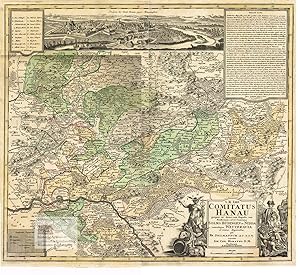
S.R. Imp. Comitatus Hanau propie sic dictus, cum singulis suis Praefecturis; ut et Comitatus Solms Büdingen et Nidda cumreliqua Wetteravia et vicinis Regionibus. Große flächenkolorierte Landkarte der Stadt Hanau, Hessen-Darmstadt, der Grafschaft Nidda und Frankfurt am Main mit Prospekt der Stadt Hanau gegen Mittag. Kupferstich von Johann Christoph Homann Nürnberg 1728
Published by Nürnberg: Johann Christoph Homann, 1728
Seller: historicArt Antiquariat & Kunsthandlung, Wiesbaden-Breckenheim, Germany
Seller rating 5 out of 5 stars
Map First Edition Signed
1. großer Original-Kupferstich von Johann Christoph Homann (in der Platte signiert) auf rückseitig unbedrucktem Bütten mit dekorative abgesetztem Plattenrand, Blattgröße ca. 51 x 59 cm, mit Meilenzeiger unter der Titelkartusche unten rechts, prächtig ausgeschmückte Titelkartusche mit Landesfürsten, Hermes mit geflügeltem Helm und Weingott Bachus mit Weinfass unten rechts, große Panoramaansicht der befestigten Stadt Hanau am oberen Kartenrand mit ausführlicher Legende von A (Schloß) bis V (Feldberg), von alter Hand in verschiedenen Farben präzise flächenkoloriert, sehr detaillierte Karte mit allen Städten, Dörfern, Burgen, Schlössern, Ruinen und wichtigen Bergen, von Greiffenstein im Norden bis Neustatt und Aschaffenburg im Süden, Kelsterbach, Höchst und Frankfurt am Main im Westen bis Schlüchtern und Scharzenfels im Osten, geglättete Mittelfalz, ansonsten bemerkenswert gut erhalten großer und/oder schwerer Artikel mit zusätzlichen Kosten für Versand und Versicherung - heavy and/or oversized item with additional costs for shipping and insurance - please ask us before you order this article 2100 gr.
-

Regni Bohemiae Circulus Beraunensis ex Müllerianis aliisque recentissimis subsidiis chorographice designatus, ut et secundum Statum politicum modernum expressus, et in Lucem editus ab Homannianis Heredibus. Große Landkarte des Landkreises Beraun im Königreich Böhmen. Altkolorierter Original-Kupferstich von Johann Christoph Müller bei den Homannschen Erben 1774
Language: Latin
Published by Nürnberg: Homannsche Erben zweite Ausgabe mit Kaiserlichem Privileg, 1774
Seller: historicArt Antiquariat & Kunsthandlung, Wiesbaden-Breckenheim, Germany
Seller rating 5 out of 5 stars
Map Signed
2. große Landkarte auf rückseitig unbedrucktem gefaltetem Imperialfolio-Doppelblatt mit dekorativ abgesetztem Plattenrand, extrem detailreiche Karte mit Kennzeichnung selbst kleiner Städte, Dörfer, Klöster und Kirchen von der Königsstadt Beraun im Norden bis Krasnahora im Süden, Legende oben links, böhmischer und deutscher Meilenzeiger unten, Titelkartusche mit floralem Zierrahmen unten links, von alter Hand geschmackvoll und präzise grenz- und flächenkoloriert, geglättete Mittelfalz, im breiten oberen Rand etwas fleckig, im Falz gering leimschattig, insgesamt jedoch sauber und bemerkenswert gut erhalten, sehr selten - Johann Christoph Müller aus einer Nürnberger Astronomen-Familie war einer der bedeutendsten Kartographen Österreichs. Von ihm stammen die ersten präzisen Karten Ungarns und Böhmens, die nach seinem Tod aus militärstrategischen Gründen unter Staatsverschluss kamen. - großer und/oder schwerer Artikel mit zusätzlichen Kosten für Versand und Versicherung - heavy and/or oversized item with additional costs for shipping and insurance - please ask us before you order this article 2100 gr.
-
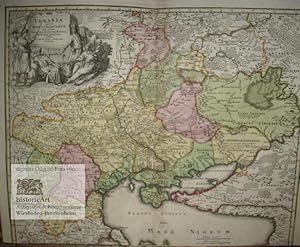
Ukrania quae et Terra Cosaccorum cum vicinis Walachiae, Moldaviae, Minorisq., Tartariae provinciis exhibita a Ioh. Baptista Homanno Noribergae. Große Landkarte der Ukraine und der Kosaken-Gebiete in der Walachei, Moldawien, Kleinasien und den Provinzen der Tartaren von Homann um 1720
Language: Latin
Published by Nürnberg: Johann Baptist Homann im Selbstverlag ohne Jahresangabe (um ), 1720
Seller: historicArt Antiquariat & Kunsthandlung, Wiesbaden-Breckenheim, Germany
Seller rating 5 out of 5 stars
Map First Edition Signed
1. dekorativer Original-Kupferstich von Johann Baptist Homann (1664-1724) auf Imperial-Folio, in der Platte signiert, auf rückseitig unbedrucktem schweren Büttenblatt, Plattengröße ca. 47 x 58 cm (Höhe x Breite), in der Mitte einmal gefaltet, prächtige Titelkartusche oben links mit Pfeife rauchenden Kosaken und Tartaren in Waffen und Tracht, Reiterheer und Kamel im Hintergrund, deutscher und polnischer Meilenzeiger am unteren Blattrand, oben das Palatinat Moskau, unten das Schwarze Meer bis Constantinopel, das Asowsche Becken und die Halbinsel Krim, Mittelfalz mit kleinen sauber hinterklebten Einrissen und einem kleinen hinterklebten Loch im oberen Kartenrand links neben der Mittelfalz, unten bis an den Plattenrand mit geringem Verlust der bildlichen Darstellung (ca. 0,5 cm) beschnitten, prächtig und sehr geschmackvoll von alter Hand flächenkoloriert und insgesamt bemerkenswert gut erhalten, von großer Seltenheit eine der seltesten und prächtigsten Karten Homanns, publiziert kurz vor seinem Ableben, sehr detailreiche und prächtig altkolorierte Darstellung der ehemaligen Ukraine, der Walachei, Moldawiens, Klein-Asiens, der Türkei, Russlands und des heutigen Polens, von Moskau im Norden bis zum Schwarzen Meer, der Krim-Halbinsel und der Stadt Constantinopel im Süden, einschließlich der Gebiete der Kosaken und Tartaren - very large and heavy item, please ask for additional shipping costs before you order - großer und/oder schwerer Artikel mit zusätzlichen Kosten für Versand und Versicherung - heavy and/or oversized item with additional costs for shipping and insurance - please ask us before you order this article 2100 gr.
-

Belli Typus in Italia victricis Aquilae progressus in statu Mediolanensi et Ducatu Mantuae demonstrans.
Publication Date: 1702
Seller: Geographicus Rare Antique Maps, Brooklyn, NY, U.S.A.
Association Member: ABAA ESA ILAB
Seller rating 4 out of 5 stars

Map Signed
Very good. Light wear along original centerfold. Mounted on contemporary paper. Original color. Size 18.5 x 21.5 Inches. This is a rare first-state example of Johann Baptist Homann's c. 1707 map of northern Italy, documenting the seesawing battle for the region during the War of the Spanish Succession (1701 - 1714). As with several other Homann maps prepared during the war, it proudly champions the Habsburg cause against their French-Bourbon enemies. A Closer Look Coverage includes the cities and towns of the Po River Basin and the alpine region to the north, as far as Grisons and Trento. Aside from settlements, mountains, rivers, lakes, canals, roads, and fortifications are documented in remarkable detail. Boundaries between duchies, bishoprics, republics, and other territories are traced in hand-color outline, with the all-important Duchy of Milan color-shaded. A legend at bottom includes symbols referring to the ongoing conflict, such as sites where the armies camped in addition to battlefields. The locations of battles at Chiari, Cremona, Luzzara, Cassano, and Castiglione, among others, are marked with crossed swords. However, the most obviously marked battle site, just south of Milan, refers not to a recent battle but one nearly two centuries earlier, the 1525 Battle of Pavia, which took place in the Visconti Park belonging to the rulers of Pavia. The battle was part of the Italian Wars of the 1520s, which were also fought between the Habsburgs and the French monarchy, and which also resulted in a Habsburg victory. An elaborate cartouche appears at bottom-right, with figures likely meant to represent the duchies of Milan, Savoy, and Mantua. Above the title is an eagle standing atop a globe, surrounded by the text 'tandem bona causa triumphat' (a good cause triumphs in the end). A figure at left beckons to a representation of the Battle of Cremona, where a surprise attack by Habsburg forces captured the French commander, the Duke of Villeroy. One of the figures at right says to the other 'Quae sunt Caesaris, Caesari' (Render unto Caesar), while the latter holds a map of Mantua, with a reference to Virgil's Eclogue 1 (Virgil was from Mantua and the poem has themes of justice in the aftermath of war). The War of the Spanish Succession (1701 - 1714) As its name indicates, the War of the Spanish Succession resulted when the childless Spanish Habsburg King Charles II died in 1700. Afterward, rival claimants aimed to ascend the throne, with the young Bourbon Philip of Anjou (grandson of Louis XIV) being proclaimed King of Spain on November 1, 1700. This presented a direct threat to the balance of power in Europe as Philip was also likely to eventually become king of France, thus raising the possibility of unifying Europe's two largest and most powerful Catholic kingdoms. As a result, the Habsburg Archduke Charles, who also claimed the right to the Spanish Crown, gained considerable support from other European powers wary of a Spanish-French union. The Bourbon and Habsburg-aligned forces engaged in an epic conflict that took place across much of western Europe and even the New World (as Queen Anne's War). Much of the fighting took place along the Rhine, especially in the Low Countries, while the Austrians were also bedeviled by a French-backed rebellion in Hungary (Rákóczi's War of Independence). However, the earliest clashes took place in northern Italy, involving the Duchies of Savoy, Milan, and Mantua (Mantova), and continued until 1707. The Habsburg General, Eugene Duke of Savoy (who was actually born to a well-connected family in Paris and only left to join the Habsburg army because his was snubbed by Louis XIV), emerged as one of the war's most effective commanders. He crossed the Alps with an army of 30,000 and won a string of victories in 1701 and early 1702. But the French reinforced their armies, appointed an equally competent commander (Louis Joseph, Duke of Vendôme), and counter-attacked to gain control of much o. Signed by Author(s).
-

Leopoldi Magni Filio Iosepho I. Augusto Romanorum et Hung: Regi Ad capeßendum Rhenanae Militiae Imperium in Castra proficiscenti Hanc Germaniae Austriacae Generalem Tabulam.
Publication Date: 1710
Seller: Geographicus Rare Antique Maps, Brooklyn, NY, U.S.A.
Association Member: ABAA ESA ILAB
Seller rating 4 out of 5 stars
Map Signed
Good. Closed centerfold split extending from bottom roughly 5 inches into page. Repaired and stabilized on verso. Laid down contemporaneous paper, likely by 18th century binder. Minor border soiling. Size 20.5 x 23.5 Inches. This is a c. 1710 Johann Baptist Homann map of southern Germany, Austria, and environs, produced for his Neuer Atlas . It is essentially wartime propaganda, celebrating the victories of the Habsburgs and their allies in the War of the Spanish Succession and supporting the Holy Roman Emperor Joseph I (r. 1705 - 1711). A Closer Look Coverage embraces from Mainz, Heidelberg, Nurnberg (Homann's hometown), and Prague in the north to Milan, Venice, and Istria in the south, and from Strasburg and Basel in the west to Vienna and Bratislava (Pressburg) in the east. Color-shading indicates the region's various kingdoms, principalities, etc., including the Republic of Venice. Bavaria, prominent near the center, was initially aligned with Bourbon France against the Habsburgs but was forced to leave the conflict following a crushing defeat at the Battle of Blenheim in 1704. Various cities in southern Germany (here as Swabia / Svevia) appear as exclaves from the surrounding lands; at least some of these were besieged during the conflict, likely the source for their being so designated. Evidence of the ongoing War of the Spanish Succession (1701 - 1714, discussed below) is everywhere. The elaborate cartouche at the top presents the Habsburg Holy Roman Emperor Joseph I, to whom the map is dedicated, with a retinue of generals meant to represent the commanders of the Habsburg-led Grand Alliance, including Prince Eugene of Savoy and John Churchill, the English Duke of Marlborough (ancestor of Prime Minister Winston Churchill), two of the greatest military commanders of their time. The figure bowing to the emperor is likely Prince Eugene of Savoy. Behind him, generals hold maps of battlefields along the Rhine, in northern Italy, and in the Adriatic. (Text at the bottom of each identifies the commanders of the battles - the Duke of Baden, the Duke Eugene of Savoy, and so on - and it is possible that the figures are meant to represent the victor of each battle, meaning the third figure from Joseph would be Eugene of Savoy). The attendant and horse behind them are ready to carry Joseph to the battlefield in the distance, presumed to be the Siege of Landau (1702), when Joseph was still 'just' an archduke, the only military campaign in which he ever directly participated. In the Adriatic, there is a fleet, and an accompanying note explains that it delivered supplies to Grand Alliance forces in northern Italy. The legend at the bottom right includes a symbol denoting the location of battles. However, these appear to be earlier battles, such as the Sack of Brescia in 1512, rather than contemporary ones. Generals or Emperor? This map has a contentious relationship with a highly similar and even rarer contemporary work, Pieter Schenk's 'Invictissimis Heroibus Duci Marleborough, Principibus Eugenio Sabaudo, et Hassiae-Casselio' While Homann's map is generally agreed to have been engraved in 1705, it is unclear if Schenk's map came before or after (most sources say after, in 1706). In any event, Schenk replaces Joseph with his father, Leopold I (who was likely already dead when the map was printed), and shifts the arrangement of figures in order to more clearly identify and glorify the generals of the Grand Alliance, and particularly the Duke of Marlborough. Other elements of the cartouche are changed or rearranged, and one of the maps is swapped with a map focusing specifically on the Battle of Blenheim. Schenk's motivations in doing so are unclear - perhaps he was trying to capitalize on the good fortunes of the Alliance to sell maps - but his apparent snub of Joseph I is suggestive of some other motive. The War of the Spanish Succession (1701 - 1714) As its name indicates, the War of the Spanish Succession resulted when the childl. Signed by Author(s).
-

Hispaniae et Portugalliae regna.
Publication Date: 1710
Seller: Geographicus Rare Antique Maps, Brooklyn, NY, U.S.A.
Association Member: ABAA ESA ILAB
Seller rating 4 out of 5 stars
Map Signed
Very good. Mounted on contemporary paper. Repaired centerfold split. Printer's crease in upper left corner. Light pencil annotations. Size 19.25 x 22.25 Inches. An example of Johann Baptist Homann's c. 1710 map of Spain and Portugal, which appeared in his Neuer Atlas . The map, and particularly the powerful illustrations at the bottom-right, refer to the ongoing War of the Spanish Succession (1701 - 1714), a major crisis dividing Europe at the time. A Closer Look Geographic coverage ranges from southern France to northern Africa (Morocco and Algeria), taking in Iberia and the Balearic Islands (exaggerated somewhat in size, as is the minuscule Alborán Island). The constituent kingdoms and territories of the Spanish Empire are outlined and color-shaded for easy distinction. Cities and towns, roads, mountains, waterways, and coastal features are documented with Homann's characteristic fastidiousness. Battleships and other striking illustrations appear at the bottom right, referencing the War of the Spanish Succession. Though perhaps not clear from the illustration itself, the text under the title makes clear that the troops are being dispatched across the sea by the Archduke and future Holy Roman Emperor Charles III (1685 - 1740, though known to history as Charles IV, at the time, at least among his supporters, he was known as Charles III, his being the intended Habsburg successor to the recently-deceased Charles II). The War of the Spanish Succession (1701 - 1714) The War of the Spanish Succession began in 1700 when childless Spanish Habsburg King Charles II died. Rival claimants vied for the vacant throne, with the young Bourbon, Philip of Anjou (grandson of Louis XIV of France), proclaimed King of Spain on November 1, 1700. Philip's ascension threatened the balance of power in Europe, as he was also likely to become king of France, potentially unifying Europe's powerful Catholic kingdoms. As a result, the Habsburg Archduke Charles, who also had a claim to the Spanish crown, gained support from European powers wary of a Spanish-French union. Bourbon and Habsburg-aligned forces engaged in a epic drawn-out conflict across much of western Europe and the New World (Queen Anne's War). The war saw alliances shift, especially when the Holy Roman Emperor Joseph I died in 1711 and was succeeded by Archduke Charles, presenting a new Habsburg threat of a European superpower. In the Peace of Utrecht, signed in 1713, Philip was granted the Spanish crown but renounced claimes to the French throne, while Charles remained the Holy Roman Emperor. The Bourbon monarchies were weakened by the conflict, losing territory in Italy and Gibraltar to the British, while the Habsburgs gained territory and strengthened their positions in Hungary and the Netherlands. Britain is generally seen as the main beneficiary of the conflict, as it was not badly impacted by the mostly-continental war. With the Dutch suffering both physical and financial costs, the door was open for Britain to become the world's dominant maritime power. Publication History and Census This map was prepared by Johann Baptist Homann for the 1710 edition of his Neuer Atlas . Homann produced several distinct maps of Iberia, each in multiple states, in the late 17th and early 18th century, beginning with his engraving of 'Novissima Regnorum Hispaniae et Portugalliae Tabula,' issued by David Funck. The present edition of his Iberia map is the most decorative and dramatic due to the illustrations referring to the ongoing war. After the conflict concluded, the martial references were replaced with pacific ones. After 1720 ('Regnorum Hispaniae et Portugalliae Tabula Generalis'), the entire map was reworked (for comparison, see his 1730 issue, previously sold by us: Hispania-homann-1730). The present example differs from the somewhat more common 'Regnorum Hispaniae et Portugalliae Tabula Generalis' in that it lacks the Regnorum and Tabula Generalis in the title and some other obvious difference. Signed by Author(s).
-
![Seller image for Portugalliae et Algarbiae cum finitumus Hispaniae regnis: Castillae legionis Andalusiae, Extrematurae, Galliciae [et] Granatae novissima tabula : qua simul littora Brasiliae meridional Americae, Portugallicae majestatis dominio subjecta nova methodo exhibentur. for sale by Geographicus Rare Antique Maps](https://pictures.abebooks.com/inventory/md/md32307605651.jpg)
Portugalliae et Algarbiae cum finitumus Hispaniae regnis: Castillae legionis Andalusiae, Extrematurae, Galliciae [et] Granatae novissima tabula : qua simul littora Brasiliae meridional Americae, Portugallicae majestatis dominio subjecta nova methodo exhibentur.
Publication Date: 1710
Seller: Geographicus Rare Antique Maps, Brooklyn, NY, U.S.A.
Association Member: ABAA ESA ILAB
Seller rating 4 out of 5 stars
Map Signed
Very good. Repaired centerfold separation. Mounted on contemporary paper. Size 19.25 x 22.25 Inches. An example of Johann Baptist Homann's c. 1710 map of Portugal and Portuguese Brazil, produced for his Neuer Atlas . It reflects the Portuguese presence in South America and the kingdom's delicate position during the War of the Spanish Succession (1701 - 1714). A Closer Look The Kingdom of Portugal is illustrated divided into its historical provinces, along with neighboring regions of Spain. Cities, towns, roads, waterways, mountains, coastal features (including Gibraltar at the bottom, extending into the border), islands, and more are traced. The ships to the west of Galicia refer to the British-Dutch victory at the Battle of Vigo Bay in 1702. The fleet further south represents the arrival of Archduke Charles in Lisbon in February-March 1704. A finely-engraved cartouche with mythological figures (Neptune, mermaids), cherubs, and the Portuguese coat of arms appears at center-left. In the lower left, an inset map details the Portuguese Empire in Brazil. A text box below the title discusses the extent of the Portuguese empire, listing colonies on four continents. At left is a large inset map of Brazil ('Regnum Brasiliae') divided into its captaincies; these were granted to Portuguese noblemen in the years following the Portuguese conquest of the Brazilian coast to encourage migration to the New World. This system was successful in Madeira, the Azores, and other Portuguese colonies in the Atlantic, but was generally unsuccessful in Brazil. Gradually, the captaincies were returned to the Crown and, by the mid-18th century, were reorganized as provinces.). The War of the Spanish Succession (1701 - 1714) The War of the Spanish Succession began in 1700 when childless Spanish Habsburg King Charles II died. Rival claimants vied for the vacant throne, with the young Bourbon, Philip of Anjou (grandson of Louis XIV of France), proclaimed King of Spain on November 1, 1700. Philip's ascension threatened the balance of power in Europe, as he was also likely to become king of France, potentially unifying Europe's powerful Catholic kingdoms. As a result, the Habsburg Archduke Charles, who also had a claim to the Spanish crown, gained support from European powers wary of a Spanish-French union. Bourbon and Habsburg-aligned forces engaged in a epic drawn-out conflict across much of western Europe and the New World (Queen Anne's War). The war saw alliances shift, especially when the Holy Roman Emperor Joseph I died in 1711 and was succeeded by Archduke Charles, presenting a new Habsburg threat of a European superpower. In the Peace of Utrecht, signed in 1713, Philip was granted the Spanish crown but renounced claims to the French throne, while Charles remained the Holy Roman Emperor. The Bourbon monarchies were weakened by the conflict, losing territory in Italy and Gibraltar to the British, while the Habsburgs gained territory and strengthened their positions in Hungary and the Netherlands. Britain is generally seen as the main beneficiary of the conflict, as it was not badly impacted by the mostly-continental war. With the Dutch suffering both physical and financial costs, the door was open for Britain to become the world's dominant maritime power. Portugal's role in the war, like Britain's, was ambiguous. Initially siding with Philip of Anjou, the Portuguese King Pedro II (r. 1683 - 1706) was persuaded to switch alliances, supporting the 1702 Habsburg-aligned 'Grand Alliance'. With the Habsburg armies tied down in Italy, the Netherlands, and Hungary, it fell to the British, Dutch, and Portuguese to attack Spain itself. They captured Madrid in 1706 and proclaimed Archduke Charles King of Spain (Charles III). Nonetheless, holding Spain was more difficult than conquering it, and with Britain securing control of the coastlines and sea lanes - its primary goal in the conflict - there was limited interest in active occupation. In some ways, these batt. Signed by Author(s).
-

Eigh. Gutachten mit U., Hamburg, d. 3. Juni 1841. Zugunsten des "Gottlob Magnus Gottfried Hechel aus Hamburg, 44 Jahr alt, .".
Language: German
Publication Date: 1841
Seller: Antiquariat Reinhold Pabel, Hamburg, Germany
Association Member: BOEV
Seller rating 5 out of 5 stars
Signed
1841. Deutsche Kurrentschrift in schwarzer Tinte auf Bütten (Wasserzeichen FLT), 1 S. auf 1 Bl., 33,5 x 21,5 cm, Ohne Adressat oder gar ein adress. Begleitschreiben (vermutlich an eine Versorgungsstelle oder Rentenkasse für Invalide o.ä. gerichtet). - Homann, Ernst. Friedr., Dr., Arzt u. Geburtshelfer, Holzdamm no. 25 [lt. Adressbuch von 1841] versucht in seinem medizinischen Gutachten die anhaltenden Rheumabeschwerden des "seit etwa 14 Jahren" von ihm behandelten freiwilligen Infanteristen der 2. Kompagnie des 1. Bataillons mit den Auswirkungen des "Feldlebens" auf seinen "so jugendlichen und zarten Organismus" zu begründen. - Stärkere Alters- und Gebrauchsspuren, mit Klebefilmstreifen unterlegte Brüche u. Einrisse, lokal durchschlagend, das leicht knitterige Papier gebräunt, mit kleinem Eckabbruch.


