Order Total (1 Item Items):
Shipping Destination:

Huggins William John (10 results)
Skip to main search results
Search filters
Product Type
- All Product Types
- Books (2)
- Magazines & Periodicals (No further results match this refinement)
- Comics (No further results match this refinement)
- Sheet Music (No further results match this refinement)
- Art, Prints & Posters (7)
- Photographs (No further results match this refinement)
- Maps (No further results match this refinement)
- Manuscripts & Paper Collectibles (1)
Condition Learn more
- New (1)
- As New, Fine or Near Fine (2)
- Very Good or Good (1)
- Fair or Poor (No further results match this refinement)
- As Described (6)
Binding
- All Bindings
- Hardcover (No further results match this refinement)
- Softcover (1)
Collectible Attributes
- First Edition (No further results match this refinement)
- Signed (No further results match this refinement)
- Dust Jacket (No further results match this refinement)
- Seller-Supplied Images (9)
- Not Print on Demand (10)
Language (2)
Free Shipping
Seller Location
Seller Rating
-

Hyperpowers (Third Flatiron Anthologies)
Book 16 of 33: Third Flatiron AnthologiesLanguage: English
Published by Third Flatiron Publishing, 2016
ISBN 10: 0692714073 ISBN 13: 9780692714072
Condition: New.
-
Autograph letter signed.
Published by No place, 5. VI. 1844., 1844
Seller: Antiquariat INLIBRIS Gilhofer Nfg. GmbH, Vienna, A, Austria
Association Member: ILAB PADA VDA VDAO
Seller rating 5 out of 5 stars

Manuscript / Paper Collectible
8vo. 3 pp. on bifolium. Mounted to larger backing paper. Substantial cover letter for a shipment of prints, about exhibiting, selling, pricing the painting "The Battle of Camperdown", three "Trafalgar" drawings, and on material that is to be picked up for a Lieutenant T. J. Irvine, inviting the addressee to take a look at the works: "I send you some prints etc. for your acceptance for the Fancy Fair and informed Mr West that there are some things left here from a Lieut. T. J. Irvine R.N. and his daughters which you will have the goodness to send for. What do you think of my sending my [.] painting of the Battle of Camperdown, it will make a show and I might get a chance of selling of it - if so the society should have the usual percentage, if put in good light it would attract a great many persons to see it. I will send it, and hang it, and take it away without putting the society to any expense [.]". - With collector's note to backing paper and some brownstaining.
-
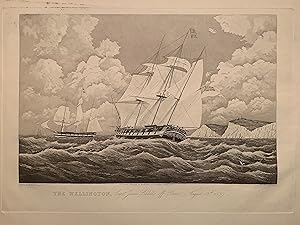
Pas de couverture. Condition: Bon. Charles Rosenburgh (illustrator). William John Huggins The Wellington Painted by W.J. Huggins Engraved by Charles Rosenburgh Late London published by mr Huggins, 105 Leadenhall street, 1840 Grande gravure XIXe Quelques défauts d'usage Dimensions : 70 x 51 cm.
-

Table Bay, Cape of Good Hope. To His Excellency the Right Honorable General Lord Charles Henry Somerset, Governor and Commander in Chief of the Cape of Good Hope
Published by T. Sutherland, Pall Mall, London, 1824
Seller: Donald A. Heald Rare Books (ABAA), New York, NY, U.S.A.
Seller rating 5 out of 5 stars
Art / Print / Poster
Print. Hand-colored aquatint engraving by T. Sutherland after W. J. Huggins. Image: (15 1/8 x 25 1/4 inches). Sheet: (18 1/2 x 27 7/8 inches). A beautiful, expansive scene showing the journeys of ships and other sailing vessels toward the Cape of Good Hope. The present image shows Table Bay, a natural bay located on the Atlantic coast of South Africa. Table Bay holds historical significance due to its strategic location and its role in maritime exploration and trade routes. The British East India Company established a refreshment station at Table Bay in 1652, which served as a crucial stopover point for ships traveling between Europe and the East Indies, providing fresh supplies and repairs. In 1795, during the French Revolutionary Wars, the British seized control of the Cape Colony, also known as the Cape of Good Hope, from the Dutch East India Company. The colony was subsequently returned to the Dutch in 1803 but was recaptured by the British in 1806 during the Napoleonic Wars. Lord Charles Henry Somerset, to whom the artist W. J. Huggins dedicated this image, served as the governor of the Cape Colony from 1814 to 1826. Under his term as governor, Somerset played an important role in British expansion into the Eastern Cape. When the British experienced a serious unemployment problem as a result of the Napoleonic Wars, the British government encouraged people to immigrate to the Cape Colony. This period saw one of the largest stages of British settlement in Africa. The present image shows masses of people arriving on ships, sailing toward the sprawling colony which can be seen in the distance. The artist William John Huggins was a renowned British marine painter who gained royal patronage for his artwork. He embarked on a voyage as a seaman between 1812 and 1814, during which he made numerous drawings of ships and landscapes in China and other locations. Settling in Leadenhall Street, London, he established himself as a professional artist, specializing in drawings of ships for the East India Company. Huggins exhibited at the Royal Academy from 1817 onward and at the British Institution for Promoting the Fine Arts from 1825. He became a marine painter to both George IV and William IV, producing notable works such as three large paintings depicting the Battle of Trafalgar. Known for his nautical expertise, Huggins's paintings are esteemed for their portrayal of ships, which were often engraved, as is the case here, further extending their reach and influence. Thomas Sutherland, the engraver, was a skilled aquatint artist, who specialized in hunting, coaching, military, and naval subjects.
-
South Sea Whale Fishery
Published by The Artist, London, 1825
Seller: Michael Treloar Booksellers ANZAAB/ILAB, Adelaide, SA, Australia
Association Member: ANZAAB ILAB
Seller rating 5 out of 5 stars
Art / Print / Poster
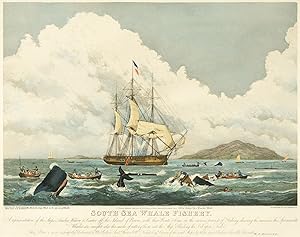
Condition: Fine. London, The Artist, 1 January 1825 (but later). A hand-coloured aquatint and etching (image 402 × 502 mm; visible surface 407 × 517 mm); matted, framed and glazed (external dimensions 685 × 785 mm); in fine condition. A dramatic and important whaling print, engraved by T. Sutherland after Huggins' painting. The engraved caption reads: 'A representation of the Ships "Amelia Wilson" & "Castor" off the Island of Bouro, with their Boats & Crew in the various process of Fishing, shewing the manner the Spermaceti Whales are caught, also the mode of cutting them into the Ship & Boiling the Oil upon Deck. This plate is most respectfully Dedicated to Ph. Skelton, Andw. Stirton, Wm. & Nichols Esqrs, Owners of the said Ships by their most obedient humble Servant W.J. Huggins'. Two scenes in the image have separate captions: 'The head of a large whale in the agonies of death', and 'A boat destroy'd by a wounded whale'. The catalogue of the 'Whaling Prints in the Francis B. Lothrop Collection' records this version of the print (#104) as a re-engraving of the original version (#103). 'Though the publication date remains unchanged, this print is a later issue, showing the longer title, captions, and the addition of "Marine Painter to His Majesty" to the imprint. Variations in other impressions suggest there may have been a third and perhaps even a fourth plate engraved of the same scene, none achieving the same fine quality as the first. At least one plate still exists today and is owned by an English publisher who continues to print it. It therefore shows considerable reworking over the years' (Ingalls: 'Whaling Prints in the Francis B. Lothrop Collection', Peabody Museum of Salem, 1987). 'Herman Melville, author of Moby-Dick (1851), judged William John Huggins to be one of very few artists able to portray a whale convincingly. Melville advised that "the only mode in which you can derive even a tolerable idea of his living contour, is by going a whaling yourself; but by so doing, you run no small risk of being eternally stove and sunk by him". Huggins, after several years at sea with the East India Company, established himself in London as a "Marine Painter, Printseller & Publisher [.] Merchants & Captains Supplied on Reasonable Terms". This engraving was produced after a painting commissioned by the owners of the two ships in this dramatic whaling scene. Its setting is by the island of Buru in Indonesia; the expression South Sea Whale Fishery related to oceans below the southern tip of Greenland' (Christchurch Art Gallery Te Puna o Waiwhetu website).
-
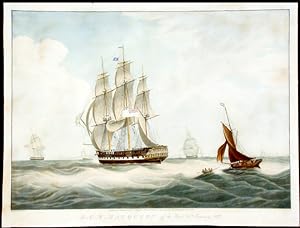
H.C.S. Macqueen off the Start, 26th. January 1832
Published by Published by W.J. Huggins, London, 1834
Seller: Donald A. Heald Rare Books (ABAA), New York, NY, U.S.A.
Seller rating 5 out of 5 stars
Art / Print / Poster
Colour-printed aquatint, finished by hand, by C. Rosenberg after Huggins. A fine image of an East-Indiaman making sail. William Huggins served for several years at sea in the service of the East India Compnay, and on his return to London was regularly employed to paint carefully detailed pictures of the company's ships. The present image is from this body of work and shows the Honourable Company Ship Macqueen making sail in crowded waters (12 other vessels are visible).
-
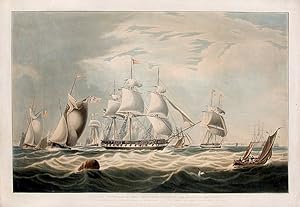
The Right Honourable Lord Yarborough's yacht, The Falcon of 351 tons
Published by Published by W.J. Huggins, London, 1835
Seller: Donald A. Heald Rare Books (ABAA), New York, NY, U.S.A.
Seller rating 5 out of 5 stars
Art / Print / Poster
Colour-printed aquatint, finished by hand, by C. Rosenberg after Huggins. A fine image of Lord Yarborough's `new' yacht William Huggins, one of the best English marine artists of the 19th century, served for several years at sea in the service of the East India Company. On his return to London used his intimate knowledge of sailing vessels to gain regular employment painting carefully detailed ship portraits. The present image falls into this category and represents the yacht that Lord Yarborough (1781-1846) had built after he was elected the first commodore of the Royal Yacht Squadron in 1824. Huggins' painting was very ably aquatinted by Charles Rosenberg, who translated several Huggins ship paintings to print. This is a superb example of 19th century marine printmaking.
-
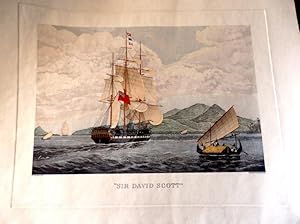
Sir David Scott. Capt D.I. Ward, at the Entrance of the Straits of Sunda Feby 1830. British Navy Ship. Aquatint Engraving.
Seller: Colophon Books (UK), Leek, STAFF, United Kingdom
Seller rating 5 out of 5 stars
Art / Print / Poster
US$ 110.83
US$ 35.31 shipping
Ships from United Kingdom to U.S.A.Quantity: 1 available
Add to basketLoose as Issued. Condition: Very Good. E. Duncan. (illustrator). 5th or later Edition. This Hand-Coloured engraving shows full plate indents and printed on either Whatman or similar cartridge cream stock paper. The engraving was originally published c1833 and two versions exist, this version is the title above and the 2nd shows this same ship as the "King George IVth" so the name was changed or two versions were printed almost simultaneously? There is no publishers name and the engraver was Edward Duncan after the painting by Huggins. No marks or stains or browning a little light handling in margins and these quite wide, over 2 inches all sides Measures 18 x 25 inches (or 45 x 34 cm) approx, unframed so can be sent rolled and carefully packed. *This engraving is probably a slightly later 19th century example so dated to later than 1833. The artist died in 1845 aged 66. He visited this part of the world as a Midshipman in about 1812-14, so the details will be accurate enough no doubt.
-

South sea whale fishery. A representation of the ships Amelia Wilson & Castor off the island of Bouro, with their boats & crew on the various process of fishing, shewing the manner the spermaceti whales are caught, also the mode of cutting them into the ship & bouling the oil upon deck. This plate is most respectfully dedicated to Philip Skelton, Andrew Stirton, William Nichols owners of the said ships, by their most obedient humble servant W.J. Huggins.
Seller: Gert Jan Bestebreurtje Rare Books (ILAB), Vianen, Netherlands
Seller rating 5 out of 5 stars
US$ 1,972.00
US$ 39.16 shipping
Ships from Netherlands to U.S.A.Quantity: 1 available
Add to basketLondon, W.J. Huggins, marine painter, 1825. Coloured aquatint by T. Sutherland. Ca. 44 x 56 cm. A fine early impression of this spectacular scene showing the British whalers Amelia Wilson and Castor off Buru, Indonesia, with a dying sperm whale smashing a whale boat, crew cutting in blubber alongside one of the ships, and several whale boats giving chase. William John Huggins (1781-1845) was a porolific marine artist and ship portraitist, working in London from 1814 until his death in 1845. His devotion to ships and the sea resulted from an early career with the East India Marine Company, during which he sailed the world over serving in a variety of capacities (Ingalls 103). - A dramatic and important whaling print in fine condition. Brewington 188.
-

Whaling - Thomas Sutherland after William John Huggins, 1825
Seller: Inter-Antiquariaat Mefferdt & De Jonge, Amsterdam, Netherlands
Seller rating 3 out of 5 stars

Art / Print / Poster
US$ 1,165.27
US$ 48.73 shipping
Ships from Netherlands to U.S.A.Quantity: 1 available
Add to basket"South Sea Whale Fishery." Aquatint engraving made in 1825 by Thomas Sutherland after a painting by William John Huggins official Marine Painter to his Majesty. Size: 43,2 x 55,9 cm. "A representation of the Ships Amelia Wilson and Castor off the Island of Bouro with their Boats and Crew in the various processes of Fishing, shewing the manner the Spermacetti Whales are caught, also the mode of cutting them into the Ship, and Boiling the Oil upon the Deck." The view illustrates the South Sea Whale Fishery, expressing the excitement, richness, romance, and brutality of the whaling trade. In this image the sailors of the HMS Amelia Wilson battle with numerous sperm whales with the island of Buru (Indonesia) in the background. The English southern whale fishery, commencing from London in 1775, was conducted primarily in the mid to south Atlantic, but by the mid-1790s it had moved to the Pacific and Indian Oceans. Initially, the move was limited to the areas off the coasts of Africa, South America and the east coast of Australia. But by 1815 the trade had spread to the wider Pacific, encompassing areas in the south, central and north Pacific, as well as the rim areas between Japan and New Guinea. In the Indian Ocean the trade extended north to the Seychelles and into the waters around Timor and the Moluccas, such as to be seen on our engraving. It was the oil of the sperm whale they were after. Sperm whale oil was always in demand as it had a number of unique qualities. It was more portable than gas and burnt more purely and with less smoke than animal, vegetable and other whale oils. As a lubricant its fine qualities resulted in much less wear on moving parts. Sperm oil also played a key role in lighting the better-class houses of London and contemporaries correlated the spread and use of gas lighting in streets with the increased use of Argand lamps in private homes. A price for sperm oil per gallon was always quoted in the London papers. Herman Melville, author of Moby-Dick (1851), judged William John Huggins to be one of very few artists able to portray a whale convincingly. Melville advised that "the only mode in which you can derive even a tolerable idea of his living contour, is by going whaling yourself; but by so doing, you run no small risk of being eternally stove and sunk by him". Price: Euro 975,-.