Order Total (1 Item Items):
Shipping Destination:

Illust Boyd Smith (1 results)
Skip to main search results
Search filters
Product Type
- All Product Types
- Books (1)
- Magazines & Periodicals (No further results match this refinement)
- Comics (No further results match this refinement)
- Sheet Music (No further results match this refinement)
- Art, Prints & Posters (No further results match this refinement)
- Photographs (No further results match this refinement)
- Maps (No further results match this refinement)
- Manuscripts & Paper Collectibles (No further results match this refinement)
Condition Learn more
- New (No further results match this refinement)
- As New, Fine or Near Fine (No further results match this refinement)
- Very Good or Good (1)
- Fair or Poor (No further results match this refinement)
- As Described (No further results match this refinement)
Binding
- All Bindings
- Hardcover (1)
- Softcover (No further results match this refinement)
Collectible Attributes
- First Edition (1)
- Signed (No further results match this refinement)
- Dust Jacket (No further results match this refinement)
- Seller-Supplied Images (1)
- Not Print on Demand (1)
Language (1)
Price
- Any Price
- Under US$ 25 (No further results match this refinement)
- US$ 25 to US$ 50 (No further results match this refinement)
- Over US$ 50
Free Shipping
Seller Location
Seller Rating
-
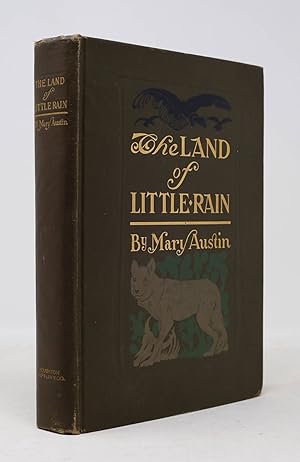
The Land of Little Rain
Published by Houghton Mifflin and Company, Boston and New York, 1903
First Edition
Hardcover. Condition: Very good. First. WITH 77 BOTANICAL WATERCOLORS EXECUTED ON THE TEXT. First edition. Boston and New York: Houghton, Mifflin and Company; 1903. First edition. Small quarto (8 3/8" x 6 1/4", 215mm x 159mm): pp. [6] (half title, blank, title, copyright, dedication, blank) vii-xi, [5] (blank, note on the illustrations, blank, contents, blank) 1-2 ("Land of Little Rain" title, blank) 3-280, [2] (text, colophon). [=xvi, 282] With a lithographed frontispiece and two plates. Bound in the publisher's olive polychrome pictorial cloth gilt. Title and publisher gilt to spine. Top edge of the text-block gilt, bottom and fore-edges untrimmed. Fore-corners bumped. With mild rubbing to the extremities. Near fine. Ex-libris of James Strohn Copley to the front paste-down. Early gift inscription in blue ink "Aunt Hattie/ with love from Lucy./ Christmas - 1904." on the recto of the first free end-paper. Throughout, 77 watercolors of wildflowers decorating the text. Three pages of manuscript (matching the hand of the inscription) index to the illustrations on the final end-papers. Mary Hunter Austin (1868-1934) explored the Mojave Desert in the closing years of the twentieth century. The Land of Little Rain, Austin's most renowned book, is a series of fourteen vignettes about the landscape and people of the desert. It is deeply spiritual in its connection to nature, and especially to plants: "If you have any doubt about it, know that the desert begins with the creosote. This immortal shrub spreads down into Death Valley and up to the lower timber-line, odorous and medicinal as you might guess from the name, wandlike, with shining fretted foliage." (p. 10) Indeed, so important is the book in painting a portrait of California's deserts, that the book is no. 2 in the Zamorano Eighty, a list of 80 essential works of Californiana. The extraordinary set botanical watercolors running through the work is therefore almost a personal commentary, especially since the artist was careful to note the plants' origins in her index: Yosemite and Redlands. Might she have brought the book with her as a sort of spiritual guide to the vast expanses, and used it as a sketchbook? There is a masterful mise-en-page, with the image often intermingling with the text, even across an opening. Subtle shadows in pale washes give an immediacy to the illustrations. Inasmuch as the gift inscription is written in the same hand as the index, Lucy must surely be the artist. Can it be Lucy Angeline Bacon (1857/8-1932), the California Impressionist? Bacon studied at the Art Students League, moved to Paris and, at the advice of Mary Cassatt, studied with Camille Pissarro -- the only American to do so. By 1898 she had returned to California (San Jose), and by 1905 she gave up her painting career, while continuing to teach art. Can this 1904 Christmas present to her Aunt Hattie have been a final flowering (forgive the pun) of her artistic output? It is a robust leap from a single name, but there cannot have been many women painting from life in Yosemite and Redlands at the turn of the century. The fineness of the work and the confidence of the placement against the text suggests a professional artist. James Strohn Copley (1916-1973) was the consummate twentieth-century Californian. He published the San Diego Union and Evening Tribune (merged into the Union-Tribune in 1992), and was a longtime friend and confidant of Goldwater and Nixon. He began in the Northeast, managing the school newspaper at Phillips Andover and the humor magazine at Yale. Eventually the Copley Press came to own a great many papers in Illinois and, principally, California. The present item was bought at his sale, Sotheby's New York (20 May 2011, lot 1059). Graff 114, Howes A400, Zamorano Eighty, 2.