
Inkyo (31 results)
- Softcover
Seller: Better World Books, Mishawaka, IN, U.S.A.Better World Books
Contact seller5-star sellerCondition: Used - Good
US$ 15.44
Free ShippingShips within U.S.A.Quantity: 1 available
Condition: Good. Pages intact with minimal writing/highlighting. The binding may be loose and creased. Dust jackets/supplements are not included. Stock photo provided. Product includes identifying sticker. Better World Books: Buy Books. Do Good.

- Hardcover
Seller: Antiquariat Thomas Haker GmbH & Co. KG, Berlin, GermanyAntiquariat Thomas Haker GmbH & Co. KG
Contact seller5-star sellerCondition: Used - Fine
US$ 13.74
US$ 23.15 shippingShips from Germany to U.S.A.Quantity: 1 available
Hardcover/Pappeinband. Condition: Sehr gut. 217 p. Very good. Shrink wrapped. / Sehr guter Zustand. In Folie verschweißt. Sprache: Englisch Gewicht in Gramm: 604.

Published by London General Press,, London: 1931
- Hardcover
- First Edition
Seller: Grendel Books, ABAA/ILAB, Springfield, MA, U.S.A.Grendel Books, ABAA/ILAB
Contact seller5-star sellerCondition: Used - Very good
US$ 35.00
US$ 7.00 shippingShips within U.S.A.Quantity: 1 available
Hardcover. Condition: Very Good. First edition. Faded along the spine and edges, previous owner's book-plate on front paste-down, foxing on endpapers, else very good in purple cloth. No dust jacket. ; 207 pages B003RKG950.

- Hardcover
Seller: killarneybooks, Inagh, CLARE, Irelandkillarneybooks
Contact seller5-star sellerCondition: Used - Very good
US$ 40.43
US$ 39.01 shippingShips from Ireland to U.S.A.Quantity: 1 available
Hardcover. Condition: Very Good. Not an Indian/economy edition. Printed in the Netherlands. Hardcover, xxiv + 194 pages, NOT ex-library. A clean and bright copy with unmarked text and firm binding, free of inscriptions and stamps. Gentle external shelfwear. Published without a dust jacket. -- East Asian Economic Regionalism atte…mpts to analyze the feasibilities of economic integration in East Asia and to discuss emerging economic integration efforts in East Asia with special reference to an East Asian FTA. Although economic integration is desirable economically, positions and approaches of each regional economy toward East Asian economic integration may differ depending on the circumstances of the countries concerned. East Asian Economic Regionalism provides diverse positions on East Asian economic integration by ASEAN countries, as well as the Northeastern countries of China, Japan and Korea. The volume also provides economic assessment of EAFTA and evaluates East Asian economic integration. East Asian Economic Regionalism may be the first book on East Asian economic integration with positions toward economic integration of major players in the region. -- Contents: Introduction and Overview; Part I: Northeast Asian Views on an EAFTA -- Ch. 1. China's Approach to an Institutional Regional Arrangement / Guoqiang Long and Liping Zhang; Ch. 2. East Asian Free Trade Agreement: Strategic Aspects for Japan / Kazuhiro Igawa and Bonggil Kim; Ch. 3. Evaluation of Recent Progress of FTAs in East Asia: A Korean Perspective / Inkyo Cheong; Part II: Southeast Asian Views on EAFTA -- Ch. 4. An East Asian FTA: A New Frontier of Economic Cooperation in East Asia / Termsak Chalermpalanupap; Ch. 5. Indonesia's FTA Policy and Its Perspectives on an East Asian FTA / Deddy Saleh; Ch. 6. An East Asia FTA: A Malaysian Perspective / Mohd Haflah Piei; Ch. 7. An East Asian FTA: A Philippine Perspective / John Lawrence Avila; Part III: Assessment of East Asian Regionalism -- Ch. 8. Estimation of Economic Effects of FTAs in East Asia: CGE Approach / Inkyo Cheong; Ch. 9. Asian Regionalism: Promises and Pitfalls / Richard E. Baldwin; Ch. 10. EU's Strategy Towards East Asian Integration and Regionalism / Sung-Hoon Park.

- Hardcover
Seller: Books Puddle, New York, NY, U.S.A.Books Puddle
Contact seller4-star sellerCondition: Used
US$ 106.72
US$ 3.99 shippingShips within U.S.A.Quantity: 1 available
Condition: Used. pp. 224.
- Hardcover
Seller: Biblios, frankfurt am main, HESSE, GermanyBiblios
Contact seller4-star sellerCondition: Used
US$ 112.43
US$ 11.52 shippingShips from Germany to U.S.A.Quantity: 1 available
Condition: Used. pp. 224.

- Hardcover
Seller: NEPO UG, Rüsselsheim am Main, , GermanyNEPO UG
Contact seller5-star sellerCondition: Used - Very good
US$ 115.64
US$ 27.78 shippingShips from Germany to U.S.A.Quantity: 1 available
Condition: Gut. Auflage: 2005. 194 Seiten Exemplar aus einer wissenchaftlichen Bibliothek Sprache: Englisch Gewicht in Gramm: 469 24,1 x 16,0 x 1,8 cm, Gebundene Ausgabe.
- Hardcover
Seller: Ria Christie Collections, Uxbridge, United KingdomRia Christie Collections
Contact seller5-star sellerCondition: New
US$ 133.86
US$ 16.07 shippingShips from United Kingdom to U.S.A.Quantity: Over 20 available
Condition: New. In.

- Softcover
Seller: Books Puddle, New York, NY, U.S.A.Books Puddle
Contact seller4-star sellerCondition: New
US$ 160.12
US$ 3.99 shippingShips within U.S.A.Quantity: 4 available
Condition: New. pp. 224.
- Softcover
Seller: Ria Christie Collections, Uxbridge, United KingdomRia Christie Collections
Contact seller5-star sellerCondition: New
US$ 167.83
US$ 16.07 shippingShips from United Kingdom to U.S.A.Quantity: Over 20 available
Condition: New. In.
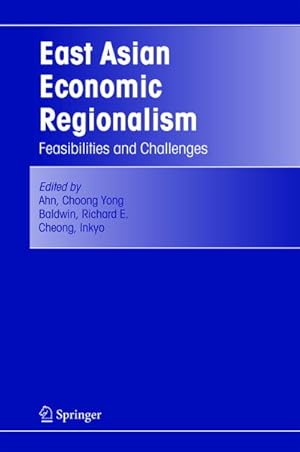
East Asian Economic Regionalism: Feasibilities and Challenges
Ahn, Choong Yong (Editor) / Baldwin, Richard E. (Editor) / Cheong, Inkyo (Editor)
- Softcover
Seller: Revaluation Books, Exeter, , United KingdomRevaluation Books
Contact seller5-star sellerCondition: New
US$ 177.30
US$ 13.41 shippingShips from United Kingdom to U.S.A.Quantity: 2 available
Paperback. Condition: Brand New. 194 pages. 9.45x6.30x0.51 inches. In Stock.
 More images
- Softcover
Seller: preigu, Osnabrück, Germanypreigu
Contact seller5-star sellerCondition: New
US$ 113.44
US$ 81.03 shippingShips from Germany to U.S.A.Quantity: 5 available
Taschenbuch. Condition: Neu. East Asian Economic Regionalism | Feasibilities and Challenges | Choong Yong Ahn (u. a.) | Taschenbuch | xxiii | Englisch | 2010 | Humana | EAN 9781441937216 | Verantwortliche Person für die EU: Springer Verlag GmbH, Tiergartenstr. 17, 69121 Heidelberg, juergen[dot]hartmann[at]springer[dot]com | Anbi…eter: preigu.

- Softcover
Seller: AHA-BUCH GmbH, Einbeck, GermanyAHA-BUCH GmbH
Contact seller5-star sellerCondition: New
US$ 134.44
US$ 71.57 shippingShips from Germany to U.S.A.Quantity: 1 available
Taschenbuch. Condition: Neu. Druck auf Anfrage Neuware - Printed after ordering - Economic regionalism has become a worldwide phenomenon. Since the Asian financial crisis, East Asian countries are accelerating the ongoing market-driven economic integration as well as institutional economic integration. The question is whether Ea…st Asia can reach an East Asian FTA (EAFTA), which is the first step towards institutional economic integration.East Asian Economic Regionalism attempts to analyze the feasibilities of economic integration in East Asia and to discuss emerging economic integration efforts in East Asia with special reference to an East Asian FTA. Although economic integration is desirable economically, positions and approaches of each regional economy toward East Asian economic integration may differ depending on the circumstances of the countries concerned. East Asian Economic Regionalism provides diverse positions on East Asian economic integration by ASEAN countries, as well as the Northeastern countries of China, Japan and Korea. The volume also provides economic assessment of EAFTA and evaluates East Asian economic integration. East Asian Economic Regionalism may be the first book on East Asian economic integration with positions toward economic integration of major players in the region.
- Hardcover
Seller: Mispah books, Redhill, SURRE, United KingdomMispah books
Contact seller4-star sellerCondition: Used - As new
US$ 175.47
US$ 33.54 shippingShips from United Kingdom to U.S.A.Quantity: 1 available
Hardcover. Condition: Like New. LIKE NEW. SHIPS FROM MULTIPLE LOCATIONS. book.

- Hardcover
Seller: AHA-BUCH GmbH, Einbeck, GermanyAHA-BUCH GmbH
Contact seller5-star sellerCondition: New
US$ 136.34
US$ 72.38 shippingShips from Germany to U.S.A.Quantity: 1 available
Buch. Condition: Neu. Druck auf Anfrage Neuware - Printed after ordering - Economic regionalism has become a worldwide phenomenon. Since the Asian financial crisis, East Asian countries are accelerating the ongoing market-driven economic integration as well as institutional economic integration. The question is whether East Asia… can reach an East Asian FTA (EAFTA), which is the first step towards institutional economic integration.East Asian Economic Regionalism attempts to analyze the feasibilities of economic integration in East Asia and to discuss emerging economic integration efforts in East Asia with special reference to an East Asian FTA. Although economic integration is desirable economically, positions and approaches of each regional economy toward East Asian economic integration may differ depending on the circumstances of the countries concerned. East Asian Economic Regionalism provides diverse positions on East Asian economic integration by ASEAN countries, as well as the Northeastern countries of China, Japan and Korea. The volume also provides economic assessment of EAFTA and evaluates East Asian economic integration. East Asian Economic Regionalism may be the first book on East Asian economic integration with positions toward economic integration of major players in the region.
- Softcover
Seller: Mispah books, Redhill, SURRE, United KingdomMispah books
Contact seller4-star sellerCondition: Used - As new
US$ 214.16
US$ 33.54 shippingShips from United Kingdom to U.S.A.Quantity: 1 available
Paperback. Condition: Like New. LIKE NEW. SHIPS FROM MULTIPLE LOCATIONS. book.
 More images
- Softcover
Seller: Jonathan A. Hill, Bookseller Inc., New York, NY, U.S.A.Jonathan A. Hill, Bookseller Inc.
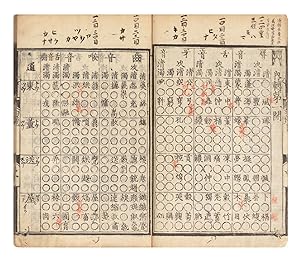
Contact seller5-star sellerTen columns per page, 20 characters per column. The first leaf in Japanese, the remainder in Chinese. 1 p.l., 52 folding leaves. 8vo (275 x 173 mm.), orig. wrappers (wrappers quite rubbed & and somewhat worn), old stitching. From the colophon: "Kyoto: Tahara Ninzaemon, 1641." A very rare early edition not in WorldCat or NIJL of…one of the "two priceless records of the earlier stages of the Chinese language."Edwin G. Pulleyblank, "Qieyun and Yunjing: The Essential Foundation for Chinese Historical Linguistics" in Journal of the American Oriental Society, Vol. 118, No. 2 (April-June 1998), p. 213. The Yunjing, along with its predecessor, the Qieyun, were the standard pronunciation guides of the Early Middle Chinese and Middle Chinese periods. The original motivation to compile these guides to pronunciation was religious: Chinese monks turned their attention to the analysis of the sounds of their own language as recitations of chants depended for their effectiveness on correct pronunciation. The need for rhyming tables soon extended to scholarly and practical purposes as well. By the sixth century, educated speech of the south and that of the north had diverged but were still mutually intelligible and sufficiently unified to constitute a common language. The aim of the first such rhyming table, the Qieyun (601), was to codify this common standard, a lingua franca for the elite, preserving a maximum number of distinctions between syllables. The Qieyun went through many revisions and enlargements during the succeeding Tang period. "The earliest extant complete rhyme table is the Yunjing [or, in Japanese: Inkyo] (Mirror of Rhymes), now known only in an edition [by Linzhi Zhang (active 1161-1203)] of the southern Song period (the prefaces are dated 1161, [1197], and 1203), but datable by internal evidence originally to the ninth or tenth century."Pulleyblank, "Chinese Traditional Phonology" in Asia Major, Third Series, Vol. 12, No. 2 (1999), p. 114 (and much of our description is based on this fine article, which explains how these rhyming tables work). The Yunjing comprises a series of charts that arrange Chinese characters in large tables according to their tone and syllable structures to indicate their proper pronunciations. It is the essential foundation for Chinese historical linguistics and remains the essential guide to Middle Chinese phonology. The Yunjing came to Japan in the 13th century in either manuscript or printed book format, where it was preserved (no printed copies or manuscripts survive in China). Our movable type edition was modelled after the 1528 edition (no copy of this edition survives today). Our edition contains Zhang's Prefaces of 1197 and 1203 and an Afterword, dated 1528, written by the prominent Confucian scholar Nobukata Kiyohara (1475-1550). In his Afterword, Kiyohara furnishes the valuable information that this book was copied in Japan from the Chinese edition and that the 1528 edition was published by Munenaka (or Sochu) Ronshi, a scholarly Buddhist practitioner and friend of Kiyohara, at the Komyoji Temple, in Sakai, south of Osaka. There were many editions of the Inkyo in following centuries. Our edition also contains the preliminary leaf with 50 Japanese "alphabet sounds" (Go on go i), which first appeared in the 1628 edition; they help to explicate the following tables. These 43 tables of guides to pronunciation are remarkable for their complexity and, at the same time, their simplicity. While religious motives were the original reason for the interest in correct pronunciation, other scholarly needs expanded the importance of the Yunjing in China and the Inkyo in Japan. It is considered to be of the greatest importance to Chinese and Japanese scholars from the 12th century to the present day. Facsimiles were made in Japan by Chinese scholars in the early 20th century and brought back to China. A very good copy, preserved in a chitsu. Some worming, touching a few characters.
 More images
- Softcover
Seller: Jonathan A. Hill, Bookseller Inc., New York, NY, U.S.A.Jonathan A. Hill, Bookseller Inc.
Contact seller5-star sellerCondition: Used
US$ 27,500.00
US$ 20.00 shippingShips within U.S.A.Quantity: 1 available
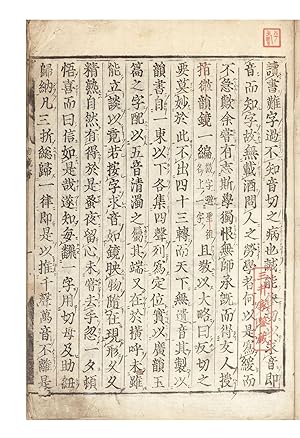
11 columns per page, 20 characters per column. Written in Chinese with manuscript Japanese reading marks. 52 folding leaves. Large 8vo (290 x 205 mm.), orig. wrappers (wrappers somewhat worn & rubbed), manuscript title-label on upper cover, new stitching. From the colophon: "Kyoto: Kotetsu shoin, 1608." A very rare movable type…edition not in WorldCat or NIJL of one of the "two priceless records of the earlier stages of the Chinese language."Edwin G. Pulleyblank, "Qieyun and Yunjing: The Essential Foundation for Chinese Historical Linguistics" in Journal of the American Oriental Society, Vol. 118, No. 2 (April-June 1998), p. 213. The Yunjing, along with its predecessor, the Qieyun, were the standard pronunciation guides of the Early Middle Chinese and Middle Chinese periods. The original motivation to compile these guides to pronunciation was religious: Chinese monks turned their attention to the analysis of the sounds of their own language as recitations of chants depended for their effectiveness on correct pronunciation. The need for rhyming tables soon extended to scholarly and practical purposes as well. By the sixth century, educated speech of the south and that of the north had diverged but were still mutually intelligible and sufficiently unified to constitute a common language. The aim of the first such rhyming table, the Qieyun (601), was to codify this common standard, a lingua franca for the elite, preserving a maximum number of distinctions between syllables. The Qieyun went through many revisions and enlargements during the succeeding Tang period. "The earliest extant complete rhyme table is the Yunjing [or, in Japanese: Inkyo] (Mirror of Rhymes), now known only in an edition [by Linzhi Zhang (active 1161-1203)] of the southern Song period (the prefaces are dated 1161, [1197], and 1203), but datable by internal evidence originally to the ninth or tenth century."Pulleyblank, "Chinese Traditional Phonology" in Asia Major, Third Series, Vol. 12, No. 2 (1999), p. 114 (and much of our description is based on this fine article, which explains how these rhyming tables work). The Yunjing comprises a series of charts that arrange Chinese characters in large tables according to their tone and syllable structures to indicate their proper pronunciations. It is the essential foundation for Chinese historical linguistics and remains the essential guide to Middle Chinese phonology. The Yunjing came to Japan in the 13th century in either manuscript or printed book format, where it was preserved (no printed copies or manuscripts survive in China). Our movable type edition was modelled after the 1528 edition (no copy of this edition survives today). It contains Zhang's Prefaces of 1197 and 1203. There were many editions of the Inkyo in following centuries. These 43 tables of guides to pronunciation are remarkable for their complexity and, at the same time, their simplicity. While religious motives were the original reason for the interest in correct pronunciation, other scholarly needs expanded the importance of the Yunjing in China and the Inkyo in Japan. It is considered to be of the greatest importance to Chinese and Japanese scholars from the 12th century to the present day. Facsimiles were made in Japan by Chinese scholars in the early 20th century and brought back to China. A very good copy, with the seal of the Mitsui family. Minor worming, touching a few characters. Light staining towards end. ? Kazuma Kawase, Kokatsuji-ban no kenkyu [Study of the Early Typographic Editions of Japan] (1967), I, p. 379 & III, p. 75 for a reproduction of the colophon.
 More images
- Softcover
Seller: Jonathan A. Hill, Bookseller Inc., New York, NY, U.S.A.Jonathan A. Hill, Bookseller Inc.
Contact seller5-star sellerCondition: Used
US$ 110,000.00
US$ 20.00 shippingShips within U.S.A.Quantity: 1 available
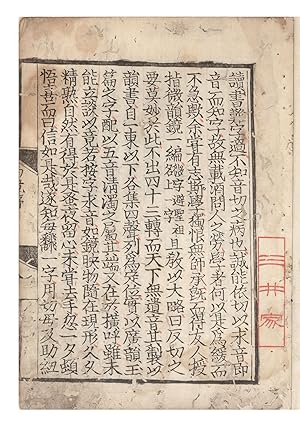
Ten columns per page, 20 characters per column. 52 folding leaves. Large 8vo (280 x 203 mm.), later wrappers, new stitching. [Japan]: colophon dated "1564." The earliest surviving edition of one of the "two priceless records of the earlier stages of the Chinese language."Edwin G. Pulleyblank, "Qieyun and Yunjing: The Essential F…oundation for Chinese Historical Linguistics" in Journal of the American Oriental Society, Vol. 118, No. 2 (April-June 1998), p. 213. The Yunjing, along with its predecessor, the Qieyun, were the standard pronunciation guides of the Early Middle Chinese and Middle Chinese periods. This is a very rare book, with only three (or, perhaps, two) other known copies. The original motivation to compile these guides to pronunciation was religious: Chinese monks turned their attention to the analysis of the sounds of their own language as recitations of chants depended for their effectiveness on correct pronunciation. The need for rhyming tables soon extended to scholarly and practical purposes as well. By the sixth century, educated speech of the south and that of the north had diverged but were still mutually intelligible and sufficiently unified to constitute a common language. The aim of the first such rhyming table, the Qieyun (601), was to codify this common standard, a lingua franca for the elite, preserving a maximum number of distinctions between syllables. The Qieyun went through many revisions and enlargements during the succeeding Tang period. "The earliest extant complete rhyme table is the Yunjing [or, in Japanese: Inkyo] (Mirror of Rhymes), now known only in an edition [by Linzhi Zhang (active 1161-1203)] of the southern Song period (the prefaces are dated 1161, [1197], and 1203), but datable by internal evidence originally to the ninth or tenth century."Pulleyblank, "Chinese Traditional Phonology" in Asia Major, Third Series, vol. 12, No. 2 (1999), p. 114 (and much of our description is based on this fine article, which explains how these rhyming tables work). The Yunjing comprises a series of charts that arrange Chinese characters in large tables according to their tone and syllable structures to indicate their proper pronunciations. It is the essential foundation for Chinese historical linguistics and remains the essential guide to Middle Chinese phonology. The Yunjing came to Japan in the 13th century in either manuscript or printed book format, where it was preserved (no printed copies or manuscripts survive in China). There was an edition printed in Japan in 1528 of the text, now called in Japanese Inkyo but no copy survives. The Afterword (see below) in our edition is the only early record of the existence of the 1528 edition. Our edition, of 1564, which might be considered a Gozan-ban, is the earliest extant edition of the text to survive, in China or Japan. Zhang's two Prefaces, dated 1197 and 1203, are printed here. The Afterword, dated 1528, was written by the prominent Confucian scholar Nobukata Kiyohara (1475-1550). In his Afterword, Kiyohara furnishes the valuable information that this book was copied in Japan from the Chinese edition and that the 1528 edition was published by Munenaka (or Sochu) Ronshi, a scholarly Buddhist practitioner and friend of Kiyohara, at the Komyoji Temple, in Sakai, south of Osaka. There were many editions of the Inkyo in following centuries, including a movable type edition of 1608. These 43 tables of guides to pronunciation are remarkable for their complexity and, at the same time, their simplicity. While religious motives were the original reason for the interest in correct pronunciation, other scholarly needs expanded the importance of the Yunjing in China and the Inkyo in Japan. It is considered to be of the greatest importance to Chinese and Japanese scholars from the 12th century to the present day. Facsimiles were made in Japan by Chinese scholars in the early 20th century and brought back to China. According to the Union Catalogue of Early Japa.

Language: Italian
- Hardcover
- Print on Demand
Seller: S N Books World, Delhi, , IndiaS N Books World
Contact seller5-star sellerLeatherbound. Condition: NEW. BOOKS ARE EXEMPT FROM IMPORT DUTIES AND TARIFFS; NO EXTRA CHARGES APPLY. Leatherbound edition. Condition: New. Leather Binding on Spine and Corners with Golden leaf printing on spine. Bound in genuine leather with Satin ribbon page markers and Spine with raised gilt bands. Pages: 128. A perfect gift… for your loved ones. Reprinted from 1922 edition. NO changes have been made to the original text. This is NOT a retyped or an ocr'd reprint. Illustrations, Index, if any, are included in black and white. Each page is checked manually before printing. As this print on demand book is reprinted from a very old book, there could be some missing or flawed pages, but we always try to make the book as complete as possible. Fold-outs, if any, are not part of the book. If the original book was published in multiple volumes then this reprint is of only one volume, not the whole set. IF YOU WISH TO ORDER PARTICULAR VOLUME OR ALL THE VOLUMES YOU CAN CONTACT US. Resized as per current standards. Sewing binding for longer life, where the book block is actually sewn (smythe sewn/section sewn) with thread before binding which results in a more durable type of binding. Language: Italian Pages: 128.
- Softcover
- Print on Demand
Seller: Brook Bookstore On Demand, Napoli, NA, ItalyBrook Bookstore On Demand
Contact seller3-star sellerCondition: New
US$ 102.82
US$ 6.37 shippingShips from Italy to U.S.A.Quantity: Over 20 available
Condition: new. Questo è un articolo print on demand.

- Softcover
- Print on Demand
Seller: BuchWeltWeit Ludwig Meier e.K., Bergisch Gladbach, , GermanyBuchWeltWeit Ludwig Meier e.K.
Contact seller5-star sellerCondition: New
US$ 127.56
US$ 26.62 shippingShips from Germany to U.S.A.Quantity: 2 available
Taschenbuch. Condition: Neu. This item is printed on demand - it takes 3-4 days longer - Neuware -An analysis of the feasibilities of East Asian economic integration, providing diverse positions on East Asian economic integration by ASEAN countries as well as the north-eastern countries of China, Japan, and Korea. 224 pp. Englis…ch.
- Hardcover
- Print on Demand
Seller: BuchWeltWeit Ludwig Meier e.K., Bergisch Gladbach, , GermanyBuchWeltWeit Ludwig Meier e.K.
Contact seller5-star sellerCondition: New
US$ 127.56
US$ 26.62 shippingShips from Germany to U.S.A.Quantity: 2 available
Buch. Condition: Neu. This item is printed on demand - it takes 3-4 days longer - Neuware -An analysis of the feasibilities of East Asian economic integration, providing diverse positions on East Asian economic integration by ASEAN countries as well as the north-eastern countries of China, Japan, and Korea. 224 pp. Englisch.

- Softcover
- Print on Demand
Seller: moluna, Greven, , Germanymoluna
Contact seller5-star sellerCondition: New
US$ 110.01
US$ 56.71 shippingShips from Germany to U.S.A.Quantity: Over 20 available
Kartoniert / Broschiert. Condition: New. Dieser Artikel ist ein Print on Demand Artikel und wird nach Ihrer Bestellung fuer Sie gedruckt. An analysis of the feasibilities of East Asian economic integration, providing diverse positions on East Asian economic integration by ASEAN countries as well as the north-eastern countries of… China, Japan, and Korea.|Economic regionalism has beco.

- Hardcover
- Print on Demand
Seller: moluna, Greven, , Germanymoluna
Contact seller5-star sellerCondition: New
US$ 110.01
US$ 56.71 shippingShips from Germany to U.S.A.Quantity: Over 20 available
Gebunden. Condition: New. Dieser Artikel ist ein Print on Demand Artikel und wird nach Ihrer Bestellung fuer Sie gedruckt. An analysis of the feasibilities of East Asian economic integration, providing diverse positions on East Asian economic integration by ASEAN countries as well as the north-eastern countries of China, Japan,…and Korea.|Economic regionalism has beco.
- Hardcover
- Print on Demand
Seller: Majestic Books, Hounslow, , United KingdomMajestic Books
Contact seller4-star sellerCondition: New
US$ 165.94
US$ 8.72 shippingShips from United Kingdom to U.S.A.Quantity: 4 available
Condition: New. Print on Demand pp. 224 Illus.
- Softcover
- Print on Demand
Seller: Majestic Books, Hounslow, , United KingdomMajestic Books
Contact seller4-star sellerCondition: New
US$ 166.21
US$ 8.72 shippingShips from United Kingdom to U.S.A.Quantity: 4 available
Condition: New. Print on Demand pp. 224 49:B&W 6.14 x 9.21 in or 234 x 156 mm (Royal 8vo) Perfect Bound on White w/Gloss Lam.
- Softcover
- Print on Demand
Seller: Biblios, frankfurt am main, HESSE, GermanyBiblios
Contact seller4-star sellerCondition: New
US$ 177.26
US$ 11.52 shippingShips from Germany to U.S.A.Quantity: 4 available
Condition: New. PRINT ON DEMAND pp. 224.
- Hardcover
- Print on Demand
Seller: THE SAINT BOOKSTORE, Southport, , United KingdomTHE SAINT BOOKSTORE
Contact seller5-star sellerCondition: New
US$ 160.21
US$ 29.44 shippingShips from United Kingdom to U.S.A.Quantity: Over 20 available
Hardback. Condition: New. This item is printed on demand. New copy - Usually dispatched within 5-9 working days.

- Hardcover
- Print on Demand
Seller: buchversandmimpf2000, Emtmannsberg, BAYE, Germanybuchversandmimpf2000
Contact seller5-star sellerCondition: New
US$ 127.56
US$ 69.45 shippingShips from Germany to U.S.A.Quantity: 1 available
Buch. Condition: Neu. This item is printed on demand - Print on Demand Titel. Neuware -Economic regionalism has become a worldwide phenomenon. Since the Asian financial crisis, East Asian countries are accelerating the ongoing market-driven economic integration as well as institutional economic integration. The question is wheth…er East Asia can reach an East Asian FTA (EAFTA), which is the first step towards institutional economic integration.East Asian Economic Regionalism attempts to analyze the feasibilities of economic integration in East Asia and to discuss emerging economic integration efforts in East Asia with special reference to an East Asian FTA. Although economic integration is desirable economically, positions and approaches of each regional economy toward East Asian economic integration may differ depending on the circumstances of the countries concerned. East Asian Economic Regionalism provides diverse positions on East Asian economic integration by ASEAN countries, as well as the Northeastern countries of China, Japan and Korea. The volume also provides economic assessment of EAFTA and evaluates East Asian economic integration. East Asian Economic Regionalism may be the first book on East Asian economic integration with positions toward economic integration of major players in the region.Springer-Verlag KG, Sachsenplatz 4-6, 1201 Wien 224 pp. Englisch.


