

Order Total (1 Item Items):
Shipping Destination:

Jacques Stroumsa (19 results)
Skip to main search results
Search filters
Product Type
- All Product Types
- Books (19)
- Magazines & Periodicals (No further results match this refinement)
- Comics (No further results match this refinement)
- Sheet Music (No further results match this refinement)
- Art, Prints & Posters (No further results match this refinement)
- Photographs (No further results match this refinement)
- Maps (No further results match this refinement)
- Manuscripts & Paper Collectibles (No further results match this refinement)
Condition Learn more
- New (7)
- As New, Fine or Near Fine (5)
- Very Good or Good (5)
- Fair or Poor (No further results match this refinement)
- As Described (2)
Binding
Collectible Attributes
- First Edition (4)
- Signed (1)
- Dust Jacket (No further results match this refinement)
- Seller-Supplied Images (8)
- Not Print on Demand (14)
Language (5)
Free Shipping
Seller Location
Seller Rating
-

Paperback. Condition: Good. No Jacket. Pages can have notes/highlighting. Spine may show signs of wear. ~ ThriftBooks: Read More, Spend Less.
-
Paperback. Condition: Good. No Jacket. Pages can have notes/highlighting. Spine may show signs of wear. ~ ThriftBooks: Read More, Spend Less.
-

Condition: Bueno. : Tria la vida. El violinista d'Auschwitz es una conmovedora narración autobiográfica de Jacques Stroumsa, un violinista judío que sobrevivió a los horrores de los campos de concentración nazis. En este libro, Stroumsa relata su experiencia en Auschwitz, Birkenau, Mauthausen y Gusen II, donde su talento musical y habilidades como ingeniero eléctrico le permitieron integrarse a la orquesta del campo y trabajar en el departamento técnico, lo que contribuyó a su supervivencia. La obra es un testimonio de resiliencia y una llamada a la memoria para no olvidar los horrores del Holocausto. EAN: 9788483007976 Tipo: Libros Categoría: Historia Título: Tria la vida. El violinista d'Auschwitz Autor: Jacques Stroumsa Editorial: Columna Idioma: ca Páginas: 192 Formato: tapa dura.
-
Violinist in Auschwitz
Seller: Ria Christie Collections, Uxbridge, United Kingdom
Seller rating 5 out of 5 stars

US$ 29.27
US$ 16.06 shipping
Ships from United Kingdom to U.S.A.Quantity: Over 20 available
Add to basketCondition: New. In.
-

TRIA LA VIDA EL VIOLINISTA D'AUSCHWITZ
First Edition
Encuadernación de tapa blanda. Condition: Excelente. 1ª Edición. TRIA LA VIDA EL VIOLINISTA D'AUSCHWITZ. JACQUES STROUMSA. EDITORIAL COLUMNA. AÑO: 1999.EXCELENTE ESTADO. IDIOMA: CATALAN.
-

Condition: very good. Gut/Very good: Buch bzw. Schutzumschlag mit wenigen Gebrauchsspuren an Einband, Schutzumschlag oder Seiten. / Describes a book or dust jacket that does show some signs of wear on either the binding, dust jacket or pages.
-

Tria la vida: El violinista d'Auschwitz
Language: Catalan
Published by Columna, Barcelona, 1999
First Edition
Encuadernación de tapa blanda. Condition: Bien. Novel·la (illustrator). 1ª Edición. Todos nuestros libros son de segunda mano.
-

Tu choisiras la vie : Violoniste à Auschwitz
Language: French
Published by Cerf (Histoires Judaîsmes), Paris, 1998
Couverture souple. Condition: Bon. 148 p. Cote, cachet et code barre de biblio. Code 2040.
-
Les Juifs présentés aux Chrétiens : cérémonies et coutumes qui s'observent aujourd'hui parmi lers Juifs
Language: French
Published by Paris, Les belles lettres, Paris, 1998
ISBN 10: 2251339345 ISBN 13: 9782251339344
brossura. Condition: Fine. 1998. Opera con copertina morbida in brossura e alette. XLIX, 289 p. : ill. in b/n ft ; 21 cm. N80. Book.
-
Encuadernación de tapa blanda. Condition: Como Nuevo. TRIA LA VIDA. EL VIOLINISTA D'AUSCHWITZ. Jacques Stroumsa. Columna 1999. Traducció d'Isabel-Clara Simó. Pòrtic de Maria Àngels Anglada.
-
-
PAP. Condition: New. New Book. Shipped from UK. THIS BOOK IS PRINTED ON DEMAND. Established seller since 2000.
-
Violinist in Auschwitz
Seller: PBShop.store UK, Fairford, GLOS, United Kingdom
Seller rating 5 out of 5 stars
US$ 31.29
US$ 4.41 shipping
Ships from United Kingdom to U.S.A.Quantity: Over 20 available
Add to basketPAP. Condition: New. New Book. Delivered from our UK warehouse in 4 to 14 business days. THIS BOOK IS PRINTED ON DEMAND. Established seller since 2000.
-
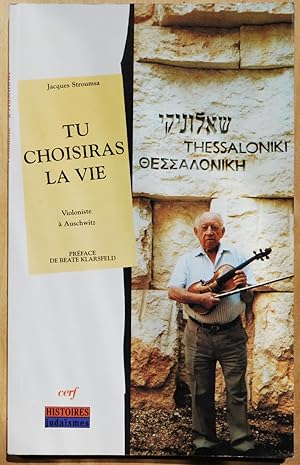
Tu choisiras la vie. Violoniste à Auschwitz.
Published by Cerf, 1998
Seller: ShepherdsBook, Granges-près-Marnand, Switzerland
Seller rating 5 out of 5 stars
First Edition Signed
Couverture souple. Condition: Bon. Edition originale. Dédicacé par l'auteur.
-
Ed. Columna; Barcelona. 1999. Castellano. Rustica. 21x14 cms. 192 pags. Buen estado. NARRATIVA. Ref. 45353.
-

Geiger in Auschwitz - Ein jüdisches Überlebensschicksal aus Saloniki 1941-1967
Language: German
Published by Hartung-Gorre Konstanz 1993, 1993
ISBN 10: 3891916523 ISBN 13: 9783891916520
Seller: Antiquariat Buchtip Vera Eder-Haumer, Wien, W, Austria
Seller rating 5 out of 5 stars
First Edition
Condition: 0. 1. aufl. Sprache: Deutsch 112 Seiten, Okart / paperback 8° Abbildungen, guter Zustand.
-
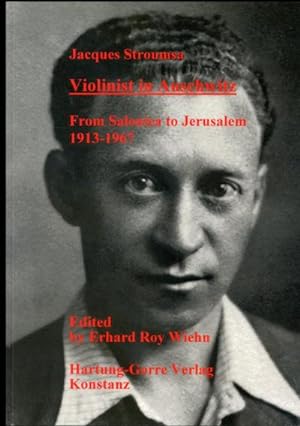
Violinist in Auschwitz
Seller: BuchWeltWeit Ludwig Meier e.K., Bergisch Gladbach, Germany
Seller rating 5 out of 5 stars
Taschenbuch. Condition: Neu. This item is printed on demand - it takes 3-4 days longer - Neuware -Jacques Stroumsa: Preface to the English editionProfessor Dr. Erhard Roy Wiehn from the University of Konstanz and editor of an important collection of books about the Shoah, has asked me to write a preface for the English edition of my book, Violinist in Auschwitz. The experience acquired in Germany during my lectures at Gymnasia (high schools) in Berlin and neighboring Potsdam in 1993 and 1994 gave me a number of important insights which I would like to share with the English-speaking public. The Nazi concentration camps were intended to completely destroy the human personality and to reduce it to a number tattooed on the skin, like animals in a slaughterhouse. The questions that people asked were, for example: having survived physically after being in Auschwitz and Mauthausen for two years, having survived the terrible Death March in January 1945, how did you find the strength to be a human being again; how did you adjust to living in a normal society again Above all, where did you find the strength to come back to Germany (the land where crime was so scientifically organized) and, day after day, tell young Germans the details of your sufferings How could you tell them that the younger generation is not guilty, that they and their parents (who are now the same age as my children) were not even born at the time when these events occurred The answers to these anguished questions were given to me by the children themselves; they were deeply moved by my lectures. One day, in December 1994, I received an invitation from Micaela von Marcard, head dramaturge of the Berlin State Opera, to attend the Memorial Concert to be given in Berlin on January 28, 1995, on the fiftieth anniversary of the liberation of Auschwitz. Also, Mrs. von Marcard asked me to write some 'Memories of Auschwitz' for Vivace, the bulletin of the State Opera. I used the occasion of my visit to Berlin to present several lectures at various Gymnasia in the vicinity and, most important, to once again meet a few of the girls who had written to me after my original lectures. I am very grateful to Mr. and Mrs. Leonhard Dünnwald for organizing this reunion in their villa in BerIin. I am also very grateful to four girls, Juliana, Tina, Katrin and Kristin for coming so far to our meeting and for their most thoughtful contributions to the discussions of these very anguished questions. My sincere appreciation to James S. Brice, an American student at the University of Konstanz, for translation. 108 pp. Englisch.
-

Violinist in Auschwitz
Language: English
Published by Hartung-Gorre, Hartung-Gorre Aug 2019, 2019
ISBN 10: 3891918690 ISBN 13: 9783891918692
Seller: buchversandmimpf2000, Emtmannsberg, BAYE, Germany
Seller rating 5 out of 5 stars
Taschenbuch. Condition: Neu. This item is printed on demand - Print on Demand Titel. Neuware -Jacques Stroumsa: Preface to the English editionProfessor Dr. Erhard Roy Wiehn from the University of Konstanz and editor of an important collection of books about the Shoah, has asked me to write a preface for the English edition of my book, Violinist in Auschwitz. The experience acquired in Germany during my lectures at Gymnasia (high schools) in Berlin and neighboring Potsdam in 1993 and 1994 gave me a number of important insights which I would like to share with the English-speaking public. The Nazi concentration camps were intended to completely destroy the human personality and to reduce it to a number tattooed on the skin, like animals in a slaughterhouse. The questions that people asked were, for example: having survived physically after being in Auschwitz and Mauthausen for two years, having survived the terrible Death March in January 1945, how did you find the strength to be a human being again; how did you adjust to living in a normal society again Above all, where did you find the strength to come back to Germany (the land where crime was so scientifically organized) and, day after day, tell young Germans the details of your sufferings How could you tell them that the younger generation is not guilty, that they and their parents (who are now the same age as my children) were not even born at the time when these events occurred The answers to these anguished questions were given to me by the children themselves; they were deeply moved by my lectures. One day, in December 1994, I received an invitation from Micaela von Marcard, head dramaturge of the Berlin State Opera, to attend the Memorial Concert to be given in Berlin on January 28, 1995, on the fiftieth anniversary of the liberation of Auschwitz. Also, Mrs. von Marcard asked me to write some 'Memories of Auschwitz' for Vivace, the bulletin of the State Opera. I used the occasion of my visit to Berlin to present several lectures at various Gymnasia in the vicinity and, most important, to once again meet a few of the girls who had written to me after my original lectures. I am very grateful to Mr. and Mrs. Leonhard Dünnwald for organizing this reunion in their villa in BerIin. I am also very grateful to four girls, Juliana, Tina, Katrin and Kristin for coming so far to our meeting and for their most thoughtful contributions to the discussions of these very anguished questions. My sincere appreciation to James S. Brice, an American student at the University of Konstanz, for translation.Books on Demand GmbH, Überseering 33, 22297 Hamburg 108 pp. Englisch.
-

Taschenbuch. Condition: Neu. nach der Bestellung gedruckt Neuware - Printed after ordering - Jacques Stroumsa: Preface to the English editionProfessor Dr. Erhard Roy Wiehn from the University of Konstanz and editor of an important collection of books about the Shoah, has asked me to write a preface for the English edition of my book, Violinist in Auschwitz. The experience acquired in Germany during my lectures at Gymnasia (high schools) in Berlin and neighboring Potsdam in 1993 and 1994 gave me a number of important insights which I would like to share with the English-speaking public. The Nazi concentration camps were intended to completely destroy the human personality and to reduce it to a number tattooed on the skin, like animals in a slaughterhouse. The questions that people asked were, for example: having survived physically after being in Auschwitz and Mauthausen for two years, having survived the terrible Death March in January 1945, how did you find the strength to be a human being again; how did you adjust to living in a normal society again Above all, where did you find the strength to come back to Germany (the land where crime was so scientifically organized) and, day after day, tell young Germans the details of your sufferings How could you tell them that the younger generation is not guilty, that they and their parents (who are now the same age as my children) were not even born at the time when these events occurred The answers to these anguished questions were given to me by the children themselves; they were deeply moved by my lectures. One day, in December 1994, I received an invitation from Micaela von Marcard, head dramaturge of the Berlin State Opera, to attend the Memorial Concert to be given in Berlin on January 28, 1995, on the fiftieth anniversary of the liberation of Auschwitz. Also, Mrs. von Marcard asked me to write some 'Memories of Auschwitz' for Vivace, the bulletin of the State Opera. I used the occasion of my visit to Berlin to present several lectures at various Gymnasia in the vicinity and, most important, to once again meet a few of the girls who had written to me after my original lectures. I am very grateful to Mr. and Mrs. Leonhard Dünnwald for organizing this reunion in their villa in BerIin. I am also very grateful to four girls, Juliana, Tina, Katrin and Kristin for coming so far to our meeting and for their most thoughtful contributions to the discussions of these very anguished questions. My sincere appreciation to James S. Brice, an American student at the University of Konstanz, for translation.


