Order Total (1 Item Items):
Shipping Destination:

Koster Everhardus (2 results)
Skip to main search results
Search filters
Product Type
- All Product Types
- Books (2)
- Magazines & Periodicals (No further results match this refinement)
- Comics (No further results match this refinement)
- Sheet Music (No further results match this refinement)
- Art, Prints & Posters (No further results match this refinement)
- Photographs (No further results match this refinement)
- Maps (No further results match this refinement)
- Manuscripts & Paper Collectibles (No further results match this refinement)
Condition Learn more
- New (No further results match this refinement)
- As New, Fine or Near Fine (No further results match this refinement)
- Very Good or Good (No further results match this refinement)
- Fair or Poor (No further results match this refinement)
- As Described (2)
Binding
- All Bindings
- Hardcover (No further results match this refinement)
- Softcover (1)
Collectible Attributes
- First Edition (No further results match this refinement)
- Signed (No further results match this refinement)
- Dust Jacket (No further results match this refinement)
- Seller-Supplied Images (2)
- Not Print on Demand (2)
Language (1)
Price
- Any Price
- Under US$ 25 (No further results match this refinement)
- US$ 25 to US$ 50 (No further results match this refinement)
- Over US$ 50
Free Shipping
- Free Shipping to U.S.A. (No further results match this refinement)
Seller Location
Seller Rating
-
[Aankomst van de schepen van Abel Tasman in Nieuw-Zeeland: The arrival of Abel Tasman's Ships in New Zealand]
Published by Amsterdam, 1850
Seller: Hordern House Rare Books, Potts Point, NSW, Australia
Association Member: ANZAAB ILAB
Seller rating 4 out of 5 stars

Oil on canvas, 720 x 560 mm, signed lower left; in a very good original oak frame. A beautiful and vivid painting of one of the most dramatic and far-reaching moments of Tasman's first voyage of 1642. This striking work in oil depicts Tasman's two ships the Heemskerck and the Zeehaen anchored at what is now known to have been Golden Bay, on the northwest coast of the South Island of New Zealand. The artist's mastery of composition and use of a suffused golden light means that it takes a moment to comprehend the sudden violence of the confrontation taking place in the foreground, but the eye is irresistibly drawn to a M?ori warrior brandishing his club near the prow of the ornately carved leading canoe and the Dutch sailors in the boat recoiling in alarm. This painting depicts an exact moment: in the foreground a double hulled canoe containing thirteen M?ori is depicted; the canoe is ramming the cockboat of the Zeehaen on its return to the Heemskerck. The M?ori retaliation on the morning of 19 December 1642 followed a violent and historic M?ori encounter on the previous evening with the Dutch navigator Abel Tasman and his crew, resulting in the death of one M?ori. This second violent encounter between the Dutch sailors and the M?ori the following day resulted in the death of four Dutch crewmen, with one body being taken ashore, a confrontation described by the historian Mark Stocker as "the first of many misunderstandings between the Dutch and the M?oris". These two unfortunate events ultimately led to one of the turning points not only of Tasman's voyage, but of the whole Dutch project. "No European would visit New Zealand again for another 127 years, but Tasman's bloody encounter and his circumspect navigation of New Zealand from the west had permanently entered the histories and maps of the world" (Stocker). Subsequently, Tasman's reports to the VOC on the difficult conditions prevailing in Tasmanian and New Zealand waters, as well as his later comments on the arid coasts of northwest Australia, were largely responsible for the final collapse of Dutch interest in settling Van Diemens Land, New Zealand or New Holland. Everhardus Koster The painting is by Everhardus Koster (1817-1892), a superb Dutch maritime artist who specialised in grand historical scenes and was celebrated for his gigantic oil painting of William III reviewing the Dutch Fleet (V&A). Koster trained under van Hove before settling in Amsterdam where he had a long career as both a painter and museum curator, notably at the Museum of Modern Art, Haarlem. Koster, at the height of his powers, executed this painting with the sort of attention to detail which must have come from a careful study of the history of Tasman's voyages, most obviously in terms of his fine rendering of not only the brightwork on the stern of the commander's ship at the centre, but also the ornamentation and particularly the headdresses of the M?ori warriors: the latter details confirm that Koster took a more than passing interest in the ethnographic tradition of works relating to New Zealand. "Technical accuracy mattered considerably in historical genre; we can easily discern the ornately carved waka prows and the slightly attenuated mere (club) wielded by one of the M?ori as he bashes luckless, recoiling sailors." (Stocker). Koster's sources and accuracy Moreover, given both Koster's style of working and the accurately historical composition of the work itself, it is likely that he had some knowledge of the original sketches of Tasman's voyage artist Isaack Gilsemans (c.1606-1646), especially as he has shown Tasman's flagship in three-quarter rear view and the other in profile, much like Gilsemans had originally done. There are also hints of one of the earliest and most important published views of New Zealand, the scene depicting 'De Moordenaars Baay' as engraved by Ottens for Valentijn's important voyage anthology, the Oud en Nieuw Oost-Indien (1724-1726). Whatever his precise influence.
-
Schetsboek. Nederlandsche stads- en havengezigten.
Published by F. Buffa & son; Delft, H. Koster; Leiden, P.H. van den Heuvel,, Amsterdam,, 1858
Seller: Antiquariaat FORUM BV, Houten, Netherlands
Seller rating 5 out of 5 stars

US$ 1,781.15
US$ 28.82 shipping
Ships from Netherlands to U.S.A.Quantity: 1 available
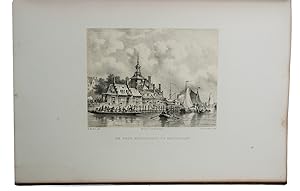
Add to basketFirst and only edition of an album with twenty four beautifully drawn lithographed Dutch city and harbour views. Lithographed by Johannes Hilverdink (1813-1902) after sketches of Everhardus Koster (1817-1892). Both artists are best known for their marine paintings.The work was commissioned by "Arti et Amicitae", the Amsterdam society of visual arts, to help Koster who just had lost one of his eyes, which could be the end of his artistic career. Fortunately, one year later, he was able to paint again.The following cities are illustrated: Amsterdam (2x), Haarlem, Rotterdam, Leeuwarden, Dordrecht, Kampen, Amersfoort, Hoorn, Delft, The Hague, Woudrichem, Utrecht, Arnhem, Maassluis, Overschie, Zutphen, Delftshaven, 's Hertogenbosch, Scheveningen, Zaandam, Harlingen, Nijmegen and Ter Veere. Foxed; binding repaired. Good copy.l Algemeene Aardrijkskundige Bibliographie Van Nederland I, p. 38; NCC (4 copies); WorldCat (7 copies); for Koster: Kramm pp. 906-908; Scheen, p. 287; Thieme & Becker XXI, p. 343; for Hilverdink: Scheen, p. 216. Contemporary half calf. With a letterpress title page, a lithographed portrait of Koster and 24 tinted lithographed views of Dutch cities and harbours by Johannes Hilverdink after Everhardus Koster, printed by Steuerwald. Pages: [26] ll.
![Seller image for [Aankomst van de schepen van Abel Tasman in Nieuw-Zeeland: The arrival of Abel Tasman's Ships in New Zealand] for sale by Hordern House Rare Books](https://pictures.abebooks.com/inventory/md/md31943181533.jpg)