
Lantern Slides (15 results)

The Community Center, Vol. 5 (Classic Reprint)
List Of Lantern Slides With Notes On The Community Schoolhouse
- Softcover
- Print on Demand
Seller: Forgotten Books, London, United KingdomForgotten Books
Contact seller4-star sellerCondition: New
US$ 17.20
Free ShippingShips from United Kingdom to U.S.A.Quantity: Over 20 available
Paperback. Condition: New. Print on Demand. This book explores the origins and development of the community center movement in the United States, focusing on its role in fostering democratic ideals and community engagement. The author traces the evolution of community centers from their inception as informal gathering places to…their formal establishment as institutions dedicated to social welfare and education. The book examines the key principles underlying the community center model, including self-government, economic self-support, and inclusive participation. It highlights the various functions and activities offered by community centers, such as social events, educational programs, civic discussions, and recreational opportunities. The author discusses the challenges and successes faced by community centers in their efforts to promote social equality, provide access to education for adults and children, and facilitate community organization. By exploring the historical context and core ideas of the community center movement, this book sheds light on its significance as a vehicle for social reform and community empowerment. This book is a reproduction of an important historical work, digitally reconstructed using state-of-the-art technology to preserve the original format. In rare cases, an imperfection in the original, such as a blemish or missing page, may be replicated in the book. print-on-demand item.
 More images
- Softcover
- Print on Demand
Seller: Forgotten Books, London, United KingdomForgotten Books
Contact seller4-star sellerCondition: New
US$ 18.21
Free ShippingShips from United Kingdom to U.S.A.Quantity: Over 20 available
Paperback. Condition: New. Print on Demand. This book is a comprehensive guide to making lantern slides, covering various methods and techniques for creating high-quality slides from negatives, prints, and other originals. The author provides detailed instructions for contact printing, copying negatives, and using the enlarging…lantern, ensuring readers can achieve precise and consistent results. The book delves into the nuances of slide-making, discussing factors such as negative preparation, exposure determination, and slide finishing. It also explores the use of warm tones and color manipulation, empowering readers to create slides that are visually appealing and impactful. The author's expertise shines through in the practical advice and troubleshooting tips provided throughout the book. They emphasize the importance of understanding the relationship between exposure, development, and slide quality, guiding readers towards a thorough understanding of the processes involved. By mastering the techniques presented in this book, readers can elevate their slide-making skills, creating captivating visuals for presentations, educational purposes, and personal enjoyment. This book is a reproduction of an important historical work, digitally reconstructed using state-of-the-art technology to preserve the original format. In rare cases, an imperfection in the original, such as a blemish or missing page, may be replicated in the book. print-on-demand item.

Language: English
- Hardcover
Seller: Dublin Bookbrowsers, Dublin, NONE, IrelandDublin Bookbrowsers
Contact seller2-star sellerCondition: Used - Good
US$ 101.34
US$ 12.04 shippingShips from Ireland to U.S.A.Quantity: 1 available
Hardcover. Condition: Good. There are 8 black & white slides and 3 colour slides. They are all images of Ireland - places not indicated. Scenes include sheep at a village market with people(2); dog walking down a village street with horse & cart in the distance; boating on a river; an ivy covered manor house; a round tower (2);…a village centre (Ferns?); the 3 colour slides show a village with thatched cottages and the Anglers Rest Hotel (possibly Headfort, Galway).
Published by Keystone [ca. 1910], Meadville 1910
Seller: Nat DesMarais Rare Books, ABAA, Portland, OR, U.S.A.Nat DesMarais Rare Books, ABAA
Contact seller3-star sellerThis is a mixed bag. Five are Underwood images and they are all beautifully hand colored and four are privately made. All are 4 x 3 3/4 inches, in very good condition. The Underwoods have printed captions and the privates have manuscript captions.The Underwood titles are; 6165. Evening on the Desert, Navajo Reservation, Arizona…)Showing a chief seated and wearing full head dress). 6178. Home Duties of the Hopi Man, Oariabi, Arizona; 6188; Blanket Weaving- a Hopi Indian at Work, Arizona; 6167. At Breakfast, typical desert home of Navajo Indians, Ariz,; 6168. Navajo Blanket weaving on the Navajo Indian Reservation, Arizona [the privates start here]'Arid Region Utah. [showing a cart with 4 hprses with an Indian seated on the ground[; Ojibway Beadwork; Indian Beadwork; Apache Indian Baskets.
 More images
Published by Teachers College, Columbia University, New York 1907
- Hardcover
- First Edition
Seller: The First Edition Rare Books, LLC, Cincinnati, OH, U.S.A.The First Edition Rare Books, LLC
Contact seller5-star sellerCondition: Used - Very good
US$ 600.00
US$ 6.00 shippingShips within U.S.A.Quantity: 1 available
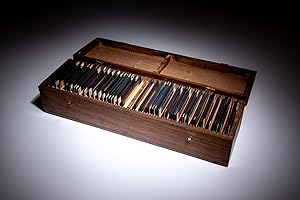
Condition: Very good. First Edition Thus. Features 46 black and white slides, each measuring 3.25" x 4", two panes of glass held together by black paper tape. Stated at bottom of each slide "Illustrations in the History of Education, prepared by Paul Monroe, Ph.D., of Teachers College, Columbia University, New York." At the top…of each individual slide is a handwritten label describing the image. Light soiling to corners, with images still clear and visible. Housed in wooden lantern slide storage box, 17.5" x 5" x 4.25", with four slightly rusted but functional hinged clasps and a broken leather handle on top. A unique set of historic images of schools from around the world. Paul Monroe (1869-1947) was an American historian and educator. Early in his career, Monroe wrote A Text-Book in the History of Education (1905) and soon after A Brief Course in the History of Education (1907), chronicling the various approaches to educating people throughout history. The lantern slides featured in this set align with the material covered in his writing and were likely used during his lectures, which took place at Columbia, Yale and the University of California. Monroe went on to improve methods of education around the world, primarily focusing his work in China. Original magic lantern slides created by James Huntington for Paul Monroe. (illustrator).
 More images
Published by Edward A, Kemp, San Francisco
- Photo
Seller: Andrew L. Christenson, Prescott, AZ, U.S.A.Andrew L. Christenson
Contact seller5-star sellerCondition: Used - Very good
US$ 100.00
US$ 7.00 shippingShips within U.S.A.Quantity: 1 available
No Binding. Condition: Very Good. Hance (1840-1919) was the first non-native resident of Grand Canyon; he was responsible for initiating trail building that allowed tourists to go into the canyon. Here he is wearing a gray suit and hat, mounted on a white horse. hand colored. Includes a copy of Frank Lockwood's "More Arizona Cha…racters" with a chapter on Hance.

Published by England. N.D. Circa 1890
Seller: HALEWOOD AND SONS ABA ILAB Est. 1867., PRESTON, , United KingdomHALEWOOD AND SONS ABA ILAB Est. 1867.
Contact seller2-star sellerCondition: Used - Very good
US$ 103.62
US$ 16.23 shippingShips from United Kingdom to U.S.A.Quantity: 1 available
No Binding. Condition: Very Good. No Jacket. Set of 12 most attractive Coloured Victorian glass Lantern Slides depicting various scenes from 'Dick Whittington.' Original (tape-strengthened) worn box. Scarce complete.
Published by Keystone [ca. 1910], Meadville 1910
Seller: Nat DesMarais Rare Books, ABAA, Portland, OR, U.S.A.Nat DesMarais Rare Books, ABAA
Contact seller3-star sellerTen Keystone Magic Lantern Slides concerning silk farming in Japan. Reputedly by photographer William Rau. All are numbered and with printed captions. Many have longer descriptions issued by Keystone (excised from the booklet that accompanied the entire set). Slides offered here are; 525-Fujiyama; 527-Girls Putting the Finishing… Touches on Bamboo Baskets; 534-A Charming Outlook Over Fertile Fields and Cozt Homes at Kiriu, Japan; 535-A Japanese Garden; 536-Silkworm Incubator; 537-Gathering Mulberry Leaves for Silkworms; 538-Feeding Mulberry Leaves to Silkworms; 539-Cocoons of Silkworms; 540-Reeling Silk from Cocoons; 541-One of Japan's Largest Silk Weaving Plants, kiriu. All are sleeved and in excellent condition.
Published by Keystone [ca. 1910], Meadville 1910
Seller: Nat DesMarais Rare Books, ABAA, Portland, OR, U.S.A.Nat DesMarais Rare Books, ABAA
Contact seller3-star sellerThese seem to be part of a Keystone series but information is hard to obtain so we will just present the titles. All are 4 x 3 3/4 inches, in very good condition and with printed captions;Titles are; 12812. Junction of Colorado and San Juan Rivers, Canal Route, Nicaragua, C.A.; 12889. Government Railway Station, Granada, Nicarag…ua; 12833. San Carlos and San Juan River, Nicaragua, C.A.; 12856. The Smoking Terror, "Momotombo" Volcano, Nicaragua. C.A. ; 12844; Using Nature's Own Tub and Washboards on Lake Nicaragua, Granada, C,A,; 12842. Good Friday Celebration, Franciscan Church and Monastery, Nicaragua C.A.; 12840. In Old Grenada by the Lake. Its Tiled Roofs and Low-arched Corridors, Nicaragua C.A.; 12857. Dome and Turret Crowned Cathedral Roof and Three of the "Volcanic Marvels"; 12858; O'er Floral and Sculptured Adornments Towers the Historic Cathedral, Leon, Nicaragua, C.A.; 12845; Landing on Beautiful Lake Nicaragua, Granada, Nicaragua, C.A.; 12850. An Architectural Monument to the intrepid and Zealous Old Monks of the Conquest, Nicaragua C.A.;12854. The Picturesque City Market, Masaya, Nicaragua; 12848. The Breezy Heights of Saratoag, Looking across Apoya Lagoon to Lake Nicaragua; 12834, Bronzed colored maidens assorting coffee, Nicaragua;Water vendor and ox cart on Lake Managua; 12835. Golden and Luscious Mangoes, the Favorite Food of the Natives, Nicaragua, C,A,The last three are hand-colored.
 More images
Published by T. H. McCallister Company [ca. 1905], New York 1905
Seller: Nat DesMarais Rare Books, ABAA, Portland, OR, U.S.A.Nat DesMarais Rare Books, ABAA
Contact seller3-star sellerThis is a lovely set of glass slides; 45 in total and including 10 hand-colored. The subject of almost all of them are horticultural and the local is from La Jolla to Redlands to Pasadena. These are most definitely not the record of a family . Avenues of Eucalyptus; vacation. There are no people shown but great care is shown in…identifying the plants and their locations. More than likely these were put together for a lecture on the Botany of Southern California. Almost all have manuscript captions. But the deciding factor is the fact that two of the magic lantern slides have captions within the negative (a strong argument for a public lecture).Common titles are; An avenue of Eucalyptus; Banana Tree is Pasadena; 10,000 acre orange grove; Olive trees, Old Mission Inn; Ophir Roses, Pasadena; Geraniums; Arroyo Seco; Tomato plants [appearing about 10 ft tall); Calla Lily Field (color); Vineyard (color); Ostriches (color); Hydrangeas (with a bearded supervisor). 1905 is a bit past the big booster time so these were likely for educational purposes. Edifying the public on the grandeur of California.
 More images
Published by London c. 1890 1890
Seller: Buddenbrooks, Inc., Newburyport, MA, U.S.A.Buddenbrooks, Inc.
Contact seller5-star seller15 hand coloured paintings on glass in lantern slide format. , 15 glass slides in wooden frames. Housed in a wooden box with sliding top, of late decorated with Greenaway figures in coloured format. A set in excellent condition. AN ESPECIALLY APPEALING SET OF BRIGHT HAND-PAINTED MAGIC LANTERN SLIDES. The images are cute and char…ming illustrations of animals, birds, or clowns. Three such images appear on each of the wooden-framed glass slides. These lantern slides, typically presented on a painted wall by an early type of image projector, helped to bring hours of entertainment into the home prior to the invention of computers or television. Lanterna Magicain were in wide use from the 18th century until the mid-20th century when it was superseded by a compact version that could hold many 35mm photographic slides: the modern slide projector. The images are vivid and extremely decorative. Black paint was used as a background to block superfluous light, so the figures can be projected without distracting borders or frames. The magic lantern and lantern slides are still popular with collectors and can be found in many museums.
 More images
Published by [Not Stated], [Atlanta] 1922
- First Edition
Seller: The First Edition Rare Books, LLC, Cincinnati, OH, U.S.A.The First Edition Rare Books, LLC
Contact seller5-star sellerCondition: Used - Near fine
US$ 1,250.00
US$ 6.00 shippingShips within U.S.A.Quantity: 1 available
Glass. Condition: Near fine. First Edition. Each slide measures 3.25 x 4.0 inches. Many with paper descriptions and" Atlanta Public Schools - Department of Visual Instruction" stamp on verso. One plate with crack, still stable. Includes the following notable images: Rebuilding of Peachtree Street (1868), Atlanta Medical College…(1855), Destruction of "Potter House" (1864), destruction of Atlanta communication system (1864), Atlanta 5-Points Grand Opera House, Atlanta Young Men's Library (1879), Joseph Smith Family Grocer (1870s), Kennesaw Mountain (1887), Five Points when Federal Troops entered Atlanta (1864), Federal entrenchments at Kennesaw Mountain (1864), Bridge across Chattahoochee (1864), Federal pontoon boats crossing Chattahochee (1864), Federal troops in Confederate Trenches (1864), The Great Atlanta Fire - 4th Ward (1917), smoke and burning buildings (1864 est.). Housed in wood box, brass clip on side. Civil War Magic Lantern Slides - The Destruction and Occupation of Atlanta. Collection of 41 Civil War Magic Lantern slides, produced from photographs and stereoviews. (illustrator).
 More images
Published by [Kopenhagen?], 1900
Seller: Antiquariaat FORUM BV, Houten, , NetherlandsAntiquariaat FORUM BV
Contact seller5-star sellerCondition: Used
US$ 17,883.51
US$ 28.94 shippingShips from Netherlands to U.S.A.Quantity: 1 available
Remarkable, all-encompassing collection of turn-of-the-century magic lantern slides. Several of the slides show cavalry horses: the "Krigen, 1848-1864" set includes (no. 45) an equestrian portrait of General Bülow, victor of the 1849 Battle of Fredericia, painted by Aug. Jerndorff; (no. 29) Friedrich von Schleppegrell riding at…the battle of Isted; (no. 26) General Krogh on horseback (all V. Richter, Kopenhagen); no. 20. captioned "Pferdeablieferung" (horse delivery).A box lebelled "København" includes: (no. 21) Brandmajoren rykker ud; (no. 20) a fire at the time of King Frederik VI of Denmark (d. 1839).Other slides show workhorses in Denmark and Sweden during haying-time or spreading manure, as well as works of the Danish painter Otto Bache: the Coronation of Christian IV in 1596; the conspirators escaping from Finderup on horseback after having murdered Eric V of Denmark in 1286. The collection also contains copies of paintings by various artists, such as Leonardo da Vinci, Raphael, and Rembrandt. Among the remaining slides, we find astronomical illustrations and pictures of observatories (Greenwich, Delhi, Potsdam, etc.); as well as numerous photographs and paintings of landscapes, people and architecture in Africa, Asia, Europe, China and America. Housed in the original publisher's wooden boxes. Includes 2 original projectors and 1 camera. More than 400 glass slides depicting various motifs related to coal mining, chemical processes and astronomy, as well as topographical motifs from Asia, Africa, China, Europe and America.

Published by Probably Scandinavia, early 20th century.
Seller: Antiquariat INLIBRIS Gilhofer Nfg. GmbH, Vienna, A, AustriaAntiquariat INLIBRIS Gilhofer Nfg. GmbH
Contact seller5-star sellerCondition: Used
US$ 17,883.51
US$ 34.73 shippingShips from Austria to U.S.A.Quantity: 1 available
More than 400 glass slides depicting various motifs of coal mining, chemical processes, astronomy and topographical motifs from Asia, Africa, China, Europe and America. Housed in original wooden boxes. Includes 2 original projectors and 1 camera. Remarkable, encompassing collection of turn-of-the-century Magic Lantern slides. Se…veral of the slides show cavalry horses: the "Krigen, 1848-1864" set includes (no. 45) an equestrian portrait of General Bülow, victor of the 1849 Battle of Fredericia, painted by Aug. Jerndorff; (no. 29) Friedrich von Schleppegrell riding at the battle of Isted; (no. 26) General Krogh on horseback (all V. Richter, Kopenhagen); no. 20. captioned "Pferdeablieferung" (horse delivery). A box labelled "København" includes: (no. 21) Brandmajoren rykker ud; (no. 20) a fire at the time of Frederik VI. Other slides show workhorses in Denmark and Sweden during haying-time or spreading manure, as well as works of the Danish painter Otto Bache: the Coronation of Christian IV in 1596; the conspirators escaping from Finderup on horseback after having murdered Eric V of Denmark. The collection also contains copies of paintings by various artists, such as Leonardo da Vinci, Raphael, and Rembrandt. Among the remaining slides, we find astronomic illustrations and pictures of observatories (Greenwich, Delhi, Potsdam, etc.); as well as numerous photographs and paintings of landscapes, people and architecture in Africa, Asia, Europe, China and America.
 More images
Seller: Max Rambod Inc, Woodland Hills, CA, U.S.A.Max Rambod Inc
Contact seller5-star sellerEye Gate House, Inc. Native American glass lantern slide archive documents Indigenous communities through early 20th-century educational media, produced during a period when ethnographic imagery circulated widely in schools and public lectures across the United States. Created circa 1900s, these slides present staged and documen…tary views of Native American life, including domestic architecture, family groupings, and cultural practices, at a time when federal assimilation policies and anthropological frameworks shaped how Indigenous people were represented to non-Native audiences. The archive provides visual evidence of how Native communities were depicted within institutional education, supporting research in Indigenous history, visual anthropology, and the history of American pedagogy. Archive of 17 glass lantern slides, both hand-colored and black-and-white, produced by Eye Gate House, Inc., New York City. Each slide features printed margins with descriptive captions identifying subjects such as "Iroquois Bark House," "Sioux Family Group," "Manhattan Island Woman," "Chilkat Family Group," and "Customs of Menomini Tribe." The imagery includes traditional dwellings constructed from bark, group portraits of families, and scenes of daily life alongside ceremonial and cultural representation. One hand-colored slide depicts a young Native woman wearing traditional dress with hair styled in the Hopi squash blossom form associated with unmarried women. Additional slides document pottery, subsistence practices, and material culture, reflecting the visual conventions of ethnographic instruction. The slides were intended for projection in lecture settings, combining image and caption to guide interpretation. These materials were produced during an era when U.S. educational systems and federal policy advanced assimilation efforts through institutions such as the Bureau of Indian Affairs, while simultaneously fostering public interest in Indigenous cultures framed as disappearing. Lantern slides functioned as tools of both instruction and cultural mediation, shaping public understanding of Native life through selective representation. At the same time, they preserve visual records of communities, dress, and built environments that hold continuing historical value. Some edge wear and cracking to four slides without loss of image; remaining slides intact with clear imagery; overall good condition. A cohesive group illustrating the intersection of Indigenous representation, education, and early visual media in the United States.


