Order Total (1 Item Items):
Shipping Destination:

Lawd William (1 results)
Skip to main search results
Search filters
Product Type
- All Product Types
- Books (1)
- Magazines & Periodicals (No further results match this refinement)
- Comics (No further results match this refinement)
- Sheet Music (No further results match this refinement)
- Art, Prints & Posters (No further results match this refinement)
- Photographs (No further results match this refinement)
- Maps (No further results match this refinement)
- Manuscripts & Paper Collectibles (No further results match this refinement)
Condition Learn more
- New (No further results match this refinement)
- As New, Fine or Near Fine (No further results match this refinement)
- Very Good or Good (1)
- Fair or Poor (No further results match this refinement)
- As Described (No further results match this refinement)
Binding
- All Bindings
- Hardcover (No further results match this refinement)
- Softcover (No further results match this refinement)
Collectible Attributes
- First Edition (1)
- Signed (No further results match this refinement)
- Dust Jacket (No further results match this refinement)
- Seller-Supplied Images (1)
- Not Print on Demand (1)
Language (1)
Price
- Any Price
- Under US$ 25 (No further results match this refinement)
- US$ 25 to US$ 50 (No further results match this refinement)
- Over US$ 50
Free Shipping
- Free Shipping to U.S.A. (No further results match this refinement)
Seller Location
Seller Rating
-
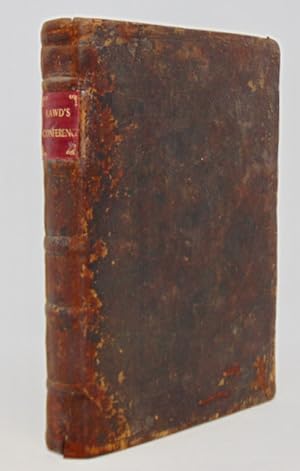
A Relation of The Conference betweene William Lawd, Then, Lrd. Bishop of St. Davids; now, Lord Arch-Bishop of Canterbury: And Mr. Fisher the Jesuite, by the Command of King James of ever Blessed Memorie With an Answer to such Exceptions as A. C. takes against it
Published by Richard Bager, Printer to the Prince HIS HIGHNES, London, 1639
Seller: Haaswurth Books, Binghamton, NY, U.S.A.
Association Member: IOBA
Seller rating 5 out of 5 stars

First Edition
Full calf. Condition: Good. First Edition. Contemporary calf with blind tooling, raised bands, replaced red leather title label, 9 3/4 inches tall. Binding quite worn and scuffed, yet with intact joints; recent title label raised at one edge. Lacking the front pastedown & blanks, begins at title page, title page with thin loss at bottom margin. [24], 388 pp. Leaf 75-66 bound out of order; almost every leaf with some words neatly underlined in brown ink; many margins with worming; a few leaves with edge tears; last leaf 387-88 lacking bottom third removing 10 lines on the recto, none on the verso. ESTC S113162. "In part a reply to: A. C. True relations of sundry conferences had betweene certaine Protestant doctours, and a Jesuite called M. Fisher.Variant (found in large-paper and some small-paper copies): title has 'Lawd'"."On 23 April 1622 James sent for Laud, asking him to use his influence with the Countess of Buckingham, who was attracted towards the church of Rome by the arguments of Percy, a Jesuit who went by the name of Fisher. By the king's orders there had been two conferences held in her presence between Fisher and Dr. Francis White, and on 24 May 1622 a third conference was held, in which Laud took the place of White. The subject then discussed was the infallibility of the church."Laud's arguments on this occasion, together with their subsequent enlargement in his account of the controversy published in 1639, mark his ecclesiastical position in the line between Hooker and Chillingworth. On the one hand he acknowledged the church of Rome to be a true church, on the ground that it 'received the Scriptures as a rule of faith, though but as a partial and imperfect rule, and both the sacraments as instrumental causes and seals of grace' (Works, ii. 144). He strove against the position 'that all points defined by the church are fundamental' (ib. ii. 31), attempting as far as possible to limit the extent of 'soul-saving faith' (ib. ii. 402). The foundations of faith were 'the Scriptures and the creeds' (ib. ii. 428). When doubts arose 'about the meaning of the articles, or superstructures upon themwhich are doctrines about the faith, not the faith itself, unless when they be immediate consequences - then, both in and of these, a lawful and free general council, determining according to Scripture, is the best judge on earth' (ib.). Laud, in short, wished to narrow the scope of dogmatism, and to bring opinions not necessary to salvation to the bar of public discussion by duly authorised exponents, instead of to that of an authority claiming infallibility (on the bibliography of the controversy see the editor's preface to the 'Relation of the Conference,' Works, vol. ii.)."Though Laud's arguments failed permanently to impress the Countess of Buckingham, they gave him great influence over her son. On 15 June, as he states in his diary, he 'became C[onfessor] to my Lord of Buckingham,' and was afterwards consulted by him on his religious difficulties." - DNB.The 24 p. introduction is addressed to Charles I. King James I. had died in 1625, between the time of the Conference (1622) and this publication (1639).William Laud (1573-1645), royal chaplain to James I., archbishop and religious advisor to Charles I.; he wielded immense power in the Church of England. Archbishop Laud was of a High-Church and anti-Puritan persuasion and used his power to suppress Puritanism to the best of his ability. He was loyal to the Crown and was accused of arbitrary and tyrannical acts against those whose religious views he condemned. He was fiercely resisted by the Church of Scotland. Many of the Church of England admired him for his resistance to Calvinism and Independency, and for his defense of the doctrines of the Church of England. After the overthrow and execution of Charles I. Laud himself was tried and executed by the House of Commons."This venerable prelate, a victim to sectarian violence and blood-thirsty ambition, evinced in his last moments the animating power of that religion w.