
Leon Daniel Sorber (1 results)
 More images
Published by 1918-1919, Salem, Oregon 1918
- Hardcover
- Signed
Seller: Katz Fine Manuscripts Inc., Cochrane, AB, CanadaKatz Fine Manuscripts Inc.
Contact seller5-star sellerCondition: Used - Fair
US$ 1,455.99
US$ 18.95 shippingShips from Canada to U.S.A.Quantity: 1 available
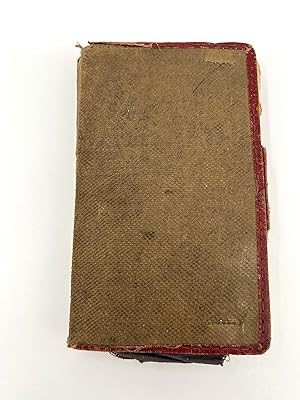
Hardcover. Condition: Fair. No Dust Jacket. On offer is an interesting handwritten notebook that defies categorization, written by American military clarinetist Leon Daniel Sorber (1895-1968) during the later part of WW1. Sorber was born in Salem, Oregon, enlisted in the United States Army in 1917 and served the remainder of the… war. Subsequently, he lived in Portland Oregon and Washington state. [See full BIO NOTES on Sorber at the end of the listing]. When he enlisted in the U. S army, Sorber joined the 162nd Infantry Regiment which was part of the 41st Division. He was assigned to a band unit and given the rank of Musician 2nd Class the equivalent of a private. The 162nd was deployed to Europe in November 1917. Sorber played the clarinet. This journal is not your typical soldier's diary. Leon was not your typical soldier. He had a poetic soul that comes through in this journal. The very first page of the journal contains post-war newspaper clippings of his three children's birth announcements (and his first child's death announcement). The rest of the journal was kept during his time in the Army. He hand-drew calendars for 1918 and 1919 in the early pages. In a beautiful, clear hand, Leon used words to work through his feelings about the war. He transcribed war poetry that he found to be meaningful, always crediting the source. For example, he transcribed the poem "The Kaiser's Dream" about Bill Kaiser, written by Private Robert Tyre of Canada, which Leon credited to the newspaper where he found it, The Oregonian. Leon also wrote out songs he played in the 162nd Infantry, listed names of his fellow band-mates and their ranks, copied down humorous war stories, made small doodles, created a detailed chart titled "Cost of War in Lives" and "Cost of War in $", where he itemized deaths from around the world and global financial implications (he does not source this chart). Leon also kept track of letters he sent while at war, and wrote 11 pages of descriptions of Army Divisions and drew their accompanying insignia. His descriptions include unit names, their crest and the origins of the crest (as he understood it). For example: "Eighty Second Division National Army of Georgia, Alabama and Tennessee. "AA" in gold braid upon circle of solid blue, the whole superimposed on square background of red. The "AA" stands for All- American, the name chosen for the division with further later significance"In another section, Leon wrote what appears to be a play (possibly an original but this is unclear) , copied poems written by other soldiers, detailed a song playlist for a funeral march (likely one he played in). He even listed a number of Shakespeare plays that had meaning to him, and he wrote out recipes and instructions for construction that he collected. Tipped into the journal is another song list, a cartoon image of a soldier, and a small, folded five-page short story that seems to have been a Sorber original. This journal is very hard to summarize. While kept during wartime and mostly about the war experience, it is more a look into the heart and soul of a deployed soldier. He hasn't recorded his daily work or events of the day, he has recorded everything that felt important to him as he attempted to make sense of the war and his place within it. He also maintains his humanity through his art, which is exceedingly clear in each page of his writing and the careful and respectful way in which he transcribed others' words. The dozens of names and addresses that Leon recorded are a genealogical treat. BIO NOTES ON LEON DANIEL SORBER: Leon was the 5th of 6 children born to parents Wilson Eugene Sorber and Estella Daniels in Salem, Oregon. He enlisted to the US Army on March 28, 1917. Just a few days later he married Ione May Phillips in Portland on April 10, 1917. Leon served in the US Army as a Musician 2nd Class until his discharge following World War One on March 10, 1919. Leon and Ione had three children. Their first child, Richard Leon Sorber lived only nine days, dying of.
