
Lobachevsky (25 results)
- Softcover
Seller: California Books, Miami, FL, U.S.A.California Books
Contact seller4-star sellerCondition: New
US$ 22.00
Free ShippingShips within U.S.A.Quantity: Over 20 available
Condition: New.

- Softcover
Seller: GreatBookPrices, Columbia, MD, U.S.A.GreatBookPrices
Contact seller5-star sellerCondition: Used - As new
US$ 19.58
US$ 2.64 shippingShips within U.S.A.Quantity: Over 20 available
Condition: As New. Unread book in perfect condition.

- Softcover
Seller: GreatBookPrices, Columbia, MD, U.S.A.GreatBookPrices
Contact seller5-star sellerCondition: New
US$ 19.94
US$ 2.64 shippingShips within U.S.A.Quantity: Over 20 available
Condition: New.

- Softcover
Seller: Revaluation Books, Exeter, , United KingdomRevaluation Books
Contact seller5-star sellerCondition: New
US$ 24.72
US$ 13.41 shippingShips from United Kingdom to U.S.A.Quantity: 2 available
Paperback. Condition: Brand New. 52 pages. 8.40x5.30x0.30 inches. In Stock.
- Softcover
Seller: Ria Christie Collections, Uxbridge, United KingdomRia Christie Collections
Contact seller5-star sellerCondition: New
US$ 23.94
US$ 16.06 shippingShips from United Kingdom to U.S.A.Quantity: Over 20 available
Condition: New. In.

- Softcover
Seller: GreatBookPricesUK, Woodford Green, United KingdomGreatBookPricesUK
Contact seller5-star sellerCondition: New
US$ 22.11
US$ 20.11 shippingShips from United Kingdom to U.S.A.Quantity: Over 20 available
Condition: New.

- Softcover
Seller: GreatBookPricesUK, Woodford Green, United KingdomGreatBookPricesUK
Contact seller5-star sellerCondition: Used - As new
US$ 25.92
US$ 20.11 shippingShips from United Kingdom to U.S.A.Quantity: Over 20 available
Condition: As New. Unread book in perfect condition.

- Softcover
Seller: moluna, Greven, , Germanymoluna
Contact seller5-star sellerCondition: New
US$ 30.58
US$ 56.70 shippingShips from Germany to U.S.A.Quantity: Over 20 available
Kartoniert / Broschiert. Condition: New.

- Softcover
Seller: AHA-BUCH GmbH, Einbeck, GermanyAHA-BUCH GmbH
Contact seller5-star sellerCondition: New
US$ 36.24
US$ 71.28 shippingShips from Germany to U.S.A.Quantity: 2 available
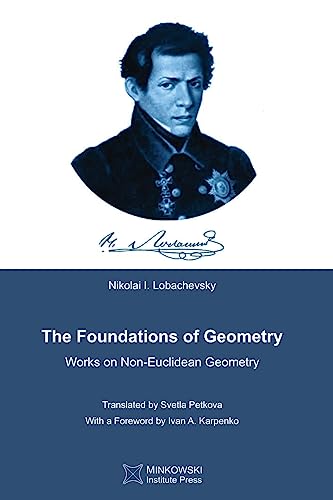
Taschenbuch. Condition: Neu. Neuware - Neither general relativity (which revealed that gravity is merely manifestation of the non-Euclidean geometry of spacetime) nor modern cosmology would have been possible without the almost simultaneous and independent discovery of non-Euclidean geometry in the 19th century by three great ma…thematicians - Nikolai Ivanovich Lobachevsky, János Bolyai and Carl Friedrich Gauss (whose ideas were later further developed by Georg Friedrich Bernhard Riemann).This volume contains three works by Lobachevsky on the foundations of geometry and non-Euclidean geometry: 'Geometry', 'Geometrical investigations on the theory of parallel lines' and 'Pangeometry'. It will be of interest not only to experts and students in mathematics, physics, history and philosophy of science, but also to anyone who is not intimidated by the magnitude of one of the greatest discoveries of our civilization and would attempt to follow (and learn from) Lobachevsky's line of thought, helpfully illustrated by over 130 figures, that led him to the discovery.
- Softcover
- Print on Demand
Seller: PBShop.store US, Wood Dale, IL, U.S.A.PBShop.store US
Contact seller5-star sellerCondition: New
US$ 25.31
Free ShippingShips within U.S.A.Quantity: Over 20 available
PAP. Condition: New. New Book. Shipped from UK. THIS BOOK IS PRINTED ON DEMAND. Established seller since 2000.
- Softcover
- Print on Demand
Seller: PBShop.store UK, Fairford, GLOS, United KingdomPBShop.store UK
Contact seller5-star sellerCondition: New
US$ 23.81
US$ 5.58 shippingShips from United Kingdom to U.S.A.Quantity: Over 20 available
PAP. Condition: New. New Book. Delivered from our UK warehouse in 4 to 14 business days. THIS BOOK IS PRINTED ON DEMAND. Established seller since 2000.

Language: French
Published by Kazan Impr Universitet 1895
- Softcover
Seller: Antiquariat Gerhard Gruber, Heilbronn, , GermanyAntiquariat Gerhard Gruber
Contact seller4-star sellerCondition: Used
US$ 118.01
US$ 46.29 shippingShips from Germany to U.S.A.Quantity: 1 available
(25 x 16,5 cm). (2) 25 S. Original-Broschur, unbeschnitten. Seltener Rechenschaftsbericht mit einem Mitgliederverzeichnis. - Stempel auf Einband.

Address pronounced at the commemorative meeting of the Imperial University of Kasan, October 22, 1893 by Professor A. Vasiliev, Translated from the Russian, with a Preface, by Dr. George Bruce Halsted.
[LOBACHEVSKY, Nicolai Ivanovich (1792-1856)] HALSTEAD, George Bruce (1853-1922).
Published by The Neomon, 1894., Austin, TX: 1894
- Softcover
Seller: Jeff Weber Rare Books, Neuchatel, NEUCH, SwitzerlandJeff Weber Rare Books
Contact seller4-star sellerCondition: Used
US$ 150.00
US$ 28.93 shippingShips from Switzerland to U.S.A.Quantity: 1 available
Volume one of the Neomonic Series. Small 8vo. viii, 40, 17 pp. Original printed wrappers, paper folder; cover lightly soiled. Burndy bookplate. Very good. Rare. Halsted was a member of the University of Texas at Austin Department of Pure and Applied Mathematics (1884-1903) where he taught noted mathematicians R. L. Moore and L.…E. Dickson among other students. He explored the foundations of geometry and introduced Non-Euclidean geometry into the United States through his own work and his many important translations. "In a period when American mathematics had few distinguished names, the eccentric and sometimes spectacular Halsted established himself as an internationally known scholar, creative teacher, and promoter and popularize of mathematics. He was a member of and an active participant in the major mathematical societies of the United States, England, Italy, Spain, France, Germany, and Russia. His activities penetrated deeply in three main fields: translations and commentaries on the works of Nicolai Lobachevski, Janos Bolyai, Girolamo Saccheri, and Henri Poincare; studies in the foundations of geometry; and criticisms of the slipshod presentations of the mathematical textbooks of his day." [DSB]. DSB Vol. VI, pp. 76-77.
 More images
Published by at the University Press, Kazan 1836
- Softcover
- First Edition
Seller: SOPHIA RARE BOOKS, Koebenhavn V, , DenmarkSOPHIA RARE BOOKS
Contact seller4-star sellerCondition: Used
US$ 195,000.00
Free ShippingShips from Denmark to U.S.A.Quantity: 1 available
First edition. Non-Euclidean Geometry Fully Developed. First edition, extraordinarily rare offprints, of both parts of Lobachevsky's second publication on non-Euclidean, or imaginary, geometry, following his epoch-making O nachalakh geometrii (1829-30). Hitherto, only journal issues or extracts of these articles have been access…ible; Rick Watson described the journal issues as exceptionally rare, but these offprints are much rarer still. We have been unable to locate any other copies (for comparison, only one offprint of O nachalakh geometrii is known to exist), and it is likely that these are the only copies outside Russia. Our offprints are from the library of Friedrich Engel, who together with Paul Stäckel was responsible for translating and editing Lobachevsky's works for a Western audience. The Voobrozhaemaya geometriya represents the issue of two millennia of criticism of Euclid's Elements: as the DSB notes, it was Lobachevsky's achievement to refute the uniqueness of Euclidean geometry and to recast it as a special case of a more general system. The non-Euclidean researches grew out of two thousand years of failed attempts to prove the parallel postulate - the assertion that through any point only one straight line can be drawn parallel to a given line - and, as the PMM editors observe, no one openly challenged that postulate as a received truth of the universe until Lobachevsky published his fundamental paper of 1826, eventually printed as a series of five articles in the Kazan University Courier in 1829-30, in which an infinity of parallels could be drawn through a given point without ever intersecting a given line. In O nachalakh geometrii Lobachevsky proceeded axiomatically, deriving the logical consequences of denying the parallel postulate. But this did not prove that imaginary geometry was free of inconsistencies and so did not, strictly speaking, prove the existence of non-Euclidean geometry. That problem is resolved in the present works. The DSB describes the change of method: where the earlier papers had defined imaginary geometry on an a priori basis, beginning from the negation of Euclid's fifth postulate and unfolding the principal tenets of the new geometry without defining it as a structure, Voobrazhaemaya geometriya built up the system analytically, starting from its inherent trigonometrical formulas and using their derivation from spherical trigonometry to guarantee internal consistency; the sequel, Primenenie voobrazhaemoi geometrii k nekotorym integralam, then applied geometrical reasoning in Lobachevskian space to the evaluation of known integrals (as a check that the new method gave valid results) and afterwards to new, previously uncalculated integrals. Both works appeared in the Uchenye zapiski (Scientific memoirs) of Kazan University, a journal Lobachevsky himself had founded. OCLC lists one copy of the 1835 offprint (at Johns Hopkins) and none of the 1836. RBH lists one copy of the 1835 paper (Christie's, 27 November 2019, lot 49, £150,000), described as an offprint although it had only the journal title page, not the separately-printed title page of our copy (the pagination of offprints and journal publications is identical). Provenance: 1. Friedrich Engel (1861-1941), German mathematician (inscription on flyleaf dated 30 April 1898). Engel studied under Felix Klein at Leipzig, where he worked, first as lecturer and later as professor of mathematics, from 1885 to 1904. In 1904 he succeeded his friend Eduard Study as full professor at Greifswald, and in 1913 he went in the same capacity to Giessen, where, after his retirement in 1931, he continued to work until his death. Engel translated the works of Lobachevsky from Russian into German, thus making these works more accessible. With Paul Stäckel he wrote a history of non-Euclidean geometry, Theorie der Parallellinien von Euklid bis auf Gauss (1895); 2. Egon Ullrich (1902-57), Austrian mathematician (20th-century inscription on flyleaf). Ullrich was associate professor at the University of Giessen from 1936 and full professor there from 1940, where he attended lectures by his colleague Friedrich Engel; 3. Dr. Martin Sändig, Wissensch.-techn. Antiquariat (Wiesbaden book label on front pastedown). In his early Kazan lectures on geometry Lobachevsky had himself attempted a proof of the fifth postulate; his own geometry grew from his later realisation that the system in which every other Euclidean axiom holds, but the fifth postulate fails, is not in itself contradictory. He named the resulting system imaginary geometry, by analogy with imaginary numbers: as imaginary numbers are the most general numbers under which the laws of real arithmetic remain consistent, imaginary geometry is the most general geometrical system. The achievement, the DSB emphasises, lay in dethroning Euclid's geometry from uniqueness and exhibiting it as a special case of a more general structure. In Lobachevskian geometry, given a line a and a point A not on it, more than one coplanar line through A can be drawn that does not intersect a. In fact infinitely many can: taken together they form an angle with vertex at A, the two boundary lines b and c being called parallels to a and the lines between them ultraparallels or diverging lines, while all other lines through A intersect a. The distance between two parallel lines, measured on a secant equally inclined to each, decreases indefinitely toward zero as one moves farther from A. The most striking contrast with Euclid is that the angle-sum of every triangle in the Lobachevskian plane falls short of two right angles. Indeed, Lobachevsky proved in O nachalakh geometrii that, if the angles of the triangle are ?, ?, and ?, its area is ? - ? - ? - ?, so that ? + ? + ? is always less than ? In Euclidean geometry the sum of the angles of a triangle equals two right angles, and in spherical geometry it is always greater. Lobachevsky derived trigonometric formulas for triangles in his plane and compared them.
 More images
Published by Hayez, Bruxelles 1901
- Hardcover
- First Edition
Seller: Eric Zink Livres anciens, PARIS, , FranceEric Zink Livres anciens
Contact seller5-star sellerCondition: Used - Fine
US$ 1,430.46
US$ 27.06 shippingShips from France to U.S.A.Quantity: 1 available
Couverture rigide. Condition: Très bon. Edition originale. Pleine toile verte moderne. Un volume in-8 (230x154 mm), (2)-132 pages et 9 planches. Dos légèrement passé. Premier édition en français de cet important ouvrage publié en Russe, entre 1835 et 1838, dans la revue des Mémoires scientifiques de Kazan. Lobachevsky est consid…éré (avec Bolyai) comme le fondateur de la géométrie non Euclidienne. C'est en 1826, qu'il présente pour la première fois ses concepts sur la géométrie non Euclidienne à l'université de Kazan. Cet article ne sera pas publié et il faudra attendre 1829-1830 pour que sa théorie soit pour la première fois publiée sous le titre "sur les fondations de la géométrie". Entre 1835 et 1838, il publie ses "Nouveaux principes de la géométrie avec une théorie complète des parallèles" en Russe qui est considérée comme étant sa meilleure publication sur la géométrie non Euclidienne. "It is from this memoir that one can draw the most completely information on the global scientific, worldoutlook and philosophical views of this great mathematician" (Popov). Rare première traduction en français de de texte majeur pour l'histoire des mathématiques. References : Popov ['Lobachevsky Geometry and Modern Nonlinear Problems', p.4 : "This is the largest work of N.I. Lobachevsky, which sums up in detail, and in the necessary cases develops, the results of his earlier work. It is from this memoir that one can draw the most completely information on the global scientific, worldoutlook and philosophical views of this great mathematician. In this work the fundamental notions of geometry are discussed in detail: adjacency, cuts and the definition of the notions of the notion of point connected with them, lines, surfaces, and also the basic theorems on perpendicular straight lines and planes, relations in triangles, linear and angular measures, measuring of areas, an others. Starting from more general fundamental premises (compared with earlier works), a theory of parallel straight lines is constructed in detail. The fundamental equations of the imaginary geometry are introduced. As a whole, in this work Lobachecsky establishes the precise axiomatic foundations of geometry and defines the principles of its logical development, accompanying them with the corresponding foundational results in each of the fields he considered"], Kline [p. 873 : "He presented his views on the foundations of geometry in a paper before the department of mathematics and physics of the University in 1826. However, the paper was never printed and was lost. He gave his approach to non-Euclidean geometry in a series of papers, the first two of which were published in Kazan journals. The first was entitled " On the Foundations of Geometry" and appeared in 1829-30. The second, entitled "New Foundations of Geometry with a Complete Theory ol Parallels" (1835-37), is a better presentation of Lobatchevsky's ideas"]. ___________________________________________________________________________________ ______________________________ENGLISH_DESCRIPTION : Modern full green cloth. 8vo (230x154 mm), (2)-132 pages and 8 plates. Spine a little faded. First edition in french of this the "New Foundations of Geometry with a Complete Theory ol Parallels". References : Popov ['Lobachevsky Geometry and Modern Nonlinear Problems', p.4 : "This is the largest work of N.I. Lobachevsky, which sums up in detail, and in the necessary cases develops, the results of his earlier work. It is from this memoir that one can draw the most completely information on the global scientific, worldoutlook and philosophical views of this great mathematician. In this work the fundamental notions of geometry are discussed in detail: adjacency, cuts and the definition of the notions of the notion of point connected with them, lines, surfaces, and also the basic theorems on perpendicular straight lines and planes, relations in triangles, linear and angular measures, measuring of areas, an others. Starting from more general fundamental premises (compared with earlier wo.
 More images
Published by Kazan, Universitetskaia tip., 1835. 1835
- Softcover
- First Edition
Seller: Antiquariat INLIBRIS Gilhofer Nfg. GmbH, Vienna, A, AustriaAntiquariat INLIBRIS Gilhofer Nfg. GmbH
Contact seller5-star sellerCondition: Used
US$ 35,761.55
US$ 34.72 shippingShips from Austria to U.S.A.Quantity: 1 available
8vo. 134 pp., final blank leaf. Original printed wrappers with printed title enclosed in decorative border. First separate printing: exceptionally rare offprint of this important essay on the foundations of calculus and real analysis by the first inventor of non-Euclidean geometry. "As early as 1835, Lobachevsky showed in [this]… memoir the necessity of distinguishing between continuity and differentiability" (Cajori). - Lobachevsky's works in other areas of mathematics were either directly relevant to his geometry (as his calculations on definite integrals and probable errors of observation) or results of his studies of foundations of mathematics (as his works on the theory of finites and the theory of trigonometric series). "The mathematicians of the 18th century did not touch the question of the relation between continuity and differentiability, presuming silently that every continuous function is eo ipso a function having a derivative. Ampère tried to prove this position, but his proof lacked cogency. The question about the relation between continuity and differentiability awoke general attention between 1870 and 1880, when Weierstrass gave an example of a function continuous within a certain interval and at the same time having no definite derivative within this interval (non-differentiable). Meanwhile, Lobachevski already in the thirties showed the necessity of distinguishing the 'changing gradually' (in our terminology: continuity) of a function and its 'unbrokenness' (now: differentiability). With especial precision did he formulate this difference in his Russian Memoir of 1835: 'A method for ascertaining the convergence, etc.'. A function changes gradually when its increment diminishes to zero together with the increment of the independent variable. A function is unbroken if the ratio of these two increments, as they diminish, goes over insensibly into a new function, which consequently will be a differential-coefficient. Integrals must always be so divided into intervals that the elements under each integral sign always change gradually and remain unbroken" (Halsted, p. 242). This work includes an extensive discussion of infinite series, including a new convergence criterion, now known as "Lobachevsky's test". Much space is also devoted in this memoir to definite integrals, prompted by the computation of areas and volumes in Lobachevskian geometry. One year later, Lobachevsky devoted a whole memoir to this subject. - Wrappers wrinkled; some damage to border on lower cover; spine and corners professionally restored with like paper. Chipped corners of title-page remargined; interior shows creasing with occasional light waterstains to margins. Exceptionally rare, as are all of Lobachevsky's Kazan publications, even in Russian collections: OCLC lists the Harvard copy only. - Cajori, History of Mathematics, S. 421. Halsted, "Biology and Mathematics", 12th Annual Report of the Ohio State Academy of Science (1903), S. 239-247. OCLC 84296869.
Published by Kazan 1842
- Softcover
Seller: Martayan Lan, New York, NY, U.S.A.Martayan Lan
Contact seller4-star sellerCondition: Used - Very good
US$ 2,000.00
US$ 10.00 shippingShips within U.S.A.Quantity: 1 available
Soft cover. Condition: Very Good. 8vo. [26 x 16 cm), (51-) 83 pp., (the issue paginated 216 [2]). Bound in original printed wrappers, leaves uncut. Very rare first edition of a treatise on a total solar eclipse by Nicolai Lobachevsky, one of the Russian mathematician¿s few works to treat a subject other than non-Euclidean geomet…ry. Lobachevsky observed the eclipse of 8 July 1842 (recorded in the volume as 26 June, using the Old Style calendar) and made minute records of its contact, path and duration. More importantly, he also attempted to explain the presence of the visible solar corona, an extremely rare phenomenon that remained a mystery to astronomers until the late 19th C. Nicolai Lobachevsky (1792-1856) studied under the German mathematician Martin Bartels at Kazan University, where, by age 28, he was appointed chair of the Department of Mathematics and Physics. He wrote his first major work, Geometriya, in 1823; by 1826 he had formulated the principle theorems of the groundbreaking non-Euclidean geometry, which paved the way for advancements in relativity theory and quantum physics. *Kagan 11. Not in DSB.
Published by Kazan 1852
- Softcover
Seller: Martayan Lan, New York, NY, U.S.A.Martayan Lan
Contact seller4-star sellerCondition: Used - Very good
US$ 7,000.00
US$ 10.00 shippingShips within U.S.A.Quantity: 1 available
Soft cover. Condition: Very Good. 2 parts in one vol. 4to. [30.4 x 23 cm], 1-26 pp.; 27-34 pp., (the whole issue paginated [ii] 96 [2]); title with old stamp in Russian and shelfmark, crossed-through, some very faint marginal waterstaining, a very good copy in original printed wrappers, ¿Uchenya Zapiski. 1852¿ on front wrapper w…ithin an ornamental border, wrappers worn. Very rare first edition of Lobachevsky¿s last work on analysis, a treatise on the values of certain defined integrals, along with an examination of the Gamma function. *Kagan 13; Engel 18. Not in DSB. For Lobachevsky¿s biography, see the previous entry.
 More images
Ueber die Convergenz der Unendlichen Reihen
Lobachevsky, Nicolai Ivanovic [Lobatschevsky, Lobachevskii, Lobatschewsky, Lobatschefsky]
Language: German
Published by Kazan [Kasan], Universitäts-Buchdruckerei 1841
- Hardcover
- First Edition
Seller: Silbergaul, St. Gallen, SG, SwitzerlandSilbergaul
Contact seller5-star sellerCondition: Used - Very good
US$ 1,227.46
US$ 32.41 shippingShips from Switzerland to U.S.A.Quantity: 1 available
Hardcover. Condition: Very Good. 1st Edition. 2°. 61 p. Half leather, rubbed and somewhat worn. Interior partly foxed, last leaf very dusty (not affecting Lobachevsky's paper). Some creases to leaves. A library stamp and shelfmarks to title page. *** Published in a supplement to "Metereologische Beobachtungen aus dem Lehrbezirk…der Kaiserlich. Russischen Universitaet Kasan". Here including the second paper published with it, "Allgemeine Bemerkungen ueber den Vortrag der Physik auf Gymnasien" by Ernst Knorr. *** Very rare.
 More images
Pangeometriya (i.e. Pangeometry). (In: "Uchenye zapiski"). - ["THE MOST CONSEQUENTIAL AND REVOLUTIONARY STEP IN MATHEMATICS SINCE GREEK TIMES"]
"LOBACHEVSKY (LOBACHEVSKII, LOBACEVSKIJ, LOBATSCHEWSKIJ), (NIKOLAI IVANOVITSCH).
- Hardcover
Seller: Herman H. J. Lynge & Søn ILAB-ABF, Copenhagen, , DenmarkHerman H. J. Lynge & Søn ILAB-ABF
Contact seller4-star sellerCondition: Used
US$ 27,105.11
Free ShippingShips from Denmark to U.S.A.Quantity: 1 available
Kazan, Kazan University Press, 1855-56. 4to (263 x 216 mm). In a nice later half calf binding with four raised bands and marbled paper covered boards. Extracted from "Uchenye zapiski, Imperatorskago Kazanskago Universiteta", 1855, vol. 1. Two library-stamps to p. 51 with offsetting to p. 50 and small stamp to last free end-paper…. With very light creasing to outer margin, otherwise a fine and clean copy. 56 pp. Exceedingly rare first appearance of Lobachevsky?s landmark 'Pangeometry', a seminal work that serves as a synthesis of his exploration into non-Euclidean geometry and its practical applications and is widely considered his clearest account of the subject. It is also the conclusion of his life's work and the last and final attempt he made to acquire recognition. Lobachevsky's contributions not only marked a turning point in mathematical thought, but were also a catalyst for profound shifts in physics, and philosophy as they expanded the boundaries of human understanding, challenging 2000 year old conventional wisdom" consequently, he is often referred to as "The Copernicus of Geometry". Lobachevsky wrote his Pangeometry in 1855, the year before his death, at a time when he was completely blind. He dictated two versions, a first one in Russian (the present), and a second in French. Despite his revolutionary work, Lobachevsky?s received little, if any, attention from the scientific community. One reason for this was that his works were published in very small numbers in relatively obscure journals ? they seem to have had minimal circulation even within Russia. The present treatise contains basic ideas of hyperbolic geometry, including the trigonometric formulae, the techniques of computation of arc length, of area and of volume, with concrete examples. It also deals with the applications of hyperbolic geometry to the computation of new definite integrals. ?Lobachevskii?s geometry represents the culmination of two thousand years of criticism of Euclid?s fifth, or parallel, postulate, which states that given a line and a point not on the line, there can be drawn through the point one and only one coplanar line not intersecting the given line. As this postulate had stubbornly resisted all attempts (including Lobachevskii?s) to prove it as a theorem, Lobachevskii came to the realization that it was possible to construct a logically consistent geometry in which the Euclidean postulate represented a special case of a more general system that allowed for the possibility of hyperbolically curved space. Lobachevskii?s system refuted the unique applicability of Euclidean geometry to the real world, and pointed the way to the Einsteinian concept of variably curved space? (Norman 1379.). ?At the same time as Lobachevsky, other geometers were making similar discoveries. Gauss had arrived at an idea of non-Euclidean geometry in the last years of the eighteenth century and had for several decades continued to study the problems that such an idea presented. He never published his results, however, and these became known only after his death and the publication of his correspondence. Janos Bolyai, the son of Gauss?s university comrade Farkas Bolyai, hit upon Lobachevskian geometry at a slightly later date than Lobachevsky. Since Gauss did not publish his work on the subject, and since Bolyai published only at a later date, Lobachevsky clearly holds priority.? DSB. Lobachevsky's non-Euclidean geometry paved the way for further advancements in mathematics, including the development of differential geometry and the study of Riemannian manifolds. These areas of mathematics have found applications in fields as diverse as physics, engineering, and computer science. Furthermore, his work laid the groundwork for Albert Einstein's theory of general relativity, which relies on the concept of curved spacetime. It showed that there is no single "correct" geometry, but rather multiple valid systems. This led to a broader understanding of the nature of axiomatic systems and their relation to reality - implications that extend well beyond the realm of mathematics, shaping our understanding of space, reality, and the limits of human knowledge.
 More images
Ueber die Convergenz der uendlichen Reihen (i.e. English: "On the Convergence of Infinite Series").
"LOBATSCHEVSKY (LOBACHEVSKY, LOBACHEVSKII, LOBACEVSKIJ, LOBATSCHEWSKIJ), (NIKOLAI IVANOVITSCH).
- Softcover
Seller: Herman H. J. Lynge & Søn ILAB-ABF, Copenhagen, , DenmarkHerman H. J. Lynge & Søn ILAB-ABF
Contact seller4-star sellerCondition: Used
US$ 3,188.84
Free ShippingShips from Denmark to U.S.A.Quantity: 1 available
(Kazan, Universitäts-Buchdruckerei, 1841). 4to. In a contemporary modest half calf over marbled paper boards. Published in a supplement to "Meteorologische Beobachtungen aus dem Lehrbezirk der Kaiserlich. Russischen Universitaet Kasan". Heft 1, 1835?1836. 1841. Small stamp to upper outer corner of front free end-paper. A few lea…ves brownspotted. Book block split between pp. 4 and 5, otherwise a fine copy. 48 pp. Exceedingly rare first appearance of this work by Lobachevsky in which he returns to convergence of infinite series, on the foundations of calculus and real analysis, which he previous had dealt with in his 1834-textbook Algerbra and his 1834-paper ?Ob ischezanii trigonometricheskikh strok? Here, he expands and further develops the modern definition of the idea of a function in the works of Dirichlet, Poisson, and himself, adding and supplying more proofs. Primarily famous for his non-Euclidean geometry, Lobachevsky published a few papers on such nongeometrical subjects as algebra and the theoretical aspects of infinite series. The chief thrust of his scientific endeavor was, however, geometrical, and his later work was devoted exclusively to his new non-Euclidean geometry, the present work being one of his last on algebra and infinite series.
 More images
- Softcover
- First Edition
Seller: Herman H. J. Lynge & Søn ILAB-ABF, Copenhagen, , DenmarkHerman H. J. Lynge & Søn ILAB-ABF
Contact seller4-star sellerCondition: Used
US$ 3,986.05
Free ShippingShips from Denmark to U.S.A.Quantity: 1 available
Kazan, 1834. 8vo. Contemporary blank, blue wrappers (original?). A closed tear and a bit of staining to back wrapper and some tears and scratches to spine. Internally very nice and clean. Presumably not an off-print, as there are stitching-holes to the margins, indicating that it has been removed from a volume, although the wrap…pers could look original, certainly contemporary. With the original title-page for Book 11 of the "Uchenye zapiski" + pp. (167)-226. Scarce first printing of Lobachavsky's main contribution to his second most important field (after non-Euclidean geometry), namely infinite series, more specifically trigonometric series. This constitutes one of Lobachevsky's earliest papers and the one in which he presents his new results in the theory of trigonometric series. It is here that he gives his definition of a function as a correspondence between two sets of real numbers, the same definition that Dirichlet some three years later discovers independently of Lobachevsky (and is given the general credit for). This important paper was published in the Scientific Memoirs of the Kazan University. "Some of Lobachevsky's early papers, too, were on such nongeometrical subjects as algebra and the theoretical aspects of infinite series. Thus, in 1834 he published his paper "Algebra ili ischislenie konechnykh" ("Algebra, or Calculus of Finites"), of which most had been composed as early as 1825. The first issue of the "Uchenye zapiski" ("Scientific Memoirs") of Kazan University, founded by Lobachevsky, likewise carried his article "Ob ischezanii trigonometricheskikh strok" ("On the Convergence of Trigonometrical Series"). The chief thrust of his scientific endeavor was, however, geometrical, and his later work was devoted exclusively to his new non-Euclidean geometry." (DSB).
Nikolaj Iwanowitch Lobatschefskij. Zwei geometrische Abhandlungen, aus dem Russischen übersetz, mit Anmerkungen und mit einer Biographie des Verfassers. 1. Teil: Die Uebersetzung. Mit einem Bildnisse Lobatschefskijs und 194 Fig. 2. Teil: Anmerkungen, .
LOBATSCHEFSKIJ - ENGEL, FRIEDRICH. (LOBACHEVSKY, LOBACHEVSKII, LOBACEVSKIJ, LOBATSCHEWSKJI)
- Softcover
- First Edition
Seller: Herman H. J. Lynge & Søn ILAB-ABF, Copenhagen, , DenmarkHerman H. J. Lynge & Søn ILAB-ABF
Contact seller4-star sellerCondition: Used
US$ 1,355.26
Free ShippingShips from Denmark to U.S.A.Quantity: 1 available
Leipzig, B.G. Tuebner, 1898-99. Royal8vo. Uncut and unopened in original printed wrappers. Wrappers with some tears. Front wrapper loose. Lithographed portrait of Lobachevsky, XVI,236,(3),237-476 pp. First edition. Contains the first translation of Lobachevsky's seminal 1829 paper 'O Nachalakh Geometrii / On the Principles of Ge…ometry' (see Sommerville Bibliography 1829).
 More images
- Hardcover
- Print on Demand
Seller: Gyan Books Pvt. Ltd., Delhi, , IndiaGyan Books Pvt. Ltd.
Contact seller5-star sellerCondition: New
US$ 93.38
Free ShippingShips from India to U.S.A.Quantity: Over 20 available
Leather Bound. Condition: New. Language: Russian. {Size: 22.22x 29.21 cms} Presenting an Exquisite Leather-Bound Edition, expertly crafted with Original Natural Leather that gracefully adorns the spine and corners. The allure continues with Golden Leaf Printing that adds a touch of elegance, while Hand Embossing on the rounded s…pine lends an artistic flair. This masterpiece has been meticulously reprinted in 2024, utilizing the invaluable guidance of the original edition published many years ago in 1883. The contents of this book are presented in classic black and white. Its durability is ensured through a meticulous sewing binding technique, enhancing its longevity. Imprinted on top-tier quality paper. A team of professionals has expertly processed each page, delicately preserving its content without alteration. Due to the vintage nature of these books, every page has been manually restored for legibility. However, in certain instances, occasional blurriness, missing segments, or faint black spots might persist. We sincerely hope for your understanding of the challenges we faced with these books. Recognizing their significance for readers seeking insight into our historical treasure, we've diligently restored and reissued them. Our intention is to offer this valuable resource once again. We eagerly await your feedback, hoping that you'll find it appealing and will generously share your thoughts and recommendations. Lang: - Russian, Pages:- 570, Print on Demand. If it is a multi-volume set, then it is only a single volume. We are specialised in Customisation of books, if you wish to opt different color leather binding, you may contact us. This service is chargeable. Product Disclaimer: Kindly be informed that, owing to the inherent nature of leather as a natural material, minor discolorations or textural variations may be perceptible. Explore the FOLIO EDITION (12x19 Inches): Available Upon Request. [Please Note - Text break , Dust in Text] 570.
 More images
- Hardcover
- Print on Demand
Seller: Gyan Books Pvt. Ltd., Delhi, , IndiaGyan Books Pvt. Ltd.
Contact seller5-star sellerCondition: New
US$ 118.38
Free ShippingShips from India to U.S.A.Quantity: Over 20 available
Full Leather Bound. Condition: NEW. Language: Russian. {Size: 22.22x 29.21 cms} A Unique Premium Leather-Bound book for elite readers/collectors of old rare books. An Original Leather is being used for binding this book with Golden Leaf Printing and designing on Spine, front and Back of the book with edge gilding. WE HAVE MULTIP…LE OPTIONS IN COLOR OF LEATHER RED, GREEN, BLUE, MAGENTA, TAN, PURPLE DEEP BROWN, BLACK AND WITH DIFFERENT COLOR LABELS. YOU MAY CHOOSE ANY COLOR OF YOUR CHOICE AND MAIL US. This service is chargeable. Original edition was published in [1883] and this unique edition is Reprinted in 2024 with the help of original edition. Black & white printing on high quality natural shade paper with sewing binding for longer life, professionally processed without changing its contents. As these are old books, we processed each page manually on computer and make them readable. We give our best to give you the best book but in some cases we have to adjust few pages which are blur or missing or black spots. If it is multi volume set, then it is only single volume. We hope that you understand these issues in these old treasure. This is an important book for the readers who want to know more about our old treasure. Our dedicated team is trying to bring these rare books back to the shelves. We are also giving service of printing the hard-to-find books which are not listed in our store. Hope you will like it and give your comments and suggestions. Lang: - Russian, Pages 570, Print on Demand. Product Disclaimer: Please be aware that because leather is a natural material, slight discoloration or change in texture may be visible. {FOLIO EDITION (Size 12x19 Inches) IS ALSO AVAILABLE ON REQUEST}. [Please Note - Text break , Dust in Text] 570.


