
Lucha Libre (9 results)

- Hardcover
Seller: Dream Books Co., Denver, CO, U.S.A.Dream Books Co.
Contact seller5-star sellerCondition: Used - Good
US$ 44.14
Free ShippingShips within U.S.A.Quantity: 1 available
Condition: good. Gently used with minimal wear on the corners and cover. A few pages may contain light highlighting or writing, but the text remains fully legible. Dust jacket may be missing, and supplemental materials like CDs or codes may not be included. May be ex-library with library markings. Ships promptly.

- Hardcover
Seller: Goodwill of Central and Coastal Virginia, Richmond, VA, U.S.A.Goodwill of Central and Coastal Virginia
Contact seller4-star sellerCondition: Used - Fair
US$ 40.67
US$ 5.74 shippingShips within U.S.A.Quantity: 1 available
Condition: acceptable.

- Hardcover
Seller: Friends of Pima County Public Library, Tucson, AZ, U.S.A.Friends of Pima County Public Library
Contact seller5-star sellerCondition: Used - Good
US$ 40.93
US$ 5.63 shippingShips within U.S.A.Quantity: 1 available
hardcover. Condition: Good. Hardcover. Good condition. Slight bumping to hardcover corners. Until further notice, USPS Priority Mail only reliable option for Hawaii. Proceeds benefit the Pima County Public Library system, which serves Tucson and southern Arizona.
- Hardcover
Seller: GoldBooks, Denver, CO, U.S.A.GoldBooks
Contact seller5-star sellerCondition: New
US$ 249.55
US$ 5.50 shippingShips within U.S.A.Quantity: 1 available
Hardcover. Condition: new. New Copy. Customer Service Guaranteed.

Published by Madrid: Artes Graficas Palermo 2016
- Hardcover
Seller: Books From California, Simi Valley, CA, U.S.A.Books From California
Contact seller4-star sellerCondition: Used - Very good
US$ 350.00
US$ 4.99 shippingShips within U.S.A.Quantity: 1 available
Hardcover. Condition: Very Good. Copy 192/200. Large, heavy book of photographs, with text in Spanish and English. Print laid in. Cover shows minor wear and bumped corners, pages are clean. A used copy in very good condition.

- Hardcover
- Art Print
Seller: Max Rambod Inc, Woodland Hills, CA, U.S.A.Max Rambod Inc
Contact seller5-star seller[Mexico] [Lucha Libre] A striking Mexican wrestling broadside advertising a Lucha Libre card at the Municipal de Laredo arena, scheduled for Viernes 7 de Mayo, 7:40 P.M. The poster highlights a roster of wrestlers, including La Sombra, Potra, Lucy, La Luna, Leslie, Sra. Torres, Rayada, and Gata, suggesting a night of female luch…adoras, a feature that became increasingly popular during the 1970s. The broadside promises "Dos luchas mas precios populares" or "Two more matches at popular prices". The imagery features a masked luchador in dynamic mid-action, rendered in bold halftone blue and black, with decorative star motifs and a crowned emblem to emphasize spectacle. Measures 25.5" x 18" on thick cloth-vinyl and is estimated to have been made between the 1970s-80s when arenas in border towns such as Nuevo Laredo and U.S.-side Laredo, Texas, promoted frequent lucha libre events to cross-border audiences. Lucha Libre, originating in the 1930s with promoter Salvador Lutteroth, had by the 1960s become a defining element of Mexican popular culture, producing stars like El Santo and Blue Demon and creating a uniquely Mexican spectacle where the mask symbolized identity, mystery, and resistance. Women's wrestling was at times banned in Mexico City but thrived in regional venues such as Laredo, Monterrey, and Tijuana, making this broadside an important artifact of borderlands sporting culture and women's athletic visibility. Some minor staining and pinholes to corners where once hung. In overall very good condition. A scarce survival of a lucha libre cloth broadside, notable for its female inclusion and its borderlands context, underscoring the sport's role as a shared cultural performance between Mexico and Mexican American communities.
 More images
Published by La Luz de Jesus Gallery
Seller: ANARTIST, New York, NY, U.S.A.ANARTIST
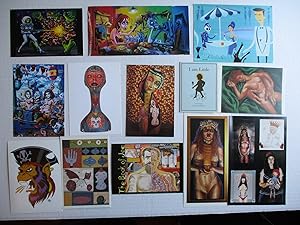
Contact seller5-star sellerBilly Shire established the La Luz de Jesus Gallery in 1986, first on Melrose Ave in Los Angeles and later in the Silverlake district on Hollywood Blvd to exhibit what became known as Lowbrow Art, Pop Surrealism and Underground artists. This collection includes about 115 art invites and ephemera from 1995-2005 including postcard…s by the following. Contact me for more complete list: Robert Williams, Joe Coleman, Shag, XnO, Calef Brown, Owen Smith, Alan Forbes, Joel Nakamura, Ned Baughman, Krystine Kryttre, Alex de Leon, Anthony X Del Rio, The Pizz, Beth Love, Kalynn Campbell, Dennis Worden, Tony Fitzpatrick, Stacy Lande, Aaron Marshall , Brian O'Connor, Glen C Davies, Liz Mcgrath, Glenn Barr, Norbert Kox, Matt Fink, Gin Stevens, Mark Ryden, El Vez, Daniel Martin Diaz, Scott Musgrove, Michael Teague, James Taylors, R.K. Sloane, Michael Hussar, Brian O'Connor, Jonathon Rosen, Clayton Brothers, Gary Baseman, Lucha Libre and many others. Foreign shipping may be extra.

- Art Print
Seller: Max Rambod Inc, Woodland Hills, CA, U.S.A.Max Rambod Inc
Contact seller5-star seller[Mexico and Latino][Film and Entertainment] Lobby card for lucha libre film "Santo contra el Doctor Muerte" starring iconic Mexican luchador Santo, 1973. Lobby card depicts a dramatic wrestling scene within a ring, with Santo (identifiable by his signature silver mask and tights) engaged in a hold with an opponent. In the backgr…ound, what appears to be a chaotic scene with several figures in distress or conflict is visible, suggesting the film's blend of action, wrestling, and crime. The card highlights the film's cast, including Carlos Romero Marchent, George Rigaud, Helga Line, Antonio Pica, and Mirta Miller, and notes the director as Rafael R. Marchent and that it was filmed in Eastmancolor. Santo contra el Doctor Muerte is one of many films starring Santo, a cultural phenomenon in Mexico who transitioned from celebrated professional wrestler to a beloved cinematic superhero. These films typically combined elements of action, horror, science fiction, and crime, with Santo often portraying a secret agent or detective using his wrestling prowess to combat villains, monsters, and mad scientists. In Santo contra el Doctor Muerte, Santo investigates an international art forgery ring led by the titular "Doctor Death," who uses macabre methods involving captive women to create perfect copies of famous paintings. The film is notable for its blend of wrestling sequences with a more conventional espionage plot, featuring a series of death traps and a climactic chase. The prominence of lucha libre in Mexican culture, where wrestlers' masks hold significant symbolic meaning, made Santo a particularly resonant figure, embodying a unique blend of athleticism, heroism, and cultural identity. The lobby card exhibits minor creasing along the edges and some light surface wear consistent with age and handling. Small tear approximately 0.5" in length to top margin. The colors remain vibrant. Overall good to very good condition. This lobby card is a scarce piece of memorabilia from the prolific film career of Santo, offering a tangible link to Mexican popular culture and the unique genre of luchador cinema that captivated audiences throughout the mid to late 20th century.
- Art Print
Seller: Max Rambod Inc, Woodland Hills, CA, U.S.A.Max Rambod Inc
Contact seller5-star seller[Mexico] [Lucha Libre] Lucha Libre: Arena Puebla. Puebla, Mexico: January 9, 1989. Printed broadside on thin newsprint paper. Measures 14" x 9.25". Bold broadside advertising a lucha libre match held at Arena Puebla on Lunes 9 de Enero de 1989, a las 9:00 p.m. The main event is billed as the "Grandiosa Reaparición de los Misione…ros de la Muerte!!!" ("Grandiose Reappearance of the Missionaries of Death!!!"), one of the most infamous heel trios in lucha history, featuring Negro Navarro, Black Power, and El Signo. They were matched against El Texano, Dos Caras, and Tamba, a high-profile face team. Lucha libre, first popularized in the 1930s, quickly grew into one of Mexico's most enduring cultural spectacles, defined by its masked heroes and villains, elaborate identities, and the dramatic storytelling of the ring. By the 1980s, it had become a cornerstone of Mexican popular culture, blending sport, theater, and myth in a way that resonated deeply across social classes and borders. The headlining trio on this 1989 card, the Misioneros de la Muerte ("Missionaries of Death"), comprised Negro Navarro, El Signo, and Black Power. Formed in the late 1970s, they were one of the most feared and influential rudo stables in lucha libre history, known for their aggressive style, technical skill, and ability to generate massive heat with audiences. Their battles against trios like Los Brazos and Los Villanos helped define the trios match format that remains a staple of Mexican wrestling today. Revered for their role in elevating the art of the six-man tag, the Misioneros are remembered as innovators who reshaped the dynamics of lucha storytelling and solidified the dominance of faction-based rivalries in the sport The undercard includes a series of celebrated names; "Los Juniors", Blue Demon Jr., Huracán Jr., and El Hijo de Black Shadow versus Kahos, Lobo Rubio, and Zandokan -- Valente Fernández, La Mascara, and El Fantasma versus Scorpio Sr., Scorpio Jr., and Barba Negra-- Kendo Star, Lasser, and Danny Boy versus Rizado Ruiz, Ruddy Reyna, and El Hijo del Diablo. Additional notes on the broadside include rules and pricing; "Todas estas luchas serán a 2 de 3 caídas sin límite de tiempo" ("All these matches will be best two out of three falls, no time limit"), and "Las personas que arrojen objetos a los luchadores serán consignadas a las Autoridades competentes" ("Anyone who throws objects at the wrestlers will be turned over to the authorities"), as examples. The poster features striking black-and-white illustrations, including a masked luchador with a championship belt at upper left, alongside halftone portraits of individual wrestlers, giving spectators a glimpse of the billed stars. Light toning and edgewear, original fold creases. Overall very good condition. A scarce surviving Arena Puebla lucha libre broadside, notable for headlining the Misioneros de la Muerte and featuring early appearances of Blue Demon Jr. and other "junior" heirs of Mexico's legendary masked heroes, marking a generational transition in lucha libre history.


