
Meier Melchior (3 results)
Seller: Antiquariaat Arine van der Steur / ILAB, Den Haag, , NetherlandsAntiquariaat Arine van der Steur / ILAB
Contact seller4-star sellerCondition: Used
US$ 2,151.10
US$ 34.52 shippingShips from Netherlands to U.S.A.Quantity: 1 available
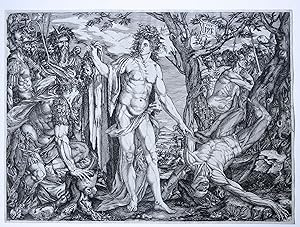
Apollo and Marsyas and the Judgement of Midas.According to Ovid, Apollo engaged in two musical competitions. When Marsyas boasted that his flute playing could rival the music of Apollo, the god proved his superiority and then punished Marsyas by flaying him alive. The Arcadian god Pan emerged unscathed from his own competition w…ith Apollo, although King Midas, present at the contest, found his ears transformed into long, shaggy grey ones for his foolishness in preferring Pan's rustic notes to Apollo's ethereal harmonies.Reverse copy after Melchior Meier (Hollstein 7). Meier has cleverly combined the two stories: as Midas points to the woodland god, Apollo not only grants the king ass's ears but mocks him with the skin of Marsyas, whose flayed body is displayed at right (left in the original). Apollo at the centre, holding a flaying knife in his left hand and the skin of Marsyas in his right hand; the flayed Marsyas hanging from a tree at right; Midas with the ears of an ass kneeling at left; satyrs and soldiers in the background. The musical instrument of Apollo, a lira da braccio, rests at his feet.Monogrammed and dated on the top right on a tablet: '1536 / MF'. The original print by Meier was published in 1581. Date of this print ca 1620.On verso scribblings in pencil and an inky fingerprint.Another impression is held by the British Museum (inv. 1919,0616.28).[NL] Apollo in het midden, met het mes in de rechter hand waarmee zojuist Marsyas gevild is, wiens huid Apollo in zijn linker hand vast heeft. Marsyas zelf hangt zonder huid aan de boom. Rechts de knielende Midas met de ezelsoren. Enkele saters en soldaten in de achtergrond. Etching on laid paper, trimmed to plate mark: total 229 x 312 mm; very bright impression, possibly restored or bleached paper. Nagler 1802.
- Art Print
Seller: Galerie Joseph Fach GmbH, Oberursel im Taunus, , GermanyGalerie Joseph Fach GmbH
Contact seller5-star sellerCondition: Used - Fine
US$ 1,659.25
US$ 51.78 shippingShips from Germany to U.S.A.Quantity: 1 available
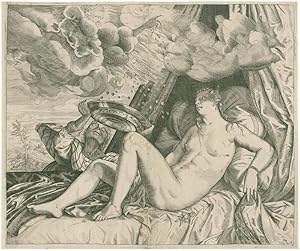
Condition: sehr guter Zustand. Kupferstich, nach Tizian (Tiziano Vecellio, 1477-1576), auf Bütten. 25,3:30,9 cm. Literatur: Brulliot I, 2893; Nagler, Monogrammisten IV, 1994; Hollstein 8. Ausgezeichneter Druck mit etwas Plattenton. Um die Plattenkante ca. 3 cm Papierrand. Mittelfalte und Knickfalte links unten geglättet, kleines… Rißchen im Unterrand und winzige Fehlstelle links oben restauriert. Insgesamt von sehr guter Gesamterhaltung. Das Gemälde von Tizian, nachdem dieser Kupferstich entstand, ist um 1554 entstanden und befindet sich im Hofmuseum in Wien. - Sehr selten.

- Art Print
Seller: Galerie Joseph Fach GmbH, Oberursel im Taunus, , GermanyGalerie Joseph Fach GmbH
Contact seller5-star sellerCondition: Used - Fine
US$ 3,081.46
US$ 51.78 shippingShips from Germany to U.S.A.Quantity: 1 available
Condition: sehr guter Zustand. Kupferstich, 1581, mit dem Monogramm MM, nach F. Salviati (1510-1563), auf Bütten mit Wasserzeichen: Tulpe im Kreis. 23:31,3 cm. Rundum auf die Umfassungslinie geschnitten, stellenweise leicht darüber, geglättet. Schöner, gleichmäßiger Abdruck. Provenienz: Sammlung Kunglia Museum, Stockholm, Lugt 1…638 (verso). Literatur: Bartsch XVI, S. 246; Nagler 1, mit Widmung an Francesco de Medici; Hollstein 17, II. Nagler schreibt über diesen Künstler: Seine Blätter sind schön radiert und grossen Teils selten. Das Todesjahr des Künstlers ist unbekannt; er arbeitete noch 1606." Der Kupferstecher und Zeichner Melchior Meier war in Venedig, Florenz und Rom tätig. Er war nach der Stechweise Dürers gebildet, nach dem er in seiner Frühzeit einige Blätter kopierte, und der Niederländer.


